AI/tech deep dives, high-conviction stock picks, and market recaps. Building an elite investor community—sharp ideas only, posers pruned. #StockAnalysis
Nvidia at CES 2026: 4 Key Takeaways
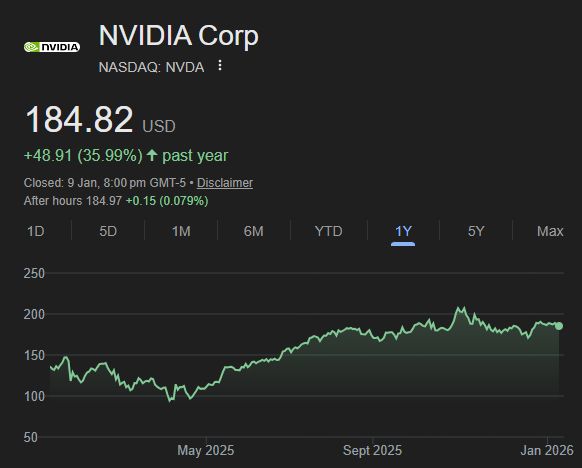
While the market remains focused on GPU ship counts, $NVDA is executing a broader "AI central nervous system" strategy.
TL/DR: By open-sourcing the "brains" of the future—specifically the Alpamayo and GR00T models—Nvidia is ensuring its hardware becomes the indispensable infrastructure for the next decade of AI development.
1. The Rubin Era: $NVDA remains King
Nvidia’s Rubin platform, the successor to Blackwell, is now in full production. Relative to Blackwell, Nvidia’s next gen Rubin architecture delivers:
4x increase in training performance = Faster time-to-market for frontier models.
10x reduction in inference costs per token = Allowing high-volume agentic AI to be profitable for enterprises.
In a competitive data center market, Total Cost of Ownership (TCO) is the only metric that matters. By delivering 5x–10x gains annually, Nvidia makes it "economically irrational" to run older hardware, forcing a continuous upgrade cycle.
2. The Robotics Ecosystem
$NVDA is moving beyond digital chatbots into Embodied AI—software that perceives, reasons, and acts in the physical world.
Alpamayo:
An open-source Vision-Language-Action (VLA) model that allows cars to reason through complex driving scenarios rather than just following rigid code.
Cosmos AI:
A foundation model for physical AI. It acts as a "world simulator," allowing robots to learn from synthetic data governed by real-world physics before they ever touch a factory floor.
GR00T:
A full-stack ecosystem providing the "brain" for humanoid and industrial robots.
Jetson Thor:
The hardware heart. A System-on-Module (SoM) based on Blackwell architecture, delivering the compute required for real-time robotic reasoning.
3. The “Google Android Ecosystem” Playbook
Nvidia’s goal is to make GR00T the universal operating layer for robotics. By partnering with industry leaders like 1X, Agility Robotics, Boston Dynamics, etc., they are creating a massive network effect.
Nvidia is using open-source software to win a standard-setting war:
Open Weights, Proprietary Pipeline:
While Alpamayo and GR00T weights are open, these models are architected to leverage the Rubin/Thor pipeline. Using a competitor’s hardware would require convincing a company to bypass the Rubin-to-Thor optimization path, which has been safety-hardened, necessitating a re-validation of the entire "chain of custody" for the AI’s logic to ensure no errors were introduced by the hardware switch.
The Result:
If a startup builds on the GR00T stack, they are effectively locked into Nvidia’s hardware for the entire lifecycle of the product.
4. Building the Moat
Nvidia’s long-term vision is built on software friction and switching cost:
Network Effect:
As more developers contribute to the GR00T ecosystem, Nvidia’s proprietary libraries (e.g., CUDA-X and cuRobo) become the standard language of the industry, it becomes harder for a competitor like $AMD to convince a company to switch to a different, less-supported software stack.
The CUDA Software:
Nvidia has thousands of "fused kernels", these are pre-optimized software snippets built over years for every conceivable AI operation. For a competitor like the AMD MI400, even if it can demonstrate faster raw math, it lacks the decade of optimization (e.g., attention mechanisms) written specifically for Nvidia chips for all types of models/workloads.
Switching Cost:
The 2026 Mercedes-Benz CLA is the first vehicle to use the full Alpamayo stack. Because the CLA’s “Nvidia Drive" stack is already safety-certified (achieving top Euro NCAP ratings), switching to a rival chip would require months/years of re-testing and re-certification—a cost no major OEM is willing to bear.
Three-Computer Architecture:
Nvidia is telling customers they need three different computers for one robot: the Nvidia DGX/Rubin (to train it), the Nvidia Omniverse/Cosmos (to simulate it), and the Jetson Thor (to run it). This "Triple Lock" is what makes it so hard for a competitor to peel away a single customer—you don't just replace the chip; you have to replace the entire development workflow.
The Goal:
By giving away the "brains" of robots and cars, Nvidia is lowering the R&D barrier for companies like Mercedes-Benz and others, while also ensuring that their high-margin hardware becomes the industry’s central nervous system.
(Not Financial Advice)
Nvidia at CES 2026: 4 Key Takeaways
While the market remains focused on GPU ship counts, $NVDA is executing a broader "AI central nervous system" strategy.
TL/DR: By open-sourcing the "brains" of the future—specifically the Alpamayo and GR00T models—Nvidia is ensuring its hardware becomes the indispensable infrastructure for the next decade of AI development.
1. The Rubin Era: $NVDA remains King
Nvidia’s Rubin platform, the successor to Blackwell, is now in full production. Relative to Blackwell, Nvidia’s next gen Rubin architecture delivers:
4x increase in training performance = Faster time-to-market for frontier models.
10x reduction in inference costs per token = Allowing high-volume agentic AI to be profitable for enterprises.
In a competitive data center market, Total Cost of Ownership (TCO) is the only metric that matters. By delivering 5x–10x gains annually, Nvidia makes it "economically irrational" to run older hardware, forcing a continuous upgrade cycle.
2. The Robotics Ecosystem
$NVDA is moving beyond digital chatbots into Embodied AI—software that perceives, reasons, and acts in the physical world.
Alpamayo:
An open-source Vision-Language-Action (VLA) model that allows cars to reason through complex driving scenarios rather than just following rigid code.
Cosmos AI:
A foundation model for physical AI. It acts as a "world simulator," allowing robots to learn from synthetic data governed by real-world physics before they ever touch a factory floor.
GR00T:
A full-stack ecosystem providing the "brain" for humanoid and industrial robots.
Jetson Thor:
The hardware heart. A System-on-Module (SoM) based on Blackwell architecture, delivering the compute required for real-time robotic reasoning.
3. The “Google Android Ecosystem” Playbook
Nvidia’s goal is to make GR00T the universal operating layer for robotics. By partnering with industry leaders like 1X, Agility Robotics, Boston Dynamics, etc., they are creating a massive network effect.
Nvidia is using open-source software to win a standard-setting war:
Open Weights, Proprietary Pipeline:
While Alpamayo and GR00T weights are open, these models are architected to leverage the Rubin/Thor pipeline. Using a competitor’s hardware would require convincing a company to bypass the Rubin-to-Thor optimization path, which has been safety-hardened, necessitating a re-validation of the entire "chain of custody" for the AI’s logic to ensure no errors were introduced by the hardware switch.
The Result:
If a startup builds on the GR00T stack, they are effectively locked into Nvidia’s hardware for the entire lifecycle of the product.
4. Building the Moat
Nvidia’s long-term vision is built on software friction and switching cost:
Network Effect:
As more developers contribute to the GR00T ecosystem, Nvidia’s proprietary libraries (e.g., CUDA-X and cuRobo) become the standard language of the industry, it becomes harder for a competitor like $AMD to convince a company to switch to a different, less-supported software stack.
The CUDA Software:
Nvidia has thousands of "fused kernels", these are pre-optimized software snippets built over years for every conceivable AI operation. For a competitor like the AMD MI400, even if it can demonstrate faster raw math, it lacks the decade of optimization (e.g., attention mechanisms) written specifically for Nvidia chips for all types of models/workloads.
Switching Cost:
The 2026 Mercedes-Benz CLA is the first vehicle to use the full Alpamayo stack. Because the CLA’s “Nvidia Drive" stack is already safety-certified (achieving top Euro NCAP ratings), switching to a rival chip would require months/years of re-testing and re-certification—a cost no major OEM is willing to bear.
Three-Computer Architecture:
Nvidia is telling customers they need three different computers for one robot: the Nvidia DGX/Rubin (to train it), the Nvidia Omniverse/Cosmos (to simulate it), and the Jetson Thor (to run it). This "Triple Lock" is what makes it so hard for a competitor to peel away a single customer—you don't just replace the chip; you have to replace the entire development workflow.
The Goal:
By giving away the "brains" of robots and cars, Nvidia is lowering the R&D barrier for companies like Mercedes-Benz and others, while also ensuring that their high-margin hardware becomes the industry’s central nervous system.
(Not Financial Advice)
The India AI Summit just confirmed a new world order: Energy, Compute, and AI Sovereignty.
By partnering with OpenAI for 1GW of infrastructure, Tata isn't just "using AI"—they are building a national firewall against total Western cloud and AI dependency.
More nations will begin to treat FLOPs as a strategic reserve, and the market hasn't priced in the step change in demand for GPUs and ASICs from the decoupling yet
$NVDA $AMD $AVGO $TSM
https://t.co/VxPMpEiLnM #ThisIsTata #TataNews
Amazon’s $200B Bet: A Game of Monopoly, Buying Utilities to Box out the Board
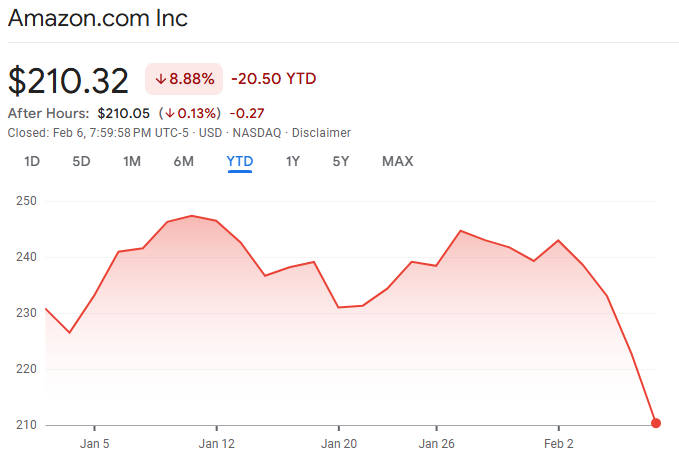
Amazon just guided for $200B in 2026 Capex. The stock dropped sharply (8–11%) because the market sees a cash flow collapse. The bulls, on the other hand, see a different story: this isn't a retailer overspending; it's a Sovereign Utility being built in plain sight.
The Gigawatt Moat:
The world is still massively underestimating the aggregate demand for intelligence.
We’ve moved past the "AI as a feature" phase. In 2026, following the SaaS-Pocalypse, every piece of software that doesn’t have native reasoning and agentic capabilities is essentially a legacy product.
Everyone thinks AWS is in a price war with Azure; they aren't. They are fighting the physical limits of physics.
1. You can buy GPUs. You can’t buy 24/7 carbon-free gigawatts without a 5-year nuclear development cycle. Amazon started building its position in 2024 with Talen Energy and X-energy. While competitors are moving aggressively too (e.g., Microsoft targeting ~2028 restarts), Amazon is among the earliest and most scaled.
2. The Endgame: Amazon isn't spending to stay in the race. They are spending to end it. The infrastructure lead Amazon is establishing by 2028–2030 will be extremely difficult to close. They are playing Monopoly, buying the utilities to box out the board. Amazon is weaponizing its balance sheet to secure supply chains, accelerating shortages and bottlenecks for everyone else (e.g., HBM memory, transformer shortages projected through 2027).
The Bears:
1. The Capex Treadmill:
Spending $200B/year burns all Free Cash Flow (FCF). If AI demand is just a bubble, Amazon is left with the world’s most expensive empty data centers.
2. Agentic Bypass:
If AI agents (like ChatGPT or Perplexity) become the new "Search Bar," users stop visiting https://t.co/j6WLtMT49n. Amazon loses the high-margin ad revenue (the "Search Tax") and becomes just a low-margin delivery pipe for someone else’s brain.
The Counter: Amazon’s Operating Leverage.
1. Silicon Arbitrage:
Amazon’s move to Trainium 3 (custom silicon), which claims 40% price-performance on AI training workloads, allows them to capture the margin $NVDA currently takes. They are essentially printing their own "shovels" for the gold rush.
2. The Physical Tax:
Even if an AI agent "bypasses" the website, it can't bypass the Cardboard Box. Amazon’s "Buy with Prime" API ensures they tax the transaction at the fulfillment layer. They are trading "Ad Clicks" (Discovery) for "Logistics Rents" (Delivery)—a far more defensible monopoly.
The Takeaway:
Amazon isn't a 2026 capex story; it's a 2028 moat realization story.
The market is currently pricing $AMZN as a "Capital Intensive Retailer" (i.e., multiple compression).
As the $200B spend comes online, and the world begins to realize that $AMZN has the largest stockpile of “secured compute”, while everyone else is still stuck waiting for power, the narrative will shift to "The Central Bank of AI Compute."
You don’t value utility on next quarter’s cash flow; you value it on the fact that everyone else has to plug into it to survive.
AI is a game of Kings.
Amazon, Google, and Microsoft… just went “ALL IN”.
(Not Financial Advice)
Edge AI Is Here: Apple’s "Free Rider" Supercycle
TL/DR: $AAPL is the dark horse of the intelligence economy. As we shift from renting tokens to owning orchestration, Apple’s Unified Memory Architecture turns Macs into 24/7 sovereign AI agents.
1. The shift to edge AI isn’t coming. It has arrived.
Moltbot (now often called OpenClaw) proves it. This open-source agentic framework installs on a Mac mini, operates 24/7, and handles your emails, calendars, and workflows via WhatsApp or Telegram. Viral adoption sees users buying dedicated Mac minis just to keep their personal "Jarvis" always on.
The nuance most miss:
The shift isn't just about running an AI model; it's about owning the loop. Swap the 'brain' (local Llama 3/DeepSeek for privacy, or call a cloud API for Claude/GPT's frontier reasoning), but the agent stays local, holding your permissions, context, and keys.
2. The Pivot: From Renting to Owning
We are witnessing a hard pivot in the economics of intelligence.
Old Model:
Rent everything (i.e., inference token cost). Every loop, every check, every action is a metered API call. Expensive, fragile, privacy-poor.
New Model:
Buy high-end hardware once, and the marginal cost of the agent's existence drops to near-zero (electricity).
A swarm of agents checking your emails every 5 minutes? Economically ruinous on pure cloud. On a Mac mini? It’s free (almost).
3. The "Hybrid" Reality: Local Body, Cloud Brain
This is where the Hardware Ceiling matters.
While Distillation allows models like DeepSeek-R1-Distill to run locally on consumer hardware, true "God-Tier" reasoning (like a 1T-parameter Kimi K2.5) still hits physical RAM limits.
The Apple Advantage:
Apple’s Unified Memory Architecture (up to 64GB/128GB, e.g., Mac Studio) allows you to run "Good Enough" models locally for 90% of tasks.
The Cloud escalation:
For the hardest 10% of tasks, your local agent seamlessly calls a Cloud API. You get the privacy and speed of local execution with the "on-demand" genius of the cloud.
4. Apple’s "Free Rider" Supercycle
Consumers aren’t buying specialized "AI Appliances." They are upgrading iPhones and MacBooks. Apple rides free on this agentic AI wave, selling the Unified Memory silicon that makes these local agents possible.
The Mac mini isn't just a computer anymore; it's a Personal Server for your private workforce.
Setting up your personal Moltbot is still too difficult for everyday consumers, but that is a UI/UX problem. Startups in Silicon Valley are surely already racing to improve and iterate upon Moltbot’s open-source architecture.
We should expect many more consumer-friendly, safety-first variations of Moltbot in the coming months/quarters. This should accelerate a hardware refresh cycle for consumer devices capable of running these local AI agents.
5. Why the Cloud Isn't Dead
So, does Edge AI kill the hyperscalers? No. Jevons Paradox ensures its survival.
As local inference makes AI cheaper, demand explodes. We will run millions of local loops, creating more total demand for intelligence, not less.
But the hyperscalers must evolve. They pivot from selling "Commodity Tokens" (which are moving to the edge) to selling "System 2 Solutions."
True AI "thinking", i.e., simulating 10,000 futures via Monte Carlo Tree Search, cannot run on a battery. It requires massive, parallel cloud clusters.
Hyperscalers stop selling "information" and start selling "test-time compute" (e.g., simulation based, game-theory optimized strategies). Think $500 per query for a cloud cluster to solve a complex supply chain optimization or legal strategy in 20 minutes.
6. The Winners:
The future is hybrid: own the agent, rent the genius.
Edge AI (The Body):
$AAPL dominates with its Unified Memory silicon powering always-on AI agents on consumer devices. Privacy-first, low-latency, and economically dominant for volume.
Cloud AI (The Brain):
$NVDA powers the premium test-time compute layer. High-margin and indispensable for competitive consumers/ enterprises seeking additional intelligence "alpha".
The Foundry:
$TSM wins either way as silicon demand explodes.
While $NVDA and $TSM are consensus plays, the dark horse is $AAPL.
As intelligence shifts from rented tokens to owned orchestration, Apple’s Unified Memory turns everyday MacBooks and Mac Minis into 24/7 sovereign AI agents.
$AAPL is emerging as the intelligence economy’s most unexpected winner.
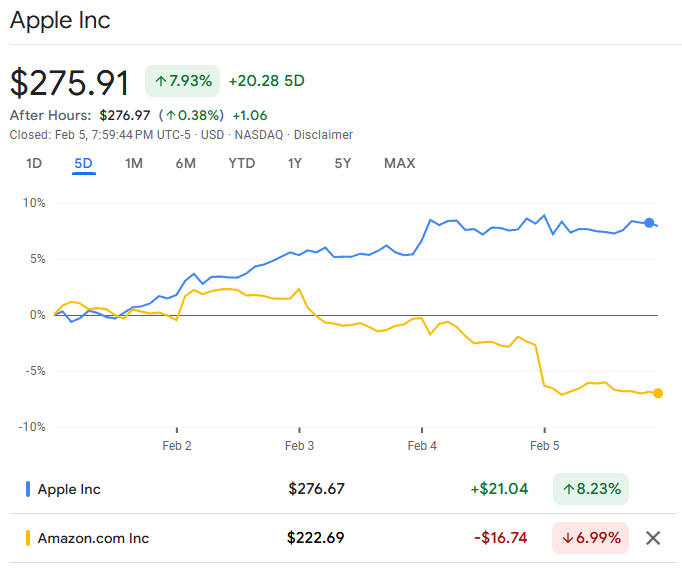
With the broader tech sector facing sharp volatility over the past few sessions, Apple’s notable resilience speaks to the potential shift in its AI narrative.
(Not Financial Advice)
TSMC's Data Flywheel: The Real Barrier to Intel's Comeback
The 2026 narrative for $INTC is seductive: Western hyperscalers, under intense pressure to derisk from the Taiwan Strait, are handing $INTC a golden ticket.
However, Intel’s earnings call last week served as a reality check: not all fabs are created equal. Intel and TSMC may use the same ASML machines, but having the same oven doesn’t mean you can bake the same cake.
To understand Intel’s uphill battle, you have to look at the "invisible" physics of chipmaking.
1.Why TSMC is a Data Monopoly:
$TSM didn't win by accident; they built a self-reinforcing flywheel.
Buying Data:
From Day 1, TSMC priced wafers low to secure massive volume. This wasn't just for revenue—it was to harvest fault data.
More wafers = more lessons:
Because TSMC ran 10x more wafers than anyone else, they could iterate 10x faster. They identify a defect, tweak the "recipe," and redeploy. By the time a competitor even starts their production run, TSMC has already moved up the learning curve, perfecting its yield "recipe."
Cost Leadership:
Higher yields = more usable chips per wafer. This gives TSMC significant cost advantages and the ability to maintain profitability even at competitive prices.
Reinvestment and Expansion:
Profits from each cycle were reinvested into expanding fab capacity ($30B+ annual CapEx), further solidifying volume dominance and perpetuating the self-reinforcing moat.
2. Chipmaking Isn't "Cookie-Cutter"
A common misconception is that if you buy a $400M ASML machine, you automatically get 2nm chips. In reality, the machine is just the "oven." The yield is the "recipe," and that recipe is a closely guarded trade secret.
The Recipe Variable:
A single chip goes through 1,000+ steps. A 1-degree temperature variance in a chemical vapor deposition (CVD) chamber or a 0.5-second difference in a plasma etch can tank a wafer's yield.
Human Capital & "Tribal Knowledge":
Yield improvement is a forensic science. It requires an army of engineers who can look at a microscopic defect and know exactly which of the 1,000 steps caused it. TSMC has decades of this specialized "muscle memory."
3. Intel’s "Equalizer" Moment:
We are currently at a rare reset in chip architecture. The shift from FinFET to Gate-All-Around (GAA) transistors forces everyone, including TSMC, onto a new learning curve.
Intel’s 18A Leapfrog: Intel is betting on PowerVia (Backside Power Delivery, “BSPD”). By moving the "power plumbing" to the back of the chip, they’ve hit a 2026 performance milestone that TSMC won't match until their A16 node late this year/early 2027.
But will that be enough?
4. TSMC’s Customer Lock-In
The "Neutral" Model:
Unlike Intel or Samsung, TSMC doesn’t design its own chips, so $NVDA, etc. never have to worry about their manufacturer becoming a competitor.
Packaging Lock-in:
TSMC’s CoWoS (Chip-on-Wafer-on-Substrate) packaging is the industry standard for AI GPUs. Controlling both the chip and the "envelope" creates a massive lock-in effect.
The Porting Nightmare:
Each foundry has a unique Process Design Kit (PDK)—the "rulebook" for how transistors are shaped. Engineers must manually redraw and re-verify millions of circuit paths to match Intel’s specific 18A physical dimensions and electrical properties. Moving a complex AI chip from TSMC to Intel would take 6 to 18 months and tens of millions in requalification costs.
Scale Economies:
Because TSMC manufacture for everyone (Apple, Nvidia, AMD), they can afford the staggering CapEx required for new nodes. A competitor cannot match TSMC’s unit cost without matching their massive volume, which creates a "Catch-22" for rivals like Intel.
5. Market Realities
Intel's 18A (1.8nm-equivalent) may lead in raw performance/power, but TSMC's N2 offers higher transistor density and better SRAM scaling; and TSMC's A16 (1.6nm) is introducing BSPD by late 2026/early 2027.
Today, TSMC's N2 yields at ~70-80%, ahead of Intel's 18A at ~60% and Samsung's SF2 at ~40-50%; this reinforces TSMC's edge in volume production reliability, critical for high-stakes chip launches.
"Buy American" tailwinds and gov subsidies are pushing $INTC hype.
Yet, $TSM remains as the only bankable choice for volume production of the most advanced chips today.
Intel's catch-up? A multi-year slog.
(Not Financial Advice)
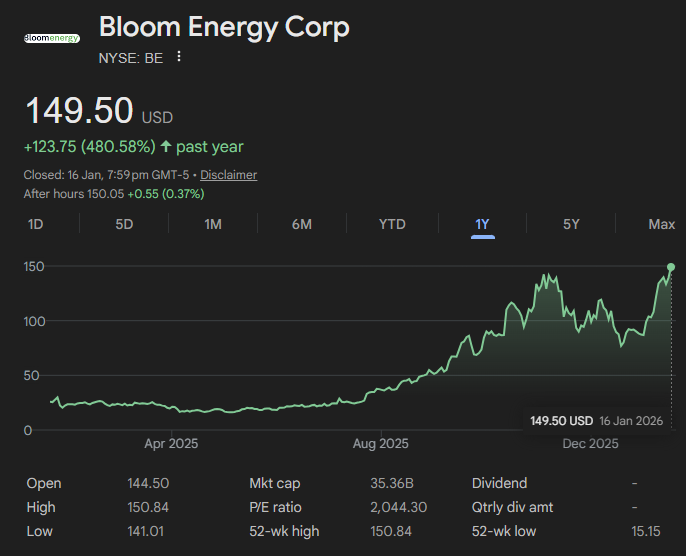
New Trade: Bloom Energy $BE
TL/DR: Bloom's 90-day, 100MW fuel cell 'power islands' are the go-to for AI data centers amid grid bottlenecks.
Trump’s "Bring Your Own Power" Mandate:
On January 16, the Trump administration unveiled a proposal to shift power costs directly to AI data centers, asking tech giants to "bring your own power" (BYOP) through a $15 billion auction for new generation capacity, to prevent household bill hikes and address grid strains.
The EPA Right Hook:
Simultaneously, the EPA's January 15 rule update closed loopholes for "temporary" natural gas turbines, directly impacting xAI's Memphis setup where unpermitted units were ruled illegal. These turbines now require Clean Air Act permits, adding 6-24 months and costs.
Bloom’s Time-to-Power Advantages:
Hyperscalers need to optimize for their total cost of ownership (TCO), emission targets (e.g., CO2, NOx), uptime reliability, and increasingly, time-to-power given the current grid bottlenecks.
Vs. turbines:
Bloom's gas-based fuel cells deliver 60-70% electrochemical efficiency without combustion (vs. 30-40% for combusting gas turbines), allowing them to dodge EPA permits. They enable 90-day modular deployments (e.g., 100 MW systems) in tight spaces and can ensure 99.999% baseload power reliability for AI workloads.
Vs. renewables:
While renewables' intermittency (e.g., solar's weather reliance) can be solved by oversized batteries for load smoothing, these power configurations are much slower (12 to 18 months) and bulkier to deploy than Bloom's system.
Vs. SMRs:
Small Modular Reactors (SMRs) promise carbon-free baseload long-term but are stalled by the HALEU bottleneck. Most next-gen designs from players like $OKLO require High-Assay Low-Enriched Uranium (HALEU), which still has negligible/non-commercial scale domestic production today. Bloom bridges the gap as the top compliant, quick-deploy option.
The Scandium Supply Risk (and Moat):
Scandium is essential for Bloom’s electrolytes, but global production is concentrated in China (65%-85% of global refined supply). In April 2025, China designated Scandium as a "dual-use military material" and implemented severe export licensing requirements.
Cornering the Non-China Market:
Bloom has effectively "monopolized" the non-China scandium market through long-term offtake agreements. Through its SK ecoplant JV in South Korea, Bloom can process electrolytes in a trade-neutral territory, shielding itself from direct US-China export bans. Bloom is also the primary customer for Rio Tinto’s expanded recovery plant in Canada (~12 tonnes/year), as well as Sumitomo’s byproduct operations in the Philippines.
The Recycling Loop:
Bloom’s "Closed-Loop" strategy is another hedge it has against supply shocks for its existing 1.5 GW installed base. Bloom currently claims a ~90% recovery rate from decommissioned stacks (typically replaced every 5 years). This means nearly all "fresh" scandium procured in 2026 can be allocated to new contracts, while the existing fleet is largely maintained by recycled materials.
The Verdict: Is there enough supply?
Yes, but with little margin for error. The non-China Scandium supply chain is currently "right-sized" for Bloom to hit its 2 GW annual production goal.
However, the scarcity is also a competitive moat— If a new competitor wanted to copy Bloom today, they literally cannot find enough scandium on the open market to reach gigawatt scale.
Valuation:
Bloom is on track to hit 2 GW of annual production capacity by Dec 2026, but final 2026 revenues depend entirely on how much of that capacity is actually utilized and shipped.
The most bullish models suggest that if Bloom achieves 90%+ utilization, driven by massive "pull" from its signed backlog (e.g., $5B Brookfield) and new contracts, revenue could surge towards $5-6B, up from ~$1.8B TTM.
Historically, Bloom’s factory has run at roughly 60% capacity due to the gap between signing deals and final "Notice to Proceed" from customers.
To get to 90% utilization, Bloom will need to move from "build-to-order" towards "standardized power blocks" that can be churned out at factory limits.
Most analysts project $2.5B to $2.7B in 2026 revenues based on a standard production ramp, giving Bloom a forward P/S ratio of over 10x.
The $BE Play:
$BE is not a 2026 earnings story. The hardware nature of Bloom’s business means that its earnings growth will always be constraint by the physics of its manufacturing capacity.
The play for $BE is about the shift in narrative, that data center developers now need behind-the-meter AND speed-to-power solutions TODAY, given BYOP and community pushback from rising electricity bills.
Longer term Considerations:
Integrated Renewables + Battery systems beat Bloom’s fuel cells on TCO, given its input fuel sensitivity to Nat Gas prices. And, any upside surprises from SMRs pilot programs and their deployment timelines could switch the narrative away from Bloom. That said, strict nuclear safety requirements likely mean longer timelines, not shorter.
The Main Risk:
If a single major source (like Rio Tinto) faces an operational outage, or if Bloom’s recycling ramp-up falls below 80% efficiency, $BE could be forced to slow its 2026/27 production.
The Narrative Arbitrage:
There is undeniable momentum behind the stock. Bloom’s technology and supply chain advantages, that can bypass the grid, dodge the EPA, and outrun the SMR nuclear clock, are real.
Are there some execution risks? Sure.
Is there a compelling 2026 narrative arbitrage for $BE? Definitely.
(Not Financial Advice)
Nvidia as “AI Fed Reserve” … possible…, but the "Intel Lesson" is a cautionary tale. For decades, Intel’s moat was the x86 Instruction Set Architecture (ISA). Investors once believed that because all enterprise software was written for x86, no one would ever leave, but we all know what happened next. Here, we saw that moats based on software compatibility (like x86) are not permanent fortresses; they are deterrents that hold as long as the hardware’s performance stays ahead of the "pain threshold" of switching. Which likely explains Nvidia’s aggressive yearly product upgrade cadence!
$COHR Just Dropped -10%
The news:
$AXTI management reported that China’s Ministry of Commerce issued fewer export permits for Indium Phosphide (InP) substrates in December than previously expected. Because they could not ship the product to fulfill existing orders, they lowered their Q4 2025 revenue guidance to a range of $22.5 million – $23.5 million
$AXTI: plunge approximately 31% in after-hours trading.
$LITE: Fell ~11%.
$COHR Thesis check:
Despite the immediate market reaction for $COHR, this news actually validates the core of the $COHR bull case.
Vertical Integration is the only hedge against China export controls. While $AXTI customers are literally waiting for government permission to receive materials, Coherent’s Sherman, Texas and Järfälla, Sweden fabs are growing their own crystals.
(Not Financial Advice)
The global AI build-out is running out of InP Lasers
TL;DR: New trade $COHR.
Severe Supply-Demand Imbalance:
Current demand for high-end InP lasers exceeds global supply by roughly 2x. This remains the single largest "non-GPU" hardware bottleneck in the current AI build-out cycle. By 2027, Coherent $COHR will likely be the lowest-cost producer of the 200G EMLs (lasers) required for 1.6T and 3.2T AI transceivers.
The Copper Wall:
Sending electricity (a.k.a. moving data among GPUs) through copper wire at these AI speeds is like trying to push water through a leaky, rusted pipe. At 800G, the pipe is spraying everywhere. At 1.6T, the pipe essentially explodes. Light (Optics) is the only way to move that much data without the signal dying. This makes InP lasers a "mandatory" purchase for every hyperscaler (e.g., Google, Meta, Microsoft).
NVIDIA’s Strategic Stockpile:
$NVDA has used its massive capital to "pre-allocate" the majority of global EML capacity through 2027, effectively locking out smaller AI players and cloud providers, forcing them to scramble for supply. The "Big Three" InP suppliers outside of China ($COHR, Sumitomo, JX) are set to benefit from the supply squeeze.
The Indium Trap:
In November 2025, China suspended export controls on Gallium and Germanium for the U.S. until late 2026. However, Indium remains under the strict February 2025 licensing regime. Indium is the "soil" these lasers are grown in. No Indium = No Wafer Substrate = No Lasers = No 1.6T networking.
The 6-Inch "Efficiency Moat":
Historically, InP has been limited to 3-inch or 4-inch wafers. Coherent ($COHR) successfully reached full High-Volume Manufacturing (HVM) on 6-inch wafers in late 2025—finishing a year ahead of schedule.
Yield "Learning Curves":
While 6-inch InP is notoriously fragile, Coherent reported in late 2025 that its initial 6-inch yields are already higher than its mature 3-inch lines, suggesting they have successfully cleared the manufacturing "Valley of Death."
The "Yield-per-Gram" Advantage:
Because 6-inch wafers provide 4x more chips per wafer, Coherent can produce significantly more chips from a given amount of restricted Indium compared to rivals on 3-inch lines. On a 3-inch wafer, the unusable perimeter is a large percentage of the surface area. On a 6-inch wafer, that "dead zone" is amortized over 4x the area, resulting in significantly more sellable chips from the same batch of refined Indium. In a supply-restricted market, this "material efficiency" is a dominant pricing lever.
The shift toward Co-Packaged Optics (CPO):
TSMC’s COUPE (Compact Universal Photonic Engine) platform is trying to push the industry away from "pluggable" transceivers to CPO, where the optical engine is stacked directly onto the compute die (CPU/GPU/ASIC) using 3D packaging. Advanced architectures like Nvidia’s Spectrum-X utilize centralized External Laser Sources (ELS) that can potentially reduce the absolute laser count per link by up to a factor of four compared to legacy pluggable modules. However, because the specs for CW lasers are so stringent, a smaller percentage of chips on an InP wafer meet the grade for CPO compared to those for standard transceivers. This likely means more InP wafer starts are required to get the same amount of "usable light”, reinforcing the current InP supply squeeze.
The Key Players:
Coherent $COHR, is the "wafer-to-module” player. By owning the entire chain from Texas-grown crystals to the final 1.6T module, they are the only player that can "self-insure" against an Indium supply shock. Their vertical integration allows them to "absorb" the China export control risk in a way that pure-play InP wafer firms like JX cannot. But you have to be comfortable with their ~$3B debt load and recent insider selling (several executives/directors reported sold $25m+ near the stock’s 52-week highs).
JX, they are the top provider of ultra-low-defect wafers and has aggressively invested in non-China critical mineral sources to bypass the licensing bottleneck. That said, if a trade war escalates in 2026, as a substrate supplier JX bears the brunt of the "input" risk without the "output" pricing power that a device-maker like Coherent has.
Similarly, Sumitomo, they are the masters of 4-inch InP wafers, though they are slightly behind in the 6-inch race. In a 12-month trade, they stand to gain from higher InP wafer prices, but longer term may see some margin compression if Coherent’s 6-inch capacity begins to flood the market.
Lumentum $LITE, The "NVIDIA & Cash" Play. They are the tactical partner for NVIDIA’s next-gen switch architecture, giving them a revenue floor that $COHR can’t match. They also boast a fortress balance sheet with over $1B in cash. However, because they are "price takers" (i.e., buying wafers from external sources like JX) and are locked into massive NVIDIA contracts without raw-material price escalators, they are more vulnerable to a "margin sandwich" if Indium costs spike.
Final Word:
Coherent $COHR is one of the few players that can offer a "China-Free" supply chain from wafer to module. This is a massive “Procurement Insurance Premium” that hyperscalers like Microsoft and Google would pay for.
(Not Financial Advice)
The global AI build-out is running out of InP Lasers
TL;DR: New trade $COHR.
Severe Supply-Demand Imbalance:
Current demand for high-end InP lasers exceeds global supply by roughly 2x. This remains the single largest "non-GPU" hardware bottleneck in the current AI build-out cycle. By 2027, Coherent $COHR will likely be the lowest-cost producer of the 200G EMLs (lasers) required for 1.6T and 3.2T AI transceivers.
The Copper Wall:
Sending electricity (a.k.a. moving data among GPUs) through copper wire at these AI speeds is like trying to push water through a leaky, rusted pipe. At 800G, the pipe is spraying everywhere. At 1.6T, the pipe essentially explodes. Light (Optics) is the only way to move that much data without the signal dying. This makes InP lasers a "mandatory" purchase for every hyperscaler (e.g., Google, Meta, Microsoft).
NVIDIA’s Strategic Stockpile:
$NVDA has used its massive capital to "pre-allocate" the majority of global EML capacity through 2027, effectively locking out smaller AI players and cloud providers, forcing them to scramble for supply. The "Big Three" InP suppliers outside of China ($COHR, Sumitomo, JX) are set to benefit from the supply squeeze.
The Indium Trap:
In November 2025, China suspended export controls on Gallium and Germanium for the U.S. until late 2026. However, Indium remains under the strict February 2025 licensing regime. Indium is the "soil" these lasers are grown in. No Indium = No Wafer Substrate = No Lasers = No 1.6T networking.
The 6-Inch "Efficiency Moat":
Historically, InP has been limited to 3-inch or 4-inch wafers. Coherent ($COHR) successfully reached full High-Volume Manufacturing (HVM) on 6-inch wafers in late 2025—finishing a year ahead of schedule.
Yield "Learning Curves":
While 6-inch InP is notoriously fragile, Coherent reported in late 2025 that its initial 6-inch yields are already higher than its mature 3-inch lines, suggesting they have successfully cleared the manufacturing "Valley of Death."
The "Yield-per-Gram" Advantage:
Because 6-inch wafers provide 4x more chips per wafer, Coherent can produce significantly more chips from a given amount of restricted Indium compared to rivals on 3-inch lines. On a 3-inch wafer, the unusable perimeter is a large percentage of the surface area. On a 6-inch wafer, that "dead zone" is amortized over 4x the area, resulting in significantly more sellable chips from the same batch of refined Indium. In a supply-restricted market, this "material efficiency" is a dominant pricing lever.
The shift toward Co-Packaged Optics (CPO):
TSMC’s COUPE (Compact Universal Photonic Engine) platform is trying to push the industry away from "pluggable" transceivers to CPO, where the optical engine is stacked directly onto the compute die (CPU/GPU/ASIC) using 3D packaging. Advanced architectures like Nvidia’s Spectrum-X utilize centralized External Laser Sources (ELS) that can potentially reduce the absolute laser count per link by up to a factor of four compared to legacy pluggable modules. However, because the specs for CW lasers are so stringent, a smaller percentage of chips on an InP wafer meet the grade for CPO compared to those for standard transceivers. This likely means more InP wafer starts are required to get the same amount of "usable light”, reinforcing the current InP supply squeeze.
The Key Players:
Coherent $COHR, is the "wafer-to-module” player. By owning the entire chain from Texas-grown crystals to the final 1.6T module, they are the only player that can "self-insure" against an Indium supply shock. Their vertical integration allows them to "absorb" the China export control risk in a way that pure-play InP wafer firms like JX cannot. But you have to be comfortable with their ~$3B debt load and recent insider selling (several executives/directors reported sold $25m+ near the stock’s 52-week highs).
JX, they are the top provider of ultra-low-defect wafers and has aggressively invested in non-China critical mineral sources to bypass the licensing bottleneck. That said, if a trade war escalates in 2026, as a substrate supplier JX bears the brunt of the "input" risk without the "output" pricing power that a device-maker like Coherent has.
Similarly, Sumitomo, they are the masters of 4-inch InP wafers, though they are slightly behind in the 6-inch race. In a 12-month trade, they stand to gain from higher InP wafer prices, but longer term may see some margin compression if Coherent’s 6-inch capacity begins to flood the market.
Lumentum $LITE, The "NVIDIA & Cash" Play. They are the tactical partner for NVIDIA’s next-gen switch architecture, giving them a revenue floor that $COHR can’t match. They also boast a fortress balance sheet with over $1B in cash. However, because they are "price takers" (i.e., buying wafers from external sources like JX) and are locked into massive NVIDIA contracts without raw-material price escalators, they are more vulnerable to a "margin sandwich" if Indium costs spike.
Final Word:
Coherent $COHR is one of the few players that can offer a "China-Free" supply chain from wafer to module. This is a massive “Procurement Insurance Premium” that hyperscalers like Microsoft and Google would pay for.
(Not Financial Advice)
Nvidia’s AI Inference Bet – (2/2)
Models will keep getting bigger, making Nvidia’s HBM-rich "Virtual Wafer" the only affordable way to host them.
Modularity wins: A cloud provider can use a Nvidia NVL72 rack for 72 different small customers today, and then reconfigure it into one "Virtual Wafer" for one big customer tomorrow. A SRAM ASIC, such as Cerebras wafer, is like a Formula 1 car—it wins the race, but you can't use it to move furniture. Nvidia NVL72 is a fleet of high-end modular trucks that can be bolted together to move a mountain or split up to serve 72 separate customers.
Ultra-Large Models: If you want to run a 2-trillion parameter model, it will not fit in 44GB of SRAM. To run it "wafer-fast," you would need dozens of Cerebras wafers (costing ~$100M+ for clusters). Alternatively, you could run it on two Nvidia NVL72 racks (costing ~$6M) by using HBM.
For models that exceed the "SRAM capacity," Nvidia’s cost-per-inference is actually much lower because HBM allows you to store massive amounts of data at a fraction of the cost of SRAM.
That said, If AI models stop growing in size and start shrinking (via distillation/quantization), the specialized SRAM players could still win the inference segment on pure "price-per-token" for the mass market.
(Not Financial Advice)
The AI Inference Bet: HBM (Nvidia) vs. SRAM (ASIC) – (1/2)
TL;DR: Still long $NVDA.
In AI hardware for LLMs, the "memory wall" is a key bottleneck where data access speed limits computation. GPUs like Nvidia's use High Bandwidth Memory (HBM), which is off-chip (connected via an interposer), leading to higher latency as data travels millimeters, that can slow token generation in LLMs. In contrast, specialized inference chips like Cerebras and Groq use on-chip Static Random Access Memory (SRAM) etched directly with compute cores for micrometer-scale transfers, reducing latency dramatically.
1.The Power Efficiency Gap
Because Cerebras' wafer-scale design treats the entire system as one giant chip, data travels shorter distances on a Cerebras wafer, and therefore consumes significantly less power (23kW–46kW) compared to an Nvidia NVL72 rack (120Kw), which spends much of its energy just moving data between chips.
2.Model Capacity & Cost
However, as no single chip can hold trillion-parameter models entirely on-chip due to silicon limits, architectures adapt differently: Cerebras uses "Weight Streaming" from an external memory to feed model weights into its 44GB SRAM, keeping activations on-chip to prevent compute idle time, which lowers energy consumption per token by avoiding repeated off-chip fetches. Nvidia, however, constantly shuffles weights into its 192GB HBM per GPU, creating bottlenecks that increase token latency and energy use. For the same "math" (FLOPs), Nvidia spends a significantly higher percentage of its electricity just on the interconnect (the "talking" between chips) rather than the computation.
3.LLM Inference: Prefill vs. Decode
LLM inference can be separated into distinct phases—prefill (prompt reading) is compute-heavy, suiting Nvidia's HBM/GDDR7 for throughput with moderate latency/energy; decode (token generation) is bandwidth-bound, where SRAM in Cerebras/Groq dominates for high-speed inference, with 10x lower energy per token in small batches, but limited by low capacity (e.g., 44GB), forcing external memory streaming that spikes costs for large prompts.
4.Nvidia's Rubin Architecture
To address these trade-offs, Nvidia's 2026 Rubin introduces specialized components: the Rubin GPU with HBM4 and a "Logic-Base Die" from TSMC, placing memory controllers directly under the memory stack for near-SRAM token latency; the CPX "Context Engine" uses cheaper GDDR7 for high-capacity prefill (i.e., handling million-token contexts), lowering costs; and the Vera CPU enables unified memory at 1.8TB/s, overall closing gaps with Cerebras/Groq in energy efficiency and speed.
5. Nvidia’s counter attack via Groq Integration
The Physical Latency Gap:
SRAM (e.g., Groq/Cerebras) is etched directly onto the processor, meaning data travels micrometers. Nvidia’s HBM is "off-chip," requiring data to travel millimeters. Physically, HBM can never match the raw speed of SRAM because it is like "driving 5 miles to work" versus "living in the office."
Eliminating the "Orchestration Tax":
Standard GPUs suffer from "jitter" because the processor and memory are constantly checking if the other is ready, like hitting red lights on a commute. By “acqui-hiring” Groq’s Deterministic Tensor Streaming (DTS), Nvidia synchronizes these "traffic lights." Data is "pushed" to the processor at the exact nanosecond it is needed, eliminating idle waiting time and making HBM feel as smooth as SRAM.
The Scalability Advantage:
While SRAM is faster for small models, ultra-large (e.g., 2-trillion parameter) models cannot fit on SRAM chips without being split across thousands of units, creating delays and reducing its latency advantage. By applying DTS to their high-capacity HBM systems, Nvidia gambles that a "Giant HBM Brain" running with "clockwork precision" will be more efficient and cost-effective for AI inference than a fragmented "SRAM Brain."
(Not Financial Advice)
Which of these 10 do you think is more likely to "break" the thesis in 2026/27?
1. Scaling Laws: Do we hit a plateau of diminishing returns?
2. The Power Wall: Will the grid physically limit chip deployments?
3. Agentic ROI: Will companies actually make money off "AI Agents"?
4. The ASIC Threat: Can custom chips finally chip away at CUDA?
5. Jevons Paradox: Does cheaper compute lead to more use or just less pending?
Drop the number below—curious to see if there’s any consensus on where the floor could potentially fall out.
(2/2)
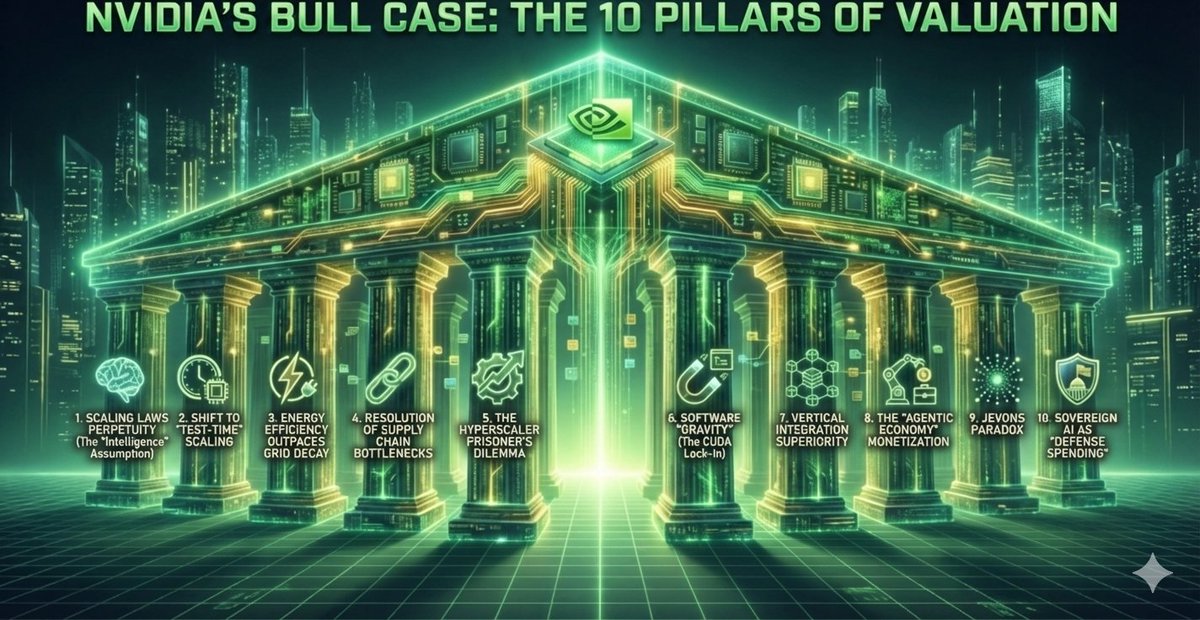
$NVDA Nvidia's AI Empire: 10 Must-Hold Assumptions for the next 5x Stock Run
1. Scaling Laws Perpetuity (The "Intelligence" Assumption)
The bedrock of the bull thesis: increasing compute (FLOPs) and data must continue to yield proportional gains in reasoning. If LLMs hit a "plateau of diminishing returns" where a 10x increase in compute yields only marginal improvement, the $500B+ annual CapEx from hyperscalers will vanish.
2. Shift to "Test-Time" Scaling
You are betting that AI transitions from Training (lumpy revenue) to Inference (recurring utility). If "thinking longer" (inference-time compute) makes models like OpenAI’s o1 significantly smarter, Nvidia chips become a permanent variable cost of doing business rather than a one-time construction expense.
3. Energy Efficiency Outpaces Grid Decay
The "Power Wall" risk: Nvidia must reduce energy-per-token faster than the power grid fails. If Blackwell and Rubin don't deliver massive performance-per-watt leaps, physical limits at local utility substations will halt chip shipments regardless of demand, unless infra solutions (e.g., nuclear/renewables) can bridge the gap.
4. Resolution of Supply Chain Bottlenecks
This assumes TSMC’s CoWoS and HBM capacity can scale to meet $500B+ backlogs. To hit the bull case, Nvidia must successfully navigate production limits that would otherwise cap revenue below market forecasts.
5. The Hyperscaler Prisoner’s Dilemma
Despite emerging custom ASICs, big tech remains locked in a cycle of Nvidia purchases. Nvidia’s 1-year release rhythm (Blackwell → Rubin → Feynman) must deliver enough efficiency gains to force constant upgrade cycles, outpacing competitors and sustaining premium pricing.
6. Software "Gravity" (The CUDA Lock-in)
You are betting the Software Moat is deeper than the Hardware Gap. Even if a competitor produces a chip with 20% better raw performance, the cost of rewriting 20 years of CUDA-optimized code and re-certifying enterprise "NIM" containers must remain too high for any rational CTO to attempt.
7. Vertical Integration Superiority
Nvidia is now a Systems Company, not a chip company. The requirement: Nvidia’s networking (InfiniBand) and NVLink interconnects must remain the only efficient way to build "Gigawatt-scale" AI factories. If generic Ethernet catches up, Nvidia’s full-stack margin premium evaporates.
8. The "Agentic Economy" Monetization
For CapEx to continue, Hyperscalers must prove AI generates revenue. If AI remains a "chatbot" and fails to evolve into "agents" capable of executing complex tasks, the current spending will be remembered as a historic bubble.
9. Jevons Paradox
This assumes that as Nvidia makes compute cheaper, the world finds more uses for it rather than pocketing the savings. Unlike smartphones, which hit a "utility ceiling," this bet posits that there is no known ceiling for corporate intelligence; lower cost-per-token will trigger an explosion in demand.
10. Sovereign AI as "Defense Spending"
AI infrastructure is now a National Security Imperative. This logic assumes governments (e.g., UAE, Japan, France) will fund "National AI Factories" with the same price-insensitivity they show for fighter jets, creating a non-cyclical revenue floor that protects Nvidia from a private-sector "AI winter.
(1/2)
(Not Financial Advice)
Will LLMs be Commoditized?
TL;DR: Don't sleep on $GOOGL ’s "free tier" playbook sucking out all the economic oxygen amid the current LLM wars.
Will LLMs commoditize? To answer this core debate, it may be helpful to consider the LLM wars for Consumer AI and Enterprise AI separately:
LLM Wars: Consumer Side
High-end AI will not automatically mean paid subscriptions if "good enough" free options exist—remember AOL charging for internet access before the free web crushed it?
What’s potentially different this time, is that frontier LLMs are brutally difficult to build; Meta has poured billions in and still lags the leaders. I suspect frontier models with differentiated capabilities, that are solving real consumer pain points, will be valuable.
That said, expect a perpetual free tier from Google and open-source models, draining economics from pure-play AI firms. Google's mastered this: Gmail, Android, Maps—all "free" to hook users, then monetize via ecosystem lock-in.
Prediction: Consumer AI = General Purpose (GP) AI assistant + on-demand specialist AI apps for niche tasks. The GP with the most users wins big via flywheel: More users lead to more developers connecting specialist AI apps to its ecosystem, which leads to better task execution and stickier users.
Google's edge here? Their track record of killer free products to grab market share. Free GP AI locks in the masses, pulls in app developers, and Google takes a platform cut—like Uber (matching riders/drivers) or Amazon (with sellers/buyers).
Risk 1: LLMs hot swapping? Competition between leading models like GPT and Gemini could encourage consumers to switch between the "best-for-task" options, especially with interoperable APIs allowing specialist AI apps to integrate across multiple AI platforms. This might reduce user loyalty to any single GP agent.
Mitigation: Consumer habits can be remarkably sticky—consider how Google Search remains dominant even when Microsoft Bing produces similar results. Similarly, while some consumers occasionally jump between Uber and Lyft apps, and some drivers work for both, Uber has pulled ahead to a market cap over 20 times that of Lyft. Over time, the winner slowly but surely widens the gap through network effects.
Risk 2: As data center infrastructure scales up—such as with Nvidia's Blackwell GPUs—tokens could become commoditized, potentially diminishing Google's cost advantage from its in-house TPUs.
Mitigation: Over the long term, token costs will likely converge toward the marginal cost of power. However, competitors like OpenAI must pay hyperscalers, who in turn pay Nvidia, introducing layers of middlemen. Google, with its full AI vertical integration, retains a margin advantage even in a commoditized token environment.
LLM Wars: Enterprise Side
Here, it is all about deep sector verticals with proprietary data for moats. Generic LLMs flop without clean data—hallucinations kill deals in high stakes sectors such as healthcare, finance, etc.
Real defensibility: Distribution + data flywheels. For instance, Microsoft can bundle AI into its empire for forced adoption; huge user base = faster feedback loops = superior model improvement cycles.
For startups: Need unique datasets in niches, going deeper than Big Tech ever would. Without capability differentiation or high switching costs, open-source alternatives cap profits.
But perhaps most importantly, enterprises demand more than features—think data and system security, where Microsoft and Google have credibility.
So, on the Enterprise AI side, LLMs hot swapping feels even less likely, given the likelihood of deep sector specialization via proprietary data, and lower reputation risk tolerance for enterprises mean wholesale changes are typically very slow.
OpenAI's Compute Bets and What It Means for the Sector
OpenAI just dropped $1.4 trillion in commitments for data center compute—yes, trillion with a T. They are banking on revenue growth to fund it, which directionally points to hundreds of billions in annual revenues. Even if they hit half that, it is game-changing. And if it is true for them, it has to be directionally spot-on for Google too. No more hand-wringing about Search dying in the AI era—GOOGL's trading at under 30x forward PE, which screams option value for the post-AI world. Compare that to OpenAI's $700B-800B private valuation on just ~$15B-$20B ARR?
Google's advantages? Elite AI research, in-house TPUs/chips, data centers, frontier models (Gemini), apps/products, billions of users/distribution, and a fortress balance sheet with FCF to self-fund. They are the lowest-cost token producer right now—can undercut everyone, price below cost, and dominate. Sure, classic Search (those 10 blue links) is under siege, but Google is simultaneously well positioned to own the AI shift. Oh, and you get Waymo (autonomous driving gold) and YouTube (ad/printing machine) basically for free at this valuation.
Valuation Risk vs. Execution Risk
$GOOGL ’s embedded option value in AI makes it a compelling long. OpenAI's massive compute bets signal explosive revenue potential in AI, but Google's vertical integration makes it the real powerhouse at a bargain valuation (vs. Mag 7 peers or OpenAI's private valuations).
Open-source momentum is the wildcard that amplifies LLM commoditization risk for everyone, with open-source fine-tuning tools making custom models cheaper/easier to implement. While Google’s role in the AI era is not guaranteed, execution risk is perhaps somewhat reduced by their track record of shipping really sticky consumer products!
The LLM wars have only just begun. New players could emerge; new AI device form factors or orchestration tools could redefine the entire game. AI could cannibalize Google Search’s ad revenue faster than Gemini could replace it, and regulatory scrutiny might slow Big Tech's dominance further.
Yet, amid these uncertainties, Google is still the incumbent to beat.
History warns: Don’t bet against the house that built the internet as we know it.
(Not Financial Advice)