Iran continues to send large amounts of crude oil via the #StraitofHormuz shipping chokepoint, according to a firm that monitors satellite imagery to observe vessel movements https://t.co/K10k52c8jQ #tankers $FRO $ECO $DHT $TNK $INSW $TEN
Traders have been closely looking for any sign that ship traffic is beginning to move through Hormuz https://t.co/wtpEUnfZrj #tankers $FRO $DHT $TNK $ECO $INSW $TEN
@Nortilus Why would you describe a ship that is outside of the Strait of Hormuz as "trapped". Surely the owner is either issuing orders for the ship to sail elsewhere or is waiting on the potential of the strait reopening ?
📢 A total of 66 gas carriers remain confined west of Hormuz!
🔎 Today we focus on LPG and LNG carriers.
🛰️ AIS-derived real-time data shows that 46 LPG carriers and 20 LNG carriers currently remain confined within the Persian (Arabian) Gulf.
ℹ️ All LNG carriers have cargo on board, while only 10 of the LPG carriers are ballasting, with the remaining 36 in laden condition.
🛑 Over the past few days, gas carriers (as well as other vessels in the region) have either switched off their AIS transponders or experienced malfunctions resulting in the loss of live signals.
🕵️♂️ Whichever the case, over the past 24 hours the 56K-deadweight, Palau-flagged LPG carrier DANUTA I was the only gas carrier to cross the Strait of Hormuz. The vessel is also believed to be part of the "ghost fleet", a group of ships with opaque ownership structures and indirect sanctions exposure.
Russian oil cargoes bound for East Asia have switched to India, suggesting New Delhi is becoming more willing to take the crude as the #USIranWar worsens https://t.co/ykHdROQipo #tankers $FRO $DHT $ECO $TNK $INSW #shadowfleet#darkfleet
A bulk carrier signaled it was Chinese-owned as it transited the Strait of Hormuz this week, highlighting how vessels are trying to ensure safe passage during the war in the Middle East https://t.co/UlTeKcX6hr #drybulk $DSX $SBLK $GNK $SHIP $CMBT
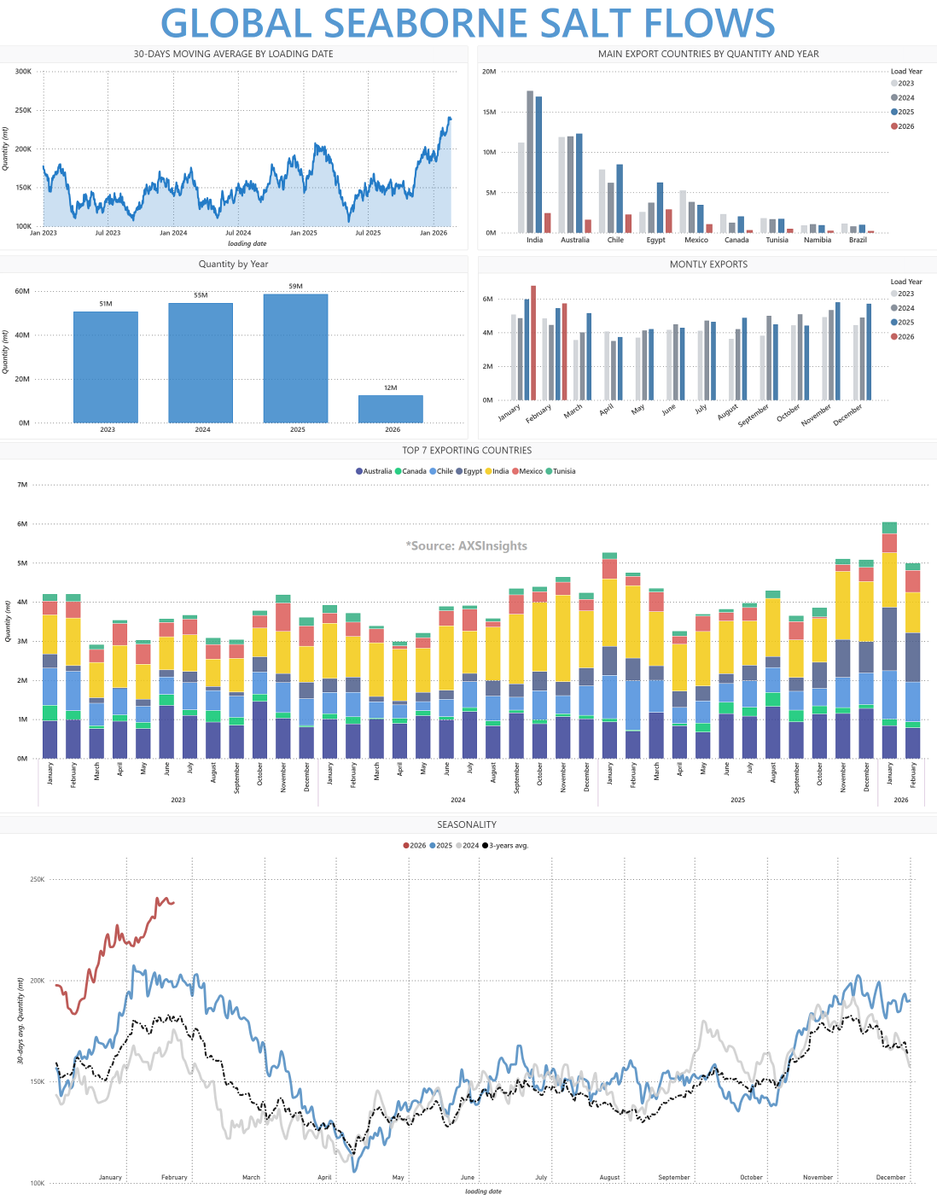
📢 Global seaborne salt flows reach peak levels at the start of 2026!
📈 Loadings of bulk salt products (including industrial salt, rock/de-icing salt, and solar salt) reached a record high of nearly 6.8 million metric tons in January.
📊 In addition to exceeding the 6-million-ton mark for the first time on record, this represents a 13.9% year-over-year increase. Preliminary February data also points to strong YoY growth, with only a few days remaining in the month.
🌍 The primary driver behind the surge in salt loadings aboard bulk carriers so far in 2026 has been Egypt.
🏆 Historically, Egypt has ranked between fourth and eighth among the Top 10 salt exporters over the past decade. However, shipments in January and February increased by more than 117.9% year over year — a trend that began gradually in October 2025 — and currently position Egypt as the largest supplier in the market since the start of 2026.
🌐 Meanwhile, salt loadings from Australia and India in early 2026 remain below last year’s levels, while Chile has shipped more than 2.2 million metric tons, broadly in line with 2025 volumes.
ℹ️ For additional context, total seaborne salt shipments reached more than 57 million metric tons in 2025. While accounting for only around 1% of global dry bulk flows, this places salt on a comparable scale to commodities such as Nickel Ore and Cement.
🛰️ With our AXSInsights module, you can monitor both major and minor dry bulk commodities in real time and stay ahead of developing trends.
💡 Find out its full capabilities at https://t.co/bacoPJu8zw.
What happens to dry bulk markets when the Suez Canal normalises?
A return to normalised transits would reduce sailing days, adding supply to the market and putting downward pressure on #dry bulk carrier earnings. The effect will differ across vessel segments.
Hear from our analysts as they break down:
◾ How much additional vessel supply could return because of shorter voyages?
◾ Which vessel segments would see the highest increase in supply?
◾ What is the outlook for the major underlying trades transiting the #SuezCanal?
Speakers: Hanif Kamar and Alexis Ellender
👉 Register here: https://t.co/dmZS57ZmoR
Saudi Arabia’s top oil shipper provisionally hired at least five VLCCs, adding to demand for the giant ships at a time when their booking costs are soaring https://t.co/8QI9Ek3yNc #tankers $FRO $DHT $ECO $TNK $TOPS $NAT $TEN $INSW
📣 𝗡𝗲𝘄𝘀 𝘀𝘁𝗼𝗿𝘆: 𝗦𝗶𝗻𝗼𝗸𝗼𝗿 𝗯𝗲𝗰𝗼𝗺𝗲𝘀 𝗹𝗮𝗿𝗴𝗲𝘀𝘁 𝗩𝗟𝗖𝗖 𝗼𝘄𝗻𝗲𝗿
South Korean shipping major Sinokor is now the largest single commercial operator in the very large crude carrier (VLCC) fleet and is expected to keep growing, according to shipping market participant estimates.
Read the full article by Charlotte Bawol: https://t.co/tXORj5gVBD
#ArgusMedia #IlluminatingTheMarkets
US supplies of gasoline are being shipped out of the country to travel thousands of miles via the Bahamas before finally ending up in California. https://t.co/atMak6HevY #tankers $HAFN $TORM $STGN
Okeanis Eco Tankers $ECO suezmaxes reportedly ready to ship Venezuelan crude to Europe after traders rolled out offers worldwide to sell cargoes at the behest of the Trump administration https://t.co/I8DN5hOL85 #tankers $FRO $DHT $TNK $TOPS $TEN $INSW