Funtrepreneur! Trader! Earth Buddy! Inner Potential Activator! I help people to activate their intelligence and develop innovative thinking to become limitless.
🌱 Introducing Regenerative Revolution | Issue 1
This World Food Day, 16 October, Save Soil presents Regenerative Revolution — an interactive digital publication highlighting the people and practices contributing to the advancement of regenerative agriculture.
✨ In recognition of the International Year of the Woman Farmer 2026, Issue 1 highlights the role of women farmers in advancing regenerative agriculture and strengthening food systems through their knowledge, leadership, and practices.
📖 Explore the first edition and subscribe to receive every issue.
Discover the new edition.
https://t.co/1FbxLL3gkE
Priya once noticed tomato and brinjal plants thriving in a garbage dump, with no one looking after them. It taught her the lesson her whole life's work now rests on: feed the soil, and the plant will protect itself. 🌱
→ She travelled from town to town rescuing vanishing crops, and built Seed Island, which now safeguards more than 1,000 heirloom varieties
→ She brought independent seed savers together to establish the Tamil Nadu Seed Collectors' Federation
→ With Save Soil, she trains farmers and home gardeners, and has shared seeds with more than 50,000 people
→ Her work has earned more than 100 agricultural awards, which she sees as proof that her methods work
She dreams of a seed bank in every village. Is there a plant from your grandmother's garden you'd love to grow again? 👇
🌾 My Regenerative Revolution
Priya's story is only a glimpse. Regenerative Revolution, Issue 1 goes much further: how soil shapes our health, where natural farming came from, the model farms where it's put to the test, and the many ways you can be part of it.
Releasing 16 October, World Food Day.
FIND YOUR NEXT STEP
Access every insight, strategy, and triumphs shaping a regenerative future..
#RegenerativeRevolution #SaveSoil #SeedSaving #HeirloomSeeds
Many cities are beginning to rethink the ground beneath them.
Depaving removes asphalt and concrete so that soil can absorb rainwater, support vegetation, reduce heat, and help restore biodiversity in urban spaces.
From Genoa to Paris, Copenhagen, New York, and São Paulo, cities are finding ways to replace sealed surfaces with green infrastructure. This is not just beautification. It is a practical response to flooding, heat, and the long-term need for more resilient cities.
Action Now: https://t.co/uVnQCIZBeZ
Source: Re Soil Foundation, “From Genoa to New York: why depaving is reshaping the future of the cities,” 5 June 2026.
Protecting microbial activity is very crucial🙏🍀☘🌱🌿
Microbes are not useful for #Soil biodiversity but also in medicine(scientific research)
🙏🍀🌴🌿🌱
@katchannaidu@ap_agriculture please implement #SaveSoil in AP region
Action https://t.co/9zoOooJonq
#TreeBasedAgriculture
A new study shows that crop residue may do more than add organic matter back to soil.
In an 11-year field experiment in paddy fields, researchers found that returning straw to the field helped increase soil organic carbon. Part of this carbon was protected within soil aggregates, while another part became chemically linked with iron oxides, making it more stable.
The finding points to an important idea: soil health depends not only on what is added to the land, but also on the hidden biological and chemical processes that help retain carbon over time.
Action Now: https://t.co/uVnQCIZBeZ
Citation: Li, B., Huang, J., Liu, L., Li, D., Duan, Y., et al. (2026). Straw return promotes soil organic carbon sequestration through aggregate protection and chemical bonding mediated by iron oxides. Agricultural Ecology and Environment, 2, e018. https://t.co/FnLSA444NL
Exploiting the soil again and again for crops without replenishing its carbon content or nutrients leads to desertification.
But whether it happens in a small garden or a farm, there are methods to restore soil health that anyone can use.
#SaveSoil 📹 gingerfootgarden [Insta]
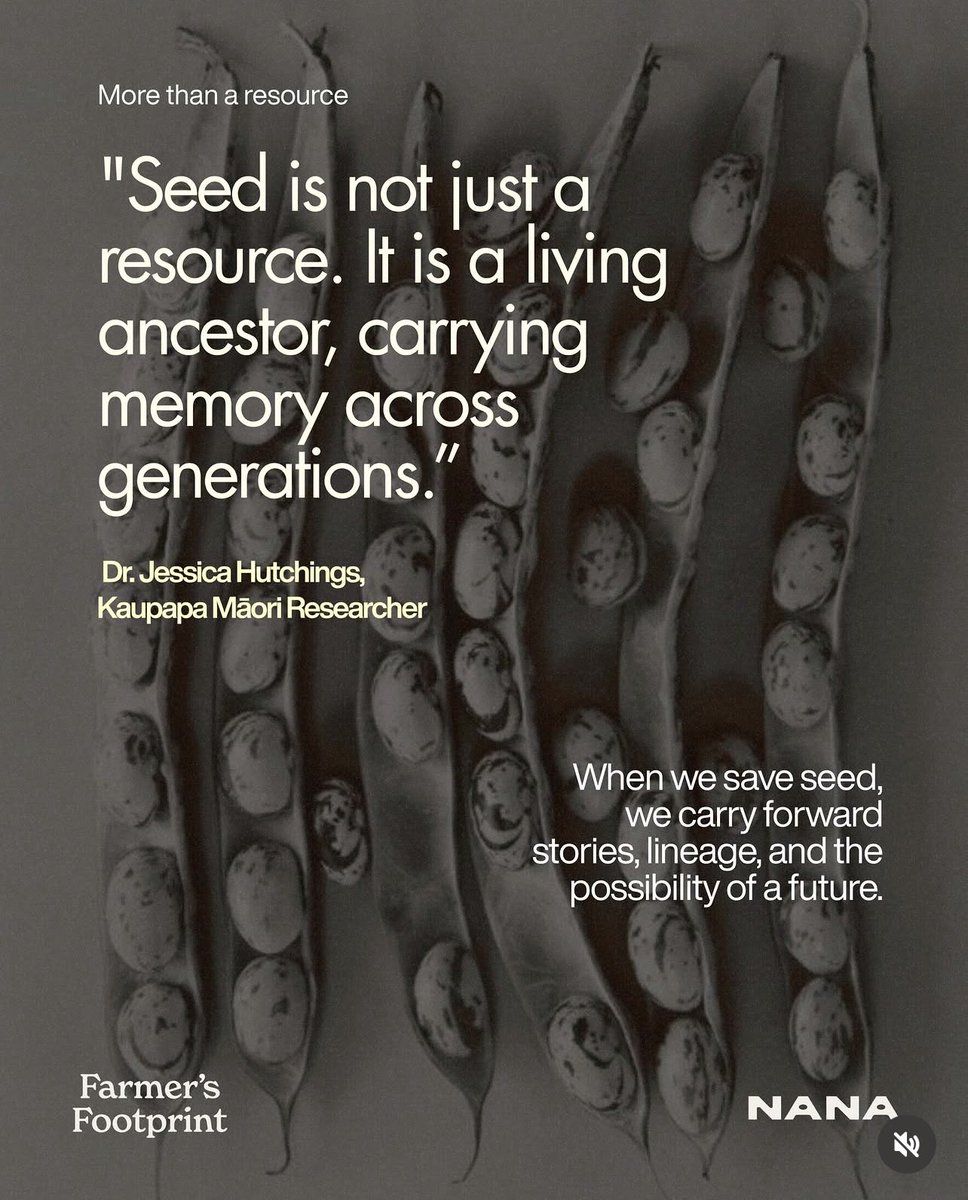
If a farmer wants to be resilient and in tune with what his soil can grow best, he/she had best learn how to save native varieties of seeds.
Annual plants especially, adapt to local soils within a few years,creating a unique variety for your land.
#SaveSoil 📹 country_calm_
Soil biodiversity is not only important for ecosystems. It can also open doors for science.
Researchers studying soil-dwelling myxobacteria identified new taxonomic diversity and five new classes of bioactive compounds. Some of these compounds showed antifungal, antiviral, or antibacterial activity.
The finding highlights why microbial diversity matters. The living world beneath the surface may hold compounds and functions that are still unknown.
Action Now: https://t.co/uVnQCIZBeZ
Citation: Agrawal, A., Garcia, R., Chen, G., et al. (2026). Unveiling the Taxonomic Diversity and Unprecedented Biosynthetic Treasure of the Phylum Myxococcota. Advanced Science, e76919. https://t.co/hpfiwjkJ9U
Tropical forests cannot be understood with one global rule.
A large satellite-based study found that forests across the Amazon, Africa, and Southeast Asia respond differently to heat, drought, soil conditions, and terrain. Even when climate shifts appear similar, carbon storage can change differently from one region to another.
This matters for climate models and forest protection. Accurate carbon predictions need local data, regional expertise, and long-term monitoring.
Action Now: https://t.co/uVnQCIZBeZ
Citation: Nunes, M., Muller-Landau, H., Görgens, E., et al. (2026). Heterogeneous climatic controls on tropical-forest biomass. Nature. https://t.co/5Gz9BJZ7aU