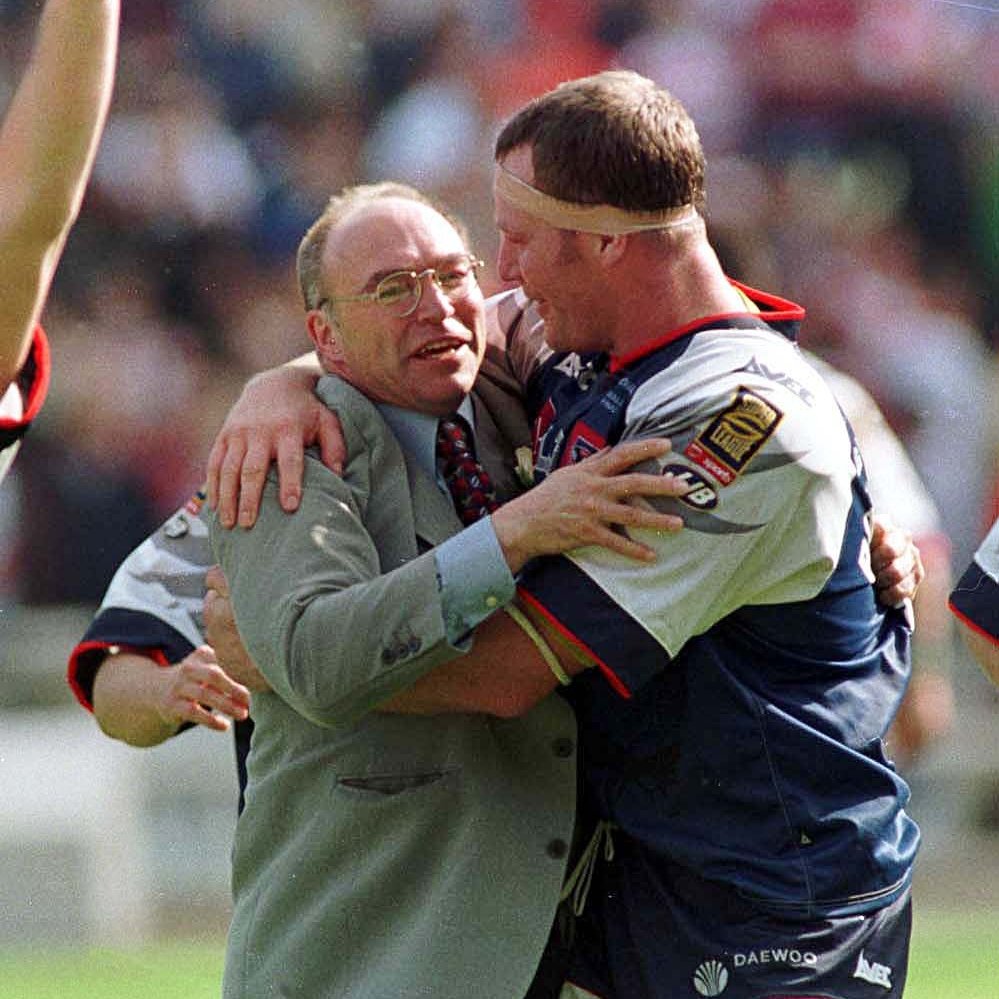
Sheffield Eagles are deeply saddened to hear of the passing of former Head Coach John Kear.
One of rugby league’s most respected and influential figures, John joined Sheffield Eagles in 1997 and will forever be remembered for leading the club to one of the greatest upsets in the sport’s history. In 1998, he guided the Eagles to a famous 17-8 victory over Wigan Warriors at Wembley Stadium, securing the Challenge Cup for the first time in our history.
After three seasons with the Eagles, John took charge of the merged Huddersfield–Sheffield side in 2000 before embarking on a successful coaching career across several clubs in the sport. Among his most notable achievements was his spell with Hull FC, where he guided the club to Challenge Cup glory in 2005, overseeing their victory over Leeds Rhinos in Cardiff.
Over the course of his career, John also held coaching roles with Wakefield Trinity, Batley Bulldogs, Bradford Bulls and Widnes Vikings. Earlier in his coaching journey, he led Bramley and Paris Saint-Germain and also spent time as an assistant coach with Wigan Warriors.
John’s standing within the game that he was entrusted with coaching at international level, leading France in 1997, England at the 2000 Rugby League World Cup and Wales from 2014 to 2025. His contribution to rugby league, both domestically and internationally, will be remembered for generations to come.
Across a coaching career spanning more than 700 professional matches, he earned a reputation as a passionate leader, outstanding communicator and tireless ambassador for rugby league.
He later received The Rugby League Writers and Broadcasters Association 2025 Merit Award winner, for services to the sport and its presentation in the media, as well as an Outstanding Contribution Award at last season’s Rugby League Awards Dinner following his retirement last year.
Everyone at Sheffield Eagles is saddened by John's passing. He will always be remembered as the coach who delivered our finest hour and as a man whose passion for rugby league touched countless players, staff and supporters throughout the game.
Our thoughts and deepest condolences are with John’s wife Dawn, his family, friends and all those who had the privilege of knowing him.
Rest in peace, John.
@mozzaev@SheffEaglesNews@_HarryJ1907 I remember watching reserve team games there. It would have needed work 30 years ago, and probably more now. But there is potential.
@Wrightyy_7@FirthBull95@totalrl As we have an asymmetric league anyway, with teams not playing all other teams. As well as the fact that Fax will strengthen as they go. Bailey's argument is not relevant here.
Peston’s analysis follows a now familiar pattern when it comes to Keir Starmer. The framing is rarely neutral. It begins not with the principle at stake, but with an implied weakness. The reader is invited to see the Prime Minister as either naïve, overly legalistic, or politically cornered. That lens then shapes the rest of the commentary.
The central issue was whether the United Kingdom should permit the United States to use British bases, including Diego Garcia, at a moment when America was arguably the initiating force in a conflict with Iran. The reported advice of the Attorney General was that doing so before any Iranian retaliation would place Britain on questionable legal ground. That is not a minor technicality. It is the difference between participating in an unlawful act and acting in collective self defence.
To portray adherence to that advice as political timidity or diplomatic miscalculation is to invert the argument. If Britain claims to uphold international law, then it cannot suspend that commitment whenever a powerful ally demands expediency. Law is not an accessory to be worn in peacetime and discarded in crisis.
It is also misleading to suggest that this was some uniquely British hesitation. Germany and France adopted similarly cautious positions. Neither signalled blanket support for immediate participation in a conflict whose legal basis was contested. That places Britain within a broader European posture rooted in prudence and legality. This was not isolation. It was alignment with major allies who took the view that international law must frame action from the outset.
The suggestion that Starmer “alienated” Donald Trump also deserves scrutiny. Alliances between states are not personal friendships. They are institutional, strategic and enduring. A refusal to act outside legal parameters is not hostility. It is sovereignty. If the American administration were to respond by withdrawing tariff arrangements secured through negotiation, that would reflect a transactional approach in Washington rather than a failure of statecraft in London.
As for the apparent shift from refusal to later cooperation, the distinction is neither cosmetic nor contradictory. Once Iran retaliated against regional allies, the legal character of the conflict changed. Collective self defence carries a different basis in international law than participation in a first strike. Recognising that distinction is not inconsistency. It is constitutional discipline.
There is also a broader point that is underplayed. Public opinion in Britain remains cautious about further military entanglement in the Middle East. A Prime Minister who insists on lawful justification before committing national assets is not necessarily weak. He may simply be reflecting both the law and the electorate.
The easy narrative is that in moments of crisis leaders must privilege realpolitik over principle. The harder truth is that once principle is abandoned in favour of expediency, it becomes far more difficult to invoke it later. If international law is dismissed as inconvenient when allies breach it, then it loses moral force when adversaries do the same.
One may disagree with Starmer’s judgment. But to suggest that fidelity to legal advice is folly misunderstands the very order Britain claims to defend.
I study authoritarianism for a living, so I do not say this lightly: America isn't facing an authoritarian future. America is living an authoritarian present.
(A long 🧵)
/1
Since early morning, my family and I have been living in a state of total psychological collapse.
Today we learned that our homes, our land, and our entire neighborhood, every house belonging to our family and our neighbors, have been completely erased. Bulldozed. Flattened into a barren stretch of yellow dust.
From the first light of day, we have been living the full meaning of defeat.
We have lost more than seventy members of our family. We have lost our land.
We now have no home to return to, no walls to protect us, no place left to call our own.
And then, one of Hamas’s leaders appears on television declaring that “the people have not been defeated,” that “Gaza has stood firm and fought a historic war.”
So let history record this:
I, Dr. Ezzideen Shehab, from Gaza, together with my family, my friends, and their families, did not fight any war.
We were the victims of an annihilation ignited by Hamas from within our homes, only for the Israeli army to descend upon us and unleash its full cruelty on the civilians of Gaza, while Hamas’s fighters vanished into their tunnels.
Let history record the truth: we were defeated, utterly, painfully, and completely defeated.
And it is we, the people of Gaza, who have the right to say whether we were defeated or not, not those who sit comfortably in Qatar or Turkey.
We were crushed, humiliated, and broken after our city was destroyed, occupied, and erased from existence.
We were displaced, stripped of everything we had built, left to wander through the ruins of our own lives.
And somewhere amid all this, I understood something simple and terrible:
My mother’s tears are holier than the homeland itself, and my father’s brokenness matters more to me than any flag.
Because what meaning does a homeland hold when it devours the ones you love, when it glorifies death but forgets the living?
We were not steadfast. We were held hostage in our own land.
We could not leave. We could not change those who claimed to rule us.
We were trapped between a merciless occupier and rulers who feed on our suffering.
And if there is one moment in my life when I must speak the truth, without fear, without hesitation, then this is that moment.
Let it be written clearly:
We were not soldiers in a war.
We were the bodies buried beneath it.
#GazaGenocide
@ricardoyorks@SheffEaglesNews I thought his contract was to 2025, therefore he has either extended his contract and the club will do its standard drip feeding announcements, or he is still negotiating. Hopefully he will stay...