I’m not here to tell you what to believe. I’m just going to lay out the numbers I’ve decoded, and you can sit with them and think for yourself 🧐
The Sumerian King List. The Mayan Calendar. Two completely separate cultures, different continents, different number systems, thousands of miles apart.
And they’re both tracking the EXACT SAME cosmic clock.
📊 THE SUMERIAN KING LIST — WHAT MY DECODER SHOWS
Before the “flood swept over,” the list records 8 names with these “reign lengths”:
• Alulim: 28,800 years
• Alalgar: 36,000 years
• En‑men‑lu‑ana: 43,200 years
• En‑men‑gal‑ana: 28,800 years
• Dumuzi: 36,000 years
• En‑sipa‑zi‑ana: 28,800 years
• En‑men‑dur‑ana: 21,000 years
• Ubara‑Tutu: 18,600 years
Mainstream says: “Ridiculous myth. No one lives that long.”
My decoder says something different:
These aren’t individual human kings with impossible lifespans. These are the Watchers. The lineage of knowledge keepers. The names represent the office, the post, the lineage of those who kept watch over the cycles generation after generation.
And the numbers attached to each name? They’re not how long a guy lived. They’re ASTRONOMICAL MARKERS — tracking how many degrees the sky shifted during that particular segment of the cosmic cycle.
🔑 THE KEY NUMBER NO ONE TALKS ABOUT: 72
Basic astronomy fact: Earth’s axis wobbles 1 degree every 72 years. This is the precession of the equinoxes.
Now divide those “impossible” Sumerian numbers by 72:
• 28,800 ÷ 72 = 400 degrees of precession
• 36,000 ÷ 72 = 500 degrees
• 43,200 ÷ 72 = 600 degrees
These aren’t random. They’re clean, exact multiples of the precession constant.
The Sumerians weren’t writing about fantasy kings. They were encoding the work of the Watchers — the ones who tracked the sky, maintained the records, and passed the knowledge down.
🌙 THE MAYAN CALENDAR — SAME CLOCK, DIFFERENT DIAL
Half a world away, the Mayans were tracking the same wobble using a completely different number system:
• 1 Mayan Great Cycle (13 baktuns) = 5,125.36 years
• 5 Great Cycles = 25,626.8 years
• Astronomical full precession cycle = ~25,770 years
Difference: 143 years. Over 26,000 years. That’s less than 0.6% “error.”
Half‑cycle turning point:
• Mayan 2.5 Great Cycles = 12,813 years
• Astronomical half‑precession = ~12,885 years
Again — almost dead on.
🌊 AND THEN — THE FLOOD MARKER
The Sumerian list builds up through these encoded precession segments… and then at the boundary, it says:
“Then the flood swept over.”
And the Mayan Calendar marks cycle turning points — the “end dates” that weren’t apocalypse predictions, but markers on the cosmic clock.
Two cultures. Same pattern. Same turning points. Same system of Watchers keeping track.
I’m not saying I’ve got all the answers. I’m saying the pattern is there. The numbers line up too cleanly to be coincidence.
If two completely separate civilizations on opposite sides of the planet both encoded the same astronomical cycle into their most sacred texts and calendars… and both left records of Watchers who kept track… maybe we should be paying attention to what else they were trying to pass on.
Make of it what you will. But I’d suggest sitting down with the numbers and having a proper think.
🇪🇸⛪️✝️
Voici l'impressionnant intérieur baroque de la basilique San Juan de Dios à Grenade, en Andalousie.
Les anciens chrétiens espagnols savaient véritablement comment construire des églises.
Le maximalisme était leur philosophie.
Le résultat en est que plus magnifique ! 👍🤩
His legs were shredded and he could not stand, so Hubert Lee led the final attack on his hands and knees, crawling forward, rising up to fire, and shouting at his men to follow him. And they did.
Lee was a master sergeant, a veteran soldier from Mississippi, holding a position near Ip'o-ri, Korea, on February 1, 1951. His company was ordered to take a key objective, and the enemy holding it was dug in and stubborn. The assault stalled, and Lee took it upon himself to get it moving. He led attack after attack against the position, four separate times, out front at the head of his small group of men each time.
On the fifth attempt, a grenade exploded right next to him. It knocked him to the ground and tore up both of his legs, wounding him seriously. He could no longer walk. By any normal measure, his fight was over.
Lee refused help and refused to go back. Instead, unable to stand, he kept advancing the only way he could, by crawling. He dragged himself forward across the ground, pushing up onto his knees to fire his weapon, then lowering back down and crawling on, all the while urging his men to keep coming with him. Then he was hit a third time, by small arms fire, and he still would not stop.
On his knees, bleeding from three wounds, he directed the final assault, and this time it broke through. His men took the objective. Between them they killed eighty three of the enemy and drove the rest off the position that a wounded sergeant had refused to let them lose.
And Hubert Lee lived. He recovered from those terrible leg wounds, returned to duty a few months later, and received the Medal of Honor from President Truman in 1952. The sergeant who could not walk but would not quit, who led his men to victory from his hands and knees, got to go home.
Just incredible! These 2 guys, in spite of the strong current and slippery conditions, carried out a kick ass rescue of the defeated monkey. Great job, fellas!
Angela Lansbury once told a story about her daughter Deirdre who was falling under the spell of a Hollywood deadbeat. He introduced her to drugs and would get her to steal food and money from her parents for him. Worried, Angela Lansbury decided to move her entire family to Ireland.
**The deadbeat guy was Charles Manson.**
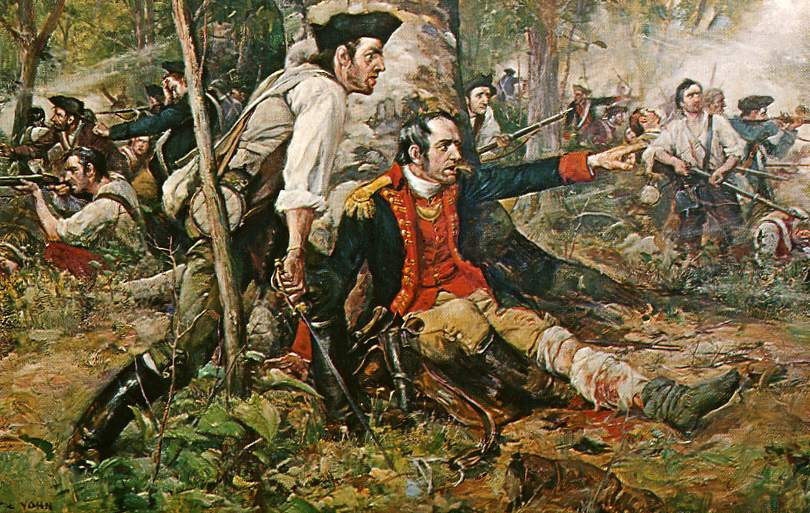
On this day in 1777, an old farmer-general got his leg shattered by a musket ball, propped himself against a tree, lit his pipe, and kept directing one of the bloodiest battles of the entire Revolution as if he had all the time in the world.
His name was Nicholas Herkimer, a plain-spoken German-American militia commander in the Mohawk Valley. When the British and their Loyalist and Iroquois allies laid siege to Fort Stanwix, Herkimer marched roughly 800 local militiamen and some Oneida allies to break the siege. They never got there. In a deep, wooded ravine near Oriskany, the enemy sprang a perfect ambush, letting the head of the column pass and then slamming the trap shut on men packed into the low ground with nowhere to run.
What followed was not a battle so much as a knife fight in the woods. Early on, Herkimer was hit, the ball smashing his leg and killing his horse. Instead of being carried off, he had his men prop him against a tree, and there he sat, calmly smoking his pipe and giving orders while the fighting raged hand to hand around him. When a sudden thunderstorm crashed down and forced a pause, he used the time to reorganize his shattered men, teaching them to fight in pairs so a warrior could not rush a man in the instant he was reloading.
The cost was horrific. Something like half of Herkimer's force was killed, wounded, or captured. As a battle it was arguably a British-Loyalist victory, but it was a gutting one, and while it raged, the fort's garrison sortied out and looted the enemy camp, further wrecking the besiegers' morale. Oriskany helped doom the whole western British thrust, which collapsed weeks later, feeding the American triumph at Saratoga.
Herkimer did not live to see it. His wounded leg was amputated in a botched operation, and he bled to death about ten days later, reportedly reading his Bible calmly to the end. A dying farmer under a tree with a pipe in his teeth, refusing to leave his men. That is the image the Mohawk Valley never forgot.
A 5-Story Temple Hidden in the Jungle… And No One Knows Why It Was Built This Way
Deep inside the ancient ruins of Edzná archaeological zone stands a structure that doesn’t follow the usual rules of the Maya world. Known as the Temple of the Five Stories, this towering building rises in five distinct levels—something incredibly rare for its time. Built during the Late Classic period (around 600–900 CE), it wasn’t just a temple… it was an entire world stacked vertically.
Each level had a purpose. Some rooms were likely used by elite residents, others for ceremonies, and some for administration. Imagine climbing higher and higher, moving from everyday life into sacred space, as if each floor brought you closer to the gods. It’s a design that feels almost modern—yet it was created over a thousand years ago.
But here’s where the mystery deepens. Edzná itself was a powerful city, supported by an advanced system of canals and water management that allowed it to thrive in the harsh lowlands of the Yucatán Peninsula. This means the people who built this temple weren’t just skilled—they were masters of engineering and planning. So why create such an unusual five-story structure? Was it a symbol of power? A spiritual pathway? Or something we still don’t understand?
Today, the temple stands silent, its stone walls holding secrets of a civilization that vanished long ago. And as the jungle slowly reclaims its edges, one question remains…
What really happened inside those five levels?
She was just a tiny puppy... cold, soaked by the rain, and trembling with fear. 💔🐶 With no one to protect her, every drop of rain made her struggle even more.
Then, a stranger noticed what everyone else had walked past. One simple act of kindness changed everything. A warm embrace, a safe place, and a second chance at life. ❤️
This is a reminder that compassion doesn't have to be grand to save a life. Sometimes, one caring heart is all it takes to turn someone's darkest moment into a new beginning.
Please share this story to remind the world that every life matters. 🐾🙏