Husband to Mama Juba. Father to Juba and Tara. Lifelong learner.
Life is not black and white. There are nuances to issues. Always extend grace to others.
Make we no steal
Make we no lie...
Business in this environment will test you.
But the ones who survive are not always the smartest.
They are the ones who stayed consistent when it was not making sense.
Let's keep doing the work my friend.
Meanwhile...Costly food isn't Good food.
Get A FULL GOAT for 65k today and A slot of Beef Shared for 45k
07018842832
Today is a special day for me and everyone at @SportingLagos 💙
Two of our Academy boys, Odinaka Okoro & Ebenezer Harcourt, will represent Nigeria at the FIFA U-20 World Cup in Chile.
When we scouted Odinaka, he was working as an aluminium apprentice in Owerri, playing football on the side and dreaming of going pro. Ebenezer has already gone from winning the Gothia Cup in Sweden to playing for the Super Eagles at CHAN.
Thank you to our fans and community for believing in the journey and supporting these talented Nigerians to pursue their dreams.
We wish them and the rest of the Flying Eagles an incredible World Cup. Make us proud 🇳🇬
From Sam Altman: "Adjusted for the subjective increase in how fast time passes, life is half over by 23 or 24. Don't waste time."
I'm 36 and this hits different because it's mathematically true.
When you're 5, one year is 20% of your entire existence.
When you're 50, it's 2%. That's why childhood summers felt endless and last year feels like it happened yesterday.
I can barely remember last month. But I can still taste the Kool-Aid from summer camp when I was 8.
Your brain literally experiences time differently as you age. The novelty fades. The patterns repeat. The days blur together.
Which means every year after 25 feels exponentially shorter than the year before.
Most people realize this too late. They spend their 20s "figuring things out" and their 30s climbing someone else's ladder, only to wake up at 40 wondering where the time went.
"it went by in a blink"
If you're under 25, you have more subjective time left than you'll ever have again.
If you're over 25, you have less time than you think.
Either way, the math is brutal and the message is clear:
Time is sacred. Relentlessly your ideas. Seize the day.
I look at it as a fire underneath me. As a good thing.
Time keeps us honest.
Happy building, I'm rooting for you.
Life lately….
It's been quite a journey, entering this new phase and gradually transitioning into it. Can you believe it's been 7 months already? 🙌🙌🙌🙌🙌🙌
Over the past few months, we've quadrupled our capacity. Now, we provide restaurants, caterers, and chefs with discounted bulk prices that are even lower than retail. We've also strengthened our partnerships with more delivery companies, making bulk deliveries quicker and more affordable for these businesses.
Thank you for your referrals, purchases, and support for our business. God bless you all! 🙌🙌🙌🙌
Actively seeking INVESTORS ONLY for long and short term, pleas get in touch in DM let’s talk business
Shop here https://t.co/TJBjrFdYUf
The sky may be wide enough, but we are still rationing feathers. Wings are unequal. Some are clipped at birth. Others are created in labs of privilege. Flying is not a poetic given. It’s a bloody effort. That the sky is wide enough, is spatially true, but materially false.
If you are ever in need of a photographer to shoot your proposal, weddings, birthday (or anything). Don’t hesitate to holla! You just might be in luck for a NIUK discount!
MY OPEN LETTER TO PRESIDENT TRUMP
The frustrating part is that I was on board for a reset. Truly. I’ve said it publicly. I’ve written about it in this very feed. I understood the need for a detox. For decades, the U.S. economy played the part of the rich guy at the table -- picking up the check for a global order that no longer worked in our favor. We hollowed out our industrial base. We enabled unfair trade imbalances under the illusion of diplomacy. We subsidized demand for cheap imports while outsourcing the hard questions about how our domestic workforce would adapt.
Eventually, that had to stop. It was unsustainable -- financially, politically, and morally. We couldn’t keep pretending that a consumption-led economy held together by zero-interest rates and global fragility was a long-term solution. I wanted a rebalancing. I welcomed the idea of a harder, smarter America-first policy that pushed for fair treatment, reciprocal agreements, and a real industrial strategy rooted in technological superiority, national security, and capital formation. That would’ve been leadership.
But that’s not what this is.
What you’ve rolled out isn’t detox -- it’s whiplash. This isn’t strategic decoupling. It’s scattershot retaliation dressed up as reform. There’s no roadmap. No operational playbook. No clear articulation of where this ends or what the metrics of success even are. It’s not an attempt to responsibly unwind America’s role as the global shock absorber -- it’s a brute-force attempt to disorder the existing system with no viable alternative in place.
You can’t replace a fragile supply chain with chaos and call it resilience. You can’t build American industry by torching the scaffolding that underpins capital flows, labor mobility, and global coordination -- especially when the U.S. itself no longer has the domestic capacity to meet its own industrial needs. You talk about bringing jobs home, but the U.S. doesn’t have the labor force, permitting structure, or wage flexibility to stand up full-scale manufacturing at speed. And now -- after years of deportation policies and underinvestment in vocational training -- you’ve made the labor gap even wider.
Capital isn’t going to rush to fill that void just because you raised tariffs. It’s going to wait. It’s going to sit on the sidelines and preserve optionality. Because right now, no CEO can confidently model a five-year capex plan. No board can greenlight supply chain onshoring when they don’t know whether a tariff rate will double next quarter based on your Twitter account or some arbitrary trade deficit formula.
That’s the issue. This wasn’t rolled out as part of a comprehensive American renewal strategy. It wasn’t coordinated with the Fed. It wasn’t communicated clearly to Treasury. It wasn’t backed by a labor reskilling program or any form of public-private manufacturing incentive beyond empty slogans. It was dropped like a bomb -- seemingly designed more to shock than to build.
And in the absence of credible structure, capital is retreating -- not realigning.
I was ready to endure the pain of a thoughtful, structured reset. Most long-term investors were. We’ve lived through tightening cycles. We understood that globalization, as it stood, had reached a breaking point. But this isn’t a correction of imbalances. This is a rupture without scaffolding.
What you’ve created isn’t reindustrialization. It’s an intentional sabotage of capital planning. No executive is going to build a factory with four-year political horizon risk, a floating tariff regime, and no labor certainty. No investor is going to fund expansion in a market where the basic cost of imports can change weekly based on what country has a current account surplus that week. The system you’ve launched isn’t designed for certainty. It’s designed for control.
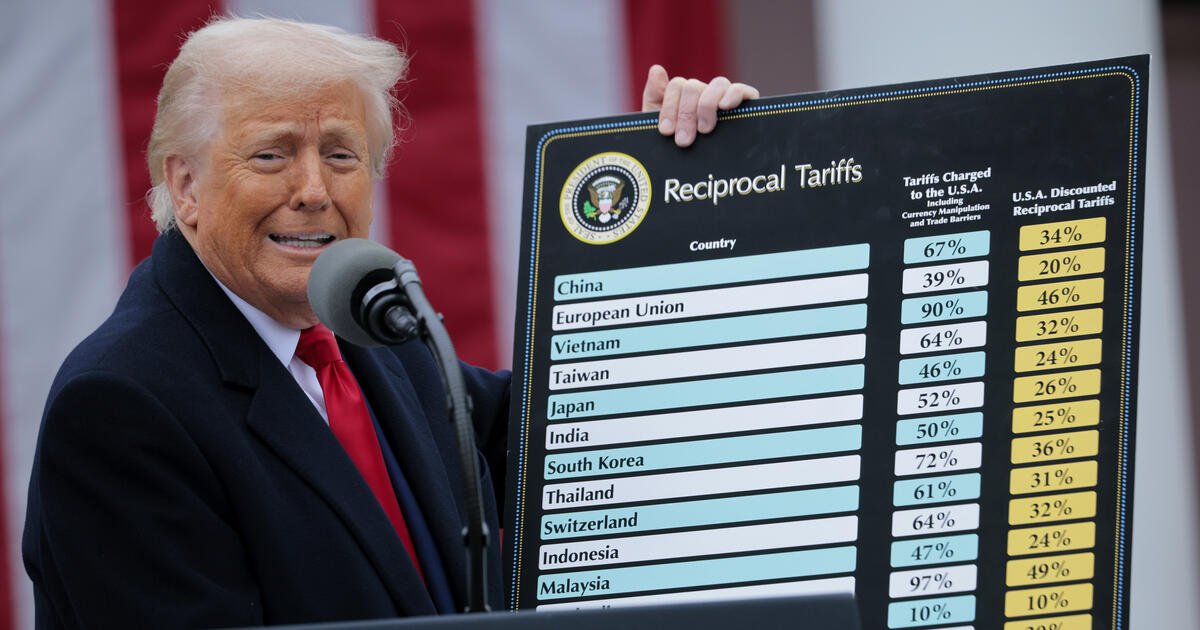
And the irony is -- we’re not even punishing bad actors. We’re punishing everyone. Allies. Poor countries. Longstanding partners. Israel gets slapped with 17% tariffs while dismantling their own to support American imports. Vietnam gets hit with 46% because it’s become too productive. Lesotho, one of the poorest countries on Earth, faces a 50% tariff because it doesn’t buy enough U.S. goods -- as if that were a sign of unfairness rather than poverty. It’s incoherent. It’s cruel. And it undermines any claim to moral high ground.
You say this is about protecting American workers. But no worker is helped by policy so erratic that no employer wants to hire. No consumer is helped when import costs rise and domestic capacity doesn’t exist to replace them. No investor is helped when the cost of capital spikes in the face of weaponized uncertainty.
This is not a plan to make America stronger. It’s a gamble that markets and allies will blink first. It’s brinkmanship with no floor.
And the most maddening part? There was a path. A real one. A version of this policy that could’ve worked -- not in headlines or soundbites, but in practice. A path that applied pressure with purpose, that aligned economic force with long-term national interest, that sent a clear message to adversaries and partners alike without destabilizing global commerce or blindsiding capital allocators.
You could’ve gone after China -- hard -- and had the backing of nearly every serious investor and strategist on the Street. Not just because of trade deficits or currency suppression, but because China has been actively undermining our economy and our people. I would’ve supported a four-year plan to end all dependence on Chinese manufacturing unless they stopped stealing American IP (DeepSeek). No more games. Make it explicit: if they don’t comply, we’ll back Taiwanese independence and bring the entire global semiconductor economy with us. No ambiguity. No half-threats. As I see it, China is at war with us -- and our policy should reflect that.
With the EU, you could’ve played it clean. Match auto tariffs percent-for-percent. That’s fair. And then leave the rest alone -- especially goods and services. We run a huge surplus on services with the EU. It props up some of our biggest competitive advantages -- enterprise software, consulting, cloud, defense tech, streaming, media IP. Tariffing the EU outside of autos would be like shooting your own foot for balance. We’re not in a trade war with Europe. We're in a competition for global enterprise dominance -- and right now, the U.S. is winning.
That’s what real strength would’ve looked like. That’s what an America-first trade doctrine could’ve achieved. You’d be rebuilding the system from the inside out -- not just throwing bricks through the windows and calling it a redesign.
Investors would’ve backed it. CEOs would’ve planned around it. Global partners would’ve respected it -- even if they didn’t like it. And capital would’ve flowed toward American resilience instead of retreating from American unpredictability.
But instead of that, you went with chaos. And now, confidence is shattered. Not because the numbers are bad -- but because no one knows what the numbers mean anymore.
That’s the cost of burning down the rules without building new ones.
So no, this is not the detox we needed. It’s not strategic decoupling. It’s not a path to renewal. It’s a slow, loud dismantling of the very foundation that has allowed American capital, innovation, and enterprise to dominate for decades. And it didn’t have to be this way.
But now we’re here. And the market is reacting accordingly -- not to the fundamentals, but to the sense that the future may no longer be modelable. That’s not a trade. That’s an exit.
I don’t want this post to be hyper-political. This isn’t about red or blue. It’s not about the 2024 election cycle. It’s not about ideology. It’s about strategy. It’s about execution.
It’s about understanding that when you're the United States -- when you sit at the helm of the global economic engine -- every policy you roll out reverberates through capital markets, supply chains, boardrooms, and governments. Words become signals. Signals become pricing. Pricing becomes pain -- or progress.
And I hope -- for the sake of the markets, for the sake of businesses trying to plan, and for the future we’re all investing into -- that it’s not too late to recalibrate.
Because we don’t need more noise.
We need a plan.
What she's saying is common and she's not wrong - women do bear a disproportionate amount of childcare and housework, and when both parents have jobs, this inevitably creates resentment towards the dads, who tend to be less proactive towards these tasks. It's good sense to communicate and develop a clear division of labor.
What isn't mentioned, however, is that a large part of the problem is also the perfectionistic and neurotic tendency of moms who can't relax or let go. Dads routinely end up on the receiving end of demands that aren't in fact necessary, especially in the moment, but become relationship-threatening "neglect" because the mom's own expectations and anxiety turn them into referenda on how he feels about her.
Take her example of the trash - her man was running late for work and didn't take it out. She says this wasn't a good excuse, because him not doing this made *her* late for work - but that's actually not the case. She could have left it. The overflowing trash was gross but wasn't going to do anything for a few more hours. It wasn't her responsibility anyway, and there's no doubt he would have dealt with it when he got home when he saw it. And odds are the shame of the mess would mean he'd take care of it sooner in the future. He'd know if he didn't do it, no one would - it would be all on him.
This approach may sound frustrating to women, but if you want your man to do things, you need to learn to leave him
space to do them - even if he's
taking longer to do them (or does them differently) than you'd like. You cannot nag and emasculate a man, and then feel upset when he inevitably distances himself from you and avoids the task. You cannot ask for a man to lead, and then continually question his leadership.
The fact that many women do not understand this is proof how many well-meaning women don't know how to be feminine.
Either solve the problems of a few rich people or a lot of poor people. But don't get stuck in between trying to sell average products at average prices to average people. That's where businesses bleed and ambition goes to die.