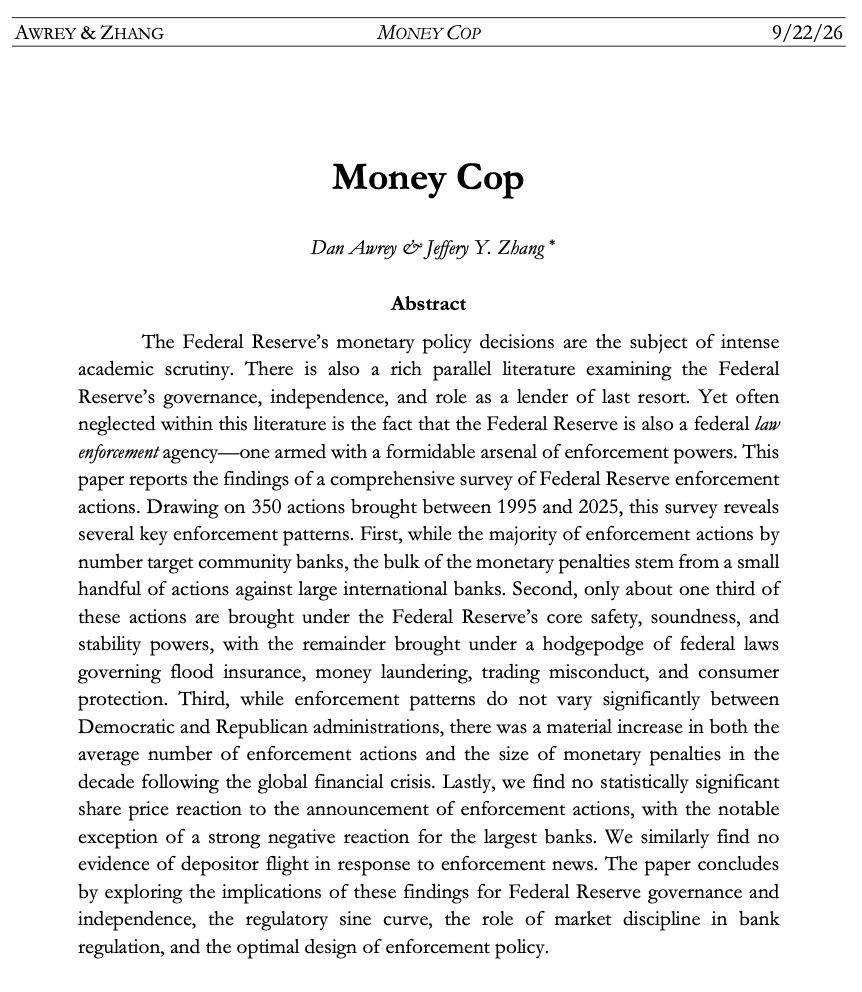
📢NEW WORKING PAPER📢
Come for our deep dive into the Fed's enforcement patterns. Stay for our analysis of what they mean for Fed governance and independence, the regulatory sine curve, market discipline in bank regulation, and optimal enforcement policy
https://t.co/riDsLNGCPU
By a weird coincidence this just came out, as scheduled for the past weeks.
I managed to squeeze a mention to Perry’s passing and a dedication at the end of the acknowledgment note in the cover page right before it was scheduled to come out. A tiny homage
https://t.co/Yg3PzQetuS
@RkBench Thanks! This is only phase 1. Data permitting , phase 2 will incorporate the entire federal law enforcement community, giving us a more holistic picture.
📢NEW WORKING PAPER📢
Come for our deep dive into the Fed's enforcement patterns. Stay for our analysis of what they mean for Fed governance and independence, the regulatory sine curve, market discipline in bank regulation, and optimal enforcement policy
https://t.co/riDsLNGCPU
Do financial sanctions provoke de-dollarization? In new co-authored research with David Steinberg (@pokerwonk) we look at this question from the unique perspective of Russian households in 2022-23.
A short 🧵(1/7)
It fits a couple of things —
1) Stripe has a history of M&A around developer tooling, dating back to them buying runkit.
2) Hard to argue with the theory of being payments for developers when they're the clear market winner for devs who need card acceptance + they've translated that mindshare to having every major AI company start taking payments on Stripe. Anthropic and Open AI become winners take most? Stripe processes the lion's share of their payments, so they squeeze the payments tool on each subscription payment, enterprise payment and per-usage payment.
3) B2B payments is huge.
4) The future of B2B payments is going to be agents buying things, and sometimes from agents. Who's going to build the agents? Developers. How are they going to be built and operate? On AI tokens.
Will OpenRouter deliver the kind of revenue to justify their ~$8B purchase price? Unclear. Stripe needs to get a software or other non-payments multiple on its total revenue, even though that revenue is largely derived from payments. Otherwise, it can fall back to earthly valuations like Block, FIS, Fiserv, Jack Henry and others. Or even —shudder—PayPal.
How do you get that not-payments multiple when you're a payments company? One key theory is to diversify, especially with more data and software based revenue. I think Shopify has done the best here. And P, J and Will talking about "more than 10" business lines doing $100M+ (presumably each) seems to hint that that's the strategy.
To the extent Stripe is using cashflow from what is historically a low-multiple business (payments) to buy higher multiple revenue businesses (orchestration software), that feels like a good trade. And doing that trade, into a growing space, while you're private and the rest of us have to speculate like this, feels like a solid move. Lets you keep buying with cashflow and potentially inflated stock (only the public markets can really tell).
But there's a greater question about this bet, beyond the nuts and bolts work to try to meaningfully diversify away from payments revenue in a business where payments revenue is tracking 2%+ of GDP and all the associated growth —
Is this a true business need?
Everyone needs payments, and Stripe made payments easy to get in the form you want them (API, POS, dashboard, etc . . .). The letter to investors (my copy must be coming in the mail) touts token spend as something everyone will need, especially corporates. But I doubt it's as high a need as payments, or even as ubiquitous. And it's not clear the Fortune 500 CFOs are going to have their teams adopt OpenRouter as the tool to manage spend.
And why would they when they're probably buying 1 to 3 AI tools on an enterprise basis + setting spend limits per seat or per team. The thesis is it's going to be hard to budget and manage AI token spend. But enterprises with lots of money to spend on tokens will need to be convinced they need a tool to do it, and also that OpenRouter is that tool.
And this is where there's a chance to out-Stripe, Stripe. Someone else (I think some devilishly handsome founders in NYC) bought and launched https://t.co/N5eMMUwETp. People in my mentions are saying DataBricks does this. It looks like others are also in on the game, or that you could see Amazon or a coding harness eat this feature as well.
We're early innings, so if token routing and orchestration is going to continue to grow Stripe doesn't have to be right or have picked THE singular winner. But in a world where they think they're going to sell this into enterprises — the same enterprises whose CFOs and Payments VPs go find multiple payment processors for redundancy and negotiating leverage purposes — it's hard to see how this offering doesn't turn into a leaky back of funnel business that needs to constantly be maintained by an army of human AEs and customer success managers.
New episode! Barry Eichengreen, Paul Blustein, and Brendan Greeley join @DavidBeckworth for a special round table discussion on dollar dominance.
@B_Eichengreen, @PaulBlustein, and @BHGreeley discuss the history of dominant currencies, whether we will always end up with a single reserve currency, whether monetary sovereignty is earned or given, the question of exorbitant privilege, what there is to do about a second China Shock, the future of dollars in the digital age, and much more.
https://t.co/p0phR7KJoU
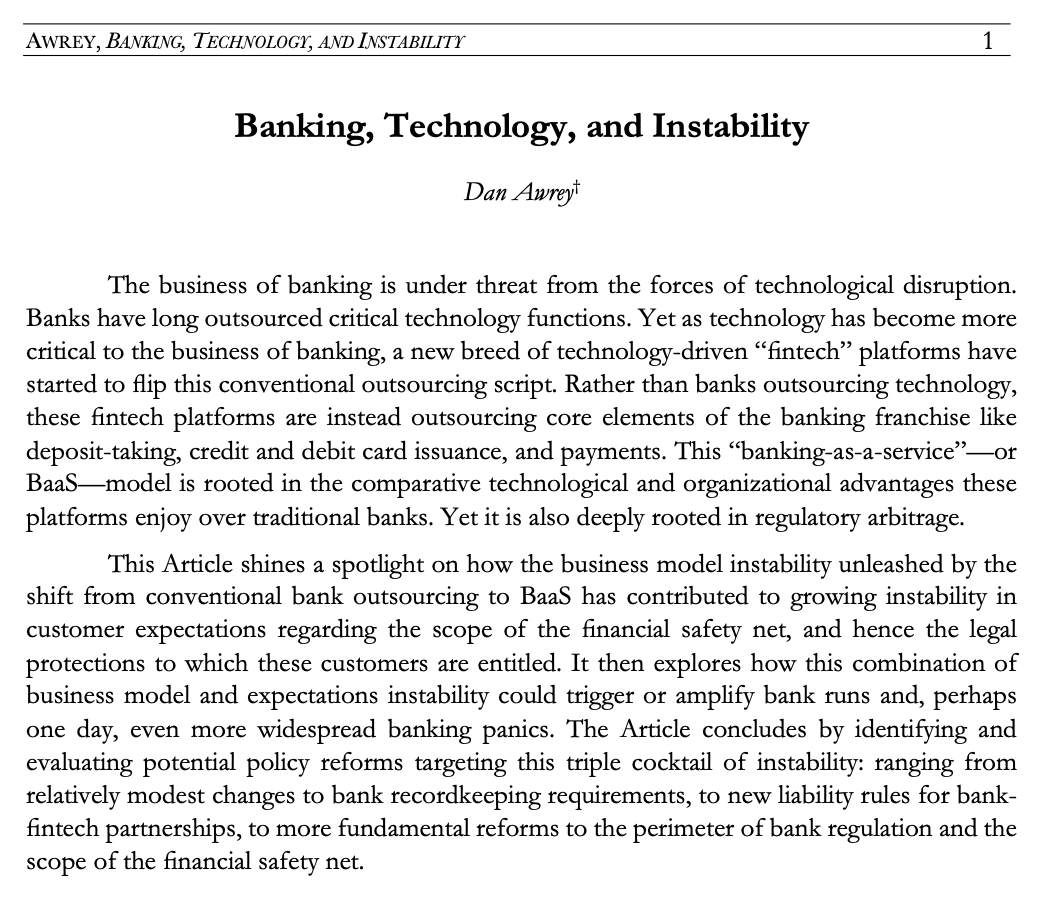
📢👷🏼🛠️ NEW WORKING PAPER exploring the impact of technological disruption on bank business models, consumer expectations, and financial stability. Questions, comments, and suggestions all very welcome: https://t.co/vKueJFk8nv
@Schornack Thanks for the shout out! I do expressly address this near the end of the book. I’m very much on record extolling the virtues of fractional reserve banking as a driver of economic growth. And the book is pretty clear that I’m not trying to replace banks.
🚨 BREAKING: CFPB says that by Sept'23 "both Evolve and Synapse were aware that there was a deficit of tens of millions of dollars in funds that Evolve was holding for End Users" in just-released complaint:
The CFPB complaint alleging Synapse violated the Consumer Financial Protection Act by engaging in "unfair" acts or practices by failing to maintain adequate records was filed as part of the bankruptcy case today, August 21st, I believe I'm the first to report.
While the complaint largely rehashes already disclosed information, it's now being alleged by a government agency. A couple interesting items worth noting:
-The CFPB alleges that "[c]onsumers did not have control over how Synapse moved or tracked funds across different Partner Banks that were holding their funds and processing their debit card, ACH, and wire transactions."
-and that "[c]onsumers were substantially injured because Synapse’s records did not match the records of its Partner Banks."
These are important as they're necessary elements to prove Synapse acted "unfairly."
The CFPB's complaint notes that not all fintech programs "migrated" to the Brokerage/cash management structure, meaning those programs' end users’ funds should have remained with Evolve.
The complaint notes (as was already known) that even for end users who were moved to the cash management program, "Evolve continued to act as a Partner Bank by providing access to certain banking products and services, including by continuing to sponsor debit cards. Evolve also continued to act as the receiving bank for ACH transfers for which consumers had previously been using Evolve’s routing number, such as direct deposit. Evolve continued to maintain accounts on behalf of these End Users to provide these services. Synapse would sweep funds from those accounts to Synapse Brokerage."
The complaint seeks to enjoin Synapse from further violations of the CFPA (a non-issue, as it's bankrupt), additional injunctive relief (also largely irrelevant), award relief the court finds necessary to redress injury to consumers (this theoretically could be a significant monetary amount, though the chance of recovering any money seems very low), and a civil money penalty (necessary to enable CFPB to tap victim relief fund).
It's worth noting that Synapse was a third-party service provider to Evolve. While the CFPB isn't making an accusation that Evolve engaged in "unfair" acts or practices, that doesn't preclude Evolve's regulators, the St. Louis Federal Reserve and the Arkansas State Bank Department, from potentially pursuing an enforcement action against Evolve for "unfair" practices conducted by Synapse on the bank's behalf (though I wouldn't hold your breath.)
Many states offer consumers a *private* right of action for a business' "unfair" conduct, potentially offering victims an avenue to file civil suits against Evolve stemming from Synapse's "unfair" conduct.
Fintech Biz Weekly just dropped:
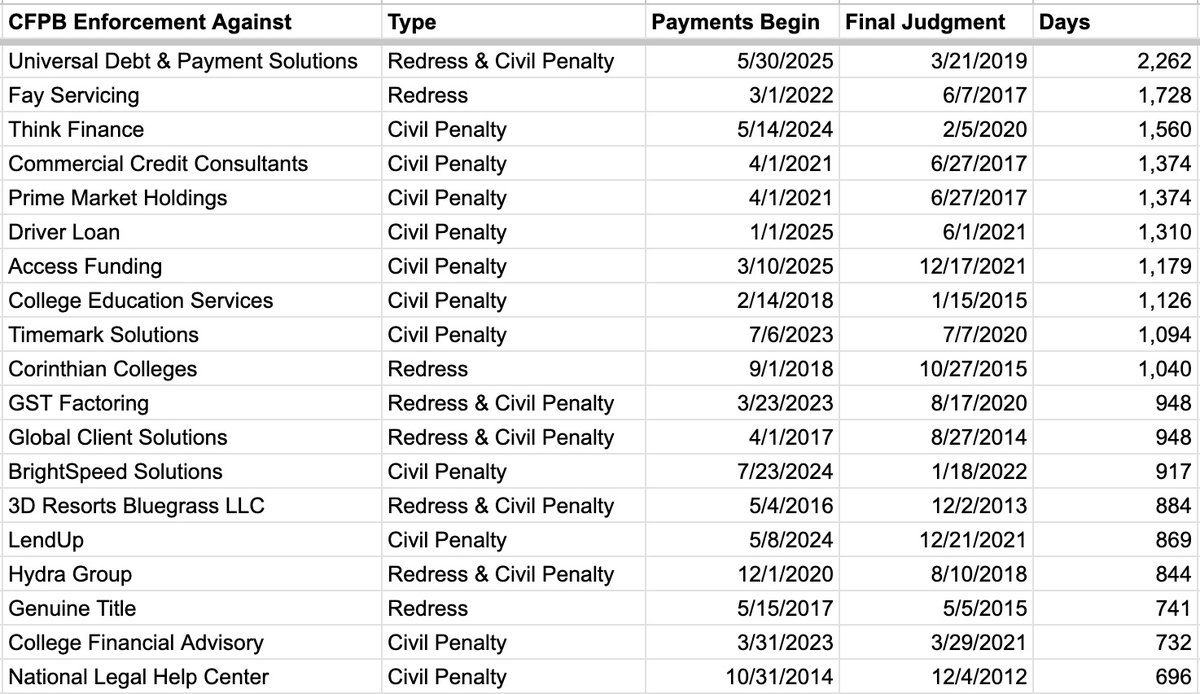
Synapse-Evolve victims could end up waiting YEARS to get a CFPB bail out payment, new analysis of Bureau records suggests.
CFPB's average time from a final order to starting payments to victims? A whopping *682 days*
You know where to find it.
Meanwhile, so-called "wholesale" or intermediated CBDCs are basically just a reincarnation of the existing system - a label without content. What matters are the choices we make with the design of this system, not the name on the tin 4/4
This is a very thoughtful piece by William Buiter on @ProSyn. But like many reviews of #beyondbanks it ascribes to me a position that I don't hold: namely, that we should separate all money and payments from financial intermediation 1/4 https://t.co/8dRjPRpZpL
This is also why, to Buiter's lament, I ignore CBDCs. Central banks rarely have an advantage over private firms in conducting technological experiments with new payment tech, let alone the infrastructure we might build on top of it. This makes retail CBDCs a fool's errand 3/4
As stablecoins grow, so does their impact on the markets they invest in. They already influence short-term Treasury yields, with implications for monetary policy and financial stability https://t.co/NzlGUo1hxN
#Stablecoins#Treasuries#FinancialStability
@rohangrey@regulatorynerd@tphillips@Arturo_P_A Hey guys, great thread. Trusts, including so-called “springing” trusts, were often pretty central to MTL consumer protection frameworks. But it’s also amazing how much has changed since I wrote my 2020 article, and how much I missed. One day soon we’re going to need Bad Money II.





![mikulaja's tweet photo. 🚨 BREAKING: CFPB says that by Sept'23 "both Evolve and Synapse were aware that there was a deficit of tens of millions of dollars in funds that Evolve was holding for End Users" in just-released complaint:
The CFPB complaint alleging Synapse violated the Consumer Financial Protection Act by engaging in "unfair" acts or practices by failing to maintain adequate records was filed as part of the bankruptcy case today, August 21st, I believe I'm the first to report.
While the complaint largely rehashes already disclosed information, it's now being alleged by a government agency. A couple interesting items worth noting:
-The CFPB alleges that "[c]onsumers did not have control over how Synapse moved or tracked funds across different Partner Banks that were holding their funds and processing their debit card, ACH, and wire transactions."
-and that "[c]onsumers were substantially injured because Synapse’s records did not match the records of its Partner Banks."
These are important as they're necessary elements to prove Synapse acted "unfairly."
The CFPB's complaint notes that not all fintech programs "migrated" to the Brokerage/cash management structure, meaning those programs' end users’ funds should have remained with Evolve.
The complaint notes (as was already known) that even for end users who were moved to the cash management program, "Evolve continued to act as a Partner Bank by providing access to certain banking products and services, including by continuing to sponsor debit cards. Evolve also continued to act as the receiving bank for ACH transfers for which consumers had previously been using Evolve’s routing number, such as direct deposit. Evolve continued to maintain accounts on behalf of these End Users to provide these services. Synapse would sweep funds from those accounts to Synapse Brokerage."
The complaint seeks to enjoin Synapse from further violations of the CFPA (a non-issue, as it's bankrupt), additional injunctive relief (also largely irrelevant), award relief the court finds necessary to redress injury to consumers (this theoretically could be a significant monetary amount, though the chance of recovering any money seems very low), and a civil money penalty (necessary to enable CFPB to tap victim relief fund).
It's worth noting that Synapse was a third-party service provider to Evolve. While the CFPB isn't making an accusation that Evolve engaged in "unfair" acts or practices, that doesn't preclude Evolve's regulators, the St. Louis Federal Reserve and the Arkansas State Bank Department, from potentially pursuing an enforcement action against Evolve for "unfair" practices conducted by Synapse on the bank's behalf (though I wouldn't hold your breath.)
Many states offer consumers a *private* right of action for a business' "unfair" conduct, potentially offering victims an avenue to file civil suits against Evolve stemming from Synapse's "unfair" conduct.](https://pbs.twimg.com/media/Gy5TKGDWMAAfnZK.jpg)