Wheels down. Game on. 🇭🇷⚽
Team Croatia touches down at Toronto Pearson ahead of its match against Panama tomorrow. Another arrival, another wave of global energy as Toronto gears up for a big matchday.
It's not every day a Swainson's Hawk turns up at Toronto Pearson.
Known for one of the longest migrations of any North American raptor, the Swainson's Hawk is typically found in Western Canada and west of the Mississippi River, making sightings in Ontario relatively rare. Each year, the species travels thousands of kilometres between its breeding grounds in North America and its wintering grounds in South America.
Earlier this spring, Falcon Environmental wildlife manager Keith Everett found the hawk in one of the wildlife management enclosures on airport property.
Before being released, the hawk was fitted with a band so researchers can track its migration patterns in the wild.
The airfield is busy on days like today, with more than 1,000 aircraft arriving and departing at Toronto Pearson.
As of 10:45 a.m., we’ve already seen 209 aircraft movements.
Here’s what 10 minutes of activity looked like on one of the aprons, viewed from our tower 23 storeys above Terminal 1.
Did you know Toronto Pearson has an extensive stormwater system made up of both underground and aboveground infrastructure that can process tens of millions of litres of water?
Across the airport, four stormwater facilities, together holding the equivalent of 67 Olympic-sized swimming pools, work alongside a network of retention ponds.
This system helps manage rainfall, reduce flood risk and prevent contaminants from entering nearby creeks.
• Moores Creek Facility: 42 million litres of underground storage, plus another 42 million litres above ground.
• Carlingview Stormwater Facility: 17 million litres of underground storage.
• Aeroquay Facility: 6.6 million litres underground.
• Etobicoke Creek Facility: an above-ground engineered wetland with capacity for 57.8 million
litres.
Together, these facilities collect and treat stormwater so it meets environmental standards before being released back into the natural system.
Here's a look at the underground portion of Moores Creek:
Every day, flights arriving and departing from Toronto Pearson cover hundreds of thousands of kilometres — from short trips to London, Ont., to long-haul journeys as far as Manila, Philippines.
With Artemis II scheduled to return to Earth later today, we wanted to compare how a day’s worth of flights at Toronto Pearson stacks up against the mission’s 1,118,000-kilometre, 10-day journey around the moon.
Today’s 999 scheduled flights will cover a combined 2,817,147 kilometres — roughly 2.5 times the distance Artemis II will travel on its journey around the Moon and back to Earth.
Did you know we have an alert system called our Lightning Warning System (LWS)?
The LWS notifies employees when lightning is in the forecast and moving toward or away from the airport. If a strike is recorded within eight kilometres of Toronto Pearson International Airport, an extensive warning system is activated, including more than 100 strobes across Terminal 1, Terminal 3 and the infield concourse.
When those strobes are flashing, employees who work outdoors to head indoors. As a result, some operations on the airfield may slow down to ensure employees are safe.
We regularly test this system to make sure the electrical components are functioning properly and that all strobe lights are operational when needed.
Here’s what those strobes looked like this morning as lightning moved across the sky:
Today marks the beginning of Major League Baseball’s 50th season in Toronto, as well as the 50th season of the Jays. Here’s how the airport has changed along with them since that first pitch in 1977:
The franchise takes flight: In 1977, the fledgling Blue Jays began and ended their road trips at Toronto International Airport, originally known as Malton Airport. It was renamed Toronto Lester B. Pearson International Airport in 1984, a year before the Jays won their first American League pennant. Today, it's commonly referred to as Toronto Pearson.
Building blocks: Aeroquay 1, with its iconic circular design, was just over a decade old in 1977, and Terminal 2 was just five years old. Terminal 3 opened in 1991, in time for Toronto’s only MLB all-star game. Today’s Terminal 1 didn’t open until 2004.
Taking flight: In the early 1980s, Toronto Pearson was handling about 235,000 aircraft movements annually – on average, 643 flights per day. By 2025, that number had climbed to around 386,600 movements, approximately 1,000 flights per day. In other words, the odds of spotting the Jays or their opponents taking off or landing are low … but never zero.
A different league: In 1977, Canada’s airports served a total of about 40 million travellers. By 2025, Toronto Pearson alone welcomed 47.3 million passengers – enough to fill Rogers Centre 884 times over.
It’s been a snowy, icy morning at the airport, with 1.4 centimetres of accumulation so far.
Aircraft are moving through the Central Deicing Facility for treatment before departure.
Here’s a look at an Ethiopian Airlines A350 being deiced ahead of takeoff.
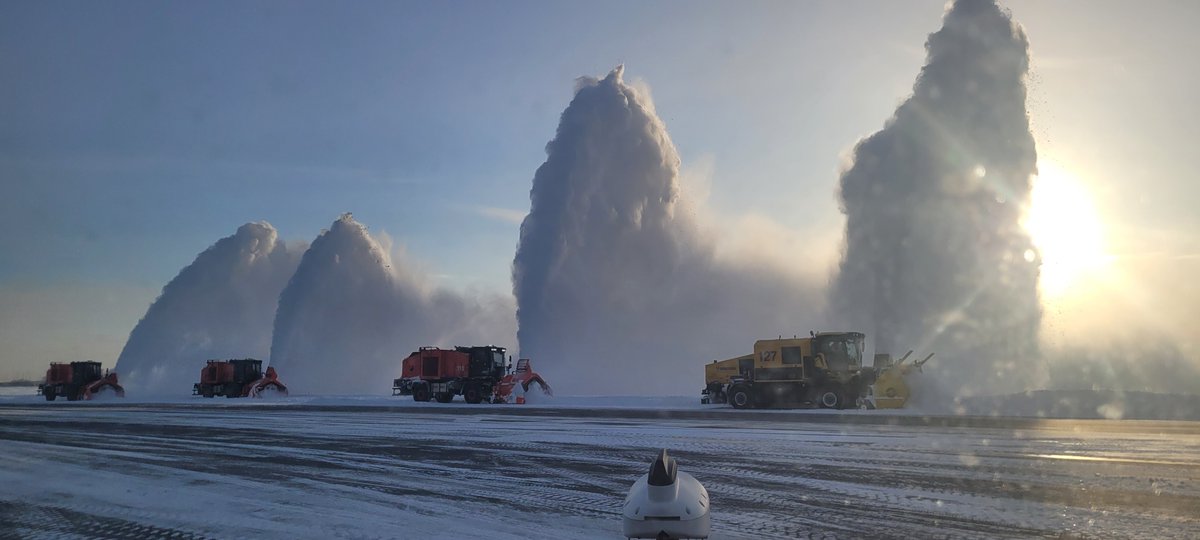
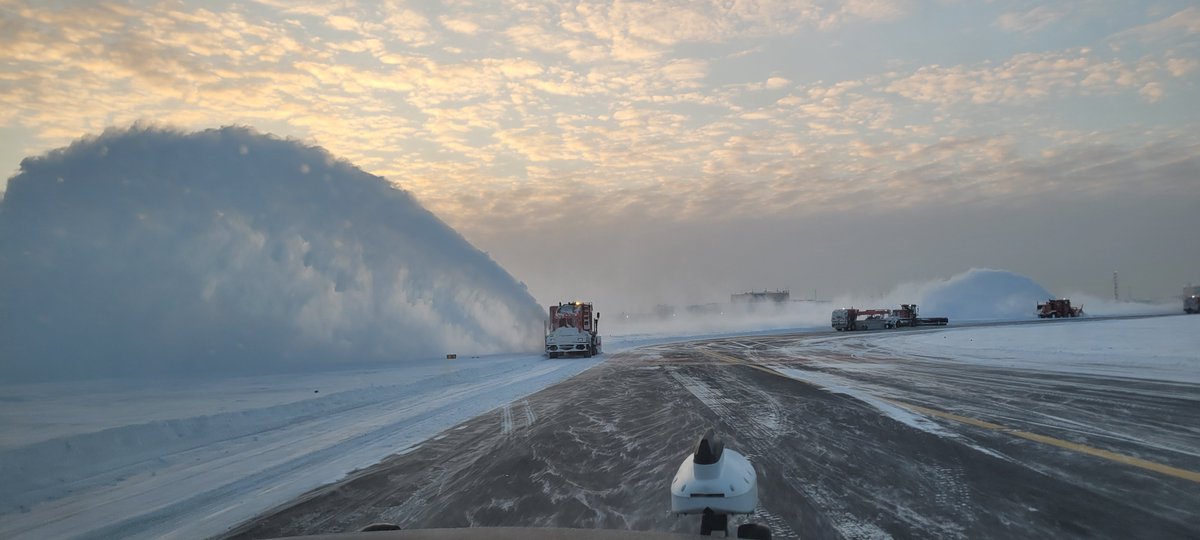
Forty-six centimetres in one day, and cleared in 24 hours!❄️✈️
Drifting and blowing snow increased accumulations in some areas, putting people, planning and equipment to the test. This is when the Pearson Snow Fighters deliver.
Our high-performance snow blowers, each powered by a 1,000-horsepower blower engine, can move massive volumes of snow every hour, throwing it more than 100 metres. This is the scale and precision required to keep Canada’s largest airport and one of North America’s busiest airports moving safely.
Through expertise, coordination and relentless teamwork, the airfield, apron and groundside areas were cleared safely and efficiently - an outstanding effort by the teams who delivered under extreme conditions and whose skill and commitment kept the airport moving.
Severe weather continues to impact flight operations with 41cm of snow accumulation at Toronto Pearson as of 7 p.m.
Air traffic management initiatives remain in effect to ensure the safe movement of aircraft. Crews continue snow clearing operations on runways, taxiways, and apron areas.
We are working with our airline partners to support operations and advise passengers to check their flight status directly with their airline before travelling to the airport.
Snow clearing operations continue on the airfield after 46cm of snow fell at Toronto Pearson.
Air traffic management initiatives remain in place to safely manage aircraft movements. The severe winter weather impacted flights to and from Toronto Pearson, and flight schedules may change throughout the day as airlines work to restore normal operations following yesterday’s delays and cancellations.
Flights to and from Atlantic Canada and certain parts of the U.S. may be impacted today as the system moves through the region.
Passengers are advised to check directly with their airline before coming to the airport. Those travelling to Toronto Pearson should allow extra time and drive safely. For passengers taking the UP Express, please note it is operating every 30 minutes.
We will continue to provide operational updates throughout the day.
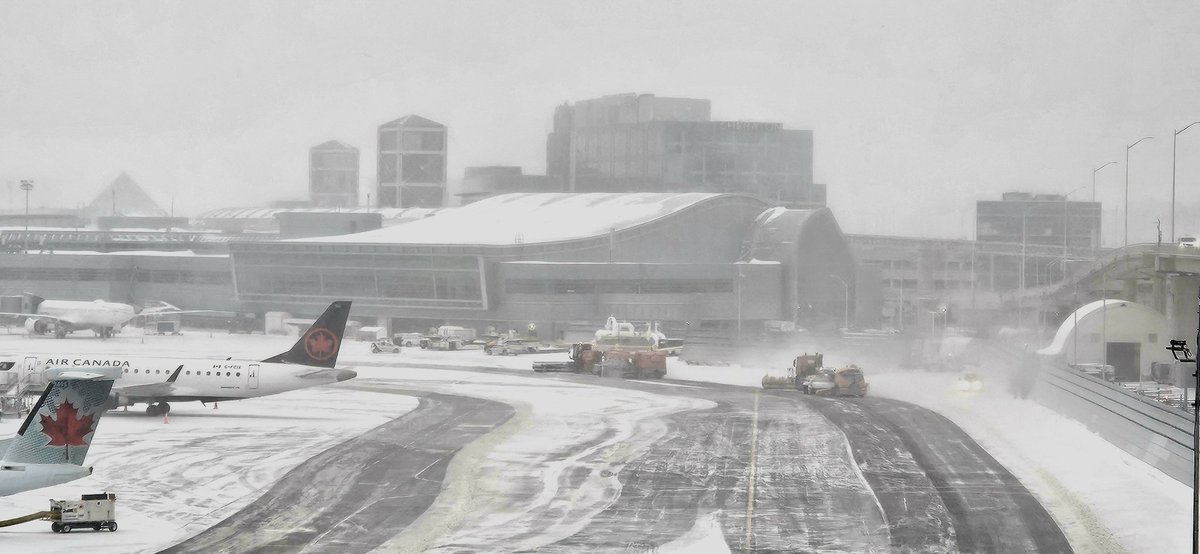
Here's a look at snow clearing operations on the apron at Terminal 1.
Our teams use front-end loaders to load large volumes of snow into inground and portable snow melters. This process enables us to keep critical apron surfaces cleared of snow to support airport operations.
Passengers are advised to check their flight status with their airline before coming to the airport as the winter weather is impacting flight operations, and schedules may change throughout the day.
Air traffic management initiatives are in place to ensure the safe movement of aircraft.
Snow-clearing crews are actively out clearing runways, taxiways, and apron areas. Teams are operating continuous snowplow rotations to keep approximately 5 million square metres of airfield surfaces clear.
Departing aircraft will be routed through the Central Deicing Facility prior to takeoff.
We will continue to provide operational updates throughout the day.
It’s a bitterly cold morning on the airfield, with temperatures at -13°C but feeling like -22°C with the windchill. Departing aircraft are moving through the Central Deicing Facility, where deicing operations are underway.
Today, we’re expecting 121,212 travellers to move through the terminals, with approximately 60 per cent travelling through Terminal 1.
Today’s traveller breakdown:
• Terminal 1: 70,871
• Terminal 3: 50,341
In these extreme cold conditions, outdoor crews must take more frequent warming breaks to limit exposure. While this can slow some airfield operations, it is essential to protect the health and safety of everyone working outside.
Snow continues to fall at the airport with 12 cm recorded as of 9 a.m.
Traffic Management Initiatives remain in place to ensure the safe arrival and departure of aircraft.
Here's a look at our airfield this morning and some of the snow clearing operations underway at Terminal 1.
Please check your flight status with your airline and allow for extra time to get to the airport if your travelling today.
Snow continues to fall at the airport, and our airfield teams are out keeping critical areas clear so planes can take off and land.
As of 10 a.m., approximately 3 cm of snow has fallen so far today. Our team will stay out on the airfield clearing snow to ensure the safe arrival and departure of aircraft.
It's a snowy morning at the airport, with the forecast calling for up to 10 cm of snow, mainly falling over the next few hours before tapering off to light flurries this afternoon.
Our crews at the Airfield Maintenance Facility are ready to plow runways, taxiways and apron areas to keep them safe for operations, while teams at the Central Deicing Facility are gearing up to deice aircraft. It’s expected to be a busy morning, with all departing flights heading to the facility for a spray before takeoff.
A traffic management initiative is in place to help regulate the flow of departing aircraft. Travellers are encouraged to check their flight status before coming to the airport.
We’re monitoring the weather as snow continues to fall across the Greater Toronto Area, with forecasts calling for up to 15 cm of accumulation.
Our teams at the Airfield Maintenance Facility are actively clearing runways, taxiways and aprons to keep flights moving safely.
If you’re flying out of Pearson today, your aircraft will pass through our Centralized Deicing Facility before departure.
Please check your flight status before coming to the airport and allow extra time on the roads when travelling to Pearson.
We’ll continue to post operational updates on X throughout the day.
The first of the day's travellers are making their way through the terminals.
We're planning for 448 arrivals coming in from 45 different countries and 442 departures taking off to 45 different countries.
Of those flights, 334 are arriving and departing to cities across Canada. The busiest routes are all domestic, with Vancouver (YVR) leading the way with 44 flights, followed by Calgary (YYC) at 40 flights and Montreal (YUL) with 39 flights.