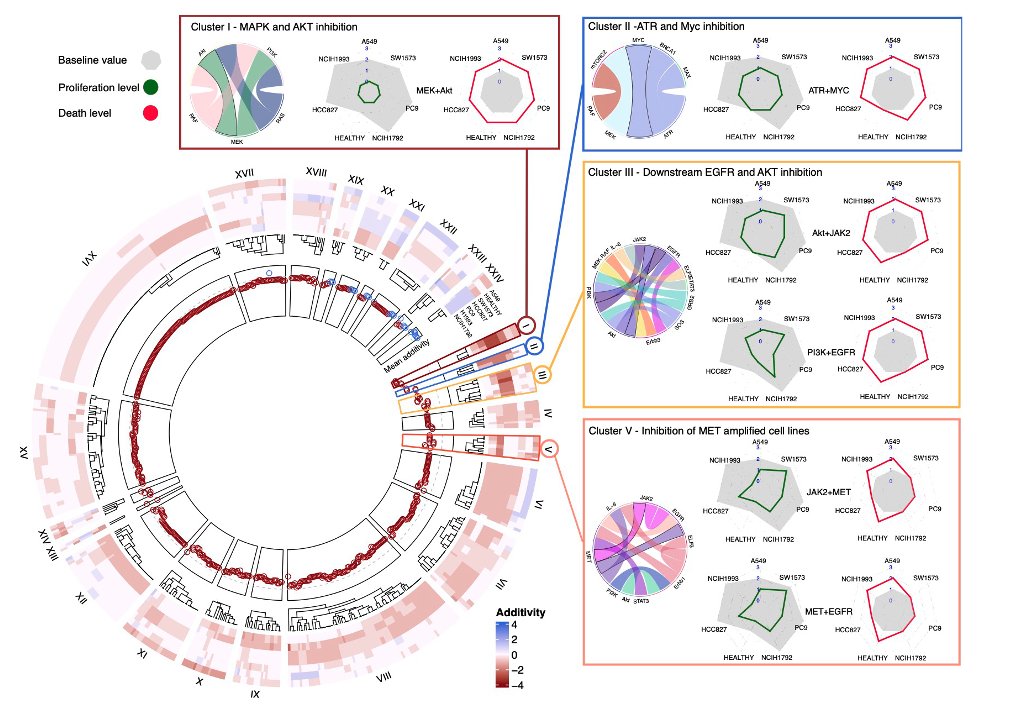
In 1999, Tom Maniatis discovered something remarkable: neurons achieve self-avoidance via stochastic methylation of the protocadherin gene cluster.
We've just discovered this locus is an evolvable in-vivo barcode across the human tissues: https://t.co/DMyHA5TIS0 🧵
How do tissues organise, adapt, or collapse? 🧬
We’re looking for a postdoc with strong quantitative skills to tackle these questions in a highly interdisciplinary project bridging spatial omics, ecology & mathematical modelling.
Apply 👉 https://t.co/CPpu4AVcg5
Please share.
Just published in @TheLancet! We show that the capsule sponge improves Barrett's surveillance, helping prioritize high-risk patients for endoscopy & offering a more efficient, patient-friendly approach for low-risk individuals. https://t.co/Fs5vlq6yxT
#GITwitter#Earlydetection
[Preprint alert]
We’re thrilled to introduce EnrichMap: a powerful method for spatial gene set enrichment. It’s spatially aware, biologically meaningful and built for the next generation of spatial transcriptomics. https://t.co/mqo7IWHz1f
Are you interested in cancer genomics and cancer evolution? A 3-year postdoc position available
to join my MRC-funded project on #ChromosomalInstability#CancerPhylogenetics!
Please get in contact if you are interested.
Deadline 30 Apr 2025.
https://t.co/RHxcpEdXDu
Happy to see this invited world view article published; My personal call for clinicians & researchers working in oncology to be more empathetic when it comes to presenting patient data which has life-changing implications for the individuals in question
@NatRevGastroHep
Excited to share our new preprint exploring the potential to personalise treatment for non-small cell lung cancer (NSCLC) using in silico modelling: https://t.co/vodY0HHiuF
🎉 Excited to share that our paper, "Context-dependent effects of CDKN2A and other 9p21 gene losses during the evolution of esophageal cancer," has been published in Nature Cancer! 🧬
Read more: https://t.co/S9OjKCz6nk
Delighted to introduce our new spatial transcriptomics tool, SpottedPy, recently published @GenomeBiology, allowing the identification of tumour hotspots at different scales and the exploration of distances and overlap with tumour microenvironment niches: https://t.co/SY0G6DcmTm
🎓PhD Opportunities in Early Cancer Detection!
Join us for a fully funded 3.5-year PhD starting Oct 2025
🌟Projects include modelling progression risks in Barrett's Oesophagus
🗓 Apply by 16 Feb 2025
#phdpositions#AcademicTwitter#CancerResearch
📢 Exciting PhD Opportunity! Join https://t.co/pZwirSSB15 to explore immune cell populations in healthy and premalignant breast tissues. Study how BRCA mutations shape the immune landscape and the impact of PARP inhibitors on mutational signatures. Apply>https://t.co/PcZWH9Lrs6
🚨 Interested in spending 4 years studying how tumours evolve and developing new diagnostic methods? Take a look at the Alliance for Cancer Early Detection (ACED) PhD studentships available in my lab @EarlyCancerCam@CRUKCamCentre: https://t.co/hjWRiIEqst Deadline 4th Nov!
Finally out in @NatureProtocols : our group's workflows for end to end computational pathology. Compatible with UNI and other foundation models. Led by @ElNahhasOSM from @katherlab
journal link: https://t.co/oa2HFvH4Kg
full text: https://t.co/8zKLRNAgjB
How do healthy tissues evolve to become cancerous? Delighted to share our latest research tracking the somatic evolution that occurs in the decades before AML. 👇Implications for early detection and early interception. https://t.co/aJCATXkDKx
UK Science Comedy Festival is THIS SUNDAY at Camden's People Theatre! Come to see a whole evening-and-afternoon of silliness, science, nonsense, chaos and very funny people.
Plus me, talking about how much I actually love brains!🧠🧠🧠
Tickets here: https://t.co/UeuDhuC06Y


![_cenk's tweet photo. [Preprint alert]
We’re thrilled to introduce EnrichMap: a powerful method for spatial gene set enrichment. It’s spatially aware, biologically meaningful and built for the next generation of spatial transcriptomics. https://t.co/mqo7IWHz1f https://t.co/wGkbQGj5PG](https://pbs.twimg.com/media/GsbxwUDWYAAPFIw.jpg)