I'm proud we are releasing LAION-fMRI, a densely sampled 7T fMRI dataset of natural images, with very broad stimulus sampling for testing countless hypotheses & deeply exploring brain representations. It is now available at
https://t.co/hOnILHonf9
What does LAION-fMRI offer? 🧵
Excited about our new preprint: “The illusory simplicity of the feedforward pass: evidence for the dynamical nature of stimulus encoding along the primate ventral stream”
https://t.co/IbtXBTQb5t
Work with Sushrut Thorat, Anna Mitola, Paolo Papale, Peter König & Tim Kietzmann
Please circulate widely!
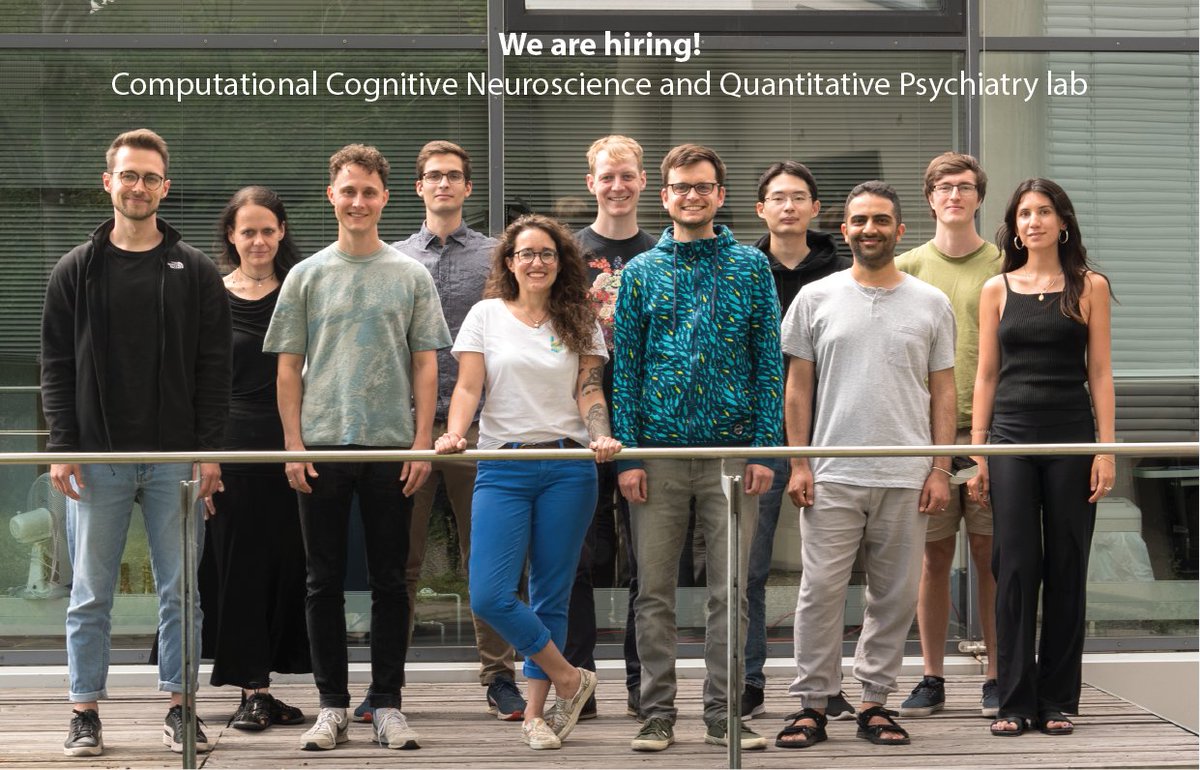
Open positions at the Vision Lab, Centre for Neuroscience, Indian Institute of Science (IISc)
Deadline: March 31 2026
(Link in thread below)
1/7 Does the infant brain have representational structure? 👶🧠In the FOUNDCOG project, we scanned 134 awake infants using fMRI. Published in Nature Neuroscience, our research reveals 2-month-old infants already possess complex visual representations in VVC that align with DNNs.
🧵 What if two images have the same local parts but represent different global shapes purely through part arrangement? Humans can spot the difference instantly! The question is can vision models do the same?
1/15
Happy to announce the publication of our Nature Communications article on how border-ownership tuning determines the connectivity of feedback projections in visual cortex with @d_jeurissen_
and @Pieters_Tweet : https://t.co/V99VRyPiZQ
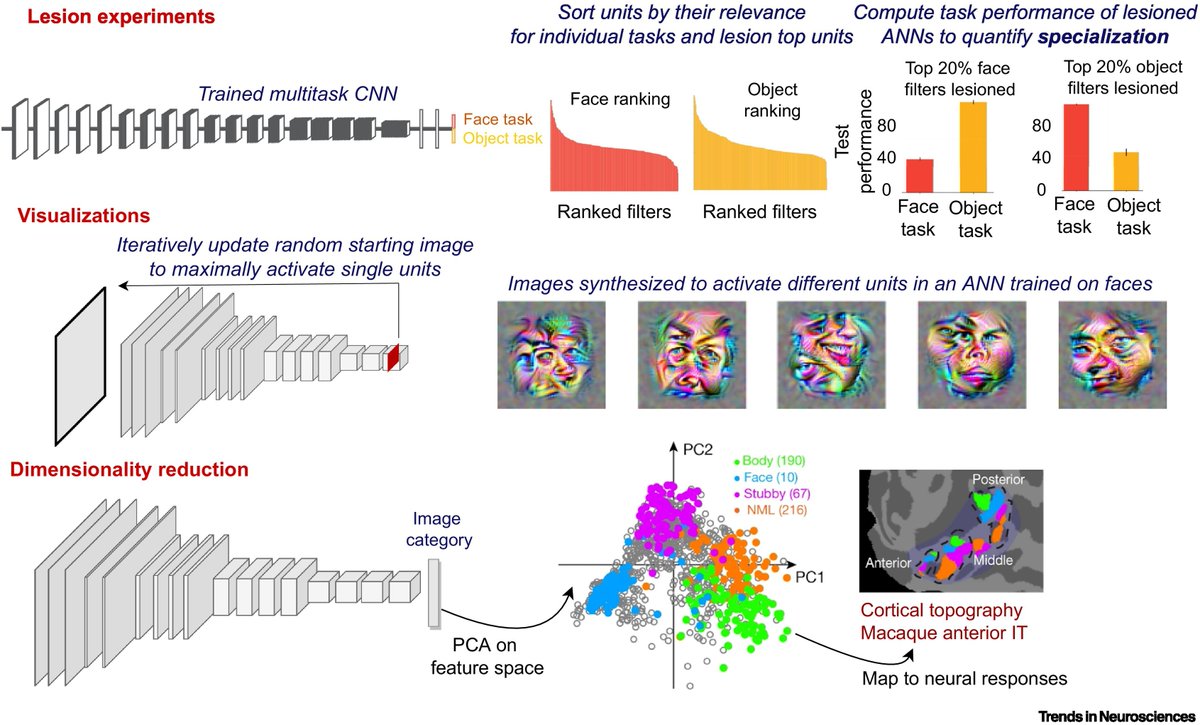
It's been some time, but our paper is finally out in @PNASNews. 🥳 We found that deep neural networks optimized for face recognition (but not for face detection or object categorization) mirror long-known behavioral phenomena observed in face perception. https://t.co/z8G9GSau32
I am looking for two postdocs to join us at Giessen University @jlugiessen, in collab. with the Max Planck Institute @MPI_CBS in Leipzig, funded by @ERC_Research & @ProLOEWE. We have exciting projects lined up but also offer a lot of freedom with implementing own ideas!👇 pls RT!
🧠 Out now @ScienceAdvances
Why do we see a systematic organization of object information in the ventral visual cortex? We provide computational support for the hypothesis that the topography reflects a smooth mapping of a unified representational space.
https://t.co/in2eR1tHME
2023-2024 JOB ALERT📢: postdoc fellow position available in the Neuro-AI & Geometric Data Analysis group @FlatironInst@NYU_CNS! Join us in the thriving community of computational neuroscientists @FlatironCCN + NYU's amazing brain science & ML community.
fMRI with panoramic visual presentations! As a participant in one of these studies I can say that you really feel like you are *in* a scene rather than just looking at a scene.
"Using artificial neural networks to ask ‘why’ questions of minds and brains"
by @Nancy_Kanwisher, Meenakshi Khosla
@meenakshik93 & Katharina Dobs @KathaDobs
https://t.co/X0pSUu1QvI
My collaborator Vassiki Chauhan just published a compelling article about sexual harassment in academia. She shares a vision for solutions, with an emphasis on collective bargaining. https://t.co/AdZrWMyXN0
New Preprint: Emergence of perceptual reorganisation from prior knowledge in human development and Convolutional Neural Networks
https://t.co/rqZT2l4OWZ
...🧵
Looking for papers & refs using manifolds & geometry for analysis of large scale behavior. It’s common to use it in computational neuro, but wondering about refs focused on behavior (even if it accompanies neuro) 🙏🏼
Example refs: @SussilloDavid@FieteGroup Tank lab @StefanoFusi2
@criticalneuro@SussilloDavid@FieteGroup@StefanoFusi2 Here, we compared behaviorally-measured similarity spaces to representational geometries in different deep neural networks. We used this approach to study letter perception, but I think the approach could be applied to many domains of perception!
https://t.co/eZno4ii3ls
Soft launch of my lab’s Twitter page (and it’s associated identity). Will update to masterdon at some stage… the to-do list is long for new PIs.
For now… follow us @Brisbrain_lab
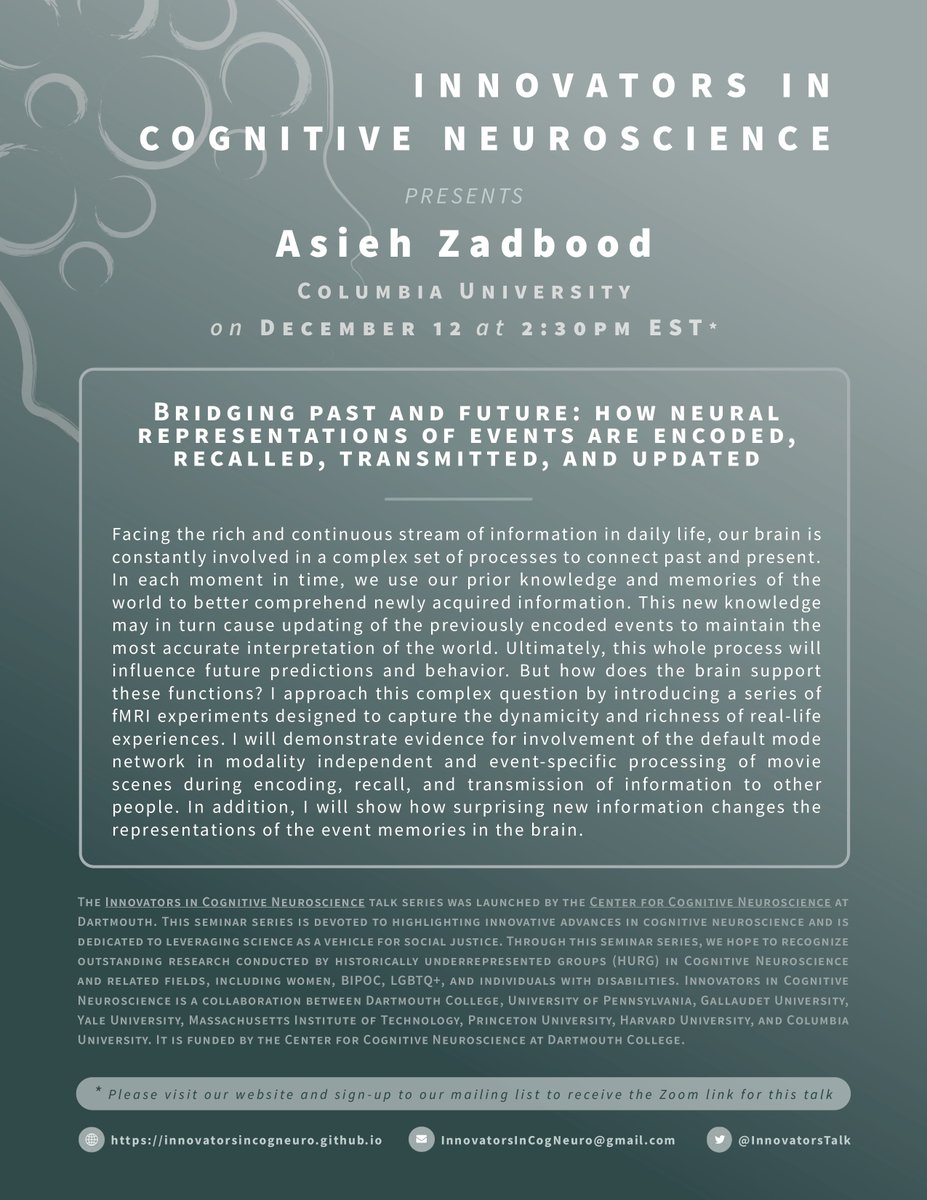
Our upcoming speaker is Dr. Asieh Zadbood from @Columbia.
Her talk on Mon, Dec 12, is titled: “Bridging past and future: how neural representations of events are encoded, recalled, transmitted, and updated”
Zoom link and other information is available at https://t.co/2skZsl7m5T
New published paper with @talia_konkle! Object-classifying neural nets account for the visual similarity of letters, even better than networks actually trained to classify letters! Supports the view that letters are perceived via general object features.
https://t.co/eZno4hZU7k
Our paper is out in Cognitive Science! We (Robert Walter-Terrill, @JaraEttinger, Brian Scholl, and I) ask to what extent perception is (or, from an evolutionary perspective, ought to be) truthful. https://t.co/1SUjX5ckQG