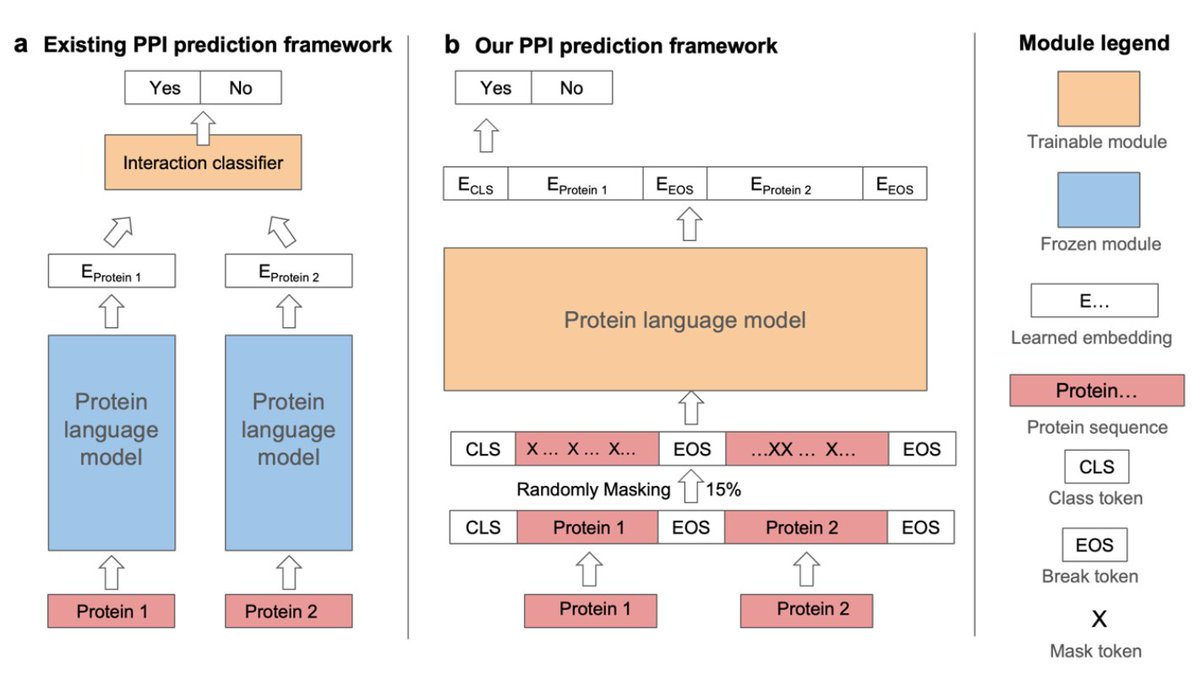
Our PLM-interact is out in @NatureComms! We show that jointly encoding protein pairs using protein language models improves protein–protein interaction prediction performance and enables fine-tuning to predict mutation effects in human PPIs.
https://t.co/9unrZqULUS
📢 NEW | Introducing PLM-interact: a new AI-powered protein language model to predict protein-protein interactions
Read the article: https://t.co/mOPm5IgN6A
Find out more in the mini-podcast: https://t.co/wR7At3B8Dj
PLM-interact is out! We learned a lot along the way, from ColBERT to next sentence prediction for PPI, from zero short PPI mutation effect prediction to full model fine-tuning, from not knowing FSDP to burning 30k GPU hours in just a few days. Heroic effort from @DanLiu_
Our PLM-interact is out in @NatureComms! We show that jointly encoding protein pairs using protein language models improves protein–protein interaction prediction performance and enables fine-tuning to predict mutation effects in human PPIs.
https://t.co/9unrZqULUS
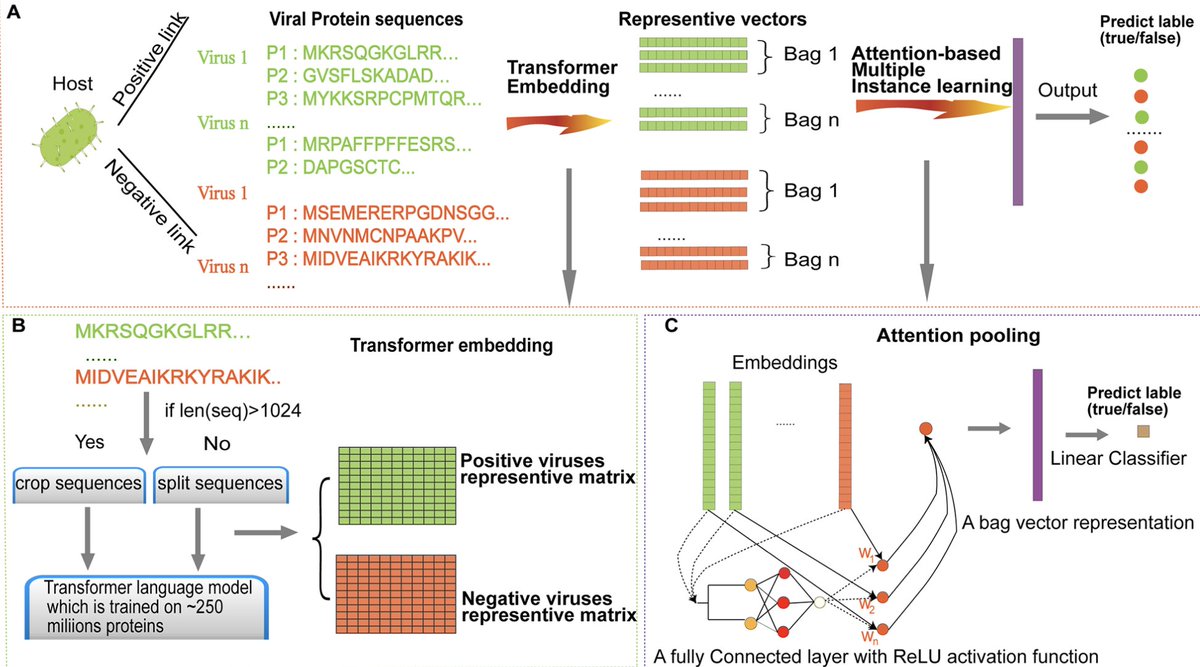
Prediction of virus-host associations using protein language models and multiple instance learning @PLOSCompBiol
1. EvoMIL introduces an innovative method for predicting virus-host associations by combining protein language models (PLMs) and attention-based multiple instance learning (MIL), using only viral sequences.
2. The approach leverages transformer-based embeddings (ESM-1b) to represent viral protein features, achieving significant improvements over traditional sequence composition features, such as k-mers and physiochemical properties.
3. EvoMIL delivers remarkable performance in multi-host prediction tasks, achieving median F1 score improvements of 10.8% and 16.2% for prokaryotic hosts, and 6.6% and 11.5% for eukaryotic hosts, in comparison with traditional methods.
4. The system excels in binary classification, achieving an AUC above 0.95 for all prokaryotic hosts and 0.8–0.9 for eukaryotic hosts, marking a milestone in virus-host prediction accuracy.
5. Attention-based MIL not only enhances prediction accuracy but also identifies key viral proteins that drive host specificity, providing insights into virus-host interactions.
6. In benchmarks, EvoMIL outperformed state-of-the-art methods, such as iPHoP and BLASTn, achieving the highest accuracy (75.27%) on independent datasets of prokaryotic hosts.
7. This model highlights the importance of integrating evolutionary and structural data in computational virology, offering a robust tool for understanding host-pathogen interactions and emerging virus detection.
8. EvoMIL’s interpretability and strong performance make it a valuable resource for virologists, offering both predictive power and biological insight into virus-host specificity.
@keyuan1@Kieran12Lamb@DanLiu_
💻Code: https://t.co/UksZvLDQGF
📜Paper: https://t.co/M4Cl4d14dh
#VirusHostPrediction #MachineLearning #ProteinLanguageModels #Virology #Bioinformatics
Big news: We just released PLM-interact, a tool for predicting protein-protein interactions, showing a 16-28% improvement over previous methods and even predicting mutation effects on interactions. Here’s the story behind this journey. 🧵👇
PLM-interact: extending protein language models to predict protein-protein interactions
1. PLM-interact introduces a novel approach to predict protein-protein interactions (PPIs) by jointly encoding protein pairs, leveraging a method similar to “next sentence prediction” in NLP. This approach allows PLM-interact to capture inter-protein contexts, significantly improving PPI prediction across species.
2. The model achieves 16-28% better AUPR scores than current state-of-the-art models on non-human species datasets (e.g., mouse, yeast, E. coli), indicating its robust cross-species predictive power. This enhancement is crucial for applications where PPI data is sparse or costly to obtain experimentally.
3. Beyond general PPI prediction, PLM-interact can identify mutation-driven changes in PPIs, making it valuable for understanding disease-causing mutations and enabling applications in clinical genomics. It detects both mutations that induce interactions and those that disrupt them, showing versatility in mutation impact assessment.
4. PLM-interact also excels in virus-host PPI prediction tasks. When trained on virus-human interaction data, it outperformed other models with improvements in AUPR, F1, and MCC metrics by 5.7%, 10.9%, and 11.9%, respectively. This capability supports virology research, including zoonotic event prediction.
5. This study demonstrates that PLMs can extend beyond single-protein tasks to learn complex biomolecular relationships, setting a new standard for PPI prediction in bioinformatics. The potential of PLM-interact to streamline PPI predictions across various organisms could transform how we approach drug discovery and genomics research.
@keyuan1@craig_macdonald@Kieran12Lamb
💻Code: https://t.co/ViIB0FkcID
📜Paper: https://t.co/F5tqfAolD1
#Bioinformatics #ProteinInteraction #MachineLearning #Genomics #ProteinLanguageModels #NLP
🚀 Our new preprint is out! We show that protein language models can predict protein-protein interactions by jointly encoding protein pairs, leading to significant improvements in PPI prediction.
https://t.co/i81iRVZAls