@EmmaMAshford@StateDept@AcadofDiplomacy We could probably use a Kennan right now.
On that note, there's some interesting commentary out there about how the jobs that were available for folks like Kennan or Bill Burns in their career progression are largely taken by political appointees these days.
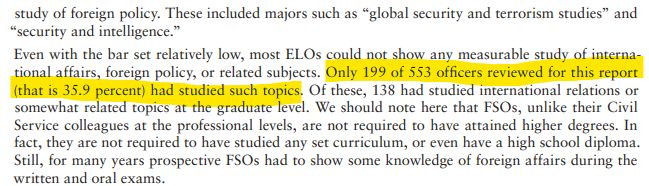
Want to guess what percent of US career diplomats have studied ANY foreign policy or international relations?
I'd love to see whether studying IR or FP has any impact on one's promotion prospects at the @StateDept. 🤷♂️
(from a 2015 report from @AcadofDiplomacy)
To be clear, whether FP/IR education improves one's promotion prospects is a different research question than the much more important question of whether studying IR or FP makes one a more effective diplomat.
Original report here: https://t.co/JpyrqlgJGW
In today's #MustRead, @DanSpoko lays out four questions that the Commission to Reform and Modernize the State Department needs to consider to set itself on a successful path.
Read more @just_security ⬇️https://t.co/LHOpiWEp93
The Commission to Reform and Modernize the State Department has a historical opportunity to build something better.
Former US diplomat @DanSpoko (@fp21org) poses four questions it needs to consider.
https://t.co/ZBl21U2LSH
@Scholars_Stage@jordanschneider Well said. But it's hard to identify what the skill or book is, exactly. What does it mean to "implement" foreign policy? It's under-theorized, and no training exists for it. My view was to emphasize skills of analysis, theory of change, strategy, monitoring & eval, etc.
@Scholars_Stage@jordanschneider ... understanding of DOD is that this outdated view was shifted by McNamara (for all his flaws), who seemed to do a lot for introducing a culture of measurement, accounting, and evaluation at the DOD that's absent at State.
@Scholars_Stage@jordanschneider Right - but no such work exists! That's not an accident: My view is that dominant view in foreign policy is that there CANNOT generalizable rules, thus no doctrine. That's what we're trying to push back against, and seed the ground for a more productive approach. My inexpert ...
@AlexHSullivan@jordanschneider@Scholars_Stage Can't go wrong with Schelling!
I feel conflicted about grand IR theory. My view is that a very skewed understanding of IR theory has pervaded the foreign policy establishment, and alternative perspectives would help sharpen one's ability to evaluate underlying assumptions.
@Scholars_Stage@jordanschneider I'm curious as what you consider theory? I see most everything as theory.
I'm not familiar with the annual Marine Corps reading list, but I'd be interested in reading it. Is that the right comparison point? My thought is that doctrine is a better starting point for this project.
But just as it would be a mistake to ignore the promises of scientific advancements, it's also be dangerous to disregard the human qualities of diplomacy.
I hope you enjoy my article:
https://t.co/RpMBosk1Yq
I have argued in the FSJ before that the State Department would benefit from an upgraded culture of decision-making, that diplomacy should be “more science and less art,” and I run a think tank dedicated to that mission.
It is the gift (and burden) of all public servants to be afflicted by visions of a better world. To be dissatisfied with the status quo but also motivated toward improvement. Many of us believe we face an inflection point today.
4. Interpersonal Skills. Foreign policy is ultimately about people. The foreign policy practitioner must be a skilled communicator, possess a deep sense of empathy, and appreciate the nuances of human emotions and motivations.
3. Living Our Ethics. Foreign policy requires morality. This involves recognizing the human cost of decisions and striving for solutions that uphold core values even in the face of trade-offs. This requires moral clarity & empathy for the diverse stakeholders involved.
2. Setting Goals. Foreign policy demands creative but pragmatic solutions. Yesterday's goals may not always suffice in a constantly evolving global landscape. One must constantly think outside of the box. This requires intellectual agility & the courage to challenge orthodoxy.
1. Defining National Interests. This requires a deep understanding of our nation’s history, culture, and politics—including the priorities of the president and Congress. National interests emerge from a complex mosaic of security, economic, and normative priorities.
I (and my org, @fp21org ) are big advocates for culture change in diplomacy. Yet, in this article, I spell out four "essentially human tasks" of diplomacy that must not be ignored by advocates of reform:
https://t.co/RpMBosk1Yq
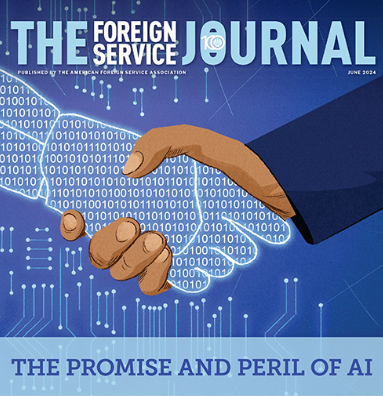
Can the State Department integrate promising new technology without undermining the essential human aspects of diplomacy? I take on this question in my new article in the Foreign Service Journal.