Over the past decade, we invested roughly $500M in building our tech.
During the same period, major insurance incumbents collectively spent an estimated $2 trillion. That's 4,000x more than us.
Yet we've built capabilities that are fundamentally different.
I think this tells us something important about the AI era: the advantage isn't how much you spend on technology. It's the architecture you build, and how deeply you integrate it into your business and culture from day one.
Thanks for following our Investor Day updates.
Elon's case for Optimus isn't really about robots. It's about what happens to the economy.
"It's not clear what an economy even means at that point. An economy becomes quasi-infinite."
Taken to fruition, he said, "this means a future of abundance, a future where there is no poverty, where people, you can have whatever you want in terms of products and services."
He said it standing next to Optimus version one at Tesla AI Day in September 2022.
What would you do first in a world without scarcity?
@elonmusk at Tesla AI Day 2022. Video: Tesla
Should Nvidia Have Kept Jensen Huang?
Tom: “They should have kept him. This guy is one of the four horsemen of the AI apocalypse. He was there in the beginning, building the video cards that propelled the video game industry. He went from video cards to making a bet on AI. He built chips for it, then better chips, then bigger chips, and he left Intel in the dust."
Vinnie: "He's amazing at his job. Yes he’s a sinner, but does that mean you have to lose your position?”
Ilan: “If it was just infidelity, I think there’s way too much on the line when it comes to AI to fire him for that reason. But if he was connected to chips that went to a shell company that ended up in China, that's a major issue."
Vinnie: “Where’s the actual evidence that Alice Huang is actually a Chinese spy? So far it’s just accusations. It’s all anonymous sources. I’m not condoning it, but it’s an extramarital affair.”
PBD: “I think something’s gonna be released that we don’t know about. They got ahead of it so quick. I think there’s something bigger going on, maybe within the company, that we don’t know the whole story of.”
Most people think of the space economy as rockets and satellites. That part, the backbone, is projected to grow from $330B in 2023 to $755B in 2035, about 7% a year.
The bigger story is the reach: the revenue other industries earn using space technology, from navigation to communications to earth observation. It is projected to grow from $300B to $1,035bn, about 11% a year, and to overtake the backbone well before 2030.
Global GDP grows about 5% a year. The growth is not in the launch, it is in what comes after it.
How to get a tech job in 2027:
- Stop applying blindly to 100 companies.
- Find people already working where you want to work.
- Build relationships before asking for opportunities.
- Study the company's product and find ways to improve it.
- Share your projects online.
- Become active in tech communities.
- Contribute to projects outside your own GitHub.
- Attend hackathons and developer meetups.
- Learn how to communicate your ideas.
- Get noticed for the things you build.
- Reach out to startup founders directly.
- Learn to build products and attract users.
- Build a personal brand around your expertise.
- Make your work visible before you need a job.
- Get closer to the tech ecosystem, even if that means relocating.
Your biggest Black Friday revenue day can still leave you with less profit and a worse January.
Here's what I'd put in a DTC brand's BFCM plan:
• Pick products with stock and margin behind them. Check bestsellers, bundles and shipping capacity before writing the offer.
• Write down the offer rules: eligible products, minimum spend, stacking, subscription terms, start and end time. Assign someone to create and test the code.
• Use one Shopify code per actual offer, not a new code for every email. Track channels with UTMs.
• Give paying subscribers their best offer before the public sale. Don't make cancelling and rebuying look like the smarter option.
• Give VIPs first pick before giving them a deeper discount. Early access doesn't have to mean cheaper.
• Tell people when the sale starts, when it ends and what to expect. Don't make them guess.
• Keep the normal signup offer until the sale starts. Then switch the popup and immediate welcome email together. Show the sale code on the thank-you screen, with an auto-apply link.
• Audit every competing offer. Welcome emails, cart flows, SMS automations, subscription portals and old image blocks all count. Check customers already waiting inside flow delays too.
• Test the actual checkout on mobile. Check a qualifying cart AND one that shouldn't qualify. A code printed in an email isn't proof it works.
• Plan how many messages one person will receive across campaigns and flows. Don't borrow somebody else's twice-a-day rule or add panic sends because Friday missed target.
• Follow up with genuine clickers who haven't bought. Filter bot clicks first. Send a plain-text founder note that answers an objection, not the same creative again.
• Check email sending limits, SMS credits and who can pause sends if the site goes down. Watch complaints, bounces and sending reputation during the sale.
• Build the new-buyer journey before the buyers arrive. Help them use what they bought. For new subscribers, make the first renewal amount and date clear.
• Give every temporary change a rollback date and an owner. Check the sale codes are off and the normal offers actually work afterwards.
• Judge the sale on store revenue, contribution after offer costs and what those buyers do next. Report email attribution as attribution. Don't call the cohort high-value before it's had time to buy again.
A bigger Klaviyo screenshot isn't the same thing as a better Black Friday.
Thought-provoking!
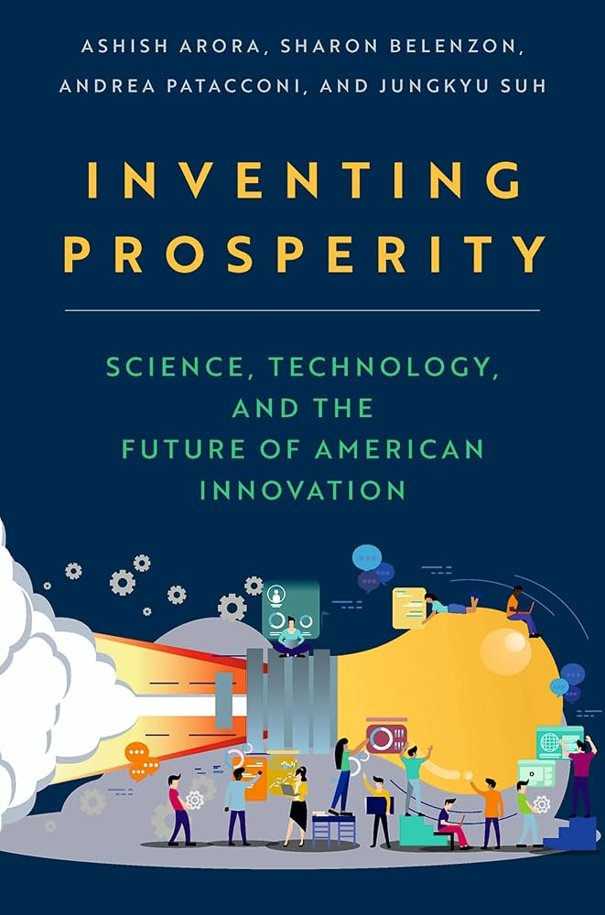
"Inventing Prosperity Science, Technology, and the Future of American Innovation" by Ashish Arora, Sharon Belenzon, Andrea Patacconi, and Jungkyu Suh.
https://t.co/jGRSDEmvYh
"America's innovation advantage has historically rested on a balanced division of innovative labor among corporate labs, universities, startups, and government. In the mid-twentieth century, famed corporate laboratories--Bell Labs, Xerox PARC, DuPont Central Research--combined discovery and development under one roof, turning frontier science into world-changing innovations. Today, many of these labs have closed, downsized, or redirected toward more short-term applications, while universities and startups have taken their stead. Inventing Prosperity explains how these structural shifts have affected the American innovation engine. In fields such as the life sciences, a deeper division of labor has accelerated discovery and commercialization by fostering specialization. In nanotechnology, new materials, and other "deep-tech" sectors, however, the results have been more disappointing. Drawing on a wealth of data linking patents, scientific papers, venture activity, and firm performance, the authors show that the chief bottleneck is not a shortage of breakthrough science or funding but a structural mismatch. Fixing this mismatch requires strengthening the connective tissue among the ecosystem's actors. Blending economic history, case studies, and fresh policy analysis, this book provides a clear-eyed, data-driven guide to reigniting America's innovation. It calls for rebuilding translational capacity inside firms, forging smarter public-private partnerships, broadening innovation policy to include smart procurement, and experimenting with new types of research organizations, so that ideas can cross institutional borders at speed. In doing so, Inventing Prosperity shows how to convert twenty-first-century breakthroughs into broad-based growth."
Joel Mokyr: "A magisterial and crisply-written survey of the economics and economic history of innovation and the massive impact of science and technology on economic growth in the past centuries and the emergence of modern knowledge economies and their future."
https://t.co/jGRSDEmvYh
solo founders and freelancers often do research, content, lead follow-up, and admin themselves.
their main problems
• Research takes too long
• Content production is slow
• Lead follow-up is inconsistent
• Too much admin
what helps them is practical multi-step workflows or light goal-based agents for research → summary → action, content pipelines and lead qualification.
they can use Claude or ChatGPT + n8n or Zapier + Notion or Sheets.
advantage
they get leverage one person can handle more work without hiring or burning out on repetitive tasks.
Cybertruck, 48 volt, leads to Optimus transforming manufacturing and humanoid robot domination by Tesla. Multi billion Factories, multi billion cybertruck, all lead to optimus unboxed and a manufacturing revolution. 4D chess endgame. @WR4NYGov@ChrisCamillo
Could Ford or Mercedes spend years remaking their factories for entirely new giant lego process with 10X the speed and volume when they use humanoid robots ?
Well since the $TSLA Cybertruck is winding down, I hope to see a new product launching at the same time.
The big unlock is the Supercharger network. Elon has referenced 7 GW of already-permitted power capacity across thousands of sites. The idea is to drop Megapods at underutilized Superchargers and run AI workloads (especially inference) during idle periods. When cars show up to charge, the compute throttles or pauses so the stalls get priority power. Pair it with on-site Megapacks and you get energy arbitrage charge the batteries cheaply off-peak, then run compute without drawing expensive peak grid power.
This ties directly into the “Digital Optimus” concept: distributed AI agents (running on Tesla AI4 chips paired with x86 systems) for knowledge work, deployed in these pods at Superchargers or anywhere else with available power. It’s a way to scale AI compute using existing distributed electricity infrastructure instead of waiting years for traditional data-center grid interconnects.
That would unlock HUGE potential for $TSLA autonomy and compute.