Según los fujitrolles, soy un bot de los caviares y rojetes del Perú. Según los caviares y rojetes del Perú, soy un fujitroll. Pero no soy un bot, eso creo.
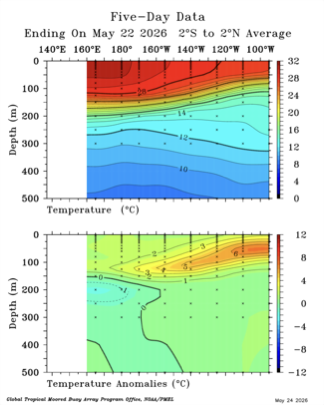
While sea surface temperature anomalies have decreased somewhat within the last week in the Niño 3.4, Niño 3 and, especially Niño 1+2 due to an enormous easterly wind burst. (that’s stronger than normal easterly trade winds) that occurred. This has caused a little bit of a little heat influx loss. But with the new Westerly wind burst and a reduction of tradewinds that are now anticipated over the next couple of weeks this along with a historically strong oceanic kalvin wave that is already working its way eastward beneath the surface I would give it at least two or three weeks and sea surface temperatures and anomalies will really start skyrocketing upward not just a little bit but potentially at very alarming rapid rates.
Now the below average subsurface anomalies just west of the IDL are a bit interesting as they are propagating also eastward rather quickly.
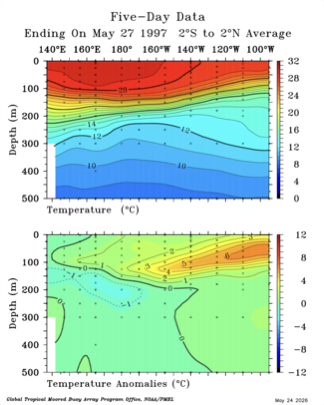
Also it is worth noting that the sub surface Max anomaly is around 11.1°C above average and I’m not saying that lightly either. We are seeing the highest subsurface anomalies out of any previous El Niño event out there including 1997, 1982, and 2015.
REPORTE SÍSMICO
IGP/CENSIS/RS 2026-0557
Fecha y Hora Local: 15/08/2026 19:22:12
Magnitud: 4.2
Profundidad: 100km
Latitud: -3.30
Longitud: -79.31
Referencia: 109 km al E de Zarumilla, Zarumilla - Tumbes
https://t.co/FzLmUhi946
REPORTE SÍSMICO
IGP/CENSIS/RS 2026-0556
Fecha y Hora Local: 15/08/2026 15:05:35
Magnitud: 4.5
Profundidad: 35km
Latitud: -5.80
Longitud: -81.22
Intensidad: III Sechura
Referencia: 52 km al SO de Sechura, Sechura - Piura
https://t.co/9m4D7poeTq
28/07/26 #ElNiño Costero #Región1+2
Pacífico ecuatorial oriental
#TSM#ATSM (Prom. diario)
Magnitud: #Extraordinario#CWR +4.05°C
Comparativo: 2026 (continúa su mayor desarrollo)
vs 1982 vs 1997 vs 2015 vs 2023
REPORTE SÍSMICO:
IGP/CENSIS/RS 2026-0478
Fecha y Hora Local: 20/07/2026,21:10:26
Magnitud: 3.5
Profundidad: 32 km
Latitud: -4.45
Longitud: -80.79
Intensidad: II-III Lancones
Referencia: 34 km al NO de Lancones, Sullana - Piura
https://t.co/oo62A7Tg5X
REPORTE SÍSMICO:
IGP/CENSIS/RS 2026-0380
Fecha y Hora Local: 26/06/2026,01:05:30
Magnitud: 3.9
Profundidad: 74 km
Latitud: -5.10
Longitud: -79.95
Intensidad: II-III Chulucanas
Referencia: 23 km al E de Chulucanas, Morropón - Piura
https://t.co/FnXWfi0YxR
REPORTE SÍSMICO:
IGP/CENSIS/RS 2026-0374
Fecha y Hora Local: 22/06/2026,16:01:06
Magnitud: 3.6
Profundidad: 27 km
Latitud: -4.82
Longitud: -80.86
Intensidad: II-III Sullana
Referencia: 21 km al NO de Sullana, Sullana - Piura
https://t.co/fk3WiOfejW
REPORTE SÍSMICO:
IGP/CENSIS/RS 2026-0378
Fecha y Hora Local: 25/06/2026,08:59:07
Magnitud: 4.0
Profundidad: 51 km
Latitud: -5.59
Longitud: -80.27
Intensidad: III Chulucanas
Referencia: 56 km al S de Chulucanas, Morropón - Piura
https://t.co/f1H1bmO4fi
REPORTE SÍSMICO:
IGP/CENSIS/RS 2026-0372
Fecha y Hora Local: 21/06/2026,10:23:46
Magnitud: 4.9
Profundidad: 45 km
Latitud: -4.13
Longitud: -80.58
Intensidad: III Máncora
Referencia: 52 km al E de Máncora, Talara - Piura
https://t.co/4eKdoiPXAD
REPORTE SÍSMICO:
IGP/CENSIS/RS 2026-0356
Fecha y Hora Local: 15/06/2026,23:49:50
Magnitud: 4.0
Profundidad: 89 km
Latitud: -4.91
Longitud: -79.93
Referencia: 33 km al NE de Chulucanas, Morropón - Piura
https://t.co/xIDt53gXZh
REPORTE SÍSMICO:
IGP/CENSIS/RS 2026-0353
Fecha y Hora Local: 13/06/2026,01:35:38
Magnitud: 5.5
Profundidad: 68 km
Latitud: -4.50
Longitud: -80.09
Intensidad: IV-V Suyo
Referencia: 10 km al O de Suyo, Ayabaca - Piura
https://t.co/p5Srj4klkb
REPORTE SÍSMICO:
IGP/CENSIS/RS 2026-0337
Fecha y Hora Local: 05/06/2026,14:29:24
Magnitud: 3.6
Profundidad: 18 km
Latitud: -5.84
Longitud: -80.89
Intensidad: II-III Sechura
Referencia: 32 km al S de Sechura, Sechura - Piura
https://t.co/ioGbNWxNAm
El Niño: dos aclaraciones
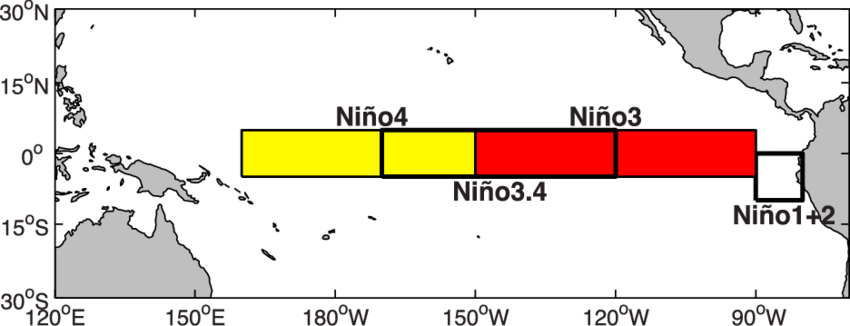
-La temperatura del agua NO se mide en la costa de Sudamérica sino en medio del Pacífico (zona 3.4)
-El calentamiento del agua NO basta para predecir su magnitud. Importa el viento: si cambia y viene del oeste, será más grave
Lo sabremos en unos días
Be prepared for the second graph to skyrocket in the coming weeks as we will see another surge of significant WWB's in the pacific. A very strong El Nino is coming...
🚨 A 9,000-mile underwater heat pulse is moving across the Pacific… and scientists are watching closely.
This massive Kelvin wave — a river of unusually warm water hidden beneath the ocean surface — is carrying temperatures up to +7.5°C (13.5°F) above normal in places.
Why it matters:
This is one of the key engines behind El Niño.
And it resembles the setup that preceded the 1997-98 Super El Niño — an event that unleashed:
• Global flooding
• Extreme droughts
• Crop failures
• Wildfires
• Fisheries collapse
• Disease outbreaks
But 2026 comes with a dangerous difference:
The planet’s oceans are already at record heat levels.
That means more atmospheric energy, more moisture, and potentially more intense extremes:
🌊 Floods
🔥 Heatwaves
🌪️ Powerful storms
🌾 Agricultural stress
🐠 Marine ecosystem damage
El Niño doesn’t hit everywhere the same way.
Some regions drown. Others dry out.
Food systems, water supplies, energy demand, fisheries, and public health can all be affected.
A giant underwater signal is moving through the Pacific right now.
The world’s weather may be responding in the months ahead.
Les prévisions du prochain El Nino se sont encore renforcées sur les dernières semaines.
L'anomalie absolue serait prévue au dessus de 3°
En relatif (anomalie relative, corrigée des effets du réchauffement climatique) on serait entre 2,5 et 3°
Le seuil pour définir un "Super-Nino" est à 2°, on serait donc largement au dessus.
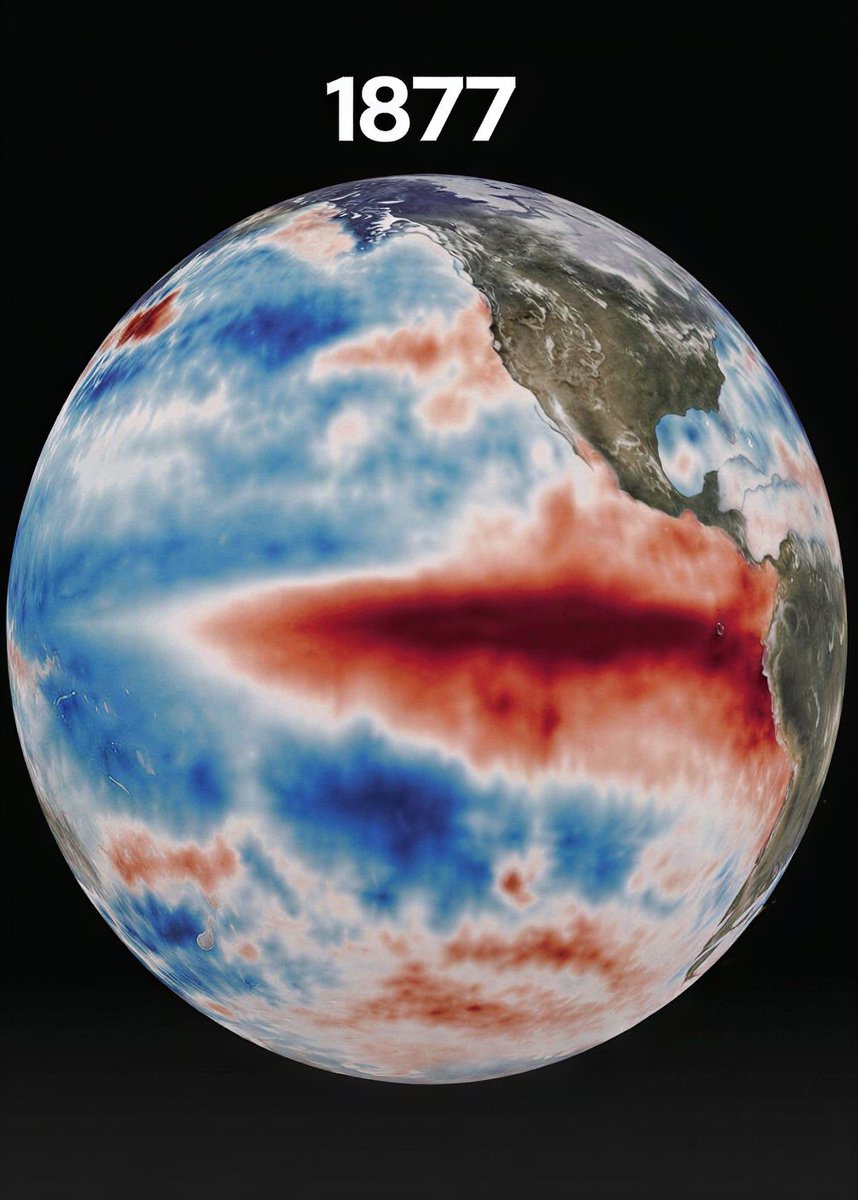
La référence historique de ce phénomène est l'épisode de 1877 (estimé avec pas mal d'incertitudes aux environs de 2,8° d'anomalie). Si les prévisions se maintiennent, on aurait un épisode comparable (en tout cas plus fort que les épisodes observés sur les 50 ou 100 dernières années)
Effets à attendre :
Les plus marqués seraient une forte sécheresse sur la zone Indonésie / Malaisie (la cellule de Walker changeant totalement de configuration) -> chute des rendements en huile de palme et hausse des cours (qui devrait plus que compenser la baisse de rendement).
Une mousson plus faible que la normale est attendue en Inde aussi (hausse du prix du sucre).
Les sociétés du secteur agriculture opérant ailleurs pourront par contre profiter pleinement de la hausse des cours sur le sucre et l'huile de palme.
Se confirma que a Castillo lo buscaron sacar de Palacio desde el primer momento. Todo lo relativo al fraude fue una mentira. Nulo respeto a la democracia. A PPK le hicieron algo parecido.
BREAKING🚨: Earth just entered intense weather cycle and could be the strongest ever recorded
The 2026 El Niño is shaping up to be the deadliest since 1877 — the year famines killed more than 50 million.
Forecasters are tracking ocean temperature spikes of 2 to 3 degrees Celsius. That's not a minor uptick. That's the signature of a once-in-150-years event.
Per LiveScience: a "Super" El Niño is now the most likely outcome by year's end. The human cost could be staggering.