I deleted Linux completely, baked Qwen3-0.6B into a 24 KB pure x86-64 assembly OS, and it runs up to 54% faster than native Linux llama.cpp.
The entire Multiboot OS binary (asm-llm-os.elf) is 24,252 bytes, written from scratch without Linux, Windows, C, Rust, or libc. It boots in 74 to 94 ms straight into 64-bit Long Mode, wakes every CPU core over APIC, maps the 614 MiB Q8_0 weights directly from physical RAM, and drops you into a live multi-turn KV-cache chat over VGA, PS/2 keyboard, and serial.
I ran head-to-head CPU benchmarks against llama.cpp (Q8_0, -ngl 0) on the same AMD EPYC 7642:
- 1 thread hits 23.67 tok/s vs 16.63 (+42%)
- 4 threads hit 78.89 tok/s vs 51.08 (+54%)
- 8 threads hit 118.08 tok/s vs 80.79 (+46%)
- 16 threads hit 134.94 tok/s vs 103.03 (+31%, 136.6 peak)
On a diskless 0 GB Proxmox VM (2014 12-core Intel Xeon E5-2670 v3, 2 GiB RAM), it boots straight to the prompt in under 5 seconds (95 ms kernel boot) and runs live out of RAM at 78 tok/s decode and up to 111.5 tok/s prefill, with a hybrid BIOS+UEFI ISO builder included too. Output stays bit-exact across thread counts and matches all 64 greedy tokens against PyTorch FP32 (0.99965 cosine).
The 14.7 KB Linux ELF build (FAST_Q8=1 INT8xINT8 AVX2+F16C) also beats llama.cpp by 18% to 36% from 1 to 40 threads, and booting bare metal with 2 MiB huge pages squeezes out another 10% on top.
Repo, ISO builder, and Proxmox setup guide are in the reply below.
Introducing Reylo Migrate!
SQL-first schema modeling & migrations for Postgres, MySQL, and SQLite
⬢ Declarative schema in `schema.sql`
⬢ Views, checks, triggers, fns, RLS, and more
⬢ Dry runs & drift checks via shadow dbs
⬢ Strict migration order via reylo.lock (optional)
Every LLM API is built wrong. REST, WebSockets, all of it. The solution was in front of us the entire time. DNS literally has a Question section and an Answer section. Cloudflare Workers can accept direct TCP connections now, so here is LLM via DNS:
dig +tcp +short @ask.southpolesteve.com https://t.co/CY3JfYGzPG TXT
Commentary on the viral video that makes some surprisingly trenchant points about LLMs, humanity, the subtleness of self and non-self, and the dangers of centralized control. https://t.co/727rjHJden
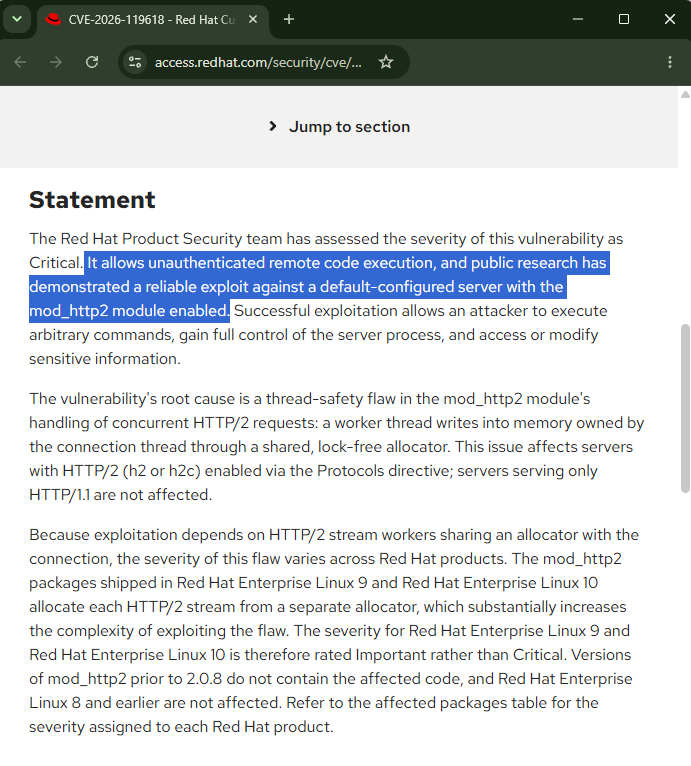
Red Hat says a reliable exploit has been demonstrated against a default Apache configuration with HTTP/2 enabled.
No authentication is required, and successful exploitation could give attackers control of the server process.
No in-the-wild exploitation has been reported.
Yes, you can use that URL for all your holy fuck Microsoft is still energetically screwing the pooch update needs.
Yeah, that neckbeardy guy in your IT department who keeps muttering about Linux? If he can stop laughing long enough to talk, you should start listening to his plan to transition you out of Microsoft dependence. And do it now.
I'm about to propose a term for a dangerous failure mode that every software engineer should be thinking about today. And another for its consequences.
Hot-state dependency: A condition in which a system's ability to function depends on organizational relationships, accumulated state, or operational knowledge that exists only in its current running configuration and cannot be reliably reconstructed following interruption.
Yes, I'm thinking about the Microsoft cloud outage that's going on right now. It could be recoverable, still most likely is, but it could also be the harbinger of a new category of systemic disaster.
Heat death: What happens when a system with hot-state dependency crashes and can't be recovered.
The obvious next question is: how do you engineer systems so as not to have any hot-state dependencies?
I don't have a complete answer to this. But I can think of a necessary part of the answer that I don't think we're taking seriously enough: unitary, replayable modification logs analous to version-control change histories.
It should be impossible - it should be an invariant of your system design - to change the state of the system without leaving a sequenced record of the change that can be audited by human and replayed in a future restart sequence.
This doesn't solve the whole problem. In particular, in a cloud-service infrastructure you don't have the option of resetting all your physical wiring changes and hardware deployments to a zero state and then replaying them.
But I guarantee you that in any sufficiently large or complex software system, you will eventually develop a hot-state dependency purely on the software level if you don't have replayable logs. So that's the minimum you have to do. The absolute dead bare minimum.
We haven't known this before because it took some time for our systems to evolve into the complexity regime where heat death is a critical risk.
But we are here, and the time is now. Be appropriately warned.
We just settled the DOM-based vs WebGPU canvas debate.
This is our WebGPU canvas rendering ~7,000 real HTML/CSS frames with over 2 million elements, at 120 fps.
And it's not just static designs. Every frame runs your full app so you can click around etc.
We built our own HTML renderer that supports every single CSS property (blurs, shadows, gradients, 3D transforms, you name it). We have full parity with chrome's own renderer!
This is possible because we own the entire pipeline. Our custom bundler takes almost any codebase and splits out its HTML, CSS and JS that is optimized for our canvas.
We basically built a mini browser, in Rust, running inside your browser.
Two years of infra work compounding and coming together finally 🥲
Lots of hot takes on the Microsoft 365 outage. Here's an engineering one.
To be clear: this is speculation. Microsoft hasn't confirmed a root cause. It's my read of their own updates, from 35 years of building and breaking systems.
What Microsoft has actually said:
• Traffic isn't up. Capacity is down. Servers are failing health checks and dropping out.
• A process that establishes secure connections gets overwhelmed, and servers stop processing requests.
• Servers they bring back fall over again as soon as traffic hits them.
• They're reverting a network config change that lines up with when it started. But changes aren't syncing, and some machines are stuck in a bad state.
• No indication of an attack.
My hypothesis: a metastable failure.
Whatever triggered it may be long gone. The outage is now keeping itself alive.
1. Reconnect storm. Every Outlook, Teams and mobile client on the planet is hammering for a fresh secure connection.
Full TLS handshakes are CPU-heavy, and a freshly rebooted server has a cold session cache.
A server comes up, eats a wall of handshakes, CPU pegs, it fails its health check and gets pulled, and its load lands on the next one. Dominoes.
2. The fix shares fate with the failure. If the rollback travels over the same secure channel that's melting, the cure can't reach the patient.
That's exactly what "changes aren't syncing" sounds like to me.
That's why they're throttling traffic types and rebuilding servers from an older config instead of flipping a switch.
You don't get out of this by finding the bug.
You get out by shedding load, restoring capacity in isolated cells, and letting traffic back in slowly.
Where AI fits (also speculation): not "an AI wrote the bad line". It's velocity. Microsoft flagged several recent config changes as suspects and took hours to find one that correlated.
When the volume of change outpaces the humans who understand each change, finding the culprit gets slow and rollbacks get messy. Automate the shipping faster than you automate the understanding, and this is the bill.
The takeaway for every business: your email, chat, files, identity and security tooling now share one failure domain. Today proved it. Have a way to talk to your team that doesn't live in the same tenant.
Happy to be proven wrong by the post-incident review. And I hope this post ages terribly.
The internet has a second audience: AI agents. 🤖
@Cloudflare just shared some fascinating data about how the web is changing.
Here are 3 things that caught our attention 🧵👇
Introducing @𝚓𝚜𝚘𝚗-𝚛𝚎𝚗𝚍𝚎𝚛/𝚌𝚑𝚊𝚝
Generative UI for Slack, Teams and more
→ Agents reply with native cards
→ Tables, fields, charts and buttons
→ Streams in as the model writes
→ One catalog for every Chat SDK platform
Good morning, we escaped the famous Firecracker VM and got root execution on the host.
Full firecracker escape technical writeup and Proof of Concept code attached below.
Rune is a native GPU-rendered Rust UI framework for desktop and web, with its own renderer, supporting headless agent-driven PNG rendering and element inspection.