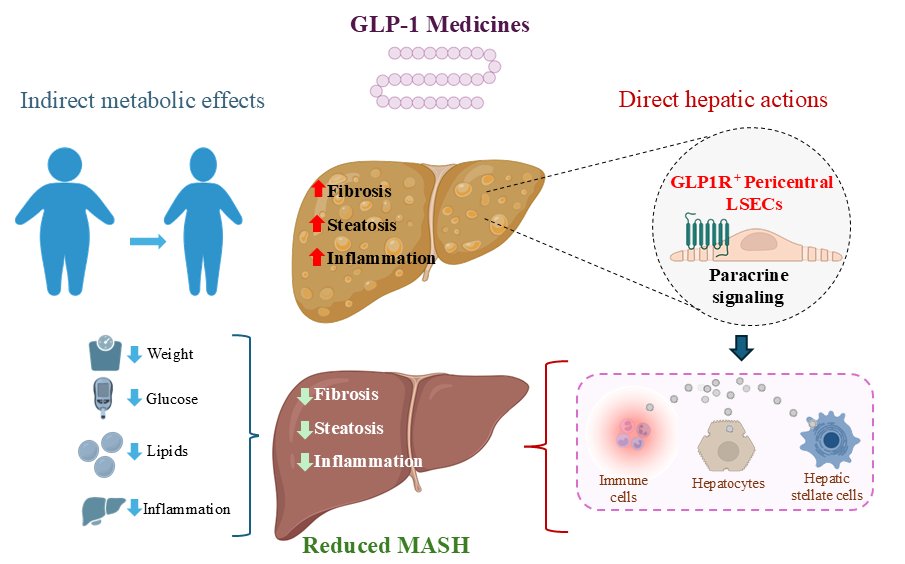
How do GLP-1 meds improve liver health through #weightloss independent mechanisms? Here @ChusaGzlzRellan & colleagues identify Liver Sinusoidal Endothelial Cells as direct targets of semaglutide, linking LSECs to reduction of #inflammation#Fibrosis#MASH https://t.co/c5FXIs2hTO
A microglial succinate-SUCNR1 axis established as a key immuno-metabolic mechanism linking systemic metabolic signals to the hypothalamic control of energy homeostasis.@Cell_Metabolism https://t.co/xJrAVSkJoM
Rare GLP1R variants (about 1:500) attenuate weight loss with semaglutide but not tirzepatide, whereas rare LOF GIPR variants have little effect on drug responses
https://t.co/eaIYNd6vDo
Stopping GLP-1 treatment linked to twice the risk of heart attack, stroke or death compared with continuing, in people with type 2 diabetes and no cardiovascular disease, according to a new study.
Find out more in @LancetRH_Europe: https://t.co/iNJmDhOPAU
The FDA is informing patients and health care providers of a potential increased risk of non-arteritic anterior ischemic optic neuropathy (NAION) associated with use of glucagon-like peptide-1 receptor agonist (GLP-1 RA) medications. FDA https://t.co/g5uHrj7LU4
SYNCHRONIZE CVOT Cardiovascular safety for the GCGR-GLP-1R co-agonist survodutide yet lingering tolerability issues highlight need for more flexibe dosing going forward https://t.co/i5pMXP48O4
A real world look at neurological outcomes post minor stroke in people with T2D using TriNetX highlighting lower risk of dementia with GLP-1 medicines https://t.co/w0gbgA7eAn
We live in a real world data environment that is fast and relentless. How should we incorporate real world data into the totality of evidence? Some perspectives from the REDDIE program @DiabetologiaJnl https://t.co/h1ASDFTUWR
Studies of NOD and human T1D islets identify pancreatic α cells as nonprofessional antigen-presenting cells and expand the current understanding of antigen presentation in autoimmune diabetes @ScienceAdvances https://t.co/oNPjDpKtf9
GLP-1 peptides protect the gut from immune injury.
Essential role of endogenous GLP-1 family peptides to reduce inflammation and restore mucosal integrity in the experimental model @DanielJDrucker@CellRepMed
https://t.co/oE0Z1VQ98m
Over 6 weeks in people with MASLD inhibition of fructose metabolism has beneficial metabolic effects that extend beyond the organs that metabolize fructose @NatMetabolism
https://t.co/WGyXosMt11
Here the authors propose that a gut microbial aldehyde-alcohol dehydrogenase, AdhE, converts metformin to pharmacologically inactive products, lowering intestinal and systemic drug exposure https://t.co/EayLc1u8i9 @Cell_Metabolism
SCOOP: Top researchers at Columbia, Stanford, and others thought they were elected to elite scientific societies alongside Nobel laureates. The catch? The organizations are a sham.
I spent the last month investigating a massive academic scam, for @Nature
https://t.co/cV4twhUrQF
@TheEndoSociety has posted a new document published in Endocrine Reviews and free to read: Obesity science, research gaps, and opportunities in the new era of obesity medicines: an Endocrine Society scientific statement @EndoSocJournals https://t.co/1N24p8s0im