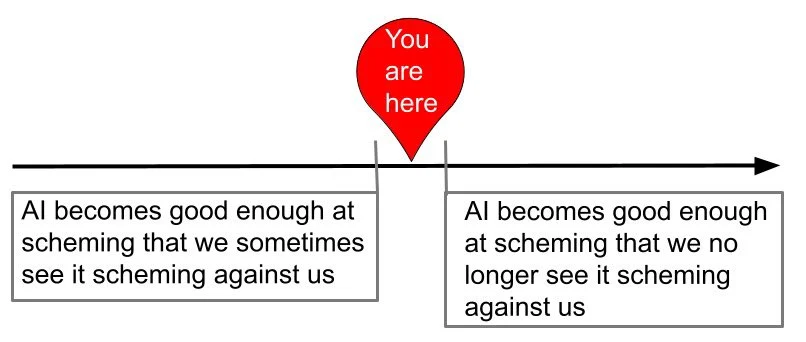
@sama@huggingface TLDR: During a test, an OpenAI model hacked out of its container to reach the internet THEN hacked into Hugging Face (!) to steal the test's answers
@dizzy_thinks really enjoyed your solar article. Cambridgeshire council did a pretty good reverse auction for solar installation. Rather than govt setting the price for solar installations, you could run a series of local reverse auctions and then use the grant against that price
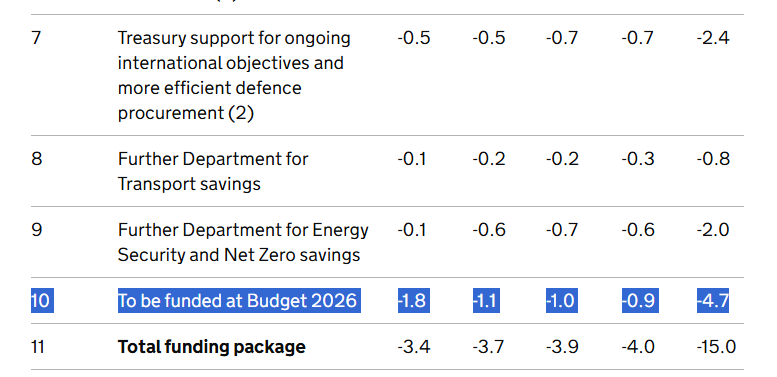
The sheer brazenness of this £5bn IOU in the defence investment plan (DIP) is truly something to behold.
One third of the total funding package 'to be funded' at the next Budget.
Am told the Treasury says this doesn't count as an 'unfunded' spending commitment because... reasons.
Hello, we are Jonathan and Abigail - unashamed pedants who want to bring this affliction to bear on all things public policy and practice.
We believe that details matter, especially in public administration. This is why today we are founding quibble: a campaign to fix the small stuff.
Think, for example, about the cookie banner that we click on every webpage. Each instance is not a big deal, so we just put up with it. But its cumulative impact adds up - on average we press it 5 times per day. The European Commission estimates that it costs EU citizens 343 million hours per year.
And who is there to represent the impacts of seemingly minor issues like this in a systematic way? We want quibble to be the answer. In the case of the cookie banner, lots of advocacy has rightly focused on privacy, but has this meant that user experience has taken a backseat? We believe there are ways to improve user experience without compromising on privacy. We will share more about this soon.
Consider another example. Did you know that in some government-run car parks you can be fined for a minor keying error, such as accidentally typing a zero instead of an “o”? Again, we will come to the detail of this quibble in the coming weeks, but for now just consider again the question: who? Who is there currently to systematically represent the interests of the parker who is given an unfair ticket?
An inherent feature of consumer interests is that those who have them rarely have enough other things in common to make collective organisation and representation feasible. This is the gap that quibble seeks to fill. Now of course excellent consumer interest groups exist. But understandably quibbles might not be at the top of their lists. Our hope is that quibble will be complementary; picking up the bottom-of-the-list issues faced by various groups - the stuff they are almost too embarrassed to raise because they are too small.
We are not embarrassed about detail. If you’ve ever had a splinter, you know small things can have a big impact. This is what quibble is committed to tackling, and our wider hope is that by doing so we will also incentivise policy makers to be even more careful about detail.
Check out our website here, including our first four campaigns: https://t.co/gZiqqHbhIL
Blair, Burnham, Streeting and Starmer all wrote essays this week. Here’s a summary of what they said for those who can’t be bothered to spend an hour reading about Labour’s favourite pastime: fighting about what it means to be Labour.
Blair's thesis is that Labour lost its nerve after 2007 and needs to rediscover the radical centre. Markets work, the private sector is your friend, competent technocratic government is still the answer, and the biggest transformative force on the horizon is AI, which he sees as a positive revolution that a serious centre-left government should embrace. Miss that wave and you miss everything. TLDR; the model isn't broken. Labour just needs to run it properly and stop indulging the perennial delusion that losing votes to the right means the country secretly wants you to go left.
Burnham, Streeting and Starmer think this misses the point. And they broadly agree on the diagnosis but disagree on the cure.
All three locate the origin of Britain's political unravelling in 2008, not 2007. The financial crisis broke the implicit bargain of modern capitalism: work hard, things get better. When that bargain collapsed and the banks got bailed out while wages stagnated for a decade, people got poorer – but also angry in a deeper, harder-to-satisfy way. And then austerity poured petrol on everything.
The more philosophically interesting disagreement is about what the crisis was actually a crisis of. Blair frames it as a delivery failure: the wrong policies and the wrong positioning. Starmer and Burnham both reach for ‘dignity’. The idea that whole communities (post-industrial, working class, people who didn't go to university) were made to feel invisible. That implies a fundamentally different kind of politics.
Burnham argues that New Labour never actually took Britain off the Thatcherite track. He blames deregulation, privatisation, leaving things to the market for the cost of living crisis. The centre failed people. You can't win them back by reasserting it more confidently. On AI, Burnham calls for tougher regulation of big tech and signals that an active, interventionist state would govern how AI develops rather than leaving it to the market. For Burnham, ungoverned AI is just the latest mechanism by which powerful interests extract value from everyone else.
Streeting is more moderate but lands in similar territory. Inequality is the organising fact of contemporary politics, and treating it as secondary is what produced the crisis in the first place. When the rules stop rewarding effort fairly, resentment grows.
Starmer agrees Britain should be an AI superpower, but where Blair frames AI as an opportunity to be seized, Starmer frames it as a force to be governed. The question isn't just whether AI grows the economy but whether Britain is a rule-maker or a rule-taker, and whether the gains flow to Blyth and Castleford or just to London.
The deepest difference, underneath all of this, is a question about whether the post-war and post-Thatcher economic settlement is fixable or finished. Blair thinks it needs better management and AI is the tool that makes better management possible. The others think the settlement itself was the problem, and are open to the possibility that AI (if ungoverned) compounds it by concentrating power further.
This is an interesting topic. Technology often brilliant for the elderly but marketed at the young. Ocado, Waymo, bone-conducting headphones (superb for the hearing impaired, promoted to young joggers), Kindle (large text), folding smartphones (ditto). A large part of YouTube use is nostalgic. And so on.
This from @Geoffrey_Cox was titanic - a truly beautiful speech.
He outshone those sat opposite. They could only watch. And nervously laugh.
This should be seen by every new MP to understand what they do, & every new barrister to understand what we do.
It speaks volumes that Owen thinks this is laughable. Campaigning, you swiftly learn people view respectful behaviour as a first condition of their vote. If you’re leafleting or canvassing, close garden gates after you!
Yet more evidence, as if we needed it, that the Chancellor must be sacked. For months Reeves has lied to the public to justify record tax hikes to pay for more welfare.
Her Budget wasn’t about stability. It was about politics: bribing Labour MPs to save her own skin. Shameful.
Running seasonal giveaways?
Here are 40+ campaign ideas for every season — from Valentine’s Day to Black Friday — to help you plan and promote smarter.
Read now → https://t.co/lLaAzuTH7n
#Gleam#GiveawayMarketing#SeasonalMarketing#EcommerceTips
Be one of the first to get your hands on a Steam Machine 🥷
@Gleamapp is giving it away to one lucky winner. Enter now for a chance 👉 https://t.co/P8h5avAvev
@ArgosHelpers do you have a policy for how long your finance team should take to respond to a query? I've had two calls to customer services and an email referring things to your finance team and I've had no response in over three weeks. I'm genuinely appalled.