Last month @MikeSav47032563 delivered a webinar for the UN Department of Economic and Social Affairs, sharing insights from the Oxford Handbook of the Sociology of Global Elites and the World Elite Database.
Catch up on the recording ⬇️
https://t.co/oByxmSxdL6
Food for thought!
"Industrial Policy Handbook: From Strategy Design to Implementation" (OECD)
"Industrial policy has returned to the forefront of policymaking across OECD countries, driven by mounting challenges: slowing productivity growth, weakening competition, supply chain vulnerabilities, and the imperative to accelerate clean and digital transitions. While concerns about rent-seeking, market distortion, and the protection of incumbent firms remain valid, the perceived costs of inaction have risen considerably. This Handbook provides practical guidance for policymakers on designing industrial strategies and implementing policies. Drawing on OECD analysis and illustrative examples from member countries, it addresses not whether to pursue industrial policy, but how to do so more effectively while preserving open markets, maintaining competitive conditions, and advancing economic security. Importantly, industrial policy does not only comprise vertical sectoral interventions but also horizontal, framework conditions (such as well-functioning capital markets, labour mobility)."
https://t.co/hxNw6gu8da
Florida's wetland offset markets generated billions of dollars in private gains from trade but also a significant increase in flood damage. We spoke with Will Rafey of @UCLA about what his findings mean for the design of environmental markets. https://t.co/2tAImhOQRU
A deep dive into living standards and inequality comparing Sweden and US, focusing on redistribution vs predistribution, and a bonus on use of price indices and PPP and what difference it makes!
Link next post.
At a bus manufacturing plant in Alabama, longtime worker Stevie Joe Thornton said a manager tried to force workers into overtime daily, despite clear limits in the contract. Thornton walked out during the forced overtime, and persuaded others to join. 1/2
https://t.co/y30hcysRaX
Major international soccer tournaments like the World Cup have a significant negative effect on student exam performance.
The odds of reaching the achievement benchmark fall by 12% on average and considerably more for students likely to be interested in soccer.
It was a pleasure to chat with The Economist's @ecurrnomics about billionaires, the future of taxation and democracy.
Comments welcome, as always.
https://t.co/Q61kzcqTnF
This is a really striking paper. It shows that vehicles "Made in Germany" are mostly not made in Germany at all.
Only 46% of the labour that goes into producing "Made in Germany" vehicles occurs in Germany. The majority of the labour is performed elsewhere (with wages as low as one-fifth the level), and the majority of the emissions occur elsewhere, but the value is disproportionately captured in Germany.
The paper was led by our colleague Laura Pérez-Sánchez at ICTA.
https://t.co/HrGLgvwszN
Forthcoming in the AER: "Taxing Top Wealth: Migration Responses and their Aggregate Economic Implications" by Katrine Jakobsen, Henrik Kleven, Jonas Kolsrud, Camille Landais, and Mathilde Munoz. https://t.co/d9yoTeOwlI
Forthcoming book review in the JEL: "Industrial Policy for the United States: Winning the Competition for Good Jobs and High-Value Industries by Marc Fasteau and Ian Fletcher" by Willy C. Shih. https://t.co/fKp6hbg0zT
Millions are working harder, paying more, and losing faith that institutions can deliver.
Imagine an economy and democracy that actually make life better.
Can big firms slow down economic growth, and keep inflation high?
In his thesis, @LlavadorPeralt shows how the behavior of individual firms can shape entire economies. 🧵
https://t.co/AVInSxdKZP
The international monetary system was “never designed to be neutral” – it’s geared (very significantly) towards the interests of the world’s richest countries, explains @gatonievas of the World Inequality Lab in our latest blog post #LSEInequalitiesBlog
https://t.co/8JilslYm4N
1/5
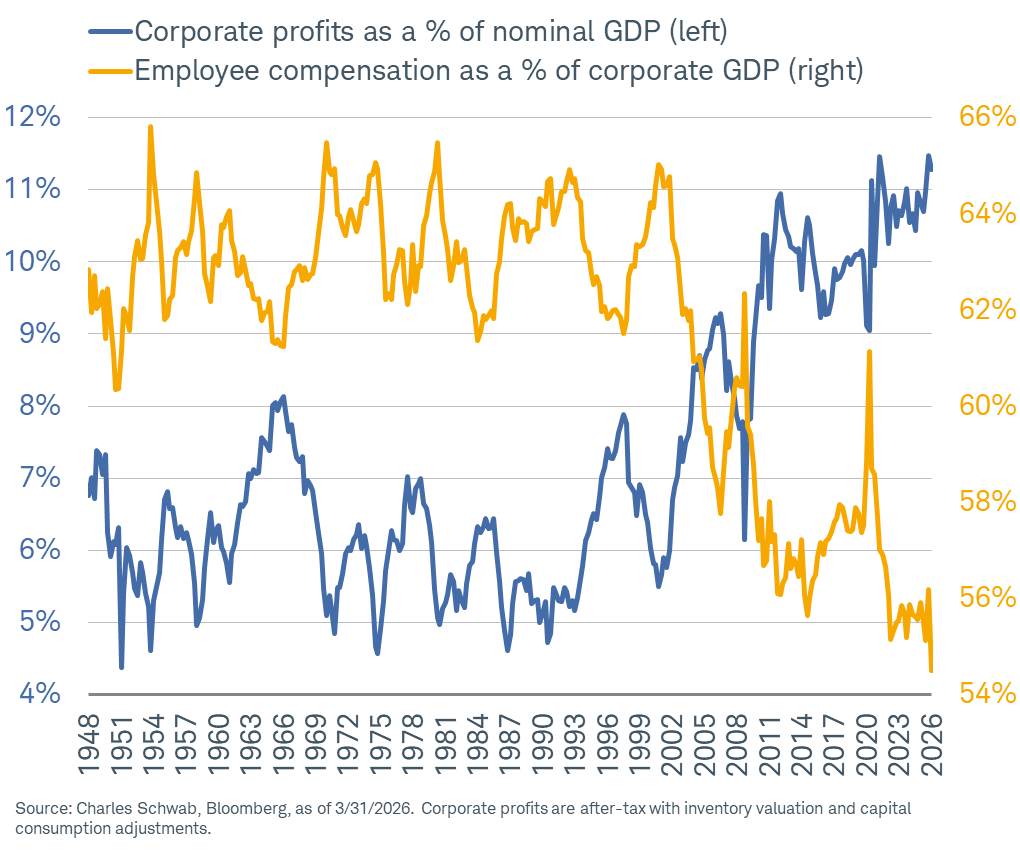
WSJ: "Labor’s share of gross domestic income (conceptually similar to GDP) sank to 51%, the lowest since records began in 1947. Profits’ share climbed to 12.1%, the highest since 1950."
@greg_ip
https://t.co/fgMqCQGON4
Ny studie om privata sjukvårdsförsäkringar 🇸🇪
Huvudresultat:
1️⃣ De går främst till höginkomsttagare (ofta via arbetsgivare)
2️⃣ Arbetsgivarförsäkring leder kausalt till mer vård och snabbare specialistkontakt
3️⃣ De ökar belastningen på offentligt finansierad vård