Historian of American religion. Author _Black Fundamentalists_. Associate Professor of Religious Studies, Texas A&M. TAMU ‘18 | SWBTS ‘12 | UNC ‘06. 1689LBCF.
my entire timeline now is just two German dudes here for the World Cup experiencing America in all its normal beauty and it’s truly the greatest thing to ever happen to my feed
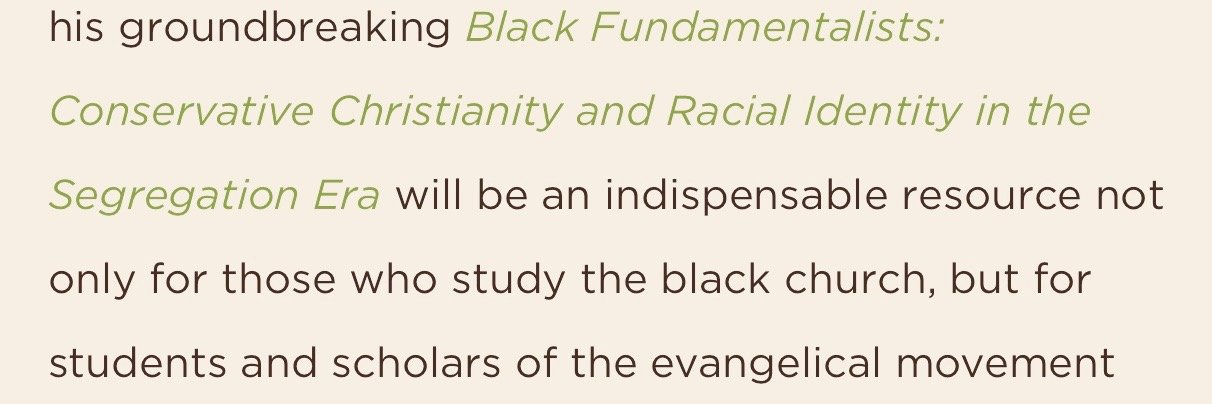
I'll end on this: no work like Wood's "The Radicalism of the American Revolution" made me want to be an American so badly. Now that I am a citizen, I'm proud to share in the tradition Wood described and defended.
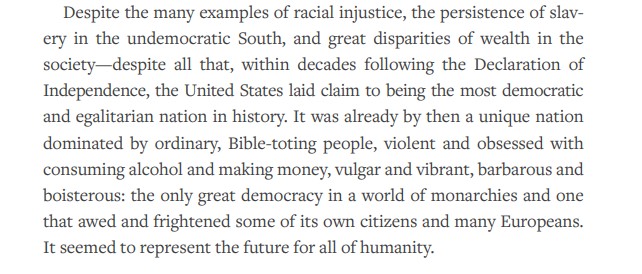
Gordon Wood wrote the lead essay for "Democracy and the American Revolution," the first volume in @AEI's "America at 250" series. I had to pick my jaw up off the ground the first time I read how he summed up the democratic force the Revolution unleashed:
I first encountered the work of Gordon Wood as an undergrad history major. I thought then that "The Radicalism of the American Revolution" was a tour de force — and its reputation with me has only improved over time.
Over the years, I purchased every single Gordon Wood book. Many years ago, when I was a young husband and new dad, Gordon Wood came to the Mall in Washington DC as part of a book festival. I brought several books for him to sign. I dropped off my wife with our young child (and the pile of books) and then searched for parking.
Dear reader, I had to park very far away. So far, in fact, that Gordon Wood's window for signing books had long since passed. I finally found my wife and young child with Gordon Wood at an empty author's booth. He not only had signed all my books, but he had stayed well past his time to leave and graciously chatted with my wife, who had implored him to wait **just a little longer** so that I could meet him. He was so kind to my wife, our child, and — when I finally showed up — me.
Imagine my delight earlier this year when Gordon Wood agreed to be filmed for The Federalist Society @FedSoc for two days, to talk about America250 and the Founding (in particular, the path from the Declaration to the Constitution) and also to talk about his own life and career as a historian. I was honored to witness my good friends @kurtlash1 and Steve Calabresi interview Gordon Wood.
... and then Gordon Wood stayed long past the agreed upon filming time to talk to me about his life and our shared love of America's Founding.
We lost a brilliant man today. We also lost a good man, a kind man. Too often, that Venn Diagram of brilliance and kindness does not overlap. It did with Gordon Wood. May God receive his soul, and may his memory be a blessing.
The Federalist Society mourns the loss of Gordon S. Wood, one of the great historians of the American founding, and a scholar whose work has shaped how generations of Americans understand who they are and where they came from.
Professor Wood illuminated America's founding with his landmark works, The Creation of the American Republic and The Radicalism of the American Revolution. His words helped us understand the extraordinary struggle and sacrifice that gave birth to our nation. Lawyers, judges, scholars, and students turn to Professor Wood's pages to learn and understand not just what the Founders did, but what they believed, and why it still matters.
The Federalist Society was privileged to work alongside Professor Wood, collaborating on several projects celebrating America's 250th anniversary. He brought to that work the same precision, dedication, and undiminished sense of wonder that he poured into his scholarship.
The Federalist Society is deeply grateful for his work and his towering presence in capturing and telling America's story. We extend our deepest condolences to his family and to all who had the good fortune to learn from him and know him.
Gordon Wood was a great scholar because he took our Founders seriously. By chronicling their words, deeds, ideas, trials, tensions, and triumphs, he proved in so many ways that America is good, just, and worthy of our love.
For nearly 40 years at Brown, Gordon S. Wood helped shape the study of early American history through his teaching, mentorship and award-winning scholarship.
The Pulitzer Prize-winning historian leaves an extraordinary legacy at Brown and far beyond, influencing generations of students, scholars and readers.
https://t.co/496zDVNt6k
I never met Gordon Wood, but I have a story about him.
In one of my grad school seminars, we read Wood’s Creation of the American Republic. The sheer erudition and evidentiary depth of the book bowled me over.
Back then, before kids and before life accelerated to warp speed, I used to call my mother every Sunday to catch up. Lots of times, we ended up talking about what I was reading that week in my grad seminars or for leisure. Mom had an omnivorous mind, and she was always looking for something else to read. She was a true intellectual—curious about almost everything, always eager to integrate new arguments or ideas into her existing schemas of how the world worked or to have those schemas challenged and changed.
When we talked that particular Sunday, I think I tried to describe to her part of Wood’s argument about the relationship between the state constitutions during the Articles of Confederation era and the federal Constitution. Maybe I was tired, maybe I didn’t completely understand her questions, but the end result of the conversation was that Mom had questions about Wood’s argument that I didn’t answer satisfactorily. I told her that she should probably just read the book, and we said goodbye.
She did eventually read the book, but the next Sunday, Mom started our conversation by saying, “Well, I had a lovely conversation with Gordon Wood this week.” For a split second, I thought she was joking, but then I remembered who I was dealing with. I started to sweat. “How?” I asked. A whole variety of unlikely scenarios in which the foremost historian of the American Revolution and my mother, who lived in Wichita, Kansas, might have met ran through my mind. “Oh, I just looked up his office phone number on Brown’s website and called, and he picked up!” Mom said. I decided I would have to find another profession.
As it ended up, Gordon Wood spent about an hour on the phone with my mother answering her questions about the Constitution. Ever since, I’ve had a soft spot for the man when I imagine him picking up the phone in Providence and finding Becky Elder from Wichita on the other end of the line. His generosity in that moment spoke very well of him.
Rest in peace, professor.
We are devastated by the sudden loss of Gordon Wood. Known to many as one of the foremost scholars on the American Revolution, Gordon was also a teacher of generations of students and other historians who, like him, help us better understand who we are as a country and a people. He will be greatly missed. Our thoughts are with his family, his many friends and all who he touched throughout his remarkable life.
On Sunday, my friend Gordon Wood was struck and killed in a car accident. Gordon taught history at Brown Univ. and was among the most accomplished historians America has produced. He won the 1993 Pulitzer Prize for The Radicalism of the American Revolution, and his earlier book The Creation of the American Republic, 1776–1787 took the 1970 Bancroft Prize. He also received the National Humanities Medal.
He was, in my view, the finest historian of America's founding—which makes it all the sadder that he did not live to see the nation's 250th birthday. His reputation reached popular culture, too. Matt Damon's character in Good Will Hunting invokes him by name in the famous bar scene, accusing a Harvard student of simply "regurgitating Gordon Wood, talking about [...] the pre-Revolutionary utopia and the capital-forming effects of military mobilization."
I feel fortunate to have collaborated with Gordon on several projects. In a 2019 anthology I compiled, he wrote an essay on the possibility of a shared American narrative. He centered his argument on equal rights as "the most radical and most powerful ideological force" the Revolution unleashed. "This powerful sense of equality is still alive and well in America," he wrote, "and despite all of its disturbing and unsettling consequences, it is what makes us one people."
When I needed jacket blurbs for my new book Lincoln's Compass, coming out this November, I turned to Gordon. The fit was natural: the book argues that Abraham Lincoln took the Declaration's claim that "all men are created equal" as his guiding moral compass—and that he refocused the nation on that claim. Gordon, ever the gentleman, offered generous praise.
He was, in many respects, the dean of American historians. He will be very hard to replace.
@ATLHeadband Probably my favorite regular season game ever (in no small part because of the booth).
The video left out the best part of the walk-off call — “Pour Larry a Crown!”
@JustWanaBS Ryan Didoshak (excellent creator of the Hot Garbage Sports channel on YouTube) talked about this a bit with @joeovies and @giglio_OG after the game. Worth a listen!





![JoshuaClaybourn's tweet photo. On Sunday, my friend Gordon Wood was struck and killed in a car accident. Gordon taught history at Brown Univ. and was among the most accomplished historians America has produced. He won the 1993 Pulitzer Prize for The Radicalism of the American Revolution, and his earlier book The Creation of the American Republic, 1776–1787 took the 1970 Bancroft Prize. He also received the National Humanities Medal.
He was, in my view, the finest historian of America's founding—which makes it all the sadder that he did not live to see the nation's 250th birthday. His reputation reached popular culture, too. Matt Damon's character in Good Will Hunting invokes him by name in the famous bar scene, accusing a Harvard student of simply "regurgitating Gordon Wood, talking about [...] the pre-Revolutionary utopia and the capital-forming effects of military mobilization."
I feel fortunate to have collaborated with Gordon on several projects. In a 2019 anthology I compiled, he wrote an essay on the possibility of a shared American narrative. He centered his argument on equal rights as "the most radical and most powerful ideological force" the Revolution unleashed. "This powerful sense of equality is still alive and well in America," he wrote, "and despite all of its disturbing and unsettling consequences, it is what makes us one people."
When I needed jacket blurbs for my new book Lincoln's Compass, coming out this November, I turned to Gordon. The fit was natural: the book argues that Abraham Lincoln took the Declaration's claim that "all men are created equal" as his guiding moral compass—and that he refocused the nation on that claim. Gordon, ever the gentleman, offered generous praise.
He was, in many respects, the dean of American historians. He will be very hard to replace.](https://pbs.twimg.com/media/HKTRZYnXkAAoZO7.jpg)


