We destroyed 99% of one of the best carbon-storing, wildfire-resistant ecosystems on Earth, and most of us don't even realize it's gone.
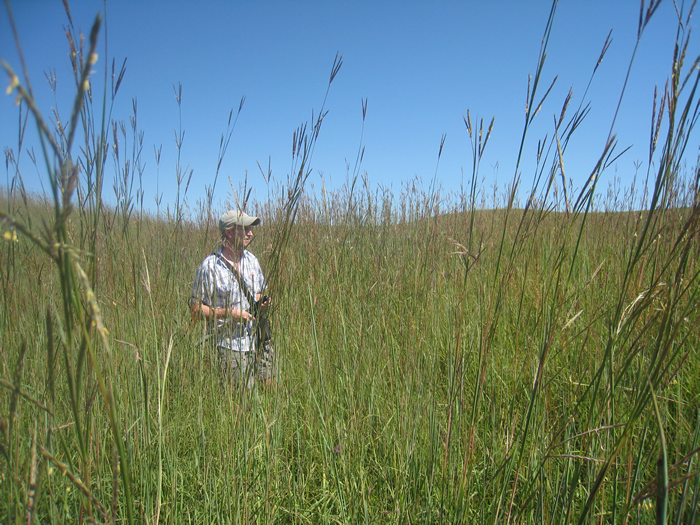
Tallgrass prairie once covered huge parts of North America. Today, almost all of it is gone, mostly converted to farms, roads, towns, and development.
Prairie does something forests can't do as reliably: it hides most of its carbon underground. Native prairie plants can send roots 10 to 15 feet deep. When fire burns across the surface, the plants come back. The carbon-rich root systems and soil remain.
A forest stores much of its carbon in trunks and branches. A prairie stores much of it where fire, drought, pests, and storms have a harder time taking it back.
That is why grasslands can be such powerful climate infrastructure. They hold soil, absorb water, reduce erosion, feed pollinators, support birds, and store carbon below our feet.
And we replaced almost all of the richest prairie with crops in roughly a century.
What would happen if we brought back even just 10% of what we lost?
Other names for Chicory are ‘watcher-of-the-road’ and ‘blue sailor weed’. A legend tells of a maiden who waited by the roadside for her beloved, never knowing he had been lost at sea. Tears from her blue eyes became the flower, forever watching for his return. #FairytaleTuesday
June’s full moon is known in Europe as the #RoseMoon, named for the season when roses are at their glorious peak. In North America it is the Strawberry Moon, marking the strawberry harvest, while elsewhere it is called the Hot Moon, reflecting the arrival of summer heat in June.
🚨 The BLM is reviewing nationwide strategies that will shape the future of America’s wild horses & burros.
⏳ Public comments close July 2.
https://t.co/YZ6wObc2vz
📸 Scott Wilson
Florida is celebrating the Fourth of July weekend, July 3-5, with free entry to Florida State Parks, giving families and visitors a chance to enjoy the outdoors without an admission fee.
With parks across the state, this is a great opportunity to explore springs, trails, beaches and historic sites while learning about Florida’s natural and cultural resources.
Parks excluded from free entry include:
-Ellie Schiller Homosassa Springs Wildlife State Park.
-Skyway Fishing Pier State Park.
-Weeki Wachee Springs State Park.
Learn more: https://t.co/LvqaXVxniU
***
📍: Lake Kissimmee State Park
💡: Plan your adventure at https://t.co/YhnWcMz9Bl Before you visit, check the KNOW BEFORE YOU GO section on the park’s webpage for real-time updates and helpful information.
.
.
#FLStateParks # #LoveFL #America250FL @America250FL
Wolves, music, and myth intertwine in folklore, representing both wild untamed nature and primal connection. In literature, wolf howls are frequently compared to symphonies, symbolizing the raw, beautiful music of the wilderness.
We talk about habitat loss in terms of acres, but we almost never talk about the habitat we've lost above our heads.
For the first time in billions of years of life on Earth, a significant portion of the planet's surface no longer gets fully dark at night.
99% of Americans and Europeans live under light-polluted skies. A third of humanity can't see the Milky Way from where they live. An entire generation has grown up under skyglow so persistent that true darkness feels foreign, even threatening.
But darkness isn't empty space. It's habitat. Moths navigate by the moon and stars. Artificial light pulls them off course, draws them into orbit around bulbs until they exhaust themselves and die, and disrupts the pollination they were doing while the rest of us slept.
Fireflies use bioluminescent signals to find mates; even a brief flash of headlights or a porch light left on can interrupt or extinguish those signals entirely.
Migrating birds navigate by celestial cues and get pulled off course by lit buildings, sometimes fatally. Bats that evolved to hunt in darkness find lit areas so disorienting that artificial light functions as a physical barrier, fragmenting their habitat the way a highway fragments a forest.
Researchers reviewing more than 150 studies concluded that light pollution is, in their words, "another important but often overlooked bringer of the insect apocalypse."
The difference between this habitat loss and others is that we made it gradually, one porch light and one streetlamp and one office building left blazing at 2am at a time, until the absence of darkness became normal and nobody thought to mourn it.
The good news is that it's the most reversible form of habitat destruction that exists. Turn the light off and the darkness returns immediately.
Pollinator Week is a celebration of all the species that help plants reproduce and ecosystems flourish!
This year, the swallowtail butterfly was named Pollinator of the Year, serving as a reminder that pollinators need different resources throughout their lives. As caterpillars, swallowtails rely on host plants for food. The featured black swallowtail caterpillar is chowing down on a plant in the parsley family. As adult butterflies, like the featured giant swallowtail, they visit flowers for nectar while helping move pollen from bloom to bloom.
Video by Megan Mitchell, FWC
Orchids thrive in The Everglades. The most common epiphytic orchid found here is the butterfly orchid (Encyclia tampensis). Orchids are protected within the park. Please take only photographs.
NPS Photo / Sara Zenner
#EvergladesNationalPark#Everglades#PollinatorWeek