$BTC just switched to GO mode: bullish trend confirmed, ADX 33 showing momentum, action says TRADE LONG. But regime still CAUTION — trade smart, not greedy. 🟢⚠️ #BTC#Bitcoin#CryptoTrading
$BTC 1D — macro roadmap if markets enter full regression 🧠
This is the big picture plan if things get ugly.
Because smart investors always have a Plan B.
🟩 Buy Zone 1 — $70,000
🟩 Buy Zone 2 — $50,000
🟩 Buy Zone 3 — $30,000
Fibonacci levels + volume profile = confluence of major support.
Even if we correct — the structure remains bullish long-term.
Will you be ready if opportunity knocks?
Not financial advice — just my view.
#Bitcoin #BTC #CryptoStrategy
@ExitDeckApp@RoundtableSpace For me it’s the combo: % inflow shows the regime shift, absolute old‑coin size confirms real supply hitting the market, and LTH SOPR > 1 is what actually seals the “sell the rip” trigger.
For me, the key thresholds are:
• Daily inflow spike: >+5% sustained over 3-5 days (baseline ~55-60K BTC/day)
• Absolute red flag: 65K+ BTC in single day from older coins (6m+)
• % of exchange reserves: when 7-day MA inflows exceed +2.5% of total reserves
Historically, when daily inflows jump 3-5% at ATH zones, price corrects 8-12% within 48hrs. The move is front-running that with tiered exits: 15-20% at first +3% spike, 25-30% if it holds above +5% for 72hrs, rest mechanical if absolute figure crosses 70K BTC.
The real alpha is pairing this with LTH SOPR acceleration — if both flip simultaneously near 1.3-1.5× ATH, that's the "sell the rip" regime.
@cryptorover Record STH loss is actually bullish if you flip the lens: massive realized loss = supply absorbed by stronger hands at a discount. When STHs panic-sell into historical extremes, it often marks distribution exhaustion, not the beginning.
@ExitDeckApp@RoundtableSpace Watch for LTH profit-taking re-acceleration + exchange inflows spiking near that zone as red flags. If LTHs keep trimming (not dumping) and spot stays strong, could overshoot 1.5× before real cap.
$BTC flips to BUY signal: RSI pushing 70, volume heating up at 2x, chart says ENTER LONG but status still CAUTION. This is opportunity with guardrails. 🟢⚠️ #BTC#Bitcoin#CryptoTrading"
@WatcherGuru Reg clarity is oxygen, but it’s not just “pass anything asap”. The Senate draft + CLARITY Act could lock in who wins: today the US already has 70+ spot/futures crypto ETPs with ~$156B AUM riding on these definitions.
@ExitDeckApp@RoundtableSpace f LTH profit‑realization already printed ~3.4M BTC, my base case is next meaningful distribution cluster sits in the 1.3–1.5x range above the last ATH, so mid‑to‑high six figures rather than right here.
@AshCrypto Even now, LTHs have already realized ~3.4M BTC in profit this cycle, a record. So yeah, above 94k can squeeze… but that much realized profit also means dry powder for one more savage fake‑break before the real mania. 🚀 or rug first?
@CryptoKaleo for many smaller/global creators X is literally rent money. Estimates put ad‑share around 8–10 USD per 1M impressions, with some niches higher.
Huge step, but “clear rules” can also hard‑code today’s assumptions into law. In 2025, US spot BTC ETFs had weeks with inflows 500× the yearly avg once rules loosened — not when they over‑defined every edge case.
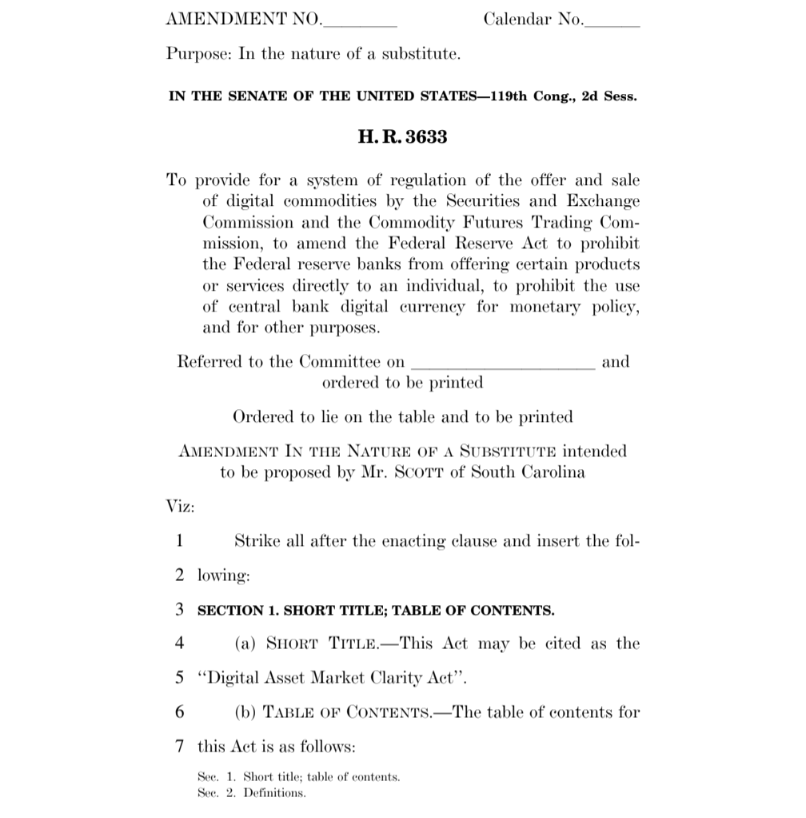
🚨 The US Senate has dropped a crypto market structure draft bill.
This is one of the most important attempts yet to write clear rules for crypto in the US, instead of forcing everything into old laws.
Right now, crypto lives in confusion:
• No one knows who regulates what
• SEC and CFTC keep fighting
• Projects don’t know how to launch legally
• Investors don’t know what is safe
This bill tries to fix all of that.
Here’s everything you need to know 👇
1. IT FINALLY DEFINES WHO REGULATES CRYPTO.
Right now: SEC says everything is a security and CFTC says crypto is a commodity.
This bill splits them clearly:
• Securities → SEC
• Commodities → CFTC
2. IT CREATES A NEW ASSET TYPE CALLED ANCILLARY ASSETS.
This is huge.
Most crypto tokens are not stocks. They don’t give ownership in a company. They give access to a network.
So the bill says: These tokens are not securities. They are ancillary assets. Meaning they are not treated like shares, they don’t need IPO style rules. But they still need transparency.
This protects innovation without killing projects.
3. IT FORCES REAL PROJECT DISCLOSURES.
Projects must clearly show:
• Who is building it ?
• How tokens are created ?
• Who owns how much ?
• How the system works ?
• What risks exist ?
• How governance works ?
No vague whitepapers.
4. BIG FUNDRAISERS MUST SHOW AUDITED DATA.
If a project raises serious money(25M+):
• They must show audited financials
• They must prove funds are real
• They must show how money is used
This kills fake treasuries and paper numbers.
5. IT PROTECTS DEVELOPERS AND BUILDERS.
Right now: One tweet can get you sued.
This bill says: Builders can talk about roadmaps, features, development plans.
As long as they are honest.
This removes fear from innovation.
6. IT CREATES A LEGAL PATH FOR DECENTRALIZATION.
Projects can start centralized. Then slowly decentralize.
Once sufficiently decentralized:
• They stop being treated like securities
• Regulation becomes lighter
This is massive for Ethereum type networks.
7. IT REGULATES EXCHANGES PROPERLY.
Crypto exchanges must:
• Register
• Separate user funds from company funds
• Follow custody rules
• Follow market surveillance
• Prevent wash trading
This makes crypto trading closer to stock markets.
8. IT BANS WASH TRADING AND FAKE VOLUME.
Wash trading becomes illegal. Fake liquidity becomes criminal.
This directly protects retail traders.
9. IT CRIMINALIZES SPOOFING AND FRONT-RUNNING.
No more fake buy/sell walls. No more insider order abuse. No more exchange manipulation.
This brings fairness.
10. IT INTRODUCES PROOF OF RESERVES.
Exchanges must show:
• They actually hold user funds
• Regular verification
• Transparency
This directly targets FTX style failures.
11. IT BRINGS DEFI INTO FINANCIAL PLANNING.
DeFi is now officially:
• Part of financial infrastructure
• Part of cybersecurity planning
• Part of systemic risk monitoring
What this bill really means:
Crypto is moving from chaos, lawsuits, regulatory fear, grey areas to defined laws, clear categories, real protections, and institutional access.
@BullTheoryio Love the ancillary‑asset idea + PoR push. But if disclosures/audits end up priced like IPOs, only mega‑VC chains survive. How do we keep the FTXs out without turning early‑stage crypto into a rich‑only walled garden
Bitcoin screams NO-GO: bullish on paper, but weak momentum, high dominance at 59%, score just 36.5. The chart is literally saying DO NOT TRADE. 🔴 #BTC#Bitcoin#CryptoTrading#RiskManagement
it’s profit-taking. LTH SOPR’s still >1, so they’re exiting in profit, not fear. The 1y+ supply only slipped from ~61%→52% while ETFs/DATs hoovered up the float. Feels more like redistribution than capitulation. Thoughts?
@cryptorover every cycle LTHs have to sell so new buyers can enter. Since early 2024, 1y+ supply fell ~9%, while spot products added tens of thousands of BTC. That’s classic rotation, not a broken signal. Curious where you’d call danger?
Even with banks lending against $BTC and friendlier accounting, Q4 2025 saw only 9 new corporate aCool to see $BTC treasuries go from meme to playbook, but it’s still early: businesses hold ~1.3M $BTC (~6.2% of supply) after $12.5B of inflows in 2025. Institutionalization is real, just not as ubiquitous as the maxis’ marketing
Mining cost is a powerful gravity, not a magic floor. Models show BTC price tracks marginal production cost closely (R² ≈ 0.97 over 2010–18), but it has dipped below that line during miner capitulations and stress.
@cryptorover that cost band is an estimate built on average power prices and hardware. In real crashes, price can pierce it before weak miners die and difficulty/price re‑equilibrate