The PhD exams are different. At Stanford I had one of these. The topics were machine learning, graphical models, and convex optimization, broad to the point of meaninglessness and my committee was Andrew Ng, Daphne Koller, and Stephen Boyd, and it was an oral so they stare.
A British biologist looked at 200,000 years of human history and found that the entire reason humans broke out of poverty was not intelligence, not language, not even agriculture, but one mechanism so simple a 6-year-old could explain it.
His name is Matt Ridley.
He is a zoologist by training, an evolutionary biologist by career, and in 2010 he wrote a book called The Rational Optimist that quietly argued the most important fact about human progress had been hiding in plain sight for the entire history of economics.
Naval Ravikant has been telling people to read everything Ridley has ever written for the last 15 years. The reason is the argument inside this one book.
For 200,000 years, anatomically modern humans walked around with the same brain you have right now. Same skull size. Same neural architecture. Same raw capacity for language, planning, and abstract thought.
For roughly 190,000 of those years, almost nothing happened. Generation after generation lived and died inside the same Stone Age toolkit their great-great-grandparents had used. Then somewhere around 50,000 years ago, the line on the chart of human progress started to tick upward. Then it bent. Then it exploded.
The question Ridley spent years on was the only question that mattered. What changed.
It was not the brain. The brain had been the same for 190,000 years. It was not language, which had existed long before the takeoff. It was not even agriculture, which arrived only 10,000 years ago and was actually preceded by the upward bend, not the cause of it.
What changed was that humans started trading with strangers.
This sounds too small to be the answer. Ridley argues that it is the answer to almost everything. The moment one human exchanged a useful object with another human from a different group, something happened that no other species on earth had ever done.
Two ideas that had developed in isolation came into contact. The flint knapper learned what the spear maker had figured out. The fisherman from the coast learned what the hunter from the forest had figured out. The two pieces of knowledge fused into something neither side could have produced alone.
Ridley calls this ideas having sex. The phrase sounds frivolous and it is meant to. The point is that ideas, like genes, get better when they combine with other ideas from different lineages.
An idea sitting inside one head, no matter how brilliant the head, eventually hits a ceiling. The same idea exposed to ten thousand other ideas does something genes do under sexual reproduction. It mixes. It recombines. It produces offspring nobody planned.
The cleanest proof of this argument is the most uncomfortable case study in the book. Tasmania.
Around 10,000 years ago, rising sea levels cut Tasmania off from mainland Australia. A population of roughly 4,000 humans was now isolated on an island, with no possibility of contact with the rest of humanity. They had the same brains. The same language. The same starting toolkit as their cousins 150 kilometers north. The natural experiment was now running.
What happened next is something no economist or geneticist had ever predicted.
The mainland Australians kept inventing. Boomerangs. Spear-throwers. Fishing nets. Bone needles for sewing fitted clothes. Watercraft with paddles. Their technology compounded slowly across the centuries.
The Tasmanians went the other way. They did not just fail to invent the new tools their cousins were developing. They started losing the tools they already had. Fishing was abandoned within a few thousand years. Bone tools disappeared. Fitted clothing disappeared. They forgot how to make fire from scratch and started carrying lit firebrands from camp to camp instead, relighting their fires from a neighbor's whenever their own went out.
By the time European explorers arrived in the 17th century, the Tasmanians had the simplest toolkit of any human society ever recorded. Their material culture had gone backward for 8,000 years.
The archaeologist Rhys Jones called it a slow strangulation of the mind.
Joseph Henrich at Harvard later proved with formal mathematical models that there was nothing wrong with Tasmanian brains. There was something wrong with their network. A toolkit requires a critical mass of people exchanging skills to maintain itself.
The act of teaching a skill is imperfect. Every generation loses a small percentage of what the last generation knew. If your population is large enough and trading widely enough, those losses get caught and corrected by someone else who still remembers.
If your population shrinks below a certain threshold and stops mixing with outsiders, the small losses compound until entire technologies disappear.
This is the part that should haunt anyone reading this in 2026.
Intelligence is not a property of the individual brain. Intelligence is a property of the network the brain is connected to. A genius in isolation will produce less than a mediocre thinker inside a dense exchange of other mediocre thinkers.
The thing your ancestors needed in order to break out of 190,000 years of stagnation was not better brains. It was better connections between brains they already had.
The implication for any individual is direct and uncomfortable. If you are smart and isolated, you will be outproduced by people half as smart who are connected.
The most successful people in any field are almost never the smartest people in it. They are the ones positioned at the intersection of the most idea flows. They are reading more authors than their competitors. They are talking to more people from more disciplines. They are in the rooms where ideas from different lineages bump into each other.
Ridley ends the book on the line that sounds optimistic but is actually a warning its this "The future will be invented by people who connect ideas, not by people who guard them."
This paragraph by Richard Feynman hits so hard:
“Fall in love with some activity, and do it! Nobody ever figures out what life is all about, and it doesn’t matter. Explore the world. Nearly everything is really interesting if you go into it deeply enough. Work as hard and as much as you want to on the things you like to do the best. Don’t think about what you want to be, but what you want to do. Keep up some kind of a minimum with other things so that society doesn’t stop you from doing anything at all.”
A guy named nbatman on Reddit accidentally built the most useful website on the internet.
It's called FMHY (Free Media Heck Yeah).
This is the website Google delisted from search for DMCA violations, Reddit shadow-banned for promoting piracy, the Motion Picture Association flagged as a top piracy threat, and the RIAA pressured hosting providers to drop. It is still online. It is still updated every month.
Here's how it works.
FMHY is the index. The wiki itself hosts nothing. It just tells you where every free thing on the internet actually lives, organized into 14 categories with safety ratings on every single link.
→ Movies and shows in 4K from 50+ streaming sites
→ Music at Spotify and Apple Music quality
→ Adobe Creative Cloud, Microsoft Office, AutoCAD, JetBrains
→ Every paid course on every major learning platform
→ 100 million books and papers through Anna's Archive
→ Free alternatives to every paid AI tool
→ A SafeGuard browser extension that flags unsafe sites in real time
It started as a single Google Doc maintained by one Reddit moderator in 2018. Google killed it with a DMCA takedown in 2023.
The community rebuilt the wiki on its own domain, mirrored it to GitHub and IPFS, and now runs it across 12 backup domains simultaneously.
There is no company. No CEO. No central server. Six anonymous volunteers maintain the entire thing in their spare time. Donations through Ko-fi pay for the hosting. Nobody profits.
Hollywood can't shut this down. Spotify can't shut this down. Adobe can't shut this down.
The entire subscription economy is held together by you not knowing this wiki exists.
https://t.co/AAr2rLlqgy
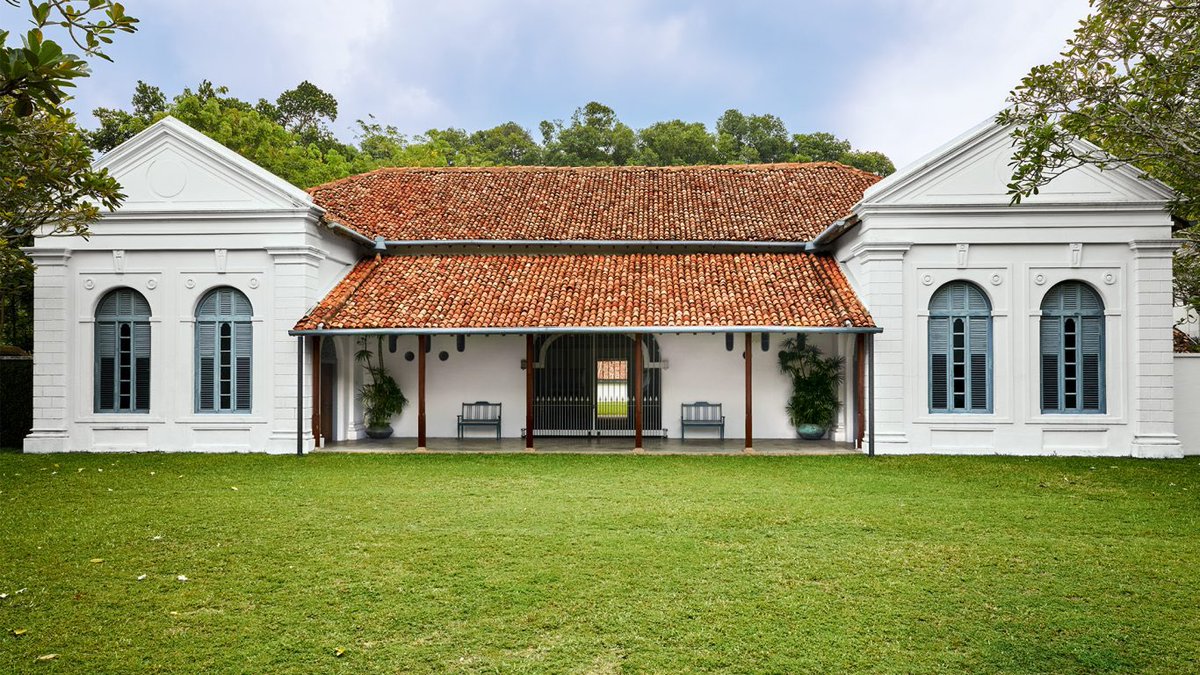
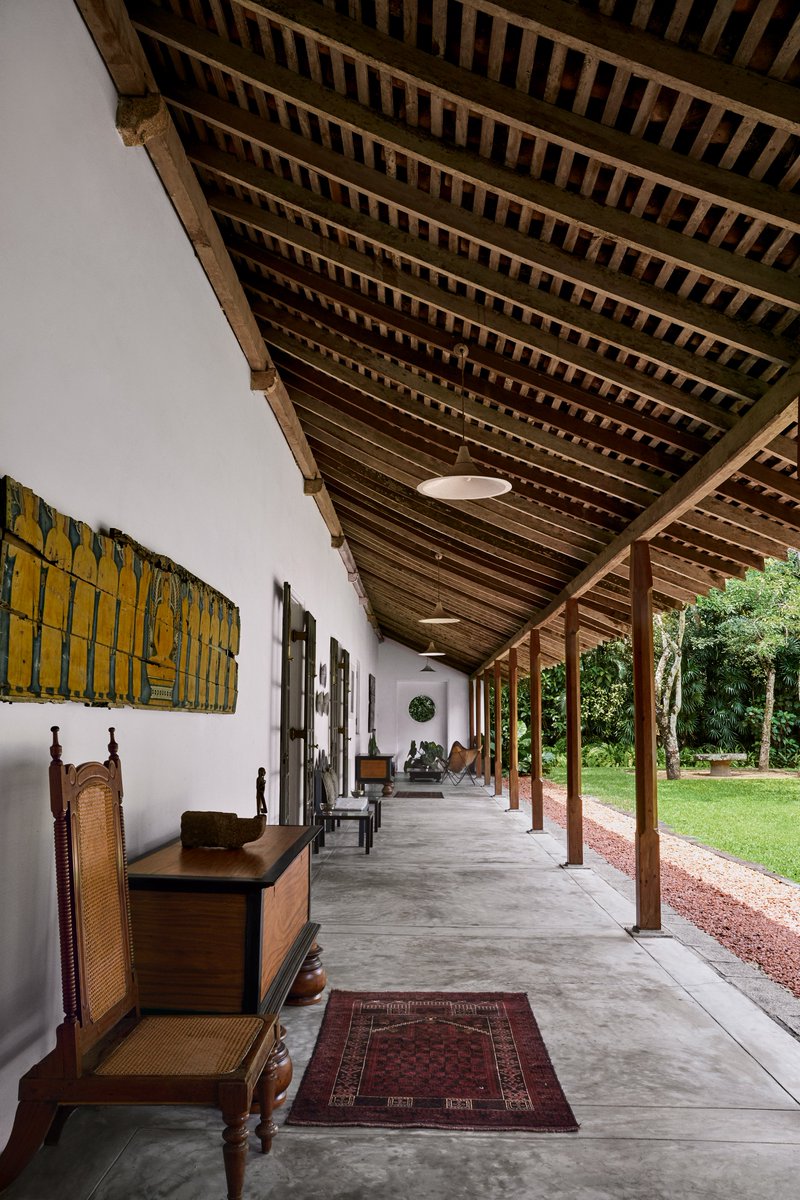
Geoffrey Bawa turned an abandoned horse stable into one of the most studied residential conversions in Asian architecture. This is how.
The Horagolla House began as an abandoned horse stable on a family property. Bawa visited the site, stood and studied it, then agreed to convert it. Over four years in the 1980s, he remodelled the stables with restraint into a double height living space.
The stable hall became the living room. Verandas looked out over garden courts. Trees were planted around the perimeter on Bawa’s advice, Hora, Kotang and Kohombo. Burma teak sourced from old houses across the island. Clay pots. A salvaged Dutch door that Sunethra and Bawa famously competed over at the same antique dealer.
Bawa rejected the imposition of preconceived forms onto a site. Every project began with the land; its trees, its light and its climate. The building followed. That philosophy produced homes that feel inevitable rather than imposed.
He is widely regarded as the father of tropical modernism in Sri Lanka and the Horagolla House is one of the clearest examples of why.
Horagolla House, Sri Lanka. Geoffrey Bawa. 📷 Ashish Sahi
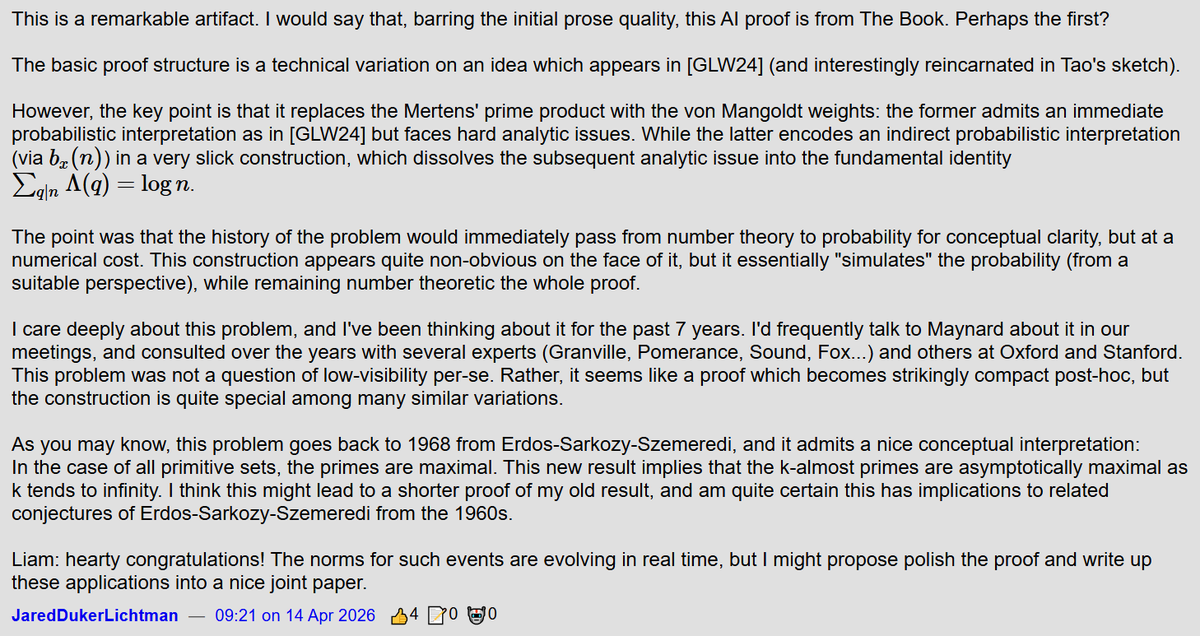
GPT-5.4 Pro solves Erdős Problem #1196!
Very pleased with this result; definitely my favourite thus far! This problem has been thought about for some time which makes this reasonably impressive and meaningful (see Lichtman's comments below).
Formalisation is underway!
This developer has reproduced many classic works, including ViT, AlphaFold3, DDPM, Imagen, and DALL·E.
Whenever I want to cross-check the details of a paper with code, I often end up looking at his implementation.
On one hand, his work is incredibly impressive from an educational perspective. On the other hand, I rarely see someone who has done so much work yet remains so silent on social media.
Lucidrains: https://t.co/O6g5OHmKX1
Only one chance in this lifetime…
Like watching sunset at the beach from the most foreign seat in the cosmos, I couldn’t resist a cell phone video of Earthset. You can hear the shutter on the Nikon as @Astro_Christina is hammering away on 3-shot brackets and capturing those exceptional Earthset photos through the 400mm lens. @AstroVicGlover was in window 3 watching with @Astro_Jeremy next to him.
I could barely see the Moon through the docking hatch window but the iPhone was the perfect size to catch the view…this is uncropped, uncut with 8x zoom which is quite comparable to the view of the human eye. Enjoy.
Destroying the @InternetArchive's @WayBackMachine would be the equivalent of the burning of the Library of Alexandria - one of the worst losses of knowledge in history.
Media giants are now threatening to do this.
We can't let this happen.
Pass it on.
NASA posted an ARTEMIS II crew photograph that I think is one of the best I have seen. This is the continent of Antarctica.
The area around the continent is clear. This is the Southern Ocean that circles Antarctica. The cold air and water tend to rob the moisture in the air. No clouds.
In the middle left of the photo is the Antarctica Peninsula.
To the left of the peninsula is Tierra del Fuego. Continuing up the upper left of the photo is the Atlantic coast of South America.
The land mass in the lower right is probably New Zealand.
DeepMind stayed in London because it is better for talent than Silicon Valley.
"I saw London and the UK as having incredible talent from top universities like Cambridge, Oxford, Imperial and UCL.
There is a deep heritage of scientific breakthroughs and world-class thinkers.
There was less competition for that talent, which made it a huge structural advantage for building DeepMind." @demishassabis
What is the single biggest advantage of building in Europe for you @torsten@antonosika@MaxJunestrand @matiii @ChrisParsonson@cjpedregal@matthewclifford@torstenreil@alanchanguk
“In the Sri Lankan school system they never teach you these things. We were clueless.”
Story of a priest named Gregory Fernando abusing children and never faced legal consequences for his crimes. Instead, the church protected him.
Is this why cardinal Ranjith is against Sex Ed? An oblivious child is the target.
https://t.co/cRRnYYMnEc
No one knows you. No one has a story about who you are. No one is waiting for you to be the person you were yesterday. You're just a stranger in a chair by the window, watching a city that doesn't need anything from you.
It's the feeling that anything could happen. That the world is bigger than the walls you built around yourself back home. That the life you've been living is just one version of a life, and there are others, and they're not as far away as you thought.
At home, you're fixed. Known. You fit into a shape that other people recognize, and after a while, you forget you're even in a shape at all. But here, alone, somewhere new, the shape dissolves. You could be anyone. You could be more of yourself than you've ever been. No one is watching to see if you stay consistent.
Solving Inverse PDEs with 1% Paired Data: Introducing Decoupled Diffusion Inverse Solver
We propose a data-efficient and physics-aware diffusion framework for solving inverse problems on function spaces.
In scientific machine learning, solving inverse problems requires costly and limited data acquisition from physical systems. Existing joint-embedding diffusion models require massive paired training data, as they represent the underlying physics implicitly through statistical correlations. In this work, we identify that under data scarcity, the observation-induced guidance signal vanishes during posterior sampling, making reconstruction impossible.
Our Solution: We propose a decoupled design against joint-embedding: an unconditional diffusion learns the coefficient prior, while a neural operator explicitly models the forward PDE for guidance. This enables (1) superior data efficiency (2) effective physics-informed learning and sampling.
Performance: Achieves state-of-the-art results on Navier-Stokes, Helmholtz, and Poisson benchmarks, improving spectral error by 54% on average.
Data Efficiency: DDIS maintains high accuracy even when limited to just 1% of paired training data, outperforming joint models by 40% in L2 error.
Robustness: Theoretical guarantees that avoid the guidance attenuation identified in joint-embedding methods.
Check out the paper for the full theoretical analysis and experiments!
https://t.co/B4MMhUlcjh
Thomas Lin , @jiacheny7, Alex Chiang, Julius Berner,
#MachineLearning #DiffusionModels #InverseProblems #PDE #NeuralOperators @Caltech #AI4Science
One of the most-viewed PNAS articles in the last week is “Quantifying the compressibility of the human brain.” Explore the article here: https://t.co/HsWpARBhH4
For more trending articles, visit https://t.co/l4XOkRLLmY.