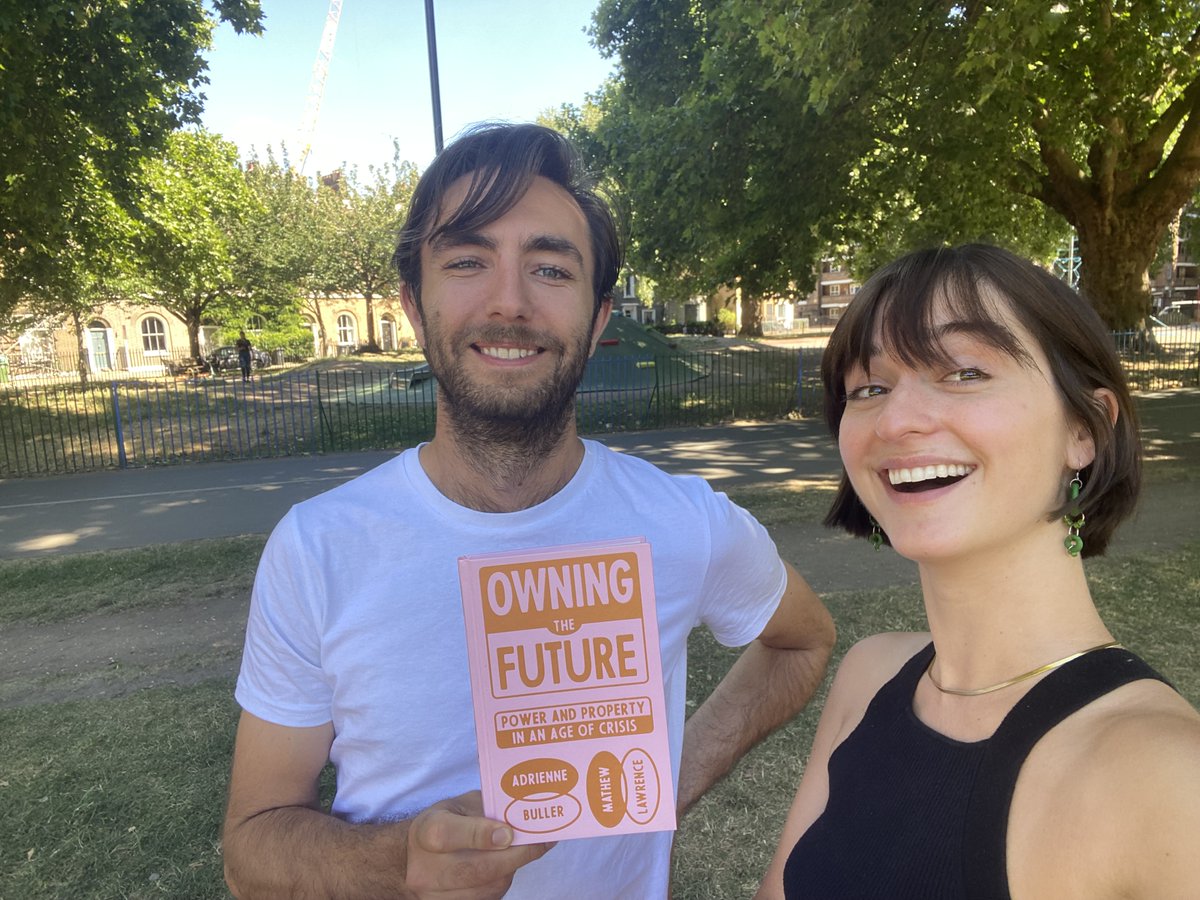
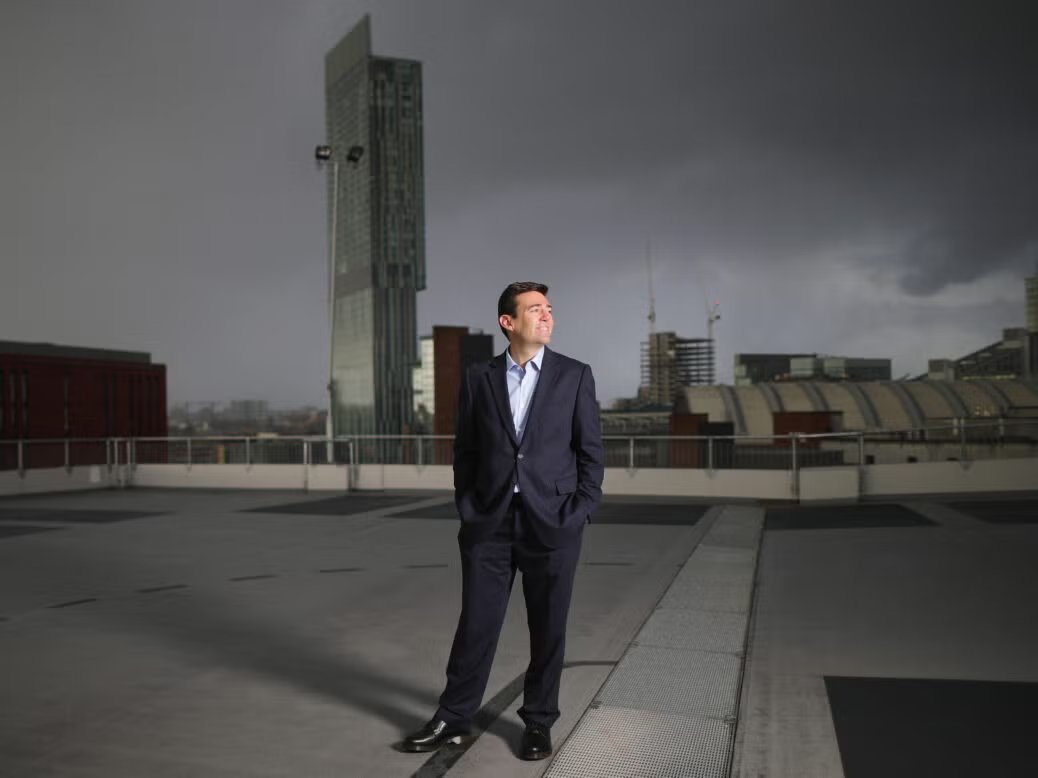
Lucky to call @adribuller a friend, colleague & now, co-author🎉
"Owning the Future" is out today from @VersoBooks
It traces how extractive ownership models connect & drive our age of crisis & how reimagining property relations can secure abundance.
https://t.co/o8fTgOcjRj
When pay runs out before the end of the week, it's irrelevant whether the next thing you need costs 50p or £50.
Before getting in an arithmetic tangle over 50p>0, pause instead on what you would do if one week you had to choose between feeding your kids or brushing their teeth.
Our Director @DantonsHead and US Principal Economist Alex Williams argue in a new essay for @mainstreamlbr that the solution to Britain’s compounding crises is the Productive State — that owns, invests and provides essentials to make life affordable.
🧵
https://t.co/S2vpZWnLHt
This by @DantonsHead is one of the most anticipated publications as a blueprint for Manchesterism, endorsed by a slew of allies including @Miatsf.
Today we have first sight of The Productive State - the essay that sets out how Burnham could reverse privatisation of utilities.
Get ahead of the game and listen to Mathew preview some of the arguments on the productive state in this conversation, the latest episode of the @LRB's ON POLITICS: https://t.co/3V5HgBIpr8
THE PRODUCTIVE STATE: A FRAMEWORK FOR MANCHESTERISM by @DantonsHead
Solving Britain's problem requires an approach that transcends the dichotomy of private market provision and welfare state redistribution.
What is required is a third pillar of political economy: the Productive State. It intervenes on the supply side by investing public money into public assets for public provision of the essentials required for a dignified life. Where the market coordinates and the welfare state redistributes, the Productive State produces: directly owning and operating capital in essential sectors, participating in markets as builder and provider rather than as regulator or redistributor.
It is the return of sovereign economic control of the economy’s foundations. The name operates on two registers: the state that produces, and the state of productivity, because public provision of essentials is the institutional precondition for a genuinely dynamic economy above the foundation it provides.
https://t.co/c2hTCOhScH
Very pleased to see @DantonsHead and @mainstreamlbr get the chance to give this piece of work the big publication it deserves.
Upon first reading I was struck by the fundamental similarities to the analysis of An Honest Day, and the interesting opportunities for synthesis between the two.
Well worth taking the time to read in detail. We should appreciate the fact that we are seeing so much high quality thinking on the left, it can be the prelude to renewal if it is now combined, harnessed and operationalised.
Notwithstanding potentially major events today… it’s more important than ever that Labour has a bold plan on the economy.
@mainstreamlbr’s first big paper by @DantonsHead and Alex Williams offers one.
Read it here: https://t.co/kHuvxwJpLQ
"Our diagnosis is the same. Britain pays too much for the basics because the state has lost control of the foundations ordinary life and enterprise depend on."
Great to have this clear-sighted piece from the Labour Growth Group's @MarkMcvitie and Common Wealth's @DantonsHead on the @newstatesman website today.
Read it!
https://t.co/mO5ghwOKkd
The retreat of public control of essentials has created an economy that extracts when it should investment, fragments when it coordinates, and prices for profit when should provide for need.
The case for change in @NewStatesman
https://t.co/JEOBP3Bu4W
The retreat of public control of essentials has created an economy that extracts when it should investment, fragments when it coordinates, and prices for profit when should provide for need.
The case for change in @NewStatesman
https://t.co/JEOBP3Bu4W
Greater Manchester Mayor Andy Burnham has set out his views on Labour's path forward and the policy challenges facing the country.
Speaking to Channel 4 News' Andrew Misra, Burnham said he wanted Labour to become “a party that they can believe in again, a party solidly on the side of working class people.”
THE CASE FOR MANCHESTERISM by @DantonsHead
Ask someone in Wythenshawe or Rochdale whether the buses are better than they were three years ago and they will say yes. Greater Manchester’s Bee Network is the most instructive public transport experiment in Britain not because it is radical in design but because it works. Since franchising began under Andy Burnham’s leadership, passenger numbers have risen for the first time in a generation. Routes have expanded into communities that private operators had abandoned as insufficiently profitable. Fares are capped at levels the deregulated system could not deliver.
The model is now spreading. A public operator optimising for coverage and frequency rather than fare recovery serves a social need that private calculation screens out, while reducing system costs through public coordination.
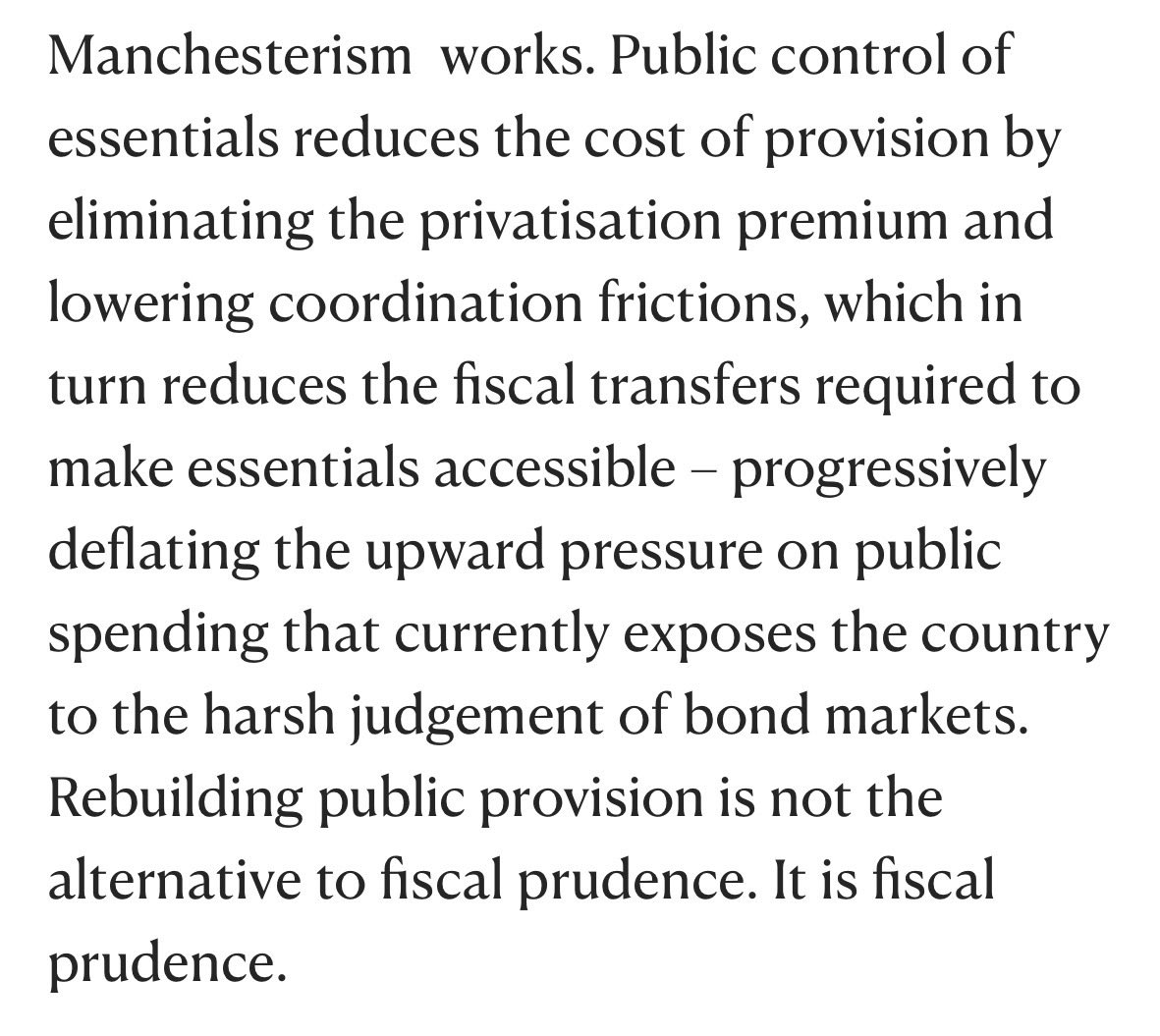
Manchesterism works. Public control of essentials reduces the cost of provision by eliminating the privatisation premium and lowering coordination frictions, which in turn reduces the fiscal transfers required to make essentials accessible – progressively deflating the upward pressure on public spending that currently exposes the country to the harsh judgement of bond markets. Rebuilding public provision is not the alternative to fiscal prudence. It is fiscal prudence.
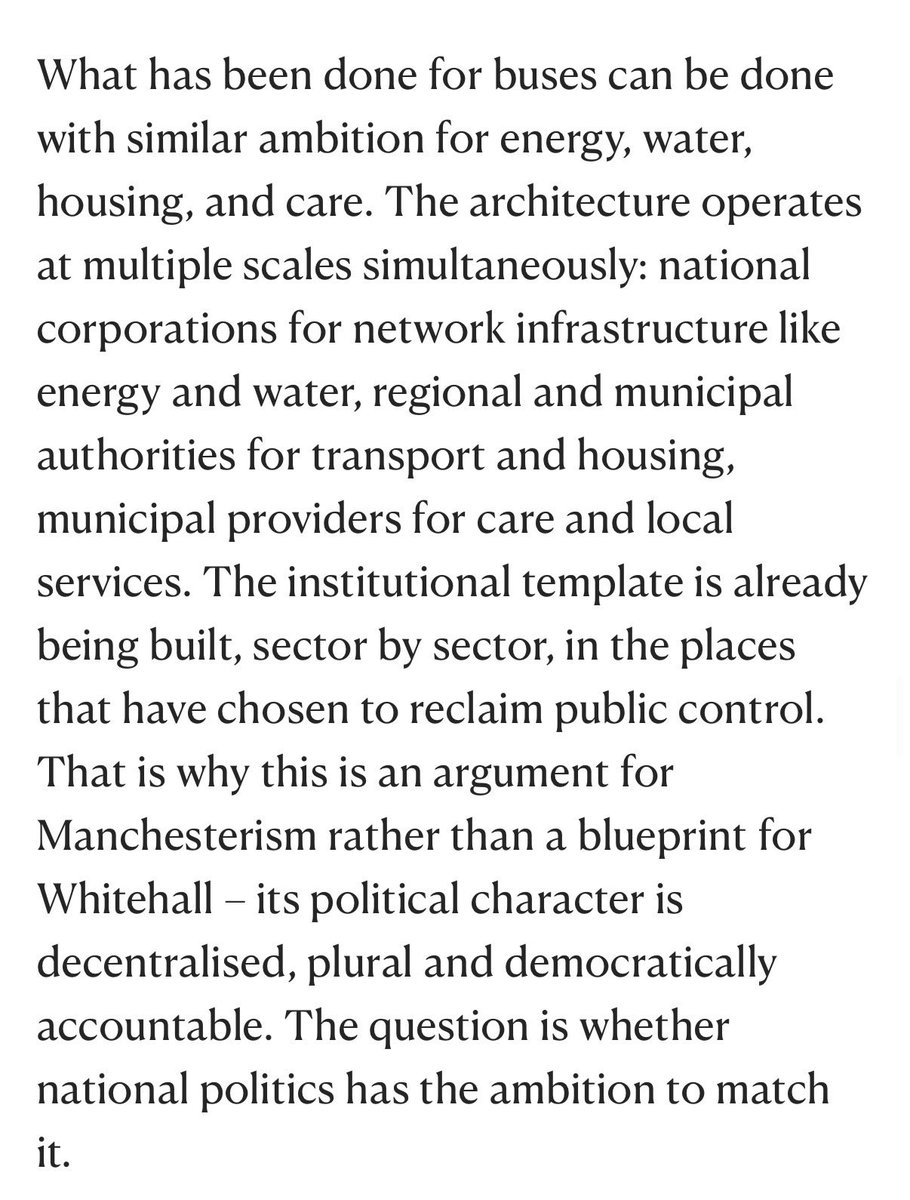
What has been done for buses can be done with similar ambition for energy, water, housing, and care. The architecture operates at multiple scales simultaneously: national corporations for network infrastructure like energy and water, regional and municipal authorities for transport and housing, municipal providers for care and local services. The institutional template is already being built, sector by sector, in the places that have chosen to reclaim public control.
That is why this is an argument for Manchesterism rather than a blueprint for Whitehall – its political character is decentralised, plural and democratically accountable. The question is whether national politics has the ambition to match it.
“The price of electricity turns not just on what technology powers the grid, but on the architecture of the energy system itself”.
Our Director @dantonshead on the Iran crisis and how a public energy system can best deliver affordability.
https://t.co/UaCM8Dn0OA