🚨 BREAKING: France’s Digital ID System Hacked—Sensitive Data of 19 Million Citizens Now Sold on the Dark Web
France’s centralized digital identity platform, operated by France Titres (formerly ANTS), suffered a major breach on April 15, 2026.
Hackers stole records affecting roughly one-third of the French population and started auctioning them on dark web forums.
The exposed database contains:
• Full names
• Email addresses and phone numbers
• Dates and places of birth
• Postal addresses
• Unique government account IDs
This information gives criminals powerful tools for identity theft, phishing campaigns, synthetic identities, and large-scale financial fraud.
The system manages passports, national ID cards, driver’s licenses, residency permits, and vehicle registrations.
Officials confirmed no biometric photos or uploaded documents were taken, but the core personal data is now circulating.
Hackers operating under aliases like “breach3d” and “ExtaseHunters” posted the massive dump soon after the intrusion.
French authorities acknowledged the security incident and are notifying affected individuals, though the sheer scale makes rapid alerts challenging.
France has seen multiple major government data breaches recently, including student records via ÉduConnect, bank account details, and medical information.
Centralized systems handling vast amounts of linked personal data create high-value targets that attract persistent attackers.
Action steps if you’re in France or have connections there:
• Closely monitor all financial and government accounts
• Strengthen 2FA on every service
• Stay alert for phishing attempts impersonating official agencies
• Consider credit monitoring or freezes where available
French authorities detained a 15-year-old suspect on April 25 in connection with the breach.
The teenager is believed to have operated under the alias “breach3d” and offered between 12 and 18 million records for sale on hacking forums.
Prosecutors in Paris have opened a formal investigation into the minor on computer crime charges.
The full story is still unfolding as more details emerge about how the breach occurred and the exact scope of the exposure.
This incident highlights the profound dangers of centralized digital ID systems.
When governments consolidate citizens’ most sensitive personal information into single, internet-connected databases, they create massive single points of failure.
One successful hack can expose millions instantly, turning everyday personal details into weapons for widespread fraud and surveillance.
As nations push for broader digital ID adoption, this breach serves as a stark reminder that convenience and control come at the steep price of heightened vulnerability for entire populations.
@OpSecInsider@turtlecute33 Well they're probably not gonna block things on current devices, and once you switch the OS they cannot really do much. Even an older pixel still gets a fair good amount of years of security updates
Google's reCAPTCHA now requires a QR code scan that only works with Google Play Services or a modern iPhone, meaning anyone without a certified device can't verify.
They tried this in 2023 (Web Environment Integrity) and pulled it after public outcry, so this time they launched it as a commercial product instead of a public proposal.
The old CAPTCHA methods are still accessible as a fallback for now, but how long Google keeps that option around is anyone's guess. 🤷♂️
Apple and Google are gradually expanding their use of hardware-based attestation. They're convincing a growing number of services to adopt it. Google's Play Integrity API and Apple's App Attest API are very similar. Apple brought it to the web via Privacy Pass, which Google intends on doing too.
Google's Play Integrity API requires hardware attestation for the strong integrity level and is gradually phasing in requiring it for the more commonly used device integrity level. Apple already has it as a requirement. Over the long term, this will increasingly lock out hardware and OS competition.
The purpose of these systems is disallowing people from using hardware and software not approved by Apple or Google. This is wrongly presented as being a security feature. Banks and government services are the main ones adopting it but Apple and Google are encouraging every service to use it.
Apple's Privacy Pass brought hardware attestation to the web to help with passing captchas on their own hardware. Many people saw that as harmless since few sites would be willing to lock out non-Apple-hardware users. Apple and Google are both likely to bring broader hardware attestation to the web.
Google's reCAPTCHA is planning an approach where they use Privacy Pass on Apple hardware, their own approach on Google Mobile Services Android devices and a QR code scanning system to require an iOS or Google certified Android device for Windows and other systems:
https://t.co/7rQnioRa8A
Banking and government services increasingly require using a mobile app where they can use attestation to force using an Apple or Google approved device and OS. Apple's privacy pass, Google's 'cancelled' Web Environment Integrity and now reCAPTCHA Mobile Verification are bringing this to the web.
Current media coverage for reCAPTCHA Mobile Verification misunderstands it and the impact of it. They're bringing a hardware attestation requirement to Windows, desktop Linux, OpenBSD, etc. by requiring a QR scan from a certified smartphone to pass reCAPTCHA in some cases. They could expand it more.
Control over reCAPTCHA puts Google in a position where they can require having either iOS or a certified Android device to use an enormous amount of the web. Google defines certification requirements for Android which includes forcing bundling Google Chrome, etc. It's enormously anti-competitive.
Google's Play Integrity API bans using GrapheneOS despite it being far more secure than anything they permit. It also bans using any other alternative. This isn't somehow specific to an AOSP-based OS. You can't avoid this by using a mobile OS based on FreeBSD instead. You'll just be more locked out.
Google's Play Integrity API permits devices with no security patches for 10 years. The device integrity level can be bypassed via spoofing but they can detect it quite well and block it once it starts being done at scale. The strong integrity level requires leaked keys from TEEs/SEs to bypass it.
It doesn't provide a useful security feature, but it does lock out competition very well. Services requiring Apple App Attest or Google Play Integrity are primarily helping to lock in Apple and Google having a duopoly for mobile devices. Play Integrity is more relevant due to AOSP being open source.
Governments are increasingly mandating using Apple's App Attest and Google's Play Integrity for not only their own services but also commercial services. The EU is leading the charge of making these requirements for digital payments, ID, age verification, etc. Many EU government apps require them.
Instead of governments stopping Apple and Google from engaging in egregiously anti-competitive behavior, they're directly participating in locking out competition via their own services. Requiring people to have an Apple device or Google-certified Android device is anti-competition, not security.
reCAPTCHA Mobile Verification will currently work with sandboxed Google Play on GrapheneOS but it clearly exists to provide a way for them to start using hardware attestation on systems without it. People without an iOS or Android device will be locked out when this is required even without that.
This isn't about security or any missing functionality. GrapheneOS can be verified via hardware attestation. Google bans using GrapheneOS for Play Integrity because we don't license Google Mobile Services and conform to anti-competitive rules already found to be illegal in South Korea and elsewhere.
Services shouldn't ban people from using arbitrary hardware and operating systems in the first place. Google's security excuse is clearly bogus when they permit devices with no patches for 10 years but not a much more secure OS. It's for enforcing their monopolies via GMS licensing, that's all.
@iKaito_1 It seemed cool at first but
> Safety Shorts
> Cannot rebind controller on mobile for absolutely no reason
> Genshin-tier multiplayer where has half the game doesn't seem to work if you're playing with a friend/gf
🚨 NEW: A UK immigration officer has been found guilty of working for China
Chi Leung "Peter" Wai, 38, used his access to the main immigration database to track Hong Kong dissidents based in the UK
@Unveiled_ChinaX The overall point is still valid, but Apple Cash I never even heard of, and esim only is not a feature. Having access to both eSIM and physical SIM is.
🚨 JUST NOW 🚨
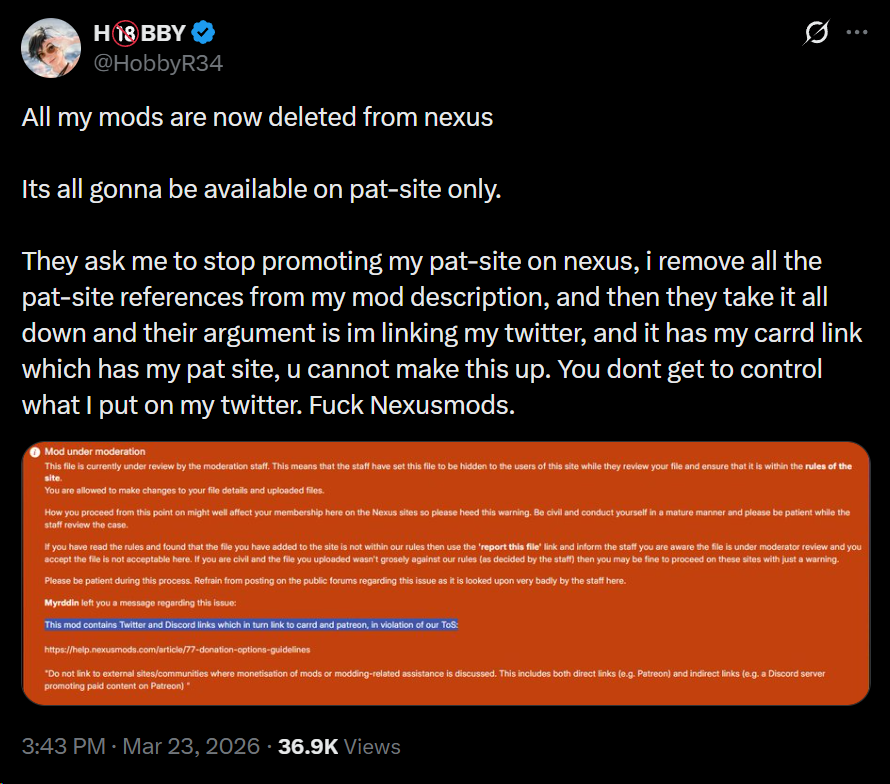
HobbyR34 just had all of his mods completely removed from NexusMods
Nexus staff removed every direct Patreon link mention as they asked. Then Nexus just nuked mods everything because his Twitter links to a Carrd, which links to Patreon.
They are now saying even indirect links through your own Twitter count as a violation of their donation rules.
This is actually odd. Nexus doesn’t own your personal Twitter or what you put in your own bio/links.
Support HobbyR34 for making mods!