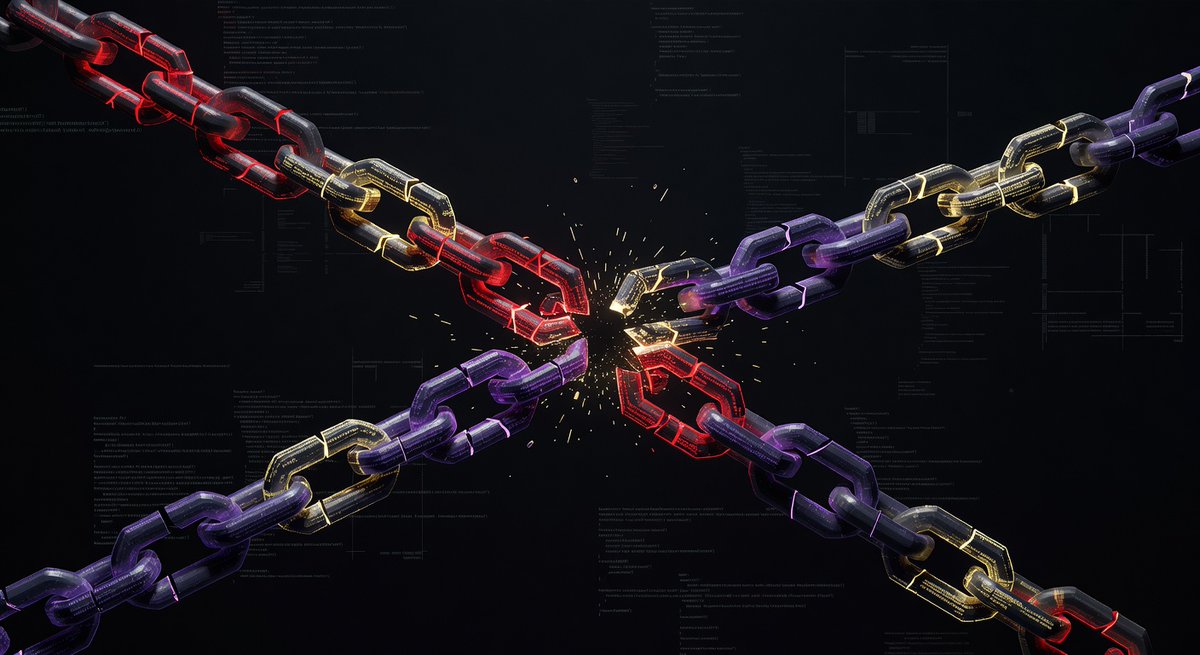
🚨Big announcement in web3 security🚨
This is a game changer for white hats in the blockchain.
Cyfrin is at another level.
Every auditor and developer must check this out immediately!!!🤯
As of today, BattleChain testnet is LIVE.
The pre-mainnet, post-testnet blockchain, where whitehats legally attack your smart contracts before they reach production.
Deploy. Get attacked. Ship stronger.
Here's why we built it, what it is, and how you can get involved 🧵
The @battlechain testnet is now LIVE.
Come enter the ultimate red-team platform.
Give us feedback so we can launch mainnet very soon, and fix web3 security.
⚔️ Anthropic odpowiada na OpenClaw!
Wydali Claude Code Channels – możesz rozmawiać z Claude przez Telegram i Discord. Nazywają to "zabójcą OpenClaw".
Czy OpenClaw utrzyma pozycję lidera? 🦐
#OpenClaw#Anthropic#Claude#AI
Man, we are so far from real security when using cryptocurrencies 😔
It's not easy to show the potential of this technology when you have to watch a series of Cyfrin courses to fully realize the potential consequences of each transaction and gain enough confidence to actually send it😕
Protocols should be your trusted accountant that prevents such sad stories
Earlier today, a user attempted to buy AAVE using $50M USDT through the Aave interface.
Given the unusually large size of the single order, the Aave interface, like most trading interfaces, warned the user about extraordinary slippage and required confirmation via a checkbox. The user confirmed the warning on their mobile device and proceeded with the swap, accepting the high slippage, which ultimately resulted in receiving only 324 AAVE in return.
The transaction could not be moved forward without the user explicitly accepting the risk through the confirmation checkbox.
The CoW Swap routers functioned as intended, and the integration followed standard industry practices. However, while the user was able to proceed with the swap, the final outcome was clearly far from optimal.
Events like this do occur in DeFi, but the scale of this transaction was significantly larger than what is typically seen in the space.
We sympathize with the user and will try to make a contact with the user and we will return $600K in fees collected from the transaction.
The key takeaway is that while DeFi should remain open and permissionless, allowing users to perform transactions freely, there are additional guardrails the industry can build to better protect users. Our team will be investigating ways to improve these safeguards going forward.
@Story91_@ETHWarsaw I was there today, and I can say that the place is great, with a really warm and friendly atmosphere. A home you want to return to - I mean it 😄
OpenAI just shipped Codex Security — an AI agent that scans entire repos for vulnerabilities and proposes fixes.
In beta it scanned 1.2M commits and flagged 10,561 high-severity issues.
As someone who runs a security audit firm, here's what most people are getting wrong about this:
AI finds quantity. It catches the known patterns — reentrancy, integer overflow, access control gaps. It does this faster than any human team ever could.
But the bugs that drain protocols aren't in the OWASP top 10. They're in the business logic. The edge case where a flash loan interacts with a governance vote interacts with a price oracle in a sequence nobody modeled.
That's where human auditors earn their fee.
The real shift: AI makes baseline security free. Which means the market for deep, logic-level audits actually grows. Protocols that thought "we ran a scanner" was enough will learn the difference the hard way.
We've already started integrating AI scanning into our pre-audit pipeline at Zealynx. It handles the obvious stuff so our auditors can focus 100% on the logic that actually kills protocols.
GM GM! Starting stream rn!!!
Building a Game for BB3 Hackathon :O
Also setting up security tools from Cyfrin Blogs - see you there :p
https://t.co/ZwV4mWfG2y
GM GM! Starting stream rn!!!
Building a Game for BB3 Hackathon :O
Also setting up security tools from Cyfrin Blogs - see you there :p
https://t.co/ZwV4mWfG2y
OWASP just released the Smart Contract Top 10 for 2026.
Access control is still number one. In 2026. After billions lost.
What caught my attention is the shift in how attackers operate now. It's no longer one bug, one exploit. They're chaining things together — flash loans with oracle manipulation with weak upgrade governance, all in a single transaction.
The report basically confirms what I've been seeing in audits: the code can be technically correct and still break under adversarial pressure. Integration risk is becoming bigger than contract-level bugs.
Worth reading the full thing if you're shipping anything on-chain this year.