Larry Ellison, the man who built Oracle into a $500 billion enterprise software empire and he said something that every investor needs to hear (Save this).
"By 2029, I can guarantee you, AI is not going to be the problem."
The problem is going to be compute specifically, who has enough of it and who does not.
Ellison described the current AI race in terms that strip away all the abstract commentary about models and capabilities and reduce it to the one thing that actually determines who wins: "Me and Elon begging Jensen for GPUs. Please take our money. We need you to take more of our money, please."
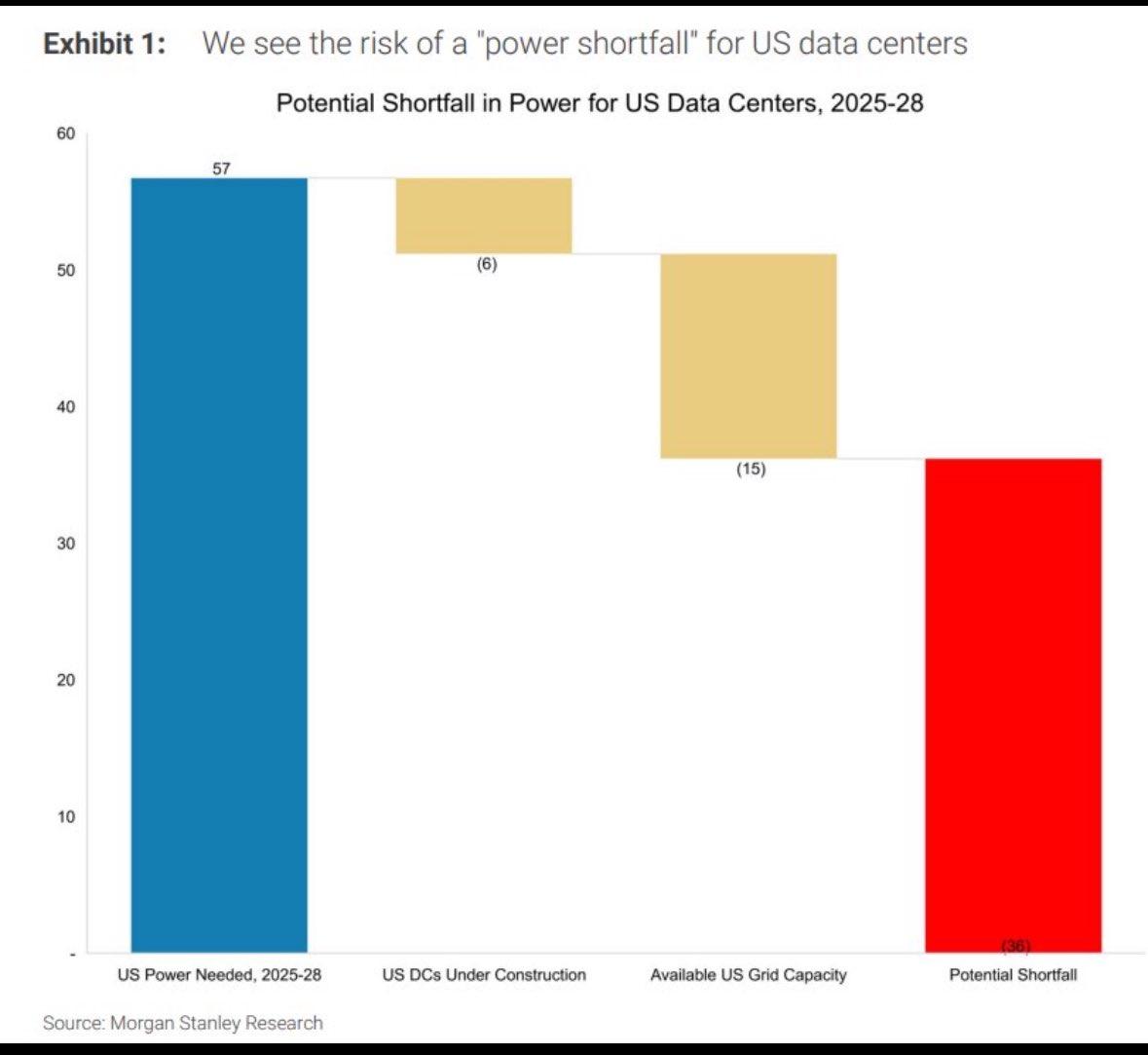
Citigroup raised its forecast for AI infrastructure spending to $2.8 trillion through 2029, with hyperscalers already spending at a $490 billion annual rate by end of 2026 and the firm estimates global AI compute demand will require 55 gigawatts of new power capacity by 2030 at a cost of approximately $50 billion per gigawatt.
Sam Altman publicly thanked Jensen Huang this past March for significantly increasing NVIDIA's capacity at AWS, the CEO of the most important AI lab in the world writing a thank you note to the chip supplier because compute is still the binding constraint on everything OpenAI wants to build.
Ellison's point about getting there first is the part of this clip that deserves a second read.
He named three specific races, self-driving, reading cancer biopsy slides, and synthesizing video and said that being first in each one is a big deal.
The logic is that in winner take most AI markets, the first mover trains the best model, the best model attracts the most usage, the most usage generates the most data, and the most data trains the next best model, a compounding loop that the second-place finisher never catches up to.
"The guys in this race are very smart and they understand they need to be best at something," Ellison said.
What makes this clip so important right now is the timing.
The AI GPU chip market is projected to grow at a 32.4% CAGR through 2029, reaching $145 billion in incremental spend, and NVIDIA's data center revenue is already running at a pace that would have seemed impossible three years ago.
Every major hyperscaler, Microsoft, Amazon, Google, Oracle, Meta is no longer funding AI capex from operating cash flows alone, they are borrowing to keep up, because falling behind in compute now means ceding the winner-take-most race Ellison just described.
At Milk Road, we have been positioned in NVIDIA, AVGO, AAOI, MU, and Bloom Energy and more.
Come join Milk Road Pro and get the full picture on how we are playing every layer of the GPU demand supercycle that Larry Ellison just guaranteed will not slow down before the end of the decade, link below/bio.
Core Scientific new BOD $Corz Steve Smith
Steve Smith ex-CEO of Equinix $Eqix (100B valuation)
- Operated over 270 data centers
- Across 6 continents
- Led > 20 acquisitions
The guy who turned Equinix into a global data center behemoth is now on the $CORZ board.
🚀🚀🚀
🚨 @Core_Scientific just added one of the most credentialed data center executives in the world to its board 🚨
⚡ Steve Smith appointed to Board of Directors — 35+ years of data center and digital infrastructure leadership
⚡ Currently CEO of @ZayoGroup — global internet network provider since 2020
⚡ Previously CEO of @Equinix from 2007–2018 — scaled annual revenue from $400M → $4B+ and oversaw 20+ acquisitions
⚡ Also sits on the board of @NEXTDC — Australia's leading publicly traded data center company
⚡ West Point graduate — BS in Engineering — HP Services, Lucent Technologies and EDS prior to Equinix
The man who built Equinix into a $60B+ data center giant just joined the $CORZ board!!!
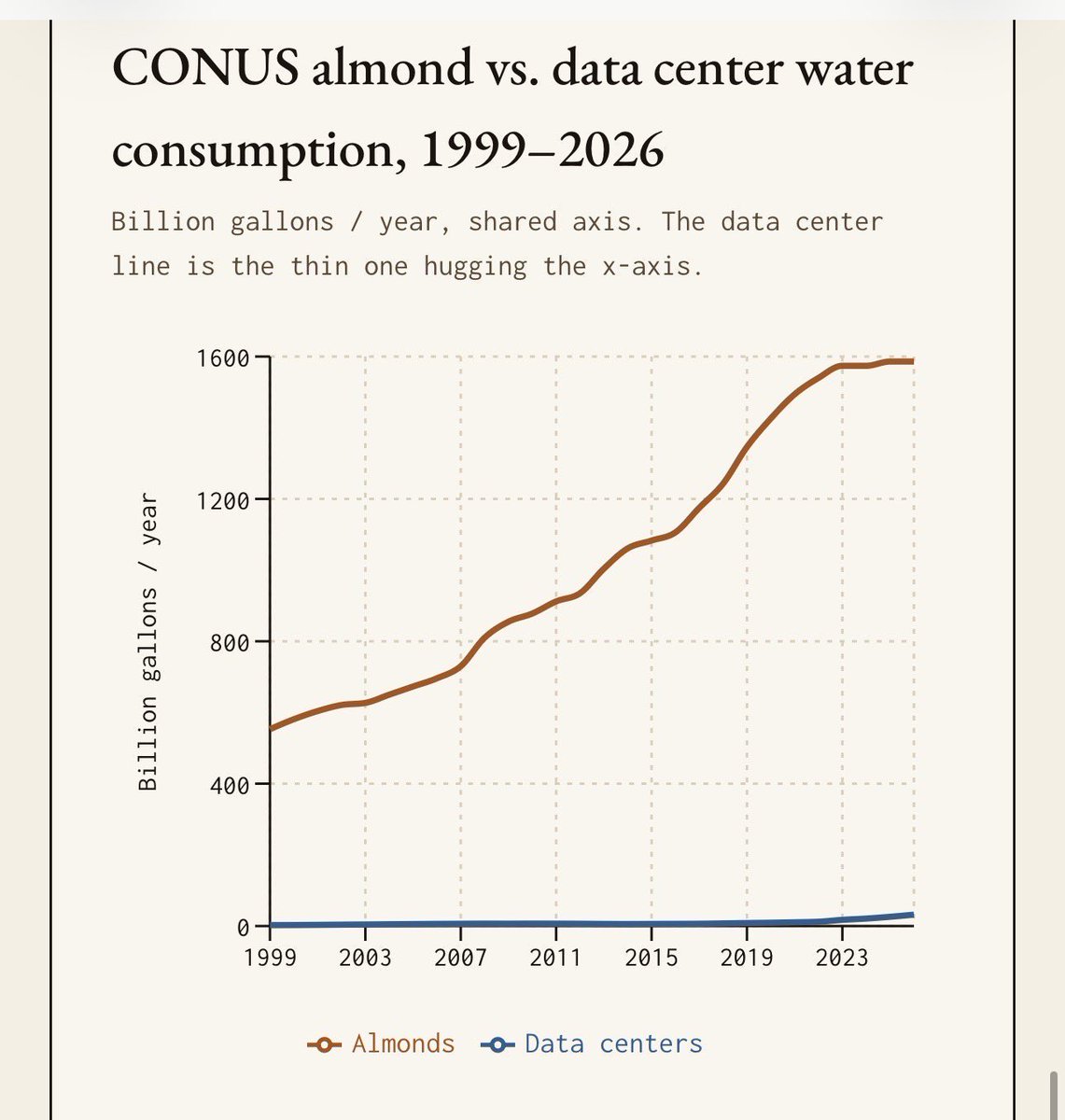
California almond farmers use 1.5 trillion gallons of water per year - 8x more than all US data centers combined.
And golf courses use 500 billion gallons of water.
This isn’t environmentalism; it’s propaganda.
Are green fairways and almond exports more important than space exploration and cancer research?
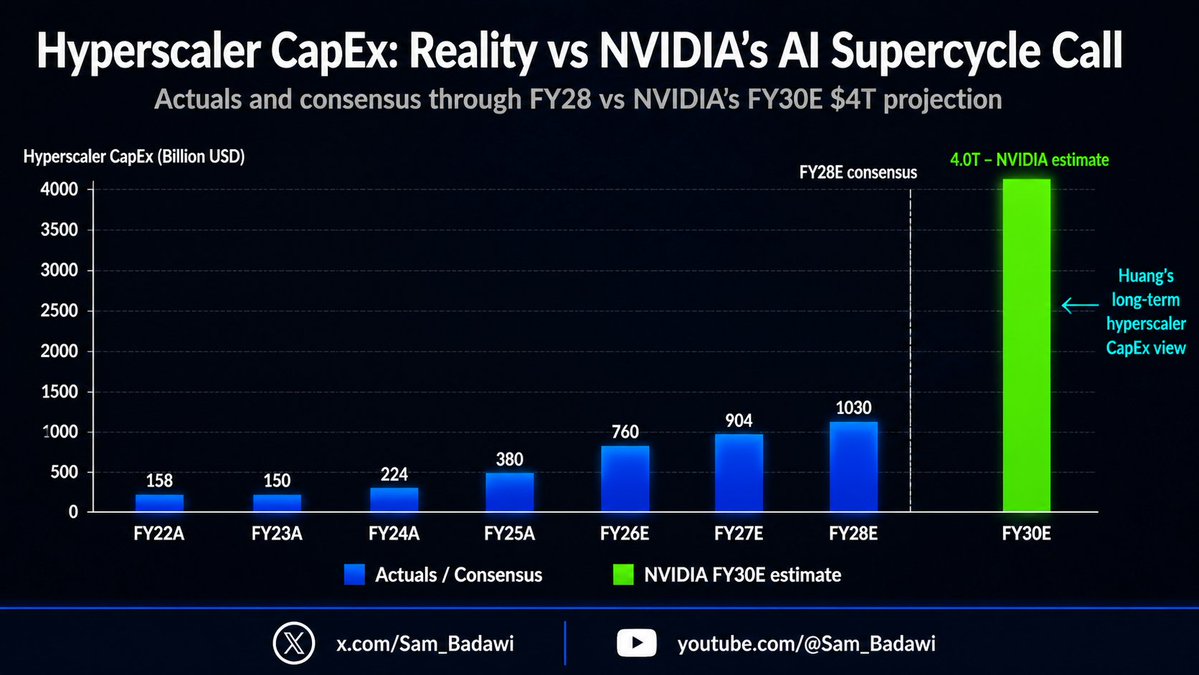
Hyperscaler CapEx consensus estimates imply spending grows from roughly $380B in FY2025 to about $1.03T by FY2028, a 39.5% CAGR.
$NVDA CEO Jensen Huang believes AI infrastructure spending could ultimately reach $4T by 2030, implying a much steeper trajectory beyond current consensus estimates.
That would require spending to accelerate dramatically from FY2028 through FY2030 as demand for compute, networking, memory, storage, cooling, and power continues to surge. Of course, much of that investment would be funded by $AMZN, $MSFT, $GOOGL, and $META.
Take a wild guess who the beneficiaries might be.
But @michaeljburry said AI servers have a 2-3 yr useful life, and hyperscalers using 5-6 yrs overstated earnings.
Yet in 2026, 4-year-old $NVDA GPUs are still running and their rental prices just jumped 20%.
Total clown call. 🤡
Short AI at your own risk
$NVDA just disclosed H100 rental prices are up ~20% in 2026 even though the H100 launched in 2022 and is now three GPU generations old.
That makes contracted capacity at $CRWV, $NBIS, $IREN, $WULF, $CIFR and $APLD more valuable if supply still cannot relieve premium AI compute pricing.
Data centers aren’t stealing your water.
Even if the total water draw of data centers triples by 2030, they’d require just 8% of the water consumed by American golf courses.
@dodgeblake interviewed @AndyMasley, the man who’s been debunking AI water doomerism. Full story 👇
"Everyone's making fun of these Koreans for being long memory stocks. But we're talking single-digit P/E multiples. It's probably going to last 2-3 more years. Triple digit growth." — @firstadopter
"Layer that onto the fact that 4 years ago, all these memory companies saw their revenue get cut in half. So they didn't expand capacity. And it takes 3-4 years to expand capacity."
"We're going to see mega pricing power. We haven't seen anything yet. These stocks are going to keep going higher, and their revenue rates are going to be astronomical."
The healthy LDL number has been quietly moving its own goalposts for forty years:
- 1988: under 160
- 1993: under 130
- 2001: under 100
- 2004: under 70 for the high-risk
- 2019: under 55 for the very-high-risk
- Current trajectory: as low as possible, indefinitely
The science did not change.
The line did.
Move the line down by 30 milligrams and you have invented millions of new patients overnight. Same arteries. Same people. Different number on the page. Blood that was healthy on Friday is a chronic condition on Monday.
A diagnosis you can give to anyone is a prescription you can sell to anyone.
The line is wherever the next prescription pad needs it to be.
Testosterone is made from cholesterol.
Oestrogen is made from cholesterol.
Cortisol is made from cholesterol.
Vitamin D is made from cholesterol.
Bile acids that digest fat are made from cholesterol.
Progesterone, which sustains pregnancy, is made from cholesterol.
Every cell membrane in your body contains cholesterol.
Every nerve is insulated by myelin, which is largely cholesterol.
Every memory you form requires cholesterol to build the synapse that holds it.
Your brain is 60% fat, mostly cholesterol.
Breast milk is rich in cholesterol because infant brains cannot develop without it.
Nature, given the job of designing the perfect first food, put cholesterol in it.
When you eat less of it, the liver makes more.
Because the body knows it cannot function without it.
We declared war on cholesterol in 1977.
Testosterone in men has dropped 25%.
Vitamin D deficiency is now endemic.
One in three adults over fifty is on a statin lowering the cholesterol the body is desperately trying to maintain.
Depression rates have tripled.
Infertility rates have doubled.
The war is going well.
When butter was demonised, Unilever sold margarine.
When tallow was demonised, Procter and Gamble sold Crisco.
When eggs were demonised, Kellogg's sold cereal.
When red meat was demonised, Cargill sold soy.
When raw milk was demonised, Nestle sold infant formula.
When leather was demonised, BASF sold PVC.
When wool was demonised, ExxonMobil sold polyester feedstock.
When animal fat was demonised, the seed-oil industry grew from a niche product to the most consumed food ingredient on earth.
Every demonisation of an animal product made a specific group of shareholders very rich.
Every one of those products had been eaten by humans for thousands of years without incident.
The science changed the moment a substitute existed to sell.
Follow the money. The advice will start to make a lot more sense.
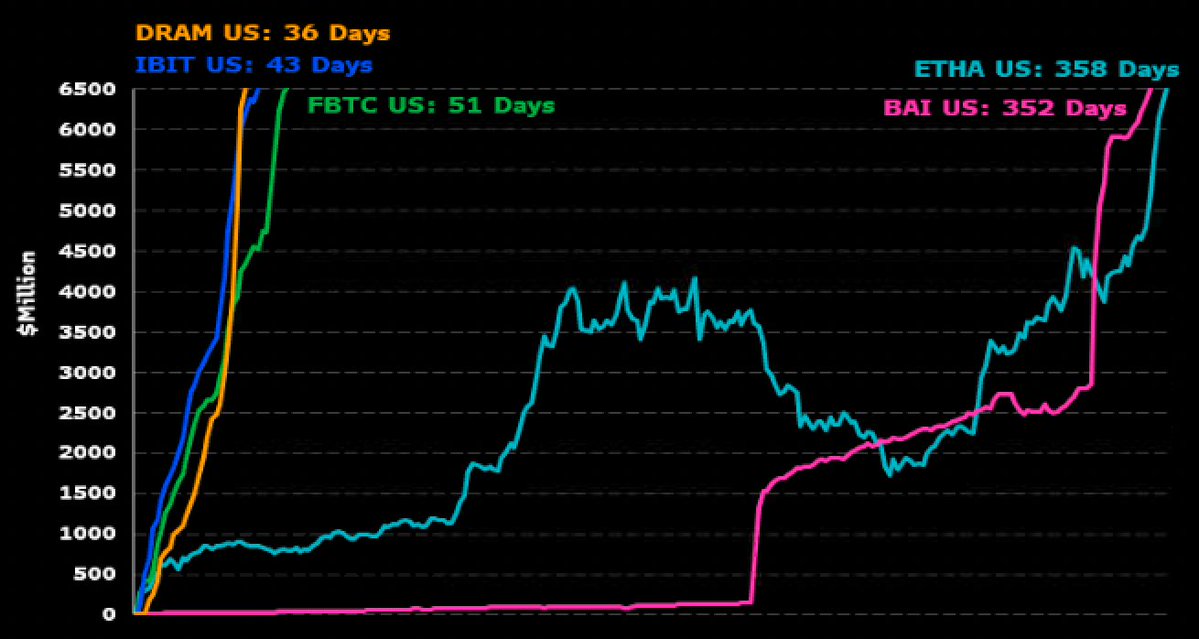
The global AI server market will grow ~$2T in the next 4-6 years (without robots). That means we’ll need at least 35× more high-speed memory (HBM/DRAM) than currently exists, from a handful of memory companies that are already sold out. Long $DRAM $MRAM and almost all others.
FASTEST-EVER: $DRAM hit $6.5b in 36 days on the market, faster than any other ETF, incl the Mighty IBIT who took 43 days to hit that mark. Thanks in part to going up 13% on Fri alone and taking in (another) $1b in flows. I'm stunned, frankly. Regardless of what happens from here this was one of the most heads-up, best timed ETF launches I've ever seen.
New Poll Best Mexican Restaurant in the State of Nevada.
FinanceBuzz and Aol just ranked @ElDoradoVegas the best Mexican restaurant in the state.
No seed oils @SeedOilScout
Real tallow for the chips and frying.
Organic and non-GMO ingredients.
https://t.co/OqABmfs8Jv
A kid drew himself sleeping in bed between mom and dad and labeled it 'safe.'
In Japan, this exact sleeping arrangement has a name. They call it 'the river.' Mother is one bank. Father is the other. The child between them is the water. Roughly 70% of Japanese mothers sleep this way with their kids, sometimes through the teenage years. The Western model of putting a kid alone in their own bedroom is barely 200 years old. For most of human history, in most cultures still alive today, kids slept beside their parents.
James McKenna runs the Mother-Baby Behavioral Sleep Lab at Notre Dame. He spent decades watching what happens when parents and kids share a bed. The bodies sync up. Heart rates align with the parent's, breathing falls into the same rhythm, and by morning even sleep stages have started matching. The parent's body, in McKenna's words, acts as a kind of biological jumper cable for the child's.
In 2013, researchers in the Netherlands tracked 193 babies through the first year of life. They measured cortisol, the brain's main stress hormone. Babies who had spent more weeks co-sleeping in the first six months produced less cortisol under stress at 12 months. Sleeping near a parent had rewired the kid's stress system to be calmer under pressure.
Inside the kid's brain at night, the amygdala, the fear alarm, gets more sensitive as the body gets tired. Darkness makes it worse. A 2021 paper in PLoS One from Australian researchers showed that light directly suppresses amygdala activity. Lights off, alarm louder. The whole brain is wired to read 'alone in a dark room' as a threat.
Now add a parent's body to that bed. The kid's nervous system reads warm body, breathing nearby, familiar smell. The threat alarm dials down. Two parents on either side dial it down twice. The drawing is the kid's brain calculating maximum safety: I am surrounded by the people who keep me alive, and nothing can reach me without going through them first.
The arrangement in this drawing is what most of human history called 'sleeping.' Sleeping the kid alone in another room is a 200-year-old Western invention that we forgot was an invention. Every kid who has ever padded into your room at 3am and crawled into the middle of the bed is just trying to redraw the picture.
Today, Core Scientific announced a multi-tiered strategy to scale its Muskogee, Oklahoma campus to approximately 1.5 GW of gross power, or approximately 1 GW of leasable power.
Read the full press release here: https://t.co/RjN716JEuA