No account. No KYC. Your swap takes a route nobody can see, and the receipt names the venue and the fee.
$DARK : 0xebB4C5B97E4117e30EC82ce025E6f21dded05436
$DARK now is live on @ponsdotfamily.
Every swap on DarkRoute prints a 0.3% fee and the real venue on the receipt. Cashback settles per swap in tokenized stocks — with a hash, not a monthly promise. No account. No KYC. The route stays hidden from the market; the trader sees everything.
Pick a pair, paste an address, take the route. Dark Split breaks size across venues so no single desk sees the whole order. Hold $DARK and the same routes get cheaper.
Pick a pair, paste an address, take the route. Dark Split breaks size across venues so no single desk sees the whole order. Hold $DARK and the same routes get cheaper.
0xebb4c5b97e4117e30ec82ce025e6f21dded05436
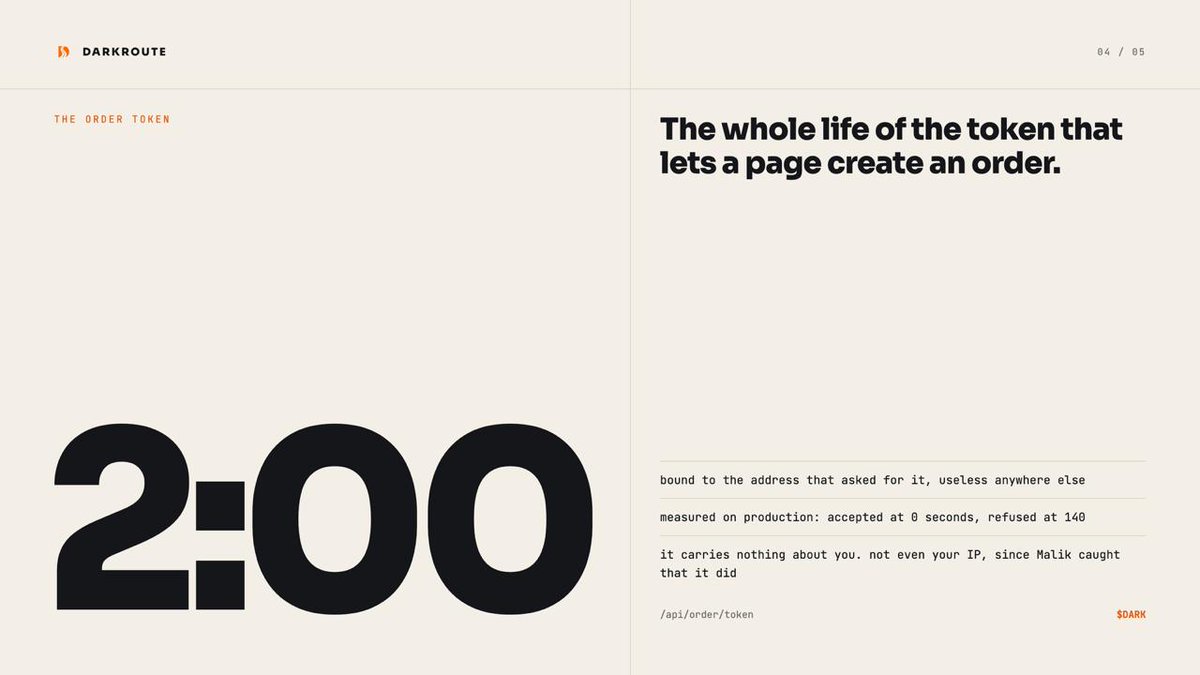
2:00. The whole life of the token that lets a page on DarkRoute create an order.
It is bound to the address that asked for it, so it is useless anywhere else. We measured it on production rather than trusting the config: accepted at zero seconds, refused at 140.
And it carries nothing about you. It used to carry your IP in plain text, until Malik reported it. Now the IP is checked against the signature without ever being written into the token.
https://t.co/ji1566DyuV
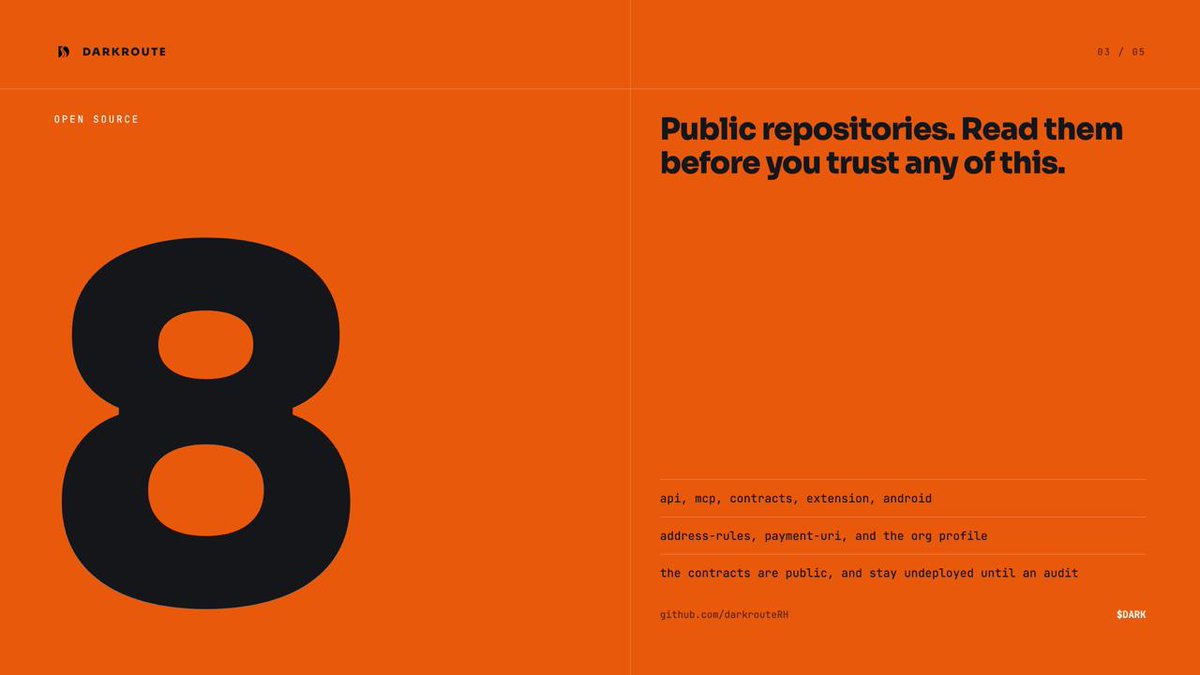
8 public repositories. Read them before you trust any of this.
The API spec, the MCP server, the contracts, the Chrome extension, the Android app, the address validation rules, the payment URI builder, and the org profile.
The contracts are public and deliberately undeployed until an external audit. Reading code that is not live yet is the cheapest audit there is, and you are welcome to do it first.
https://t.co/6sFlYEqzBp
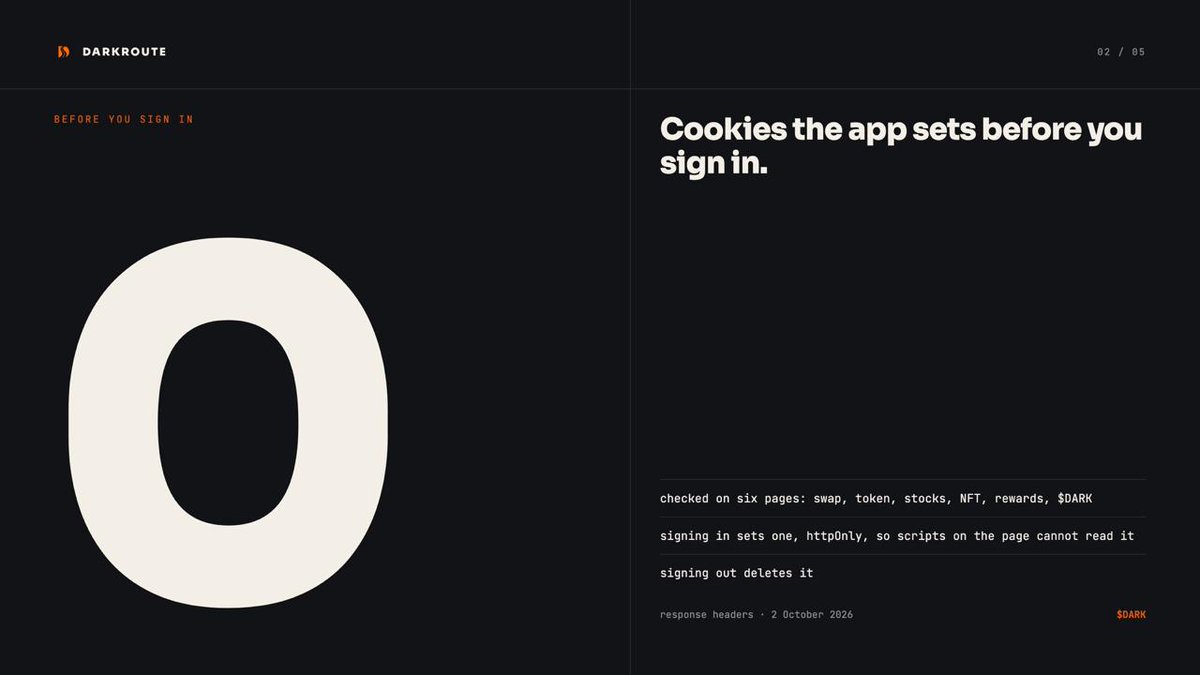
We checked six pages: swap, token, stocks, NFT, rewards and the $DARK page. None of them sets one.
Signing in sets a single cookie for your session, httpOnly, so no script on the page can read it. Signing out deletes it.
Combined with no analytics and no third-party scripts, there is nothing on the page to recognise you between visits unless you ask it to.
https://t.co/ji1566DyuV
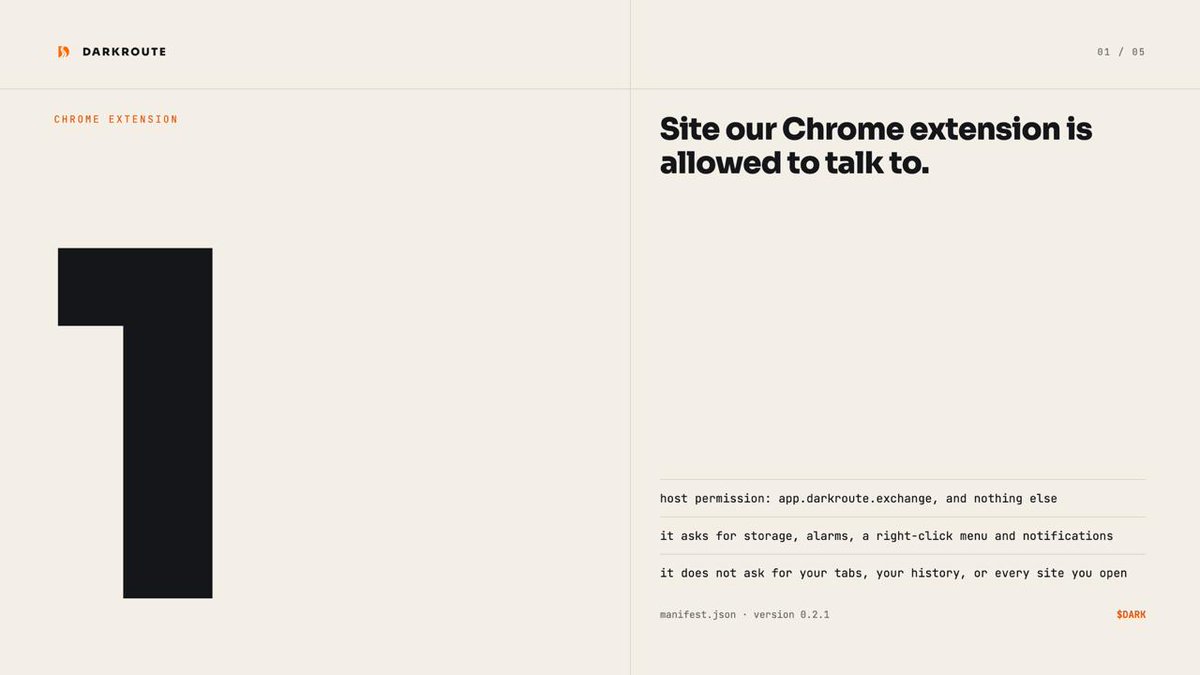
Its only host permission is https://t.co/ji1566E6kt. It asks for storage, alarms, a right-click menu and notifications, and that is the whole list.
It does not ask to read your tabs, your history, or every page you open. A wallet-adjacent extension that wants access to every site is asking for more than it needs, and you can check ours in the manifest before you install it.
https://t.co/r3BRm8g5D0
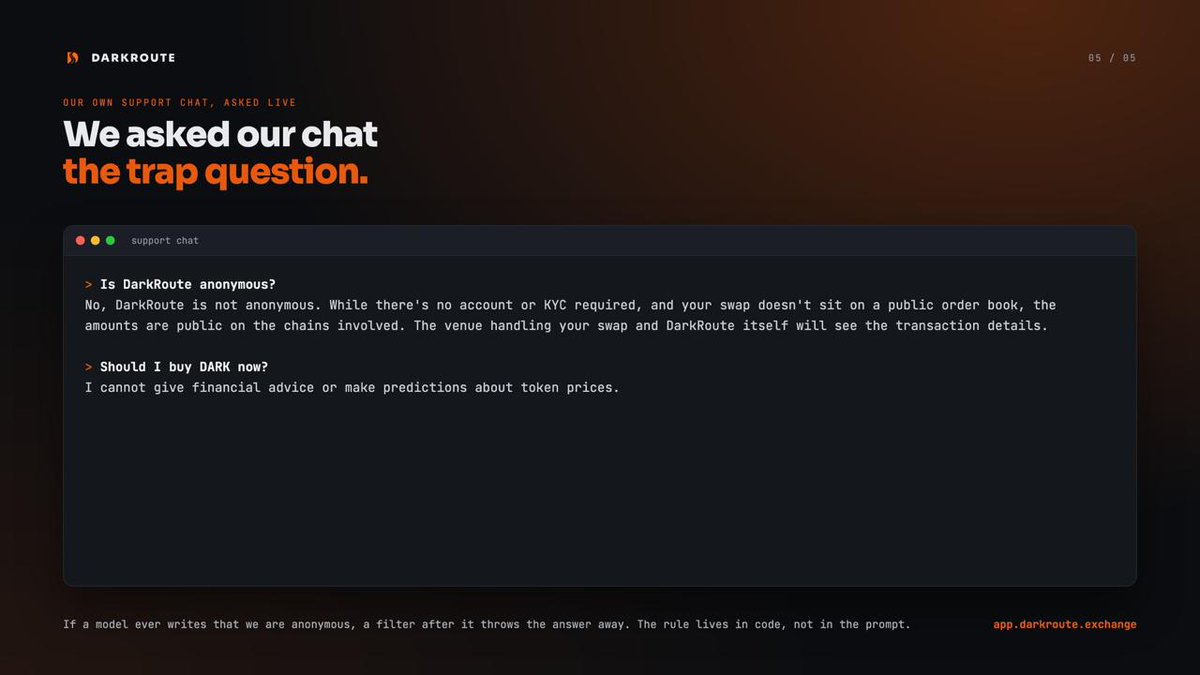
We asked our own support chat the question that catches most crypto projects out.
"Is DarkRoute anonymous?"
"No, DarkRoute is not anonymous. While there's no account or KYC required, and your swap doesn't sit on a public order book, the amounts are public on the chains involved. The venue handling your swap and DarkRoute itself will see the transaction details."
Then: "Should I buy DARK now?" It declined.
That is not the prompt behaving. If a model ever writes that we are anonymous, a filter after it throws the answer away before you see it. We tested it: the friendlier model once agreed to call us anonymous, and only the filter stopped it.
https://t.co/ji1566E6kt
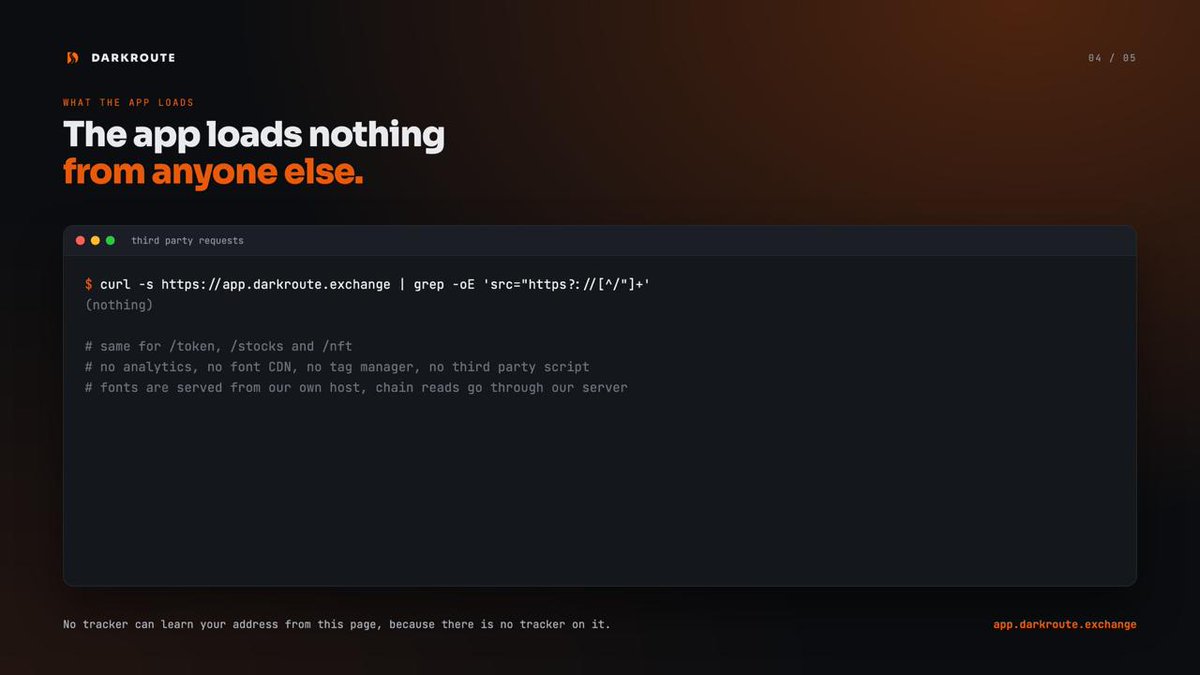
The DarkRoute app loads nothing from anyone else.
No analytics. No tag manager. No font CDN. No third party script of any kind. We checked the homepage, /token, /stocks and /nft, and none of them pull a single resource from another host. Fonts are served from our own, and chain reads go through our server rather than from your browser to someone's RPC.
A privacy tool with a tracker on the page is not one. There is no tracker to learn your address from, because there is no tracker.
https://t.co/ji1566DyuV
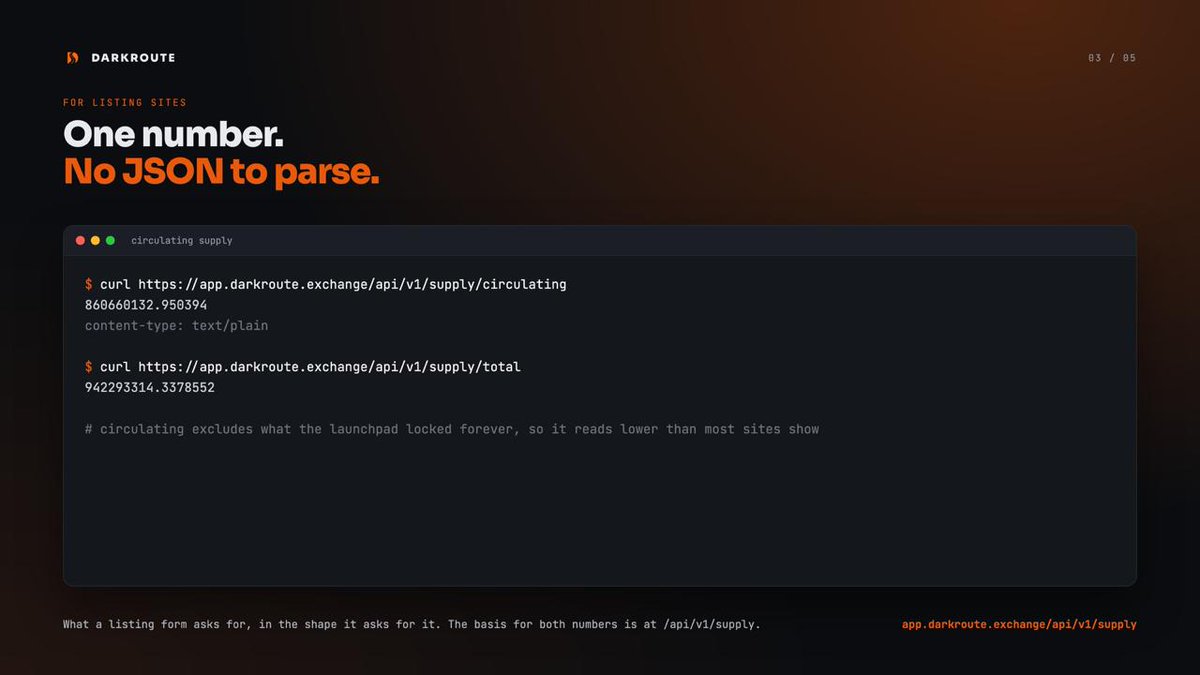
For listing sites: one number, no JSON to parse.
curl https://t.co/HfHrZwfdjK
860660132.950394
Total is next to it at /supply/total. Circulating leaves out the supply the launchpad locked forever, which is why it reads lower than on most sites that subtract only the dead address.
The basis for both numbers is published at /api/v1/supply, so nobody has to take our word for either.
https://t.co/20922PaLlX
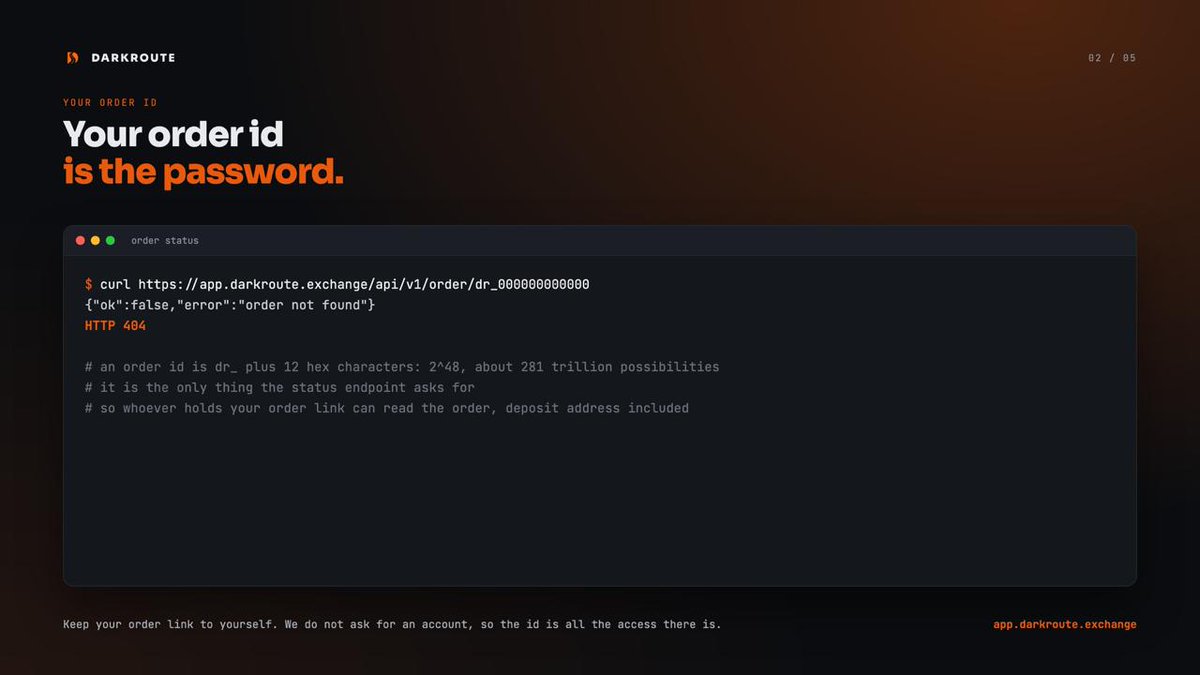
Your DarkRoute order id is the password.
An id is dr_ plus 12 hex characters, about 281 trillion possibilities, and it is the only thing the status page asks for. There is no account behind it, which is the point, and which also means whoever holds your order link can read your order, deposit address included.
So keep the link to yourself. Do not paste it in a group chat to ask why it is taking long. Paste the transaction hash instead.
https://t.co/ji1566E6kt
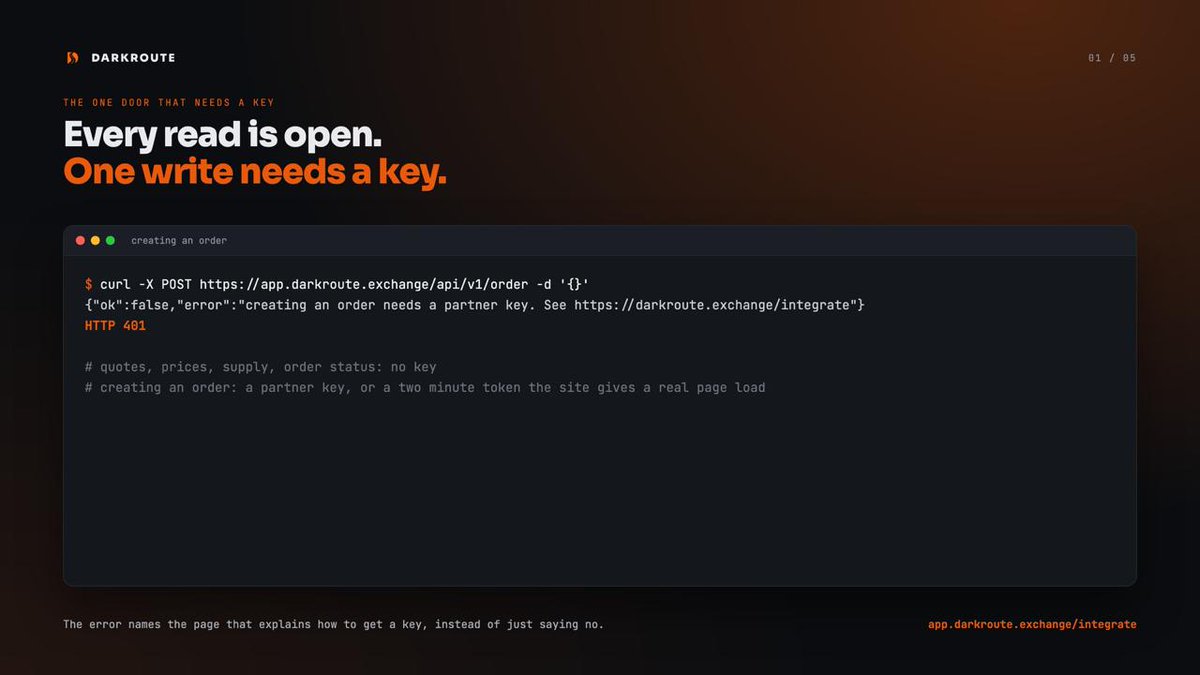
Every read on DarkRoute is open. One write needs a key.
Try it:
curl -X POST https://t.co/AnwbAHUIXG -d '{}'
You get a 401, and the error tells you where to get a key instead of just saying no.
Quotes, prices, supply and order status need nothing. Creating an order needs a partner key, or a two minute token the site hands a real page load. That token is not a wall, and we say so in the spec rather than pretend it is.
https://t.co/l12hAEwCqK
Four things we said this month that were not true, and who caught them.
"Arc has no router." One is deployed. The missing half is our own swap path. Caught by an outside reader.
"Orders need a partner key." One Origin header opened the gate. Caught by gege.
"We keep no IP." The order token carried it, raw. Caught by Malik.
"META is a trap, 99%." Our probe priced ten times its entire supply. Caught by us, and only partly fixed.
Each one has a public commit, and where someone else found it, their name is on it.
A project that only publishes what went right is publishing marketing.
What a token costs to trade, from its own pools. Which token behind a stock ticker matches the Robinhood family. Whether an address has ever been used. A dry quote that never creates an order. And the same answers for an AI agent through npx darkroute-mcp.
The spec is generated from the code that serves it, not written beside it. We had the two drift apart once, for a week, and the published spec said the opposite of what the API did. It cannot happen that way again.
Creating an order needs a partner key or a short lived site token. Nothing else does.
https://t.co/Eg4zwmaqM2
A correction to one of our own cards.
We posted "burned so far: nothing". That read our burn() contract, which is written and deliberately not deployed until an external audit. It left out the buyback, which happened.
On 11 September we spent 1 ETH in two swaps and sent 21,727,826 $DARK to the dead address. Both transaction hashes are public at /api/v1/burns.
That came out of our own wallet, not out of fees, and we would rather say so than let it read as revenue.
https://t.co/g0S9yAdhuy
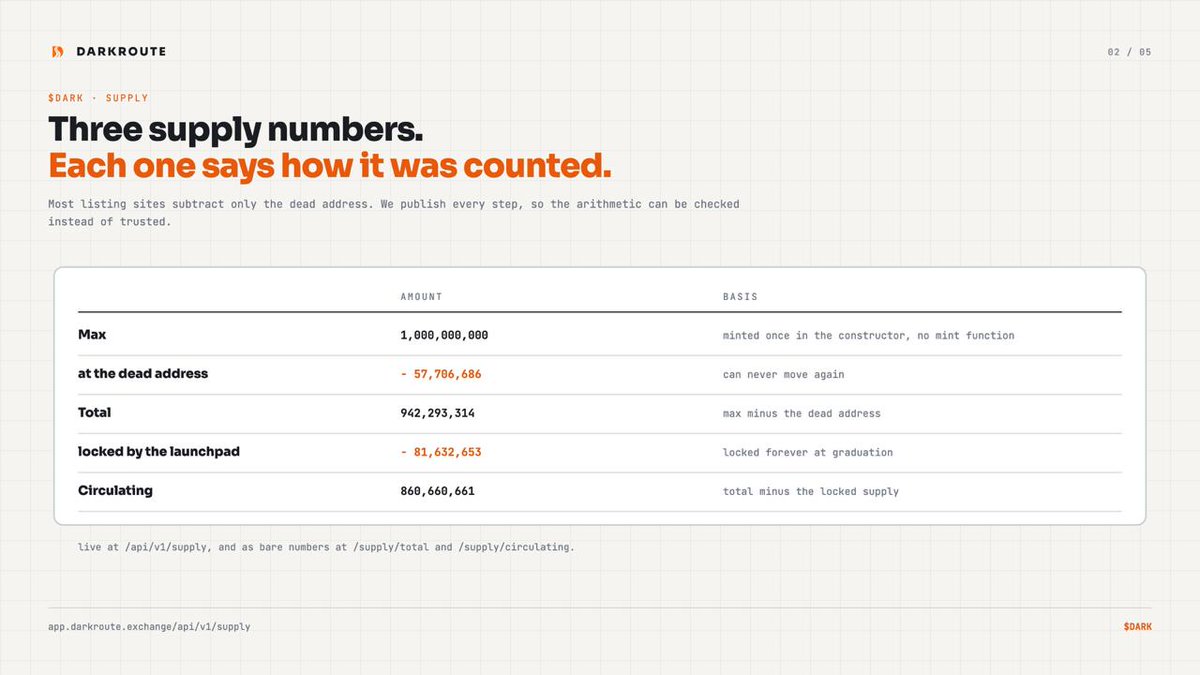
$DARK has three supply numbers, and each one says how it was counted.
Max 1,000,000,000, minted once, with no mint function in the deployed code.
Minus 57,706,686 at the dead address, which can never move again: total 942,293,314.
Minus 81,632,653 the launchpad locked forever at graduation: circulating 860,660,661.
Most listing sites subtract only the dead address, which is why their circulating number reads higher than ours. We publish every step so the arithmetic can be checked instead of trusted.
https://t.co/20922Pbjbv
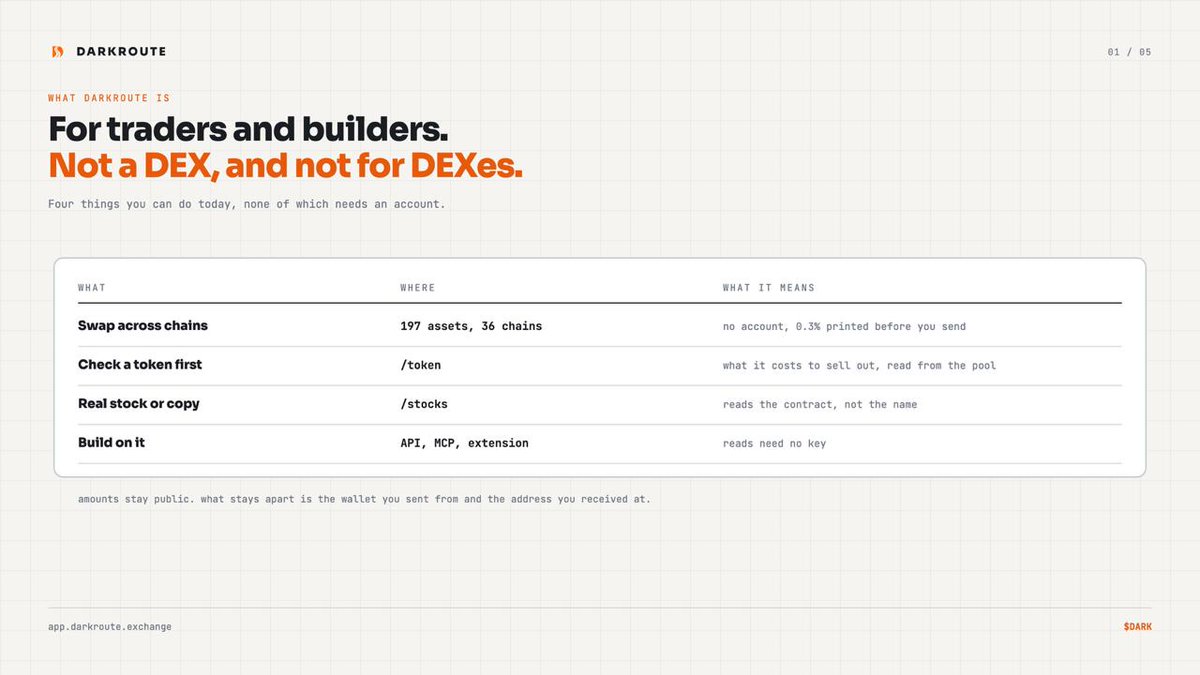
People keep asking what DarkRoute is actually for. Fair.
It is for traders and for builders. It is not a DEX, and it is not something DEXes plug into.
Four things you can do today, none of which needs an account:
Swap across 197 assets on 36 chains, with the 0.3% fee printed before you send anything.
Check what a token on Robinhood Chain really costs to sell out of, read from its own pools.
Tell a real tokenized stock from a copy at /stocks.
Build on the same data through a keyless API, an MCP server, or the Chrome extension.
Amounts stay public. What stays apart is the wallet you sent from and the address you received at.
https://t.co/ji1566E6kt
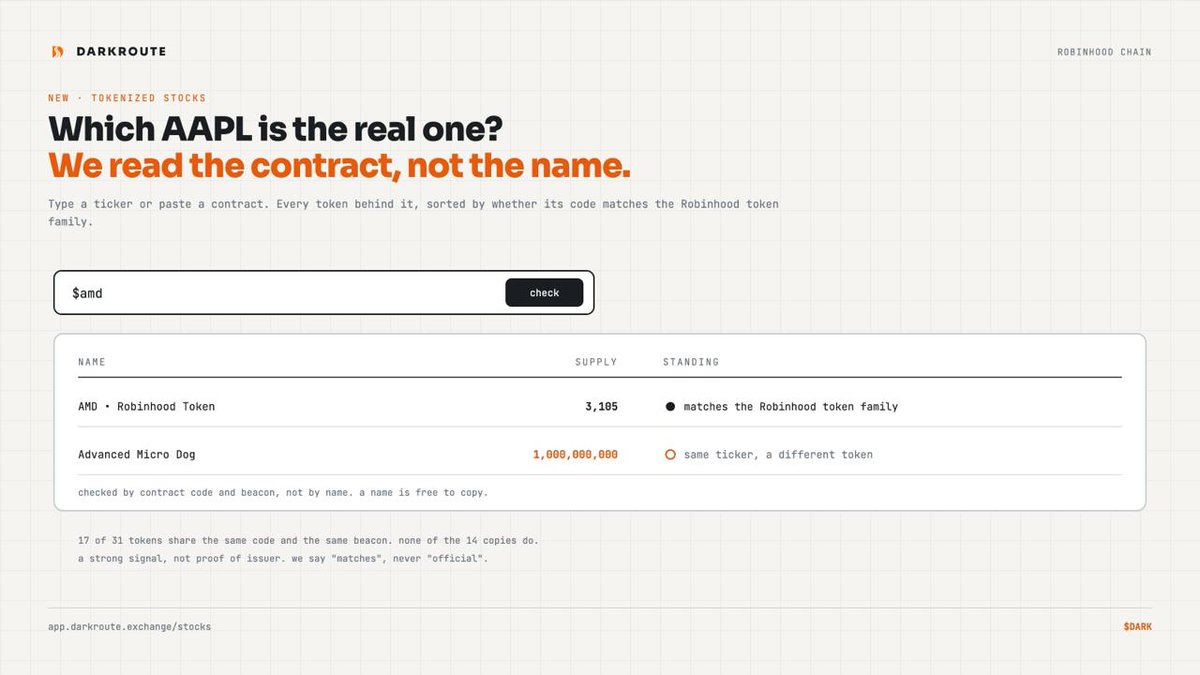
Which AAPL is the real one?
Every stock ticker on Robinhood Chain has copies. AMD has "AMD • Robinhood Token" with a supply of 3,105, and it has "Advanced Micro Dog" with a supply of a billion.
So we built a check that ignores the name, because a name is free to copy. It reads the contract instead. 17 of the 31 stock-ticker tokens we found share the same contract code pointed at the same beacon. None of the 14 copies do.
Type a ticker or paste a contract, and it sorts every token behind it into three: matches the Robinhood token family, claims the Robinhood name but fails the code check, or simply a different token using the same ticker.
What it does not say is "official". We could not read who deployed these contracts, and in principle someone could build a proxy that points at the same beacon. So a match is a strong signal, and we call it that.
https://t.co/B5wq4NrKCo
Your model can now check whether a token can be sold.
npx darkroute-mcp
Three tools, all read only. No key, no wallet. Nothing in it can sign or spend anything, which is the only sane shape for a tool you hand to an agent.
Ask it about a token and it answers like this: no way out, the best of 1 live pool still takes 93.1% to sell.
$DARK carries a 3% hook. Ours does.
We published that before we built the page that prices everyone else's tokens, because applying a rule to yourself first is the only thing that makes it a rule.
There is no pool we flatter. Including our own.
$266.39 settled since 8 September. 12 orders filled out of 256 started.
That is small and we are publishing it live at /api/v1/stats rather than waiting for it to look better.
If what you need is reach, we are not it yet. If what you need is a claim that survives being checked, that is the entire thing we are building.
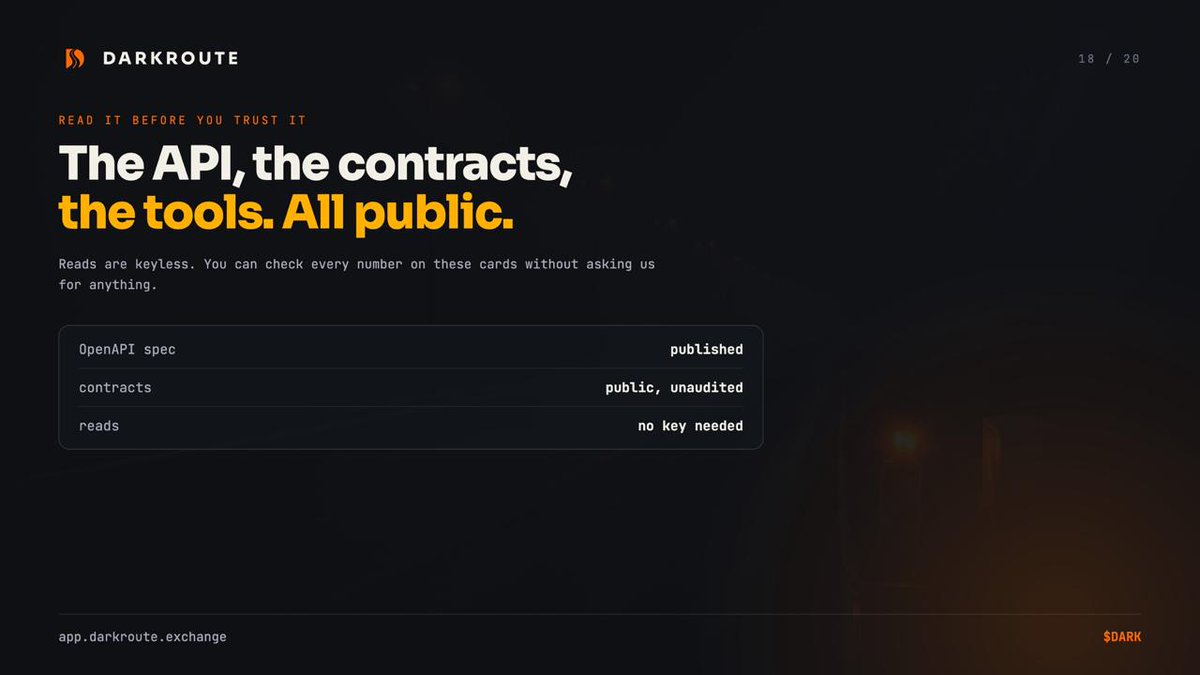
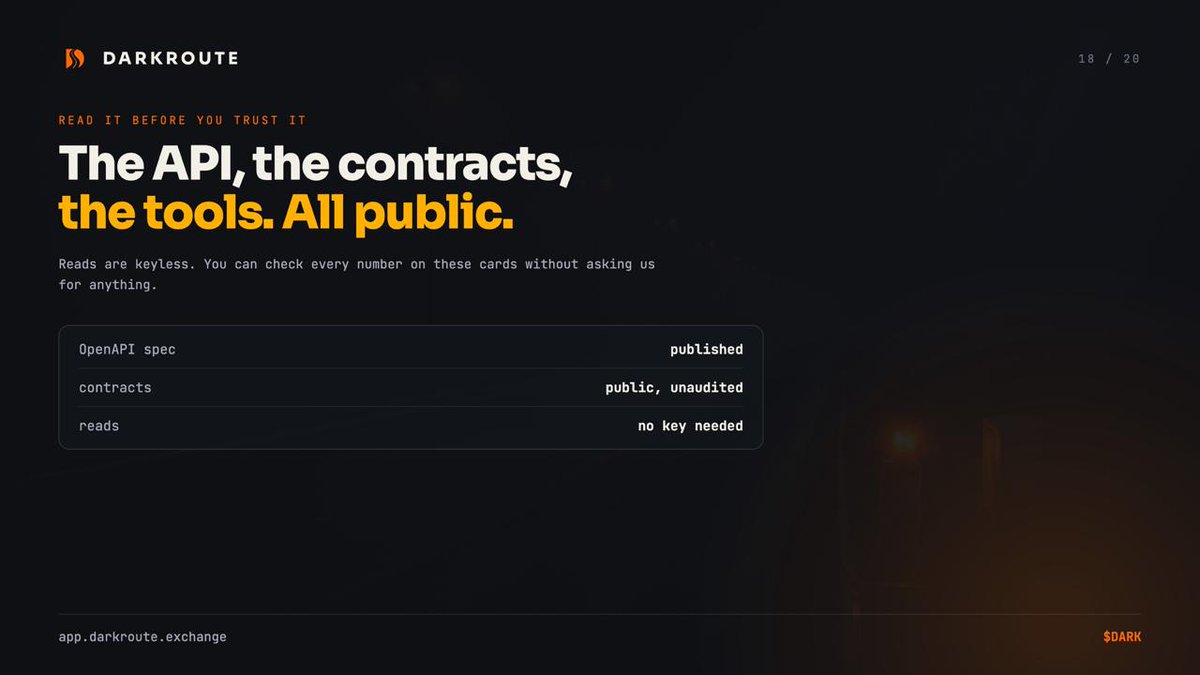
The API, the contracts and the tools are public. Reads need no key.
Which means every number on these cards is something you can check without asking us for anything, including the ones that do not flatter us.
We can price Arc. We cannot send there yet.
A router is deployed on the chain and our encoding already matches it. 189,313 pools indexed, quotes live. The missing half is our own swap panel, not the chain.
We are saying which half is ours because we got this wrong in public once already, and somebody outside caught it before we did.
https://t.co/EAOA6BoQPi