$btc countertrend shorts
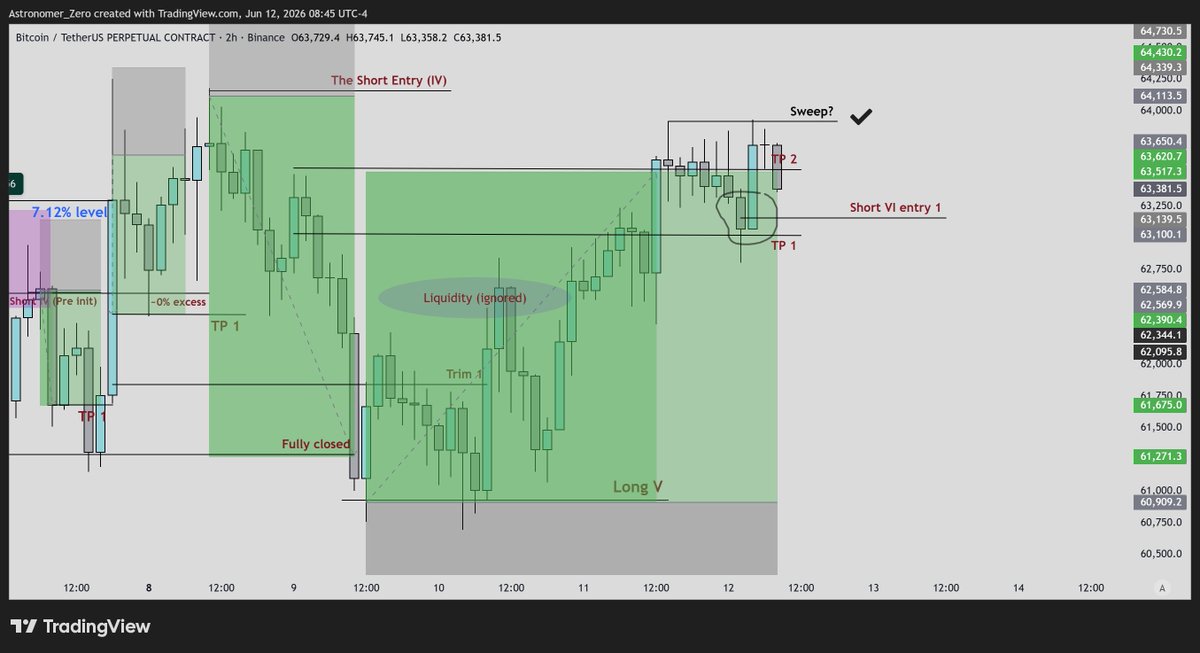
Quick update again: sweep took place as it stands. ✅
Now we just need to breach through the local cluster to receive a payout on our shorts.
Because if that cluster fails after a sweep, the markets intent of an hourly bearish bias is confirmed and we reach for the lows just below.
Patience is required because the sweep didn't take place on all exchanges. But that's not a requirement. Only binance matters (highest volume).
Reprezentacja Haiti na oficjalnych koszulkach w których zagra na Mistrzostwach Świata umieściła POLSKĄ FLAGĘ!
To nie błąd projektanta ani przypadek – to wyjątkowy gest pełen szacunku, który porusza serce każdego Polaka. W 1802 roku Napoleon wysłał kilka tysięcy żołnierzy z Polskich Legionów na San Domingo (obecne Haiti), żeby zdławić tamtejsze powstanie niewolników. Polacy jednak wybrali inną drogę. Zamiast walczyć przeciwko walczącym o wolność, wielu z nich przeszło na stronę powstańców i stanęło do walki ramię w ramię z Haitańczykami przeciwko wojskom francuskim. Po zwycięstwie rewolucji i ogłoszeniu niepodległości w 1804 roku, pierwszy przywódca Haiti – Jean-Jacques Dessalines – oddał Polakom wielki hołd. Przyznał im pełne obywatelstwo, a w konstytucji nazwał ich „Białymi Murzynami Europy”. Były to słowa najwyższego uznania i braterstwa w tamtych czasach. Część polskich żołnierzy (ok. 400–500) została na wyspie na stałe, głównie w regionie Cazale, gdzie ich potomkowie mieszkają do dzisiaj. Dziś, ponad dwieście lat później, pamięć o polskiej odwadze i solidarności wciąż żyje na Haiti. Kiedy ich piłkarze wychodzą na murawę, niosą na piersi symbol naszej wspólnej historii – historii walki o wolność, która nie zna granic ani koloru skóry.
$btc shorts
61.2k reached ✅Target reached, fully closed shorts. 4 W's in a row.
Alright! The story of the shorts are long, and the story of the shorts are strong.
We took them with conviction, a slow build, a slow and long process, because we said to not take any partials, until our target.
Well, with 4.6% deep into the move, no partials taken so far, and now our 61.2k target hit, I don't think there is any need to wait any longer, and we simply close the trade.
Thank you all for playing along, it's been a joyful ride.
Eyes on a long next, because this is our 7% bounce.
$btc - low/mid timeframes
Time to build shorts, to slowly but surely start planning for the retest of the lows.
Alright, now that we received our 7.12% bounce, we can move on to the next step of our masterplan, where some crucial moments are coming up in the market of bitcoin over the coming days/weeks.
Because not only does it mean that the low is likely in on the high timeframes per my metric, it also means that the market makers are preparing for a drop back down to retest the wick.
Why? Because into the bounce which is forming, many "engagement farming bears" (bears who weren't loud at 83k but only are now) have been trapped into the 60k low (whether it is with their positions, or in their posts which induce followers to sell at the worst time).
They are getting trapped now because at 83k they were silent so their followers likely thought they were wrong at that time, and now they talk very loudly, so that confidence translates and many positions have been sold into the 60k low (peaking into the excess period).
That's not to "dunk" on the bears, I have nothing but respect for all participants in the sport of trading. But it's a mere sentiment read, of how engagement farmers are always bearish and bullish at the worst times.
And the same sentiment is true throughout the sizes who control markets up to the large funds' level, hence why I address it and so we can act accordingly.
So the bears (or followers of the bears), have been trapped (refer to the order flow) and are likely performing some hedged moves such as calling for bottoms or rallies the next months, create vague tweets (without specifying entries or exact numbers/levels) or any other shady business which is not helpful to anyone trading, in fact, the opposite.
Again, not an offence, but a great sentiment sentiment read, to know what the best next trade is, which IMO is a short. One of those slow and size and sizeable shorts.
One that I aim to build over multiple stages by the way, as I want to up the size dramatically over time given the conviction of how many bears are trapped and now getting liquidated.
Good liquidity to fuel shorts upon and get our retest of the lows in the coming days/weeks.
Indeed, it won't be Tomorrow most likely, but that's good. The longer the bounce takes, the better for the bottoming process, the more entries we may allow ourselves to ad, and the bigger the pay-out, and
Give it time, but time is nothing but what I have.
Current leverage on these shorts: 1.1x
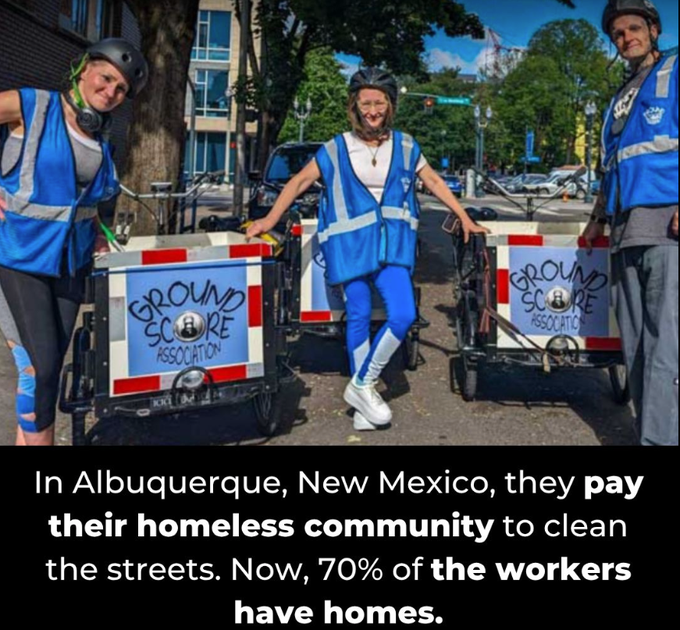
In a groundbreaking social initiative, Albuquerque, New Mexico launched a program that pays homeless individuals to clean streets, parks, and public areas.
The idea was simple — offers work, dignity, and purpose instead of punishment or pity.
The results were remarkable: over 70% of participants have now secured permanent housing or full-time employment, transforming their lives and communities alike. The city’s “There’s a Better Way” program proves that compassion-driven policies can be more effective than traditional welfare systems.
Bukele embodies what it means to be a true leader of a country.
He asked God for guidance and put his faith there in everything he does - to serve his people. The results speak for themselves. Switzerland 🇨🇭 can learn from El Salvador 🇸🇻
$btc
Shorts now fully closed.
Quick note on the shorts. Not going to give any extensive detail, I'm sure some of you are tired of me talking about them the last month.
But we still had 10% running. And with this trade up 18.25 RR, that's worth an entire trade on its own (1.825 RR). So I'm glad to announce that the wait is over, we reached into the entire trends golden zone, silver zone, a local avwap, and we have just taken out May's low on monthly open, with weekly open above.
Those are a lot of confluences, almost enough for another long. But first, time to close shorts.
Goodbye, it's been nice holding them for almost an entire month. Won't be interested in any large swing shorts like this anymore in a while as you know. Longs only next per plan.
Per my daily (and weekly) bullish bias. Another big announcement, is that I am also interested in spot again, which I also look to buy our second macro buy into (if you remember, the first one was placed at the start of Feb).
How I enter and exit positions.
Why it matters, how I do it, and why most people focus on the wrong aspects.
The golden gate to better trading.
Some context
It's been a while I wrote an educational post. For a reason, I don't particularly like the idea of only writing educational posts constantly. I set the bar high and they have to come along when it makes sense. And besides that, my focus is calls, direction, and posts that are directly tuned to make you and me money.
It's most likely why you follow me, and what I enjoy showcasing. Nothing more satisfying than planning a trade, actually taking the trade, and then seeing it turn into a win (or sometimes the occasional loss - full transparency) and having your view and opinion + learning experience and money made along with it. I aim to keep this interactive cycle with you, something that will never change. There just isn't anything more satisfying.
But aside from pressing the button, and telling you when I am pressing the button with my posts when the plan is already in place, I never really have explained why I pressed the button. What told me I should press that button, what gave me that "delusional" confidence you ever so often mention and some followers call me out on every now and then.
Reasons are extensive, and I have already partly revealed why and what my reasoning is. Not in a full, easy to repeat framework, yet, there is never enough time or space to write or transfer my order of operations in one post. But I have shared bits and pieces relevant to the time of posting. "What's your SL, Astro", or, "How do you pick your SL", is a very common question asked. All will be answered.
The good news: my order of operations is always the same. It needs to be, because it limits stress, and gives me confidence that very second one needs to get involved.
So with this post, I wanted to go deeper in exactly that, how I catch those beautiful entries, why I sometimes go for less pretty entries as well (not all my entries are aimed for a snipe, as you will learn).
Especially relevant now, because two of the most recent trades I took, both have each different style of entries presented. The short last week (using duplets/triplets), and the long Yesterday (using 1 core/kernel). Both trades were taken live, just this week. So no better time than talking about this now. Going deeper to create a better picture and answer a lot of questions.
Introduction
Trading "execution" is very broad. Every trader executes differently, inherent to style, preference and beliefs. However, I believe only very few ways actually hold merit. Lots of execution techniques are just "Let's preset entry limits, preset SL and preset TP and walk away". "Place TP at 3RR or so perhaps, if I lose, at least I can lose three times between every win, and it looks pretty on the screen." All power to those, but we all know trading isn't that "easy". No matter how powerful the play, you will have occasions where price gets very close to TP before fully reversing to SL. Your entry gets front run and you chase higher. Your "zone" gets front run. Or worst: your SL gets run and price runs to target of 3 RR. All very costly mistakes. Maybe it works for some. But all I ask is: has it ever worked for you? And how satisfactory do you feel about your own trade? (How much do you love the job). That's frankly all that matters.
On the other hand, many have a brilliant and accurate plan, but simply can't stomach price fluctuating around entry (entry anxiety), fluctuating underwater (fear of losing), or even fluctuating close to target (fear of frontrunning). No matter what, you are driven by fear. You end up losing overall, and you start blaming yourself, because at the end of the day, the plan played out, but you didn't play the plan.
So the problem is not your plan, the problem is not your edge, it's your execution.
You may feel weak emotionally because you feel you can't handle "the psychology of trading", even quit the very endeavour that has one of the highest potentials to turn anyone into a quite wealthy being, quite fast: the endeavour of trading itself.
Well, the problem isn't the trade or you, mostly, the problem is the execution strategy. Asking too much of yourself.
And don't get me wrong, some can handle it. Some are strong, very strong emotionally. But personally, as someone who takes trades every day and every week with substantial capital on the line by now, I can't handle that stress repeatedly. That's just my honest answer. And neither can institutions by the way, given the amount of capital that isn't even theirs, they have at stake. Hence, they must therefore know better how to execute the right way, safely, and smoothly, with far less stress. But how do they do it?
That's exactly why I took inspiration of them, and I thank my mentors early on for addressing this early on to me and how to do it, preventing me to form bad habits or costing me my hard earned money for many years. I will remain thankful, for having received a trading career without too much hick-up at the start. But yes, I still had periods where I tried other types of execution and frameworks just to see how I do, and I had periods where I believed in it for a while, seeing the problem with it, so there were times of personal downturn too.
Hence, with all that perspective, I developed an optimal execution strategy and framework I will highlight right here, right now. Because I think it's important for my audience to know the baseline, to know it's not your fault if you can't trade your plan. But that it's likely what unfortunately is put out most of the time, or just avoided as a topic as a whole.
So, I'm going to share how I enter, which types of positions I take (there are just two types), how I target those positions. How I always feel confident about a position, how I integrate X-ray vision to know what direction price goes, how to verify that (monitoring) and how I get out (invalidation), because we all get it wrong sometimes. And when I do, how it makes me confident that I indeed should be out of the trade. I will also share how I integrate my trades it into my higher timeframe plan, to score large moves, and scale my account drastically.
I will be referring to my trades we took this week as relevant material to address my strategy.
Let's get to it.
The plan comes first.
Something often misunderstood. Execution alone doesn't make your trading. Technically it can, that's called scalping. And with tools powerful enough, you can even just enter full swing trades and even investments with institutionally framed trades. Institutions trade too, on all timeframes, so of course, that's possible, and it's quite satisfying.
During my time on hedge fund trading floors, technology wasn't as advanced and it wasn't a large focus to go on all timeframes, but nowadays, it's very efficient and easily possible. And some of you may get the honours to learn and understand fully how I do that. But without sharing too much, I am old school in some approach, the core and heart of the tools for execution are to execute at the exact area you planned for, with a direction thereafter in mind.
So forming a plan (of where you think price is going, where it is not, what zone you want to enter, - or - going from "nothing" to know when you should be: "looking to long", "looking to short" or "do nothing) first, is key. Because it helps you give direction. It integrates your edge, your reason why you know price is going where it's going, ads to your confidence. And if your plan is in place, then the entering and exiting techniques always line up. After all, the market is one big machine, of sells and buys interacting in very repeatable patterns. Otherwise, you would have never seen the calls I make every single time.
Compare my bitcoin short started on Sat 23rd of May. The "plan" there was to take out 74.1k. But it doesn't mean I know exactly where to enter, where to put SL, where to target, etc.
So how do I go about that? Well, at least, I know I am looking to short. Thanks to the plan. But next, comes the entry.
Styles of entry
Yes, there isn't one way or style to enter a trade. There are multiple. Many old school books explain: lump sum, dca, twap, scale, pyramid, ladder, layering, tranche. Most refer to the same, but there are large nuances.
I thrive in the realm of simplicity, and in my routine, there pretty much only exist two styles of entry: Duplets/triplets and Core.
Two styles I named myself, cryptic perhaps, but the idea is simple:
Duplets are two entries taken. Triplets are three, and Core, is one.
So when to take which? Great question. And why do they even exist? Another great question. See, the way institutions position, actually are never just through one lump sum. In essence, they never use one "Core" entry. They don't know my "Core" strategy, they are blind to it. Makes sense. They work with huge capital (billions), therefore need time to enter, they do it in multiple stages.
What we aim to do, is detect their patterns, and simply do the same. Whenever they enter big obvious amounts with their clear typical footprints left behind, we do the same. And it's not so hard because amongst the tens of entries they do, only few are meant to move the market, and those few, are always easy to detect. So it's those we anticipate and enter right before, because fortunate for us, they are the best ones to time. And look at that, you're timing the market, just like that...
Clear footprint of accumulation? Enter initial position in the duplet. Clear footprint of markup? Enter convergence. Signature on top? Enter finalisation of the position.
And sometimes, there are no footprints, but instead, they culminate in a said "signature". And that is something I truly hesitated of sharing. But indeed, that is my trademarked signature. That's a core long, one and done.
And sometimes, there are neither. It's rare, but it happens. And that's okay. I do miss trades or have to take a higher entry, so be it. You have all witnessed it.
So with that, that's it. You are now entering alongside the smart players, and are doing it deliberately (you are quite literally observing it). But remember, the plan comes first. You only look for these inside the zone of interest, or after having a sense of direction already. That sense of direction may come from your edge, your plan, or maybe you just consume my plans with no end. No issue, they are there for a reason (such as Saturday's short).
And so you now you have successfully chosen an entry strategy, entered the market with logic, upon the base of a clear directional plan. Congrats, you are already in the top tier of traders.
However, you're just in the market. No one ever made money just entering and staying in the market. Technically, you could, and just TP arbitrarily, $700 dollars away. But arbitrary actions lead to arbitrary results. And Arbitrary results are usually average results. Besides, why would you follow a very finessed and simple framework, to only abandon all of it and resort to randomness there-after? The next goal therefore is, to understand where to get back out.
Monitoring and liquidity.
That is the whole reason why, you monitor your trade. To "see how it's going" But more-so, to see if the liquidity that you anticipate, is building.
What does that mean, Astro? Well, every time you enter a trade based on a plan in an interesting zone, with a direction of interest in mind, the institutions will aim for that same direction, assuming your trade is right, they are always "right" after all.
So the funds (could be large, could be small, mostly large) targeted by the institutions, are being hunted. And the institutions know exactly where their liquidity is. In fact, they plan their volume with how thick or thing the liquidity is at that time (market depth), to push price to that zone where the funds likely exit (market depth aggression). Thin air requires less volume, less aggression, thick air more. Doesn't mean they have to exit and take the loss, but they very likely will right there. That volume is in parallel with how much liquidity is generated inside the range first, before the push out of it. So based on that key volume, that's exactly how those zones can be estimated.
There are more methods and it's always good to cross-verify in probability driven markets, but simply think: institutions generate liquidity, then target it, done.
Those zones are perfect to target because price always responds and pulls back from that liquidity or at least slows. Why? Well what's the worst thing that can happen after being stopped on for example a long. Price keeps dropping? No, then you would feel relieved. "Thank the lord I was stopped because price dropped further anyway". It's for price to range or retrace. "Stopped me out on the bottom then ran anyway". Horrible.
So, those are perfect TP's to go for a first or second partial. Let's just assume it is a first partial. Your very first partials is taken, all nice and step by step.
What happens after the first partial?
Take the long of Yesterday for example. What happened after the first partial, what did I do?
I pinpointed my SL. That's right. I placed my SL only after the first partial.
But why, Astro? Does that mean you have no SL the entire process? Not exactly. I still have an invalidation, but I don't place it for the exchanges (and now the world) to see. Because whether you are a conspiracy theorist or not, every single SL placed, is open for targeting potentially, especially when you are a bigger player on the exchange.
So what to do instead? Well, the same way you detect the liquidity of the large funds who are targeted, you detect the liquidity of the institutions. Why? Because that's the exact area they are going to lose, or fail, or get wiped. But they never lose (they make the markets), and so they will defend their own position and liquidity.
Certainty? No. But very very likely. And it rarely comes to that point. It does happen though, but then your plan or read is likely wrong. Happens to the best of us, admittedly. But regardless, it is a great area to place your invalidation under. Right under the liquidity of the winners. (Not in, but under).
And with that I don't mean, place a hard SL, but more so: if that price is reached, see if that remains their liquidity, and get out manually if it does and they are knocked out.
Once your first partial is reached, it's acceptable to place your SL as a hard SL. Because by then, price is far gone, and it's just very hard to manage so many SL's manually if you take multiple trades.
For example, I have 4 long runners from the 60-80k range (I kept runners in alignment with my said "plan", the plan comes first). I am not going to monitor all of them manually for exit. That's just my honest approach, and that's just the retail trader in me. But, the good part: it works quite well. Because once institutions targeted the liquidity of those funds, their liquidity rarely changes or requires defence. So no need to really watch them closely anymore. Just a gift of the lords of the market.
There are more invalidation strategies and ways to cross-verify, again. But here is just a solid taste of it.
So, with TP's and invalidation in place, the way institutions do it, what's missing?
Not so much. But the sharp eye noticed: I talked about entry, about invalidation, about targeting. But no money is made if no size is involved. I indeed haven't talked about sizing, how to choose the right size to enter. Not as straightforward as retail trading with defined risk. And with an entry of duplets, triplets, or core size, there are some variables, as well as no "predefined SL" indeed.
Position Sizing
Again, we once more try to mimic the institution. That's our core goal.
And the shocker here is: the institution doesn't vary its size. As retail often does: when the SL width is half, to have the same risk, their size doubles.
Great technique to score clean "RR's". But tight SL syndrome becomes a real threat here, where fees and slippage impact become substantial as well as moving SL and making mistakes/oversizing.
Institutions only care about how deep the markets are (how thick/thin liquidity is), and calculate how much they can move the market for what profit.
Without too much complexity added, again: they simply make more if the market moves more, and make less if the market moves less. What does that remind you of?
Indeed, fixed position sizing. Always going 2x long, means if market moves 5%, you make 10%, if market moves 10%, you make 20%, etc. No matter where your "stop" is.
See, the institutional "stop width" is very typically rather similar. That's why you see the stop of my core position be almost the exact same width every time. And the stop of my duplets or triplets also have the exact same width every time.
Hence, fixed position sizing is key.
Now about the relative sizes? Say if my base size is 1x, how much is my core size, initial, convergence and finalisation in my duplets/triplets?
Again, we copy the institution, and mimic their relative volume. Mostly it's along the lines of: Core = 2x. Initial = 0.7x, Convergence = 1.5x, finalisation = 1x, or similar.
This framework varies, but just to give an idea.
And yes duplets and triplets are generally bigger positions, with bigger targets in mind (as is for the institution).
TP sizing
I haven't talked about TP sizing yet. How much should I partial. Do we also follow the institutions?
For once here: the answer is no. See, we can track the volume of the institution, but we can never track the intent, what they want with the position. Is it a hedge, is it to target, is it to cover? etc. That intent is locked behind their doors. But, what we do know: it's probably to make money, and do it with less capital stress (sharpe ratio impact).
Hence, the simplest and clearest TP or "partial %" to take, is simply by taking as much as you need to limit a downswing if you are wrong after 1 TP. "No trade you had work out, should ever end in a loss". That's some slight old school mindset adoption. But in case of stress free trading, very effective.
So, we simply TP the exact right amount to make sure the trade is, when hitting SL after the first TP, no longer a loss.
How much is that? The formula is always the same: Trim % = 1/(1+RR). In the case of our long taken yesterday, the liquidity sat at 1.82RR, so trim % = 1/(1+1.8RR) = 35%. I took 40% to cover fees and have some excess profit already.
The conclusion of this, is: after first partial, a trade is never a win. But it is a loss eliminated/risk eliminated. And eliminating risk should always be a first priority, after. A good business, tries to survive first, and thrive second (at the second TP), and many more to follow, indeed, in alignment with the higher timeframe plan (back to the plan).
That's how good businesses operate, that's how institutions operate, and that's how good traders operate.
So that's how I operate, inside this entire framework manifesto I just laid out for a large part as well. And that's how I have been enjoying sharing every entry, every exit, and every trade I have taken on my X page, live.
$btc - all the shorts summarized
So, as part of the bigger picture, here are all the shorts we took on this downtrend.
I have now closed all of them (except the first one for which I leave 10% open to rotate into a long).
The ride to 74.1k has been a joy. With a pivotal moment coming very soon.
$btc shorts
Added the same exact part in again, at the exact same price, with the same exact plan in mind.
Alright, our call last time offered the exact predicted $1300 move we wanted to see. It didn't give a cent less, it didn't give a cent more.
We entered at that time in anticipation of that move, but due to the slow reaction and bank holiday, exited again.
We now reached back to the same price level of 77.4k.
This time, it's likely the reaction will be more prompt and clear, especially in the order flow, so I am adding the first portion back in.
I realize it's somewhat of a parade of entering and exiting at the exact same price a few times, for which I apologize.
Mind you these shorts overall are slightly large in base size than my overall position, especially when positioning is finalized and especially compared to the first 3 trades in this current win streak. And thanks to the signature responding to the $1300 mark perfectly, we get to continue to execute our overall plan and we can continue to operate our overall pre planned execution.
So this is exactly where I wanted to ad and stay added now, for the first half of the positioning process of this trade.
A trade that carries a bit more conviction, a bit more time, and a bit more management, than my usual endeavour indeed. Conviction comes with clarity, and this trade is the clearest of the 4 trades we had, and so should the overall size after finalisation.
I am convinced in this leading us to 74.1k after all is said and done, new lows, and I still don't believe it's worth longing before reaching it.
Enjoy, and happy holding along. I will guide you through the entire process of it as always, in live time, with live entries and exits.
$btc shorts
Squeeze first, then pinch.
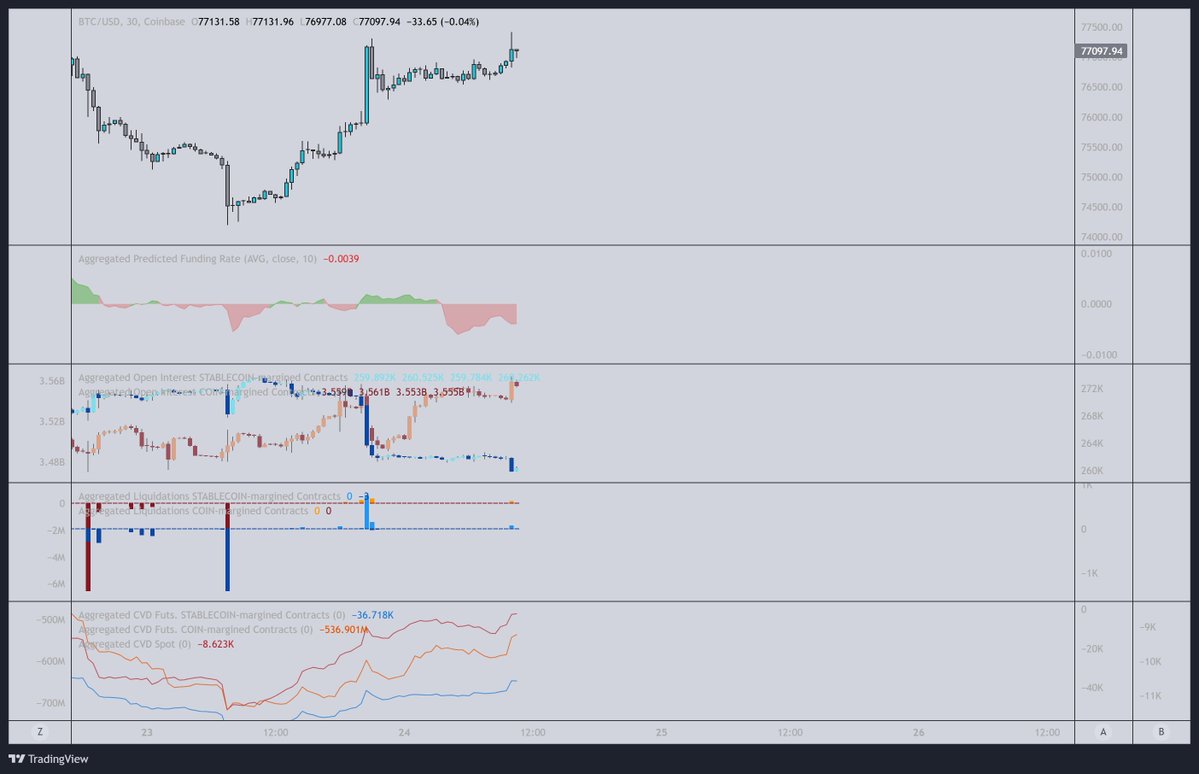
Right now, we are seeing some clamping going on.
Essentially, a full (or partial) flip of local large money turning longs into spot. This decreases the funding rate (top row) whilst OI gets an initial drop (blue bars) , then stays flat with some final squeeze action.
Once they are fully unravelled, the squeezing pressure resolves and we top IMO.
I will ad to my shorts I started today for an optimal final build. But the key is to be patient for that and not compromise your position by adding aggressively early on.
Exactly what I will do, using the order flow to be on the winning side.
Which we will be IMO. The final step of the plan is new lows coming once more after the squeeze is done.
Let's see if the trade will work out for the fourth time in a row.
$btc
Do not long this "POI", new lows are coming and so is 74.9k.
Seeing some posts out there telling you to long because we reached a "POI".
At the same time, seeing many stop losses below the lows build up.
If you are following both me and (one) of them, I encourage you, with the biggest wink and smile of "NFA", to not long that POI.
So despite how price seems to be reacting a bit locally, how price could go all the way back up to ath, how many out there have been waiting "a long time" for this box to be reached to get long again. This box won't work imo. If trading was just drawing every POI and longing it blindly, everyone would make money.
So trading isn't extremely hard. But it's not extremely easy to the point you can be lazy.
It's the sweet spot in the middle.
When daily bias is bearish = Daily POI's do not work for any big move and only for countertrend moves. We had the countertrend move already play out, so that POI must be abandoned now.
A wrong bias makes you view the bitcoin world through the wrong lens.
So we simply don't long this box/POI, even if many traders on X share it, I'm not interested in it. New lows are coming, both local and imo also sliding below 75k.
To start some conviction, I added a low size (1/4th) position starter short #3 to it to show my conviction and put some money behind it. Where if we head higher to my core reshort POI, I will only add to it.
Not a full short idea, just a position to clarify the message. Since no one seems to comprehend the idea of still lower with all these scalp long SL's building up.
Certainly a position I will ad to as my actual short #3 of the trilogy short series triggers, you will know loudly and clearly.
Farmers have figured out that the cheapest pesticide is a strip of flowers.
When you plant wildflowers through a crop field, not just around the edge but in strips running through the middle, you get ladybugs, lacewings, hoverflies, and parasitic wasps living in the field instead of visiting it.
They eat the aphids, the caterpillars, and the mites for free, all summer long.
In controlled trials, fields with tailored flower strips had leaf-beetle numbers 40 to 50% lower and crop damage cut by around 60%, enough to drop below the threshold where spraying was even considered worth it.
The flowers attract a standing army to our fields.
We spent decades engineering chemicals to kill the insects eating the crop, when the insects that eat those insects would have worked for the price of seed.
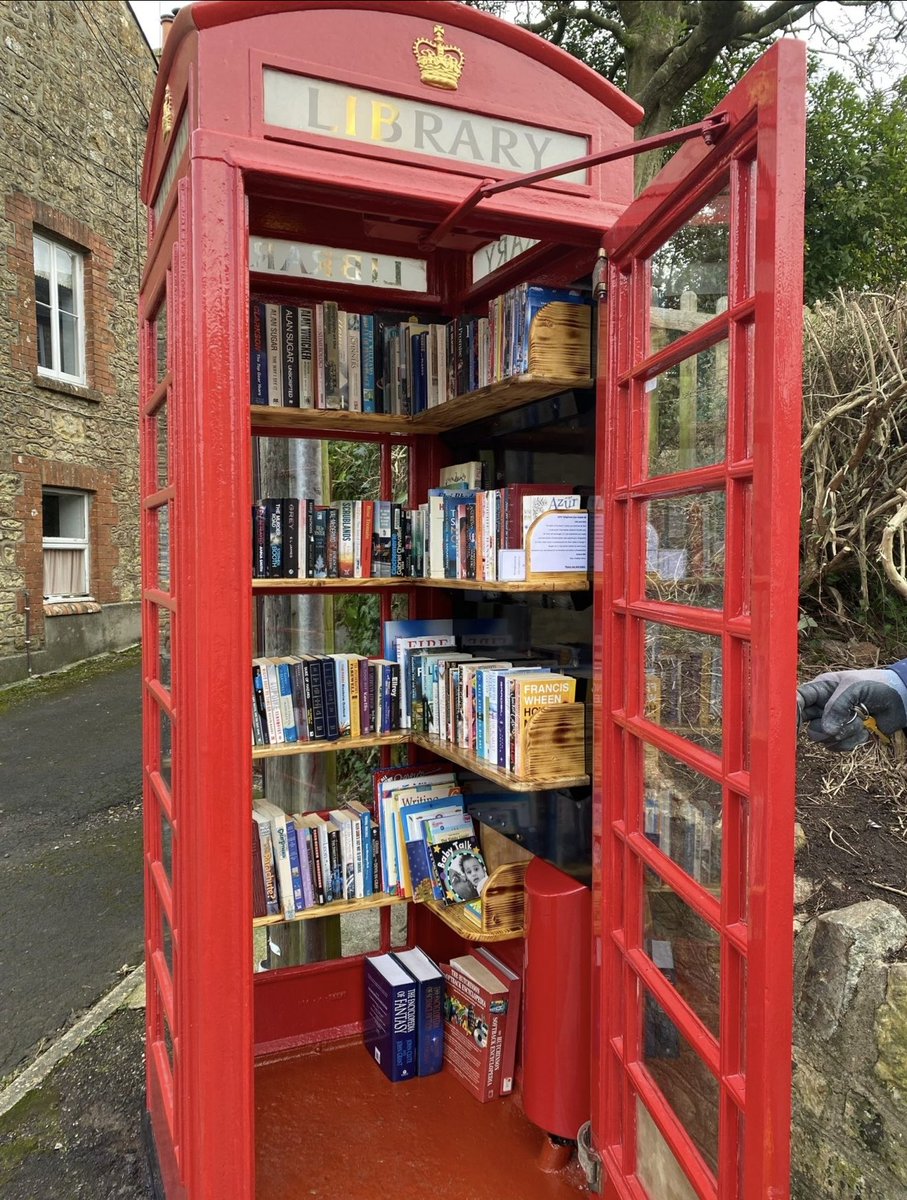
Many villages across the UK have repurposed iconic red telephone boxes into tiny community libraries, where you can take a book and leave one for someone else to enjoy too if you want to
In a major medical breakthrough, South Korean scientists have successfully implanted the world’s first 3D-printed windpipe made entirely from a patient’s own cells.
The groundbreaking procedure was performed on a woman who had lost part of her trachea after thyroid cancer surgery. Using advanced bioprinting technology, researchers created a personalized windpipe by combining the patient’s own living cells with a biodegradable scaffold.
Because the implant was made from her own biological material, her body recognized it as natural tissue. This resulted in zero rejection and eliminated the need for lifelong immune-suppressing drugs — a common requirement in traditional organ transplants.
The successful integration marks a significant step forward in regenerative medicine and personalized organ replacement.
Okay. I'm ready to talk about this.
It was the worst month of my life. Also ironically the greatest blessing god has ever given me.
Last month I was held in the Cayman Islands facing 15 years in prison.
The charge: illegal firearm importation. Here's what happened. More importantly what I learned.
Short answer: no. I haven't been smuggling guns.
In the States I legally carry a gun on me at almost all times for self defense. Part of this is ensuring I am trained.
Hence why I routinely go to the range to shoot. When I do I pack the firearm I intend to use in in a backpack.
Last month I was in a giant rush to make a private flight and didn't fully check my backpack before leaving. In it was a small firearm I missed.
It was discovered when I went through immigration.
At first I assumed I'd just be sent home.
Then my wife did some quick research. She pointed out the minimum sentence for importing a gun is 15 years. The police who showed up confirmed it.
To say I nearly pissed my pants is an understatement.
This was completely my fault. I'm an idiot. The point of this post isn't to blame or complain about anything. The laws there are fair. I'm a grown man capable of checking his bag before flying.
The point is: for three weeks on the island (on bail), I got to take a long hard look at my life.
I've built a high net worth and a company I love, with people I love working with. I have a beautiful wife who is my best friend. I do whatever I want all day every day. My parents are alive and I get to see them almost every week.
Still, despite all this, I often wake up annoyed I haven't done enough with my life. Asking myself "is this it?" In fact I'm pissed half the time, feeling I can do better.
Which is ironic. I made $20,000 a year in the military. If you'd told me then I'd achieve a 9 figure net worth and all the above, I would've assumed I'd consider my life a dream.
The twist truly hit me on the island as I watched everything I worked hard for in my life held at "gunpoint". Pun intended. Everything I worked so hard to get — poof. Didn't matter for shit.
The way the law works there are simple : if you can't prove it was an accident, the minimum is 15 years.
It became glaringly obvious. Not only was I an absolute idiot who couldn't pack his own bag. I'd also become a fool who couldn't enjoy the blessings I already had.
I'd taken all the people in my life and the success totally for granted. Blind. Blind. Blind.
Nothing like a 20-year potential sentence to make you realize: waking up with fun stuff to work on, then chilling on the couch reading with your wife at the end of the day — that's about as good as it gets.
I should be euphoric 24/7.
To go from having it all, to potentially not even having the option to piss and shit when you want — that's a wake up call if there ever was one.
Luckily, the Caymans is a fair place. I was found under exceptional circumstances during my trial. AKA the judge and the courts reviewed the case and agreed it was an accident.
I still love the island. It's probably my favorite place to vacation. Just check your luggage before you go. Ha.
My point is this: be present. Enjoy your life. One day something could happen — even by complete accident — and yoink it all away.
I have so many friends who'll read this and by all definition live a "dream life" — and yet are dissatisfied just like I was. If anything this is the default for most successful men. Not the exception.
I'm writing this to help you stop.
It took god slapping me across the face with my own ignorance to see it. It was painful and scary. Dark.
But honestly, it was the greatest blessing I've ever received. I'm writing this from my office at home, giddy as absolute fuck about my life and everything I have the option to do today.
If anything, I'm sad about how much time I wasted feeling otherwise.
Don't be ignorant and stupid like me. You might not get the blessing of a 15-year prison threat in a foreign country to wake you up.
Wake up. Appreciate what you have now.