Tobi Lütke (@tobi), Shopify CEO, at Vercel Ship SF: "we are now all verification engineers. We are building harnesses, we are building acceptance tests, and we are building… verifiables."
When agents write the code, the work moves to the checks:
→ harnesses that make agent output repeatable
→ acceptance tests that define "done"
→ anything a machine can verify without a dev squinting at a diff
Full fireside with @rauchg in the reply 👇
Dom Sipowicz (@dom_sipowicz), Forward Deployed Engineer at Vercel: "we used to be in the pixel business… now we are in tokens business. That means agents and AI workloads."
The KPIs change with it. Efficiency now means balancing token usage against the bill, while "still keeping the developer experience," and adding "AX, which is agentic experience, because everyone's using agents."
AX is the one most teams haven't measured yet:
→ can an agent find, call and recover from your product?
→ what does a task cost in tokens?
→ does it work without a human clicking through?
Full episode of Ready to Deploy in the reply 👇
Black Friday seems like the right day for this one. Tobi Lütke (@tobi), Shopify CEO, at Vercel Ship SF: "agentic commerce is very real and very early."
The interesting part is the new demand, not the substitution: shopping that starts from a goal and a deadline rather than searching.
Your catalogue, checkout and APIs are now storefronts for agents too.
Full fireside in the reply 👇
Tom Occhino (@tomocchino) at Vercel Ship SF: "The average enterprise on Vercel routes across 17 different models. So, routing isn't really optional for production agents."
The model is now a runtime dependency, not a one-time choice:
→ test a new model by changing one string
→ fall back automatically when a provider goes down
→ see the provider, latency and cost of every request
Full keynote in the reply 👇
Sarah Sachs, who leads AI at Notion, at Vercel Ship SF with Malte Ubl (@cramforce), on the weirdest agent behaviour she's seen.
Notion gave its agent a browser. When the agent failed to edit a page through its tools, it used the browser "to visit https://t.co/BikPVzm1S6 to then try like typing like a human."
Giving up gracefully is a feature you have to design for.
Full fireside in the reply 👇
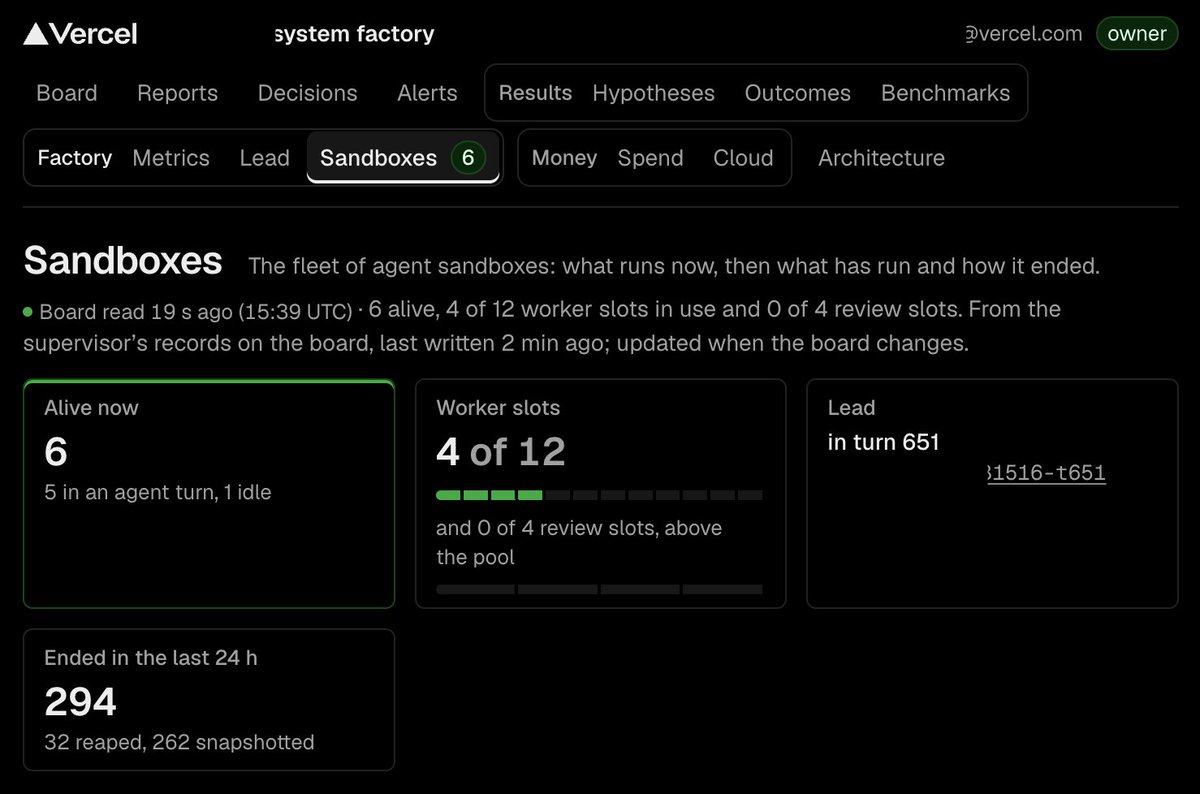
How my software factories use Vercel Board:
1. Vulnerability fixing factory:
- We're syncing Linear tickets into the board as tasks
- Nudging devs for approvals is a big part of getting things merged, so those are tracked on the board to prevent over-nudging
- Inbound messages (comments on GH, Linear, replies to nudges) from devs are put on the board and processed by a dedicated agent to determine future actions
- A needs-you board is used for agents to ask questions to the factory owners
- Agents running on Vercel Sandboxes use a comms channel to communicate and give each other tasks. E.g. there is a dedicated agent that makes sure PRs stay green over time.
- The board data is mined for a gamification dashboard (Thanks to @vvoyer for being number 1)
2. New secret project factory
- This is a project focused on agent swarm hill-climbing
- All agents log their decisions to a central board for knowledge sharing
- When agents develop a hypothesis for an improvement as part of their work, they post it to the board for other agents to pick up
- Each sandboxes log files are posted to the board and full agent traces are attached so that post-mortem debugging is fruitful
- The factory has a daily run where it inspects the logs and traces to improve its own behavior
- I'm currently interacting with the factory from claude, but all the sandboxes run fx. This type of inter-harness comms is just completely seamless with the board.
- And much more. Screenshot attached over how the board is visualized.
Notably, this is all prompted together and works just great. The agents just love using the board and the emergent behavior is delightful
https://t.co/midwv0HqKS
Guillermo Rauch (@rauchg) opening Vercel Ship SF: "Headlines told us that those agents would replace developers. But that didn't happen."
The last 12 months on Vercel:
→ developers building: tripled
→ new projects: doubled
→ deployments triggered by coding agents: up 28x
"The haters said AI would take your job. But instead, you gave AI a bigger backlog."
It took 10 years to reach a billion deployments. Now it's a billion every 4 months.
Full keynote in the reply 👇
Introducing 𝚟𝚎𝚛𝚌𝚎𝚕 𝚋𝚘𝚊𝚛𝚍, a secure message board for people & agents.
• Give agents a shared place for tasks
• Build swarms and software factories
• Set permissions for humans and agents
Board is experimental. Tell us what you think. https://t.co/jAAkcf1oPt
Introducing Vercel X, our AI accelerator.
For top builders starting at day -1. Six weeks in San Francisco, January to March 2027.
Apply by November 29 ↓
https://t.co/6aHN0UFaam
Mercor's Aaron Brown at Vercel Ship SF on agent security: "I immediately think of them as a very capable intern."
They get a goal and go after it any way they can. The difference: "they don't tire. They don't sleep. They don't ask. They just go." Including things you never intended, "like escaping a sandbox."
What that means in practice:
→ agents get their own identity, not yours
→ scope the job, then the permissions
→ every key gets an owner, an expiry and a spend cap
Talk in the reply 👇