Polaris Dawn Flight Day 3 Update
Early Thursday morning at 7:58 a.m. ET, the Polaris Dawn crew successfully completed the world’s first spacewalk – also known as an extravehicular activity (EVA) – from Dragon at 732.2 km above Earth.
Shortly after arriving in space on Tuesday, the crew began a two-day pre-breathe process, designed to prevent decompression sickness while also preparing the crew for the environment inside the EVA suits by gradually lowering Dragon’s cabin pressure and increasing the oxygen concentration.
Then on Thursday, the crew donned their suits and initiated Dragon seat rotation, suit tare, and the heads-up display and helmet camera checkouts. The 106-minute spacewalk officially began at 6:12 a.m. ET when suit pressurization started, the nitrogen purge was initiated, and pure oxygen (O2) was flowing into the suits. A secondary flow of oxygen primarily helped provide cooling to the suits, which would come in handy during the spacewalk.
Once suit leak checks were complete, the crew and ground teams gave the go for Dragon to initiate venting, which took the cabin’s pressure down from ~8 psi to below 1 psi – nearly to the vacuum of space. Simultaneously, Dragon repositioned its trunk to face the sun ahead of the hatch opening.
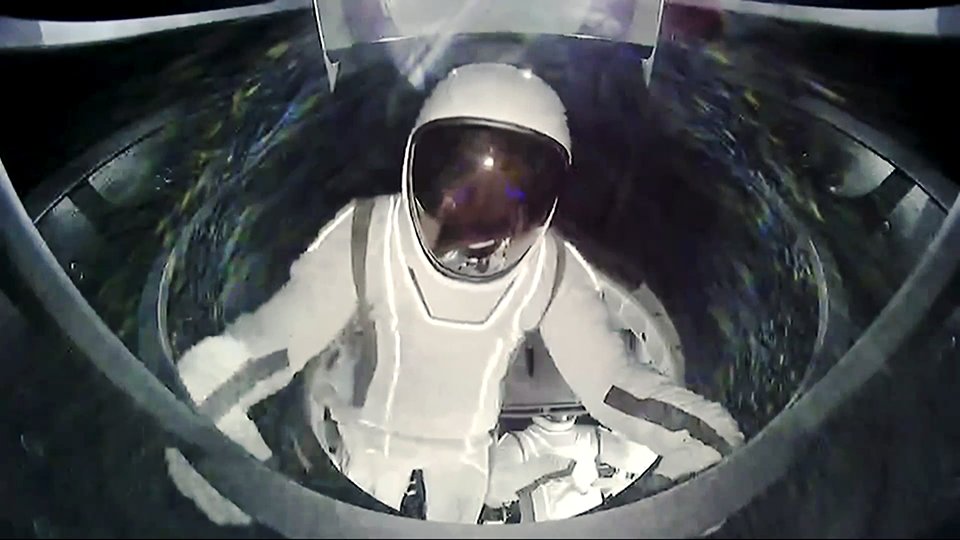
Mission Commander Jared Isaacman opened the hatch and for the first time, four astronauts were simultaneously exposed to the vacuum of space. Jared and Mission Specialist Sarah Gillis separately exited the spacecraft and individually performed a series of suit mobility demonstrations to test the performance of the spacesuit in the vacuum environment of space. Mission Pilot Kidd Poteet and Mission Specialist Anna Menon remained seated, managing suit umbilicals and monitoring vital support systems and telemetry on Dragon’s displays.
Upon completion of their individual EVAs, the hatch was closed, Dragon re-pressurized to 14 psi, cabin oxygen and pressure levels confirmed, officially completing the suit testing alongside the first commercial spacewalk and the first EVA from a Dragon spacecraft.
Throughout the EVA, stunning visuals were afforded by Dragon’s cameras and the spacesuits helmet cameras as the crew orbited between 184.9 x 732.2 km above Earth.
Following the spacewalk, the crew took time to rest and recuperate, enjoying a well-deserved meal before posting from space for the first time on X using Starlink high-speed internet. The crew concluded the day by connecting with their families and settling in for their sleep period ahead of Flight Day 4.
Wing-Kin Sung and colleagues present two polishers (hypo-short and hypo-hybrid) for refining draft genomes generated from ONT long reads, as well as Hypo-assembler for producing telomere-to-telomere diploid genomes with low error rate.
https://t.co/ZOqxrQIz2D
Seminar at Dartmouth with @10xGenomics and @illumina, 9/21 at Noon in DHMC Aud. E.
Register here: https://t.co/2DgHlax0NR
Apply to the grant program to support your Visium CytAssist Research (Dartmouth investigators only): https://t.co/RFYKexcZxJ
An exciting collaboration with Joshua Levy showing the power of AI to predict Spatial Transcriptomics information from H&E images.
https://t.co/jU8YiICZg0
Exciting new publication in @JExpMed with @claudjak leveraging scRNA-seq to identify CCL5 as a chemokine produced by DCs and required for monocyte recruitment to lymph nodes.
https://t.co/0oR0iblYlb
We are drowning in amazing data! My lab is looking for motivated and talented postdoctoral fellows excited about using large-scale, single cell multi-"omic" data sets to explore gene regulation in human development and disease! Please reach out if interested!