🎙️ Community Call Recap | Oct 8, 2026
1️⃣ Mainnet Update
Mainnet will launch before FlexNodes. Some important and exciting updates will be announced in the coming weeks.
2️⃣ Community Focus
The team encourages the community to focus on RLNC, Optimum’s core underlying technology, how Validators work and earn, and scalability.
3️⃣ Inactive Member Removal
The screening and removal process is happening phase by phase. All inactive community members will eventually be removed, regardless of their previous role or rank.
4️⃣ Art & Content
The community is encouraged to create both handcrafted and digital art. Quality will be prioritized, especially content that achieves a good balance between entertainment and education.
5️⃣ Mini Tournaments & Events
Short-term mini-events, ranging from one day to one week, including tournaments like poker and chess, will soon be added alongside larger campaigns.
6️⃣ Community Call Break
Next week’s Community Call will be paused due to the host’s personal travel schedule. The call will return the following week with several important updates
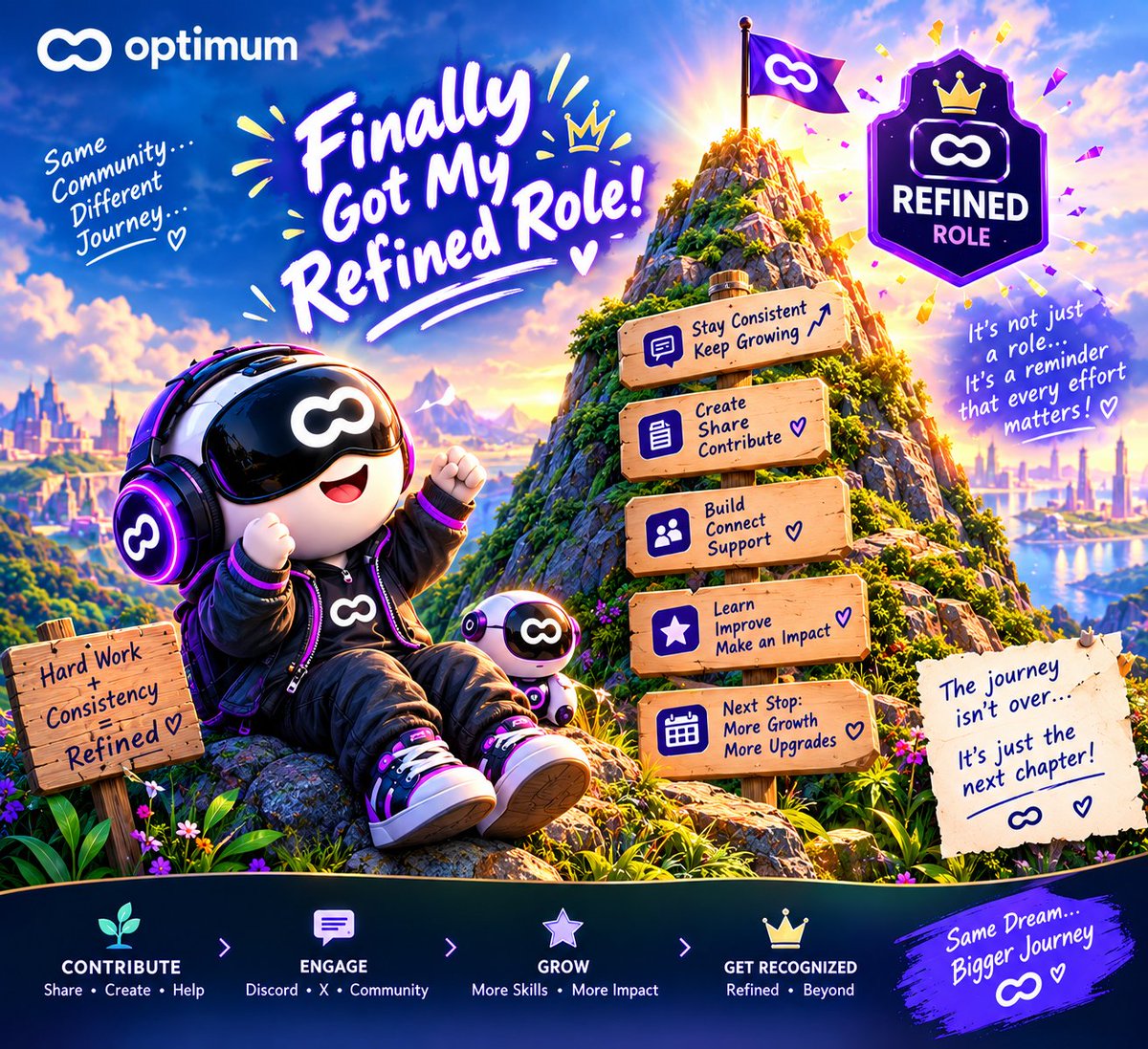
Journey / Hard Work💜
Finally, the moment arrived
The journey was worth it
Consistency paid off
Every step mattered
From effort to recognition
A milestone I’ll remember
The grind finally showed results
Kept going. Kept building
Silent work, visible results
Proof that consistency matters
Today feels special 🤍
@get_optimum@blockchainjeff@CryptoSundayz@shariaronchain@ada_pegasus
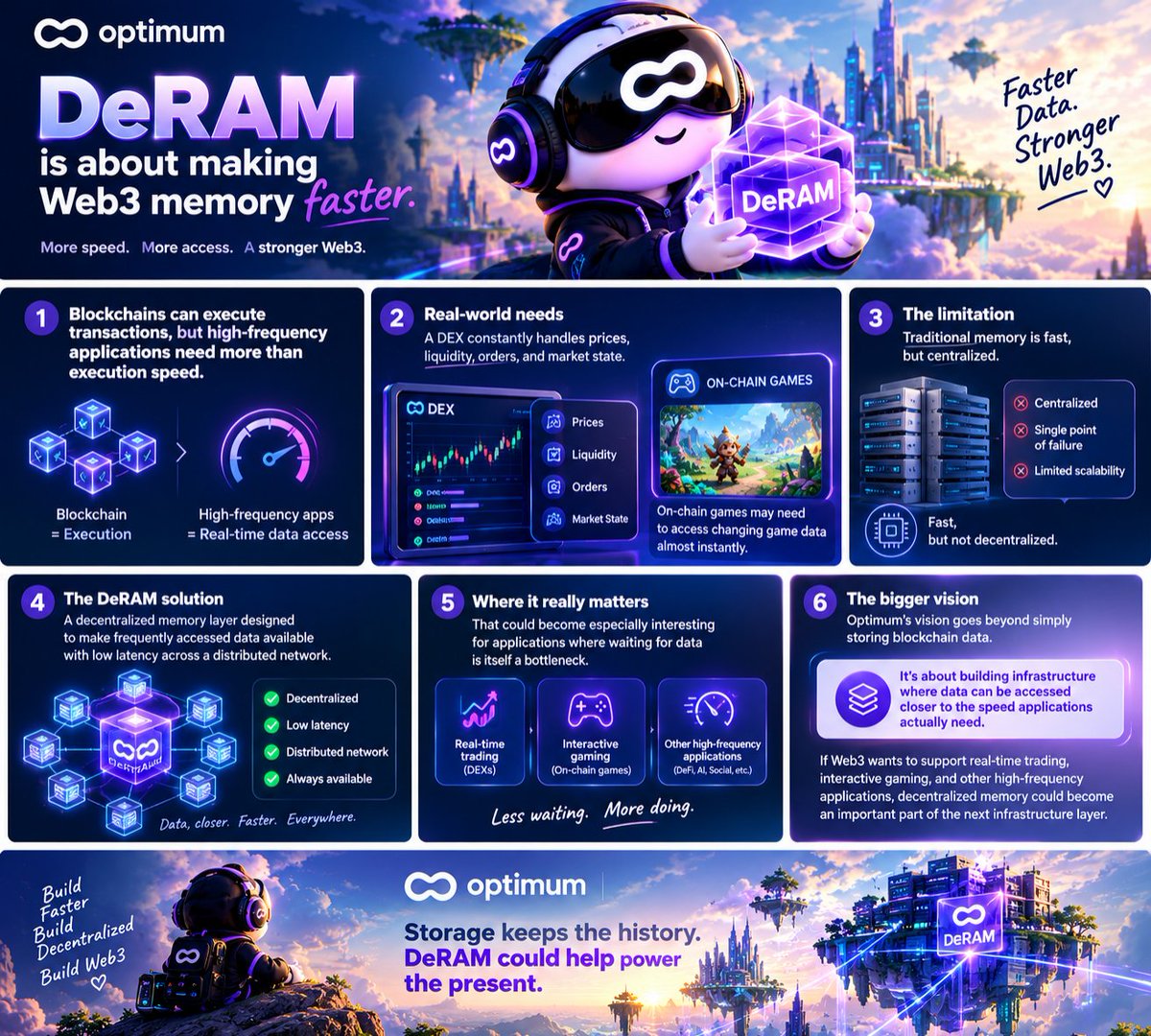
DeRAM is about making web3 memory faster.
Blockchains can execute transactions, but high-frequency applications need more than execution speed.
A dex constantly handles prices, liquidity, orders, and market state. On-chain games may need to access changing game data almost instantly.
Traditional memory is fast, but centralized.
DeRAM takes a different direction: a decentralized memory layer designed to make frequently accessed data available with low latency across a distributed network.
That could become especially interesting for applications where waiting for data is itself a bottleneck.
Optimum vision here goes beyond simply storing blockchain data.
It’s about building infrastructure where data can be accessed closer to the speed applications actually need.
If web3 wants to support real-time trading, interactive gaming, and other high frequency applications, decentralized memory could become an important part of the next infrastructure layer.
Storage keeps the history.
DeRAM could help power the present.
@get_optimum@MurielMedard@blockchainjeff@CryptoSundayz@tgogayi@ada_pegasus@TheBl0ckBoy
Stop letting legacy networking throttle decentralized performance.
@get_optimum isn't just fixing data speed it's empowering nodes to perform at their absolute ceiling.
Zero packet loss. Maximum efficiency. Pure network power.
Powering the future of decentralized data
◇ 𝙒𝙝𝙖𝙩 𝙞𝙛 𝙒𝙚𝙗3 𝙝𝙖𝙙 𝙞𝙩𝙨 𝙤𝙬𝙣 𝙢𝙚𝙢𝙤𝙧𝙮 𝙡𝙖𝙮𝙚𝙧?
Most Web3 applications have one thing in common:
𝐃𝐚𝐭𝐚 𝐧𝐞𝐞𝐝𝐬 𝐭𝐨 𝐛𝐞 𝐚𝐯𝐚𝐢𝐥𝐚𝐛𝐥𝐞 𝐟𝐚𝐬𝐭.
Traditional memory systems can deliver impressive performance, but they're built around centralized infrastructure and a limited set of operators.
Web3 needs to think differently.
That’s where DeRAM 𝐃𝐞𝐜𝐞𝐧𝐭𝐫𝐚𝐥𝐢𝐳𝐞𝐝 𝐑𝐀𝐌 gets interesting.
Optimum upcoming memory layer is exploring a way to make frequently accessed data available with low latency across a decentralized network.
And the use cases make the idea even more interesting.
⟐ 𝐃𝐞𝐜𝐞𝐧𝐭𝐫𝐚𝐥𝐢𝐳𝐞𝐝 𝐞𝐱𝐜𝐡𝐚𝐧𝐠𝐞𝐬 need fast access to order books, prices, liquidity, and constantly changing market data.
⟐ 𝐎𝐧-𝐜𝐡𝐚𝐢𝐧 𝐠𝐚𝐦𝐞𝐬 need game states and player interactions to respond without unnecessary delays.
In both cases, waiting for data can directly affect the user experience.
DeRAM is essentially exploring a decentralized memory layer for applications where 𝐦𝐢𝐥𝐥𝐢𝐬𝐞𝐜𝐨𝐧𝐝𝐬 𝐦𝐚𝐭𝐭𝐞𝐫.
Instead of treating blockchain data as something you simply store and retrieve, the idea is to make frequently needed information more readily accessible when applications actually need it.
╰┈➤ 𝐒𝐭𝐨𝐫𝐞 𝐥𝐞𝐬𝐬 𝐥𝐢𝐤𝐞 𝐚 𝐰𝐚𝐫𝐞𝐡𝐨𝐮𝐬𝐞. 𝐀𝐜𝐜𝐞𝐬𝐬 𝐦𝐨𝐫𝐞 𝐥𝐢𝐤𝐞 𝐚 𝐦𝐞𝐦𝐨𝐫𝐲.
If Web3 is going to support high-frequency applications, decentralized memory could become an important missing piece of the stack.
The next performance breakthrough may not come from faster execution alone.
It may come from making the right data available at the right moment.
@get_optimum@MurielMedard@kentlinyy@blockchainjeff@cryptooflashh@CryptoSundayz@tgogayi@shariaronchain@ada_pegasus
DeROM: Making Blockchain History Easier to Use
There’s an interesting problem hiding underneath blockchain’s biggest strength:
Blockchains remember almost everything, but remembering data and accessing it efficiently are two different things.
As a network grows, its history grows with it. Blocks, transactions, state changes, and other on-chain activity continue accumulating. For applications that need to look back through that history, simply having the data available isn't enough.
You need to be able to find and retrieve it efficiently.
That's what makes optimum DeROM roadmap interesting to me.
DeROM decentralized read-only memory is designed around the idea of creating a fast, globally ordered layer for historical blockchain data.
Think about it like a memory layer for the blockchain.
The chain keeps producing new information, while DeROM is focused on making previously recorded information easier to access when applications need it.
That could be useful for analytics, blockchain explorers, indexers, researchers, AI systems, and dApps that depend on historical on-chain activity.
And there's a bigger point here.
As Web3 becomes more data-intensive, historical information won't just be something stored for verification. It will become an active resource.
Applications will want to query years of blockchain activity, compare events, reconstruct states, analyze behavior, and feed historical information into new systems.
If retrieving that information becomes slow or expensive, it creates another bottleneck.
DeROM is an interesting attempt to address that problem at the infrastructure level.
Blockchain history shouldn't just be permanent.
It should be accessible.
Fast.
Organized.
And useful.
That's the part of @get_optimum roadmap I'm particularly curious to see develop.
@MurielMedard@blockchainjeff@CryptoSundayz@shariaronchain@ada_pegasus
In a world where data never stops, latency remains the ultimate bottleneck.
@get_optimum uses RLNC technology to move data faster with lower bandwidth overhead.
Seamlessly scaling Ethereum, L2s, and high-throughput chains at the transport layer.
Faster data. Stronger network. Built for the next era of web3
@MurielMedard@kentlinyy@blockchainjeff@CryptoSundayz@shariaronchain@ada_pegasus
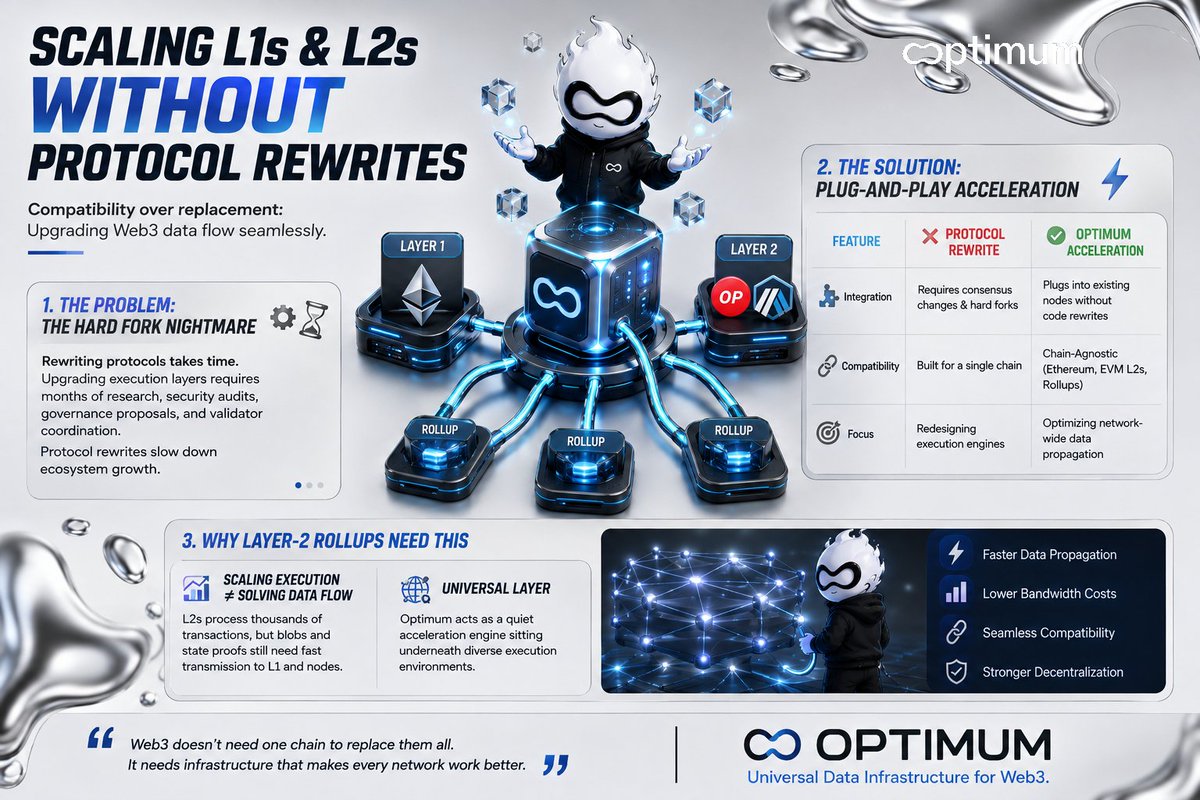
𝙎𝙘𝙖𝙡𝙞𝙣𝙜 𝙇𝙖𝙮𝙚𝙧-1𝙨 𝙖𝙣𝙙 𝙇𝙖𝙮𝙚𝙧-2 𝙍𝙤𝙡𝙡𝙪𝙥𝙨 𝙒𝙞𝙩𝙝𝙤𝙪𝙩 𝙋𝙧𝙤𝙩𝙤𝙘𝙤𝙡 𝙍𝙚𝙬𝙧𝙞𝙩𝙚𝙨
One of the biggest problems with blockchain scaling is that upgrading a network is rarely simple.
Changing core protocol infrastructure can take months of research, testing, governance discussions, and coordination between validators and developers.
That raises an important question:
𝐖𝐡𝐚𝐭 𝐢𝐟 𝐚 𝐧𝐞𝐭𝐰𝐨𝐫𝐤 𝐜𝐨𝐮𝐥𝐝 𝐢𝐦𝐩𝐫𝐨𝐯𝐞 𝐝𝐚𝐭𝐚 𝐩𝐞𝐫𝐟𝐨𝐫𝐦𝐚𝐧𝐜𝐞 𝐰𝐢𝐭𝐡𝐨𝐮𝐭 𝐫𝐞𝐰𝐫𝐢𝐭𝐢𝐧𝐠 𝐭𝐡𝐞 𝐜𝐡𝐚𝐢𝐧 𝐢𝐭𝐬𝐞𝐥𝐟?
This is where optimum chain agnostic approach becomes interesting.
Rather than competing with Ethereum, EVM chains, or Layer-2 rollups, Optimum is designed to work 𝐚𝐥𝐨𝐧𝐠𝐬𝐢𝐝𝐞 𝐞𝐱𝐢𝐬𝐭𝐢𝐧𝐠 𝐞𝐱𝐞𝐜𝐮𝐭𝐢𝐨𝐧 𝐞𝐧𝐯𝐢𝐫𝐨𝐧𝐦𝐞𝐧𝐭𝐬 by focusing on a shared challenge: moving data efficiently across distributed networks.
Every chain has its own consensus and execution design, but they all depend on nodes exchanging information.
Blocks need to propagate.
Transactions need to reach the right participants.
Rollups need to move data between different layers.
And as ecosystems grow, communication can become just as important as execution.
A universal acceleration layer could help networks improve propagation without forcing developers to rebuild their applications or redesign their core protocol.
That's particularly relevant for rollups.
Layer-2s are built to scale execution, but scaling execution doesn't automatically solve every data transmission challenge. Faster and more efficient communication can strengthen the infrastructure around them.
The bigger idea is 𝐜𝐨𝐦𝐩𝐚𝐭𝐢𝐛𝐢𝐥𝐢𝐭𝐲 𝐨𝐯𝐞𝐫 𝐫𝐞𝐩𝐥𝐚𝐜𝐞𝐦𝐞𝐧𝐭.
Web3 doesn't necessarily need one blockchain to replace every other blockchain.
It needs infrastructure that can make many different networks work better.
If optimum can provide acceleration across diverse environments without requiring protocol rewrites, it could become part of the infrastructure layer sitting quietly behind the ecosystems people already use.
𝘿𝙞𝙛𝙛𝙚𝙧𝙚𝙣𝙩 𝙘𝙝𝙖𝙞𝙣𝙨. 𝘿𝙞𝙛𝙛𝙚𝙧𝙚𝙣𝙩 𝙚𝙭𝙚𝙘𝙪𝙩𝙞𝙤𝙣 𝙚𝙣𝙫𝙞𝙧𝙤𝙣𝙢𝙚𝙣𝙩𝙨. 𝙊𝙣𝙚 𝙨𝙝𝙖𝙧𝙚𝙙 𝙣𝙚𝙚𝙙: 𝙛𝙖𝙨𝙩𝙚𝙧, 𝙢𝙤𝙧𝙚 𝙚𝙛𝙛𝙞𝙘𝙞𝙚𝙣𝙩 𝙙𝙖𝙩𝙖 𝙢𝙤𝙫𝙚𝙢𝙚𝙣𝙩.
@get_optimum@MurielMedard@kentlinyy@blockchainjeff@CryptoSundayz@shariaronchain@ada_pegasus
Slow data propagation means missed rewards. Fast data propagation means compounding edge.
While legacy p2p layers bottleneck under heavy traffic, @get_optimum accelerates data flow across every single block.
We’re stacking the foundational blocks for a sub-second onchain world.
Are you climbing with us?
@blockchainjeff@shariaronchain@CryptoSundayz@tgogayi
Everyone talks about faster blockchains.
But speed means very little if the data itself can’t keep up.
Instead of chasing another execution upgrade optimum is looking at how data moves across the network in the first place.
Faster propagation means less waiting.
RLNC means less redundant transmission.
And a stronger network means validators and users aren't fighting unnecessary bottlenecks.
The bigger picture isn't just making one chain faster.
It's about improving the foundation that every decentralized network depends on.
Data moves. Networks thrive.
Sometimes the next leap in web3 doesn't come from adding more power.
It comes from making the flow of information smarter.
@get_optimum@blockchainjeff@CryptoSundayz@ada_pegasus
Empty your mind. Be formless, shapeless, like water.
This quote hits differently when i think about what optimum is building.
For years, blockchain infrastructure has followed familiar patterns. More throughput, more hardware, more layers, more complexity.
But sometimes the answer isn't to keep forcing the same system harder.
Sometimes you have to rethink how things move.
Data is the lifeblood of every blockchain. Blocks, transactions, attestations everything depends on information reaching the right place at the right time.
That’s where Optimum’s approach feels different to me.
Instead of trying to change consensus or rebuild the entire chain, it focuses on the layer underneath: data propagation.
Using RLNC, the goal is simple in principle: transmit data more efficiently, reduce unnecessary redundancy, and make networks more resilient when conditions aren't perfect.
Like water, the best networks shouldn't struggle against every obstacle. They should adapt, flow, and still find a way through.
Maybe scalability isn't always about building something bigger.
Maybe it's about learning how to move smarter.
That’s the part of @get_optimum vision I’m watching closely.
@blockchainjeff@CryptoSundayz@ada_pegasus
Not every project trying to scale web3 needs to build another faster chain.
Sometimes, the real problem is much deeper.
Data still has to move.
Between validators.
Across networks.
Around the world.
And when that movement is slow, redundant, or inefficient, everything built on top eventually feels the impact.
That’s why i keep paying attention to @get_optimum
Optimum isn’t trying to replace the chains we already use. The focus is on improving the layer underneath making data propagation faster, more efficient, and less wasteful through RLNC powered networking.
Faster delivery.
Lower latency.
Less unnecessary bandwidth.
Simple idea, but the impact can reach much further than people realize.
Better networking can mean better validator performance, stronger infrastructure, and more room for the next generation of onchain applications to grow.
Web3 doesn’t just need more speed.
It needs smarter ways to move the data that keeps everything running.
And that’s the direction Optimum is building toward.
@blockchainjeff@shariaronchain@tgogayi@ada_pegasus
Sometimes the biggest opportunities don’t look loud at first.
While everyone is chasing the next shiny narrative, some teams are working on the infrastructure that could make everything else run better.
The idea is simple: blockchains don’t just need faster execution. Data also needs to move faster, more efficiently, and with less waste.
From improving propagation with RLNC to building a broader data acceleration network, optimum is focused on a part of web3 infrastructure that most people rarely think about.
And maybe that’s exactly why it’s worth paying attention to.
No need to rush every narrative.
Sometimes you sit back, watch the pieces come together, and let the builders cook. ♾️
@get_optimum@kentlinyy@MurielMedard@blockchainjeff@shariaronchain@CryptoSundayz@ada_pegasus
Some paths are worth taking before everyone else sees where they lead.
That’s the feeling I get from this Optimum visual.
The mascot isn’t just walking toward a castle. It feels like it’s walking toward a different way of moving data one where networks become smarter, more resilient, and less wasteful.
That’s what makes @get_optimum interesting to me.
They’re not trying to build another chain and compete for attention.
They’re working underneath the stack, rethinking how data travels between nodes with RLNC.
The road ahead is still long, but infrastructure like this could quietly become one of the things that makes the next generation of onchain systems possible.
Sometimes the biggest changes start with fixing what nobody sees.
@MurielMedard@kentlinyy@blockchainjeff@CryptoSundayz@shariaronchain@ada_pegasus
I think people are looking at Optimum as a speed play, but the bigger idea is the memory layer.
Blockchains can process a lot, but none of that matters if the data can’t move efficiently between nodes.
RLNC is basically optimum way of rethinking that layer.
Not just faster.
Smarter networking.
@get_optimum@blockchainjeff@CryptoSundayz@ada_pegasus
New week. New role. New level. 🚀
Big congrats to everyone upgraded to Refined in the Optimum community! 💜
Your consistency is showing. Your contributions matter.
Keep building. Keep contributing. Keep leveling up. ∞
@MurielMedard@blockchainjeff@CryptoSundayz@tgogayi@ada_pegasus
Optimum joining the Ethereum Korea Consortium feels like more than just another partnership.
Korea is becoming an important market for Ethereum infrastructure, and Optimum is already working with Korean validators to test and implement mump2p.
That’s the part I find interesting.
Institutional adoption doesn’t only need better applications.
It needs infrastructure that can move data reliably, efficiently, and fast across real-world networks.
Optimum is tackling that layer.
Being closer to the Ethereum ecosystem in Korea could be a meaningful step toward making better data propagation part of the infrastructure institutions actually rely on.
Infrastructure first. Adoption follows.
@get_optimum@MurielMedard@blockchainjeff@ada_pegasus@CryptoSundayz