As we kick off a new week, let's dive into the mechanics of @Bappfun a pioneering launchpad on @base
for mini-apps. Designed for indie devs and small teams, it enables tokenization of lightweight, social apps integrated with Farcaster or Baseapp think games or tools that bootstrap on-chain economies. The process is streamlined: build your app, apply via a quick form, automate token creation through smart contracts, and raise community funds with built-in refunds if milestones aren't met. No VCs or insiders; transparency rules via verifiable contracts handling liquidity and vesting. BAPS points reward genuine engagement like staking and referrals, convertible to $BAPP allocations for ecosystem perks. This model educates on fair Web3 funding: attention turns into capital, fostering sustainable growth without hype driven FDVs. Builders retain ownership, communities co-create value. A blueprint for decentralized innovation.
In the spirit of staying active this week, explore @Bappfun sustainable launch model on @base
addressing pitfalls of traditional pads like inflationary tokens and high FDVs that erode trust. Here, mini-apps launch at balanced valuations, prioritizing long-term ecosystem health over speculation. Key: automated smart contracts ensure 100% transparency in fundraising, with funds unlocking only on milestones and automatic refunds for accountability. BAPS points metricize contributions staking $BAPP, project interactions rewarding quality to build antifragile communities. For devs, it's empowerment without fees; for backers, equitable access to early-stage utility. This educational framework teaches aligned incentives: genuine participation drives compounding value loops, attracting more users to Base's on-chain world. Amid Web3's evolution, @Bappfun
sets a standard for meritocratic, developer-first infrastructure
Picture funding as a fractal labyrinth, endlessly branching paths where traditional VCs guard gates, but tokenization opens infinite routes for indie devs. In Web3, $BAPP powered launches fractalize value: small contributions compound into sustainable ecosystems, mirroring nature's self-similar patterns.Creatively, each backer is a node in the fractal, their stake branching into project growth. Intellectually, it evokes Mandelbrot's geometry: complexity from simple rules, like bonding curves ensuring fair token distribution without presales. Base's low-latency (sub-second finality) enables real-time mini-app interactions, from on-chain bots to social https://t.co/WQdYOexMv7 practice: Devs apply, community vets via Baps-weighted votes, launches at modest FDVs ($1-5M vs. $50M norms), per https://t.co/WUTlcC92RH model. Data: 70% of 2024 launches failed due to inflation (Messari); sustainable tokenomics, with vesting and burns, boost longevity by 3x.Challenges: Volatility; mitigated by liquidity bootstraps and refund mechanisms. Philosophically, it challenges Schumpeter's creative destruction: not disruption. @Bappfun
The Symphony of Self-Sovereign Identity in the Stablecoin OrchestraImagine the blockchain as a grand orchestra, where stablecoins are the steady rhythm section reliable, pegged to real-world value, enabling seamless transactions across borders. But what's missing? The conductor: your identity. In traditional finance, identities are siloed symphonies, locked in bank vaults, fragmented across apps, and vulnerable to data breaches. Enter self-sovereign identity (SSI), the maestro that puts you in control.SSI isn't just a buzzword; it's a paradigm shift rooted in cryptographic principles. At its core lies decentralized identifiers (DIDs), unique strings anchored on blockchains like Ethereum or NEAR, independent of any central authority. Paired with verifiable credentials (VCs) digital proofs issued by trusted entities but stored in your wallet these tools allow selective disclosure. Need to prove you're over 18 for a DeFi loan? Share only that credential, not your full passport.But creativity blooms in application. Picture a world where your KYC from one exchange ports seamlessly to a stablecoin remittance app, encrypted via zero-knowledge proofs (ZKPs). No redundant verifications, no privacy leaks. This reduces onboarding friction, slashing costs by up to 70% according to Deloitte studies on blockchain identity.Intellectually, SSI challenges Lockean notions of property: if data is the new oil, shouldn't you own the refinery? In the stablecoin economy, projected to hit $3 trillion by 2028 (per Bernstein Research), SSI ensures equitable access. Yet, hurdles remain interoperability standards like those from the Decentralized Identity Foundation (DIF) need https://t.co/s0kh7DzY4y idOS, we're building this future: a portable identity layer on NEAR Protocol, with MPC-secured keys and permissioned storage. It's not about replacing systems; it's harmonizing them. Join the orchestra verify once, access everywhere. @idOS_network
Envision the creator economy as a grand concerto, where mini-apps are the instruments harmonizing individual talents into a blockchain-backed orchestra. Unlike siloed platforms extracting value, mini-apps on Base weave social interactions with on-chain utility, turning passive scrolling into active participation.Creatively, liken it to a living symphony: a play-to-earn game as the violin swift, engaging; a tokenized tipping tool as the cello deep, resonant. Intellectually, this resonates with Coase's theory of the firm: reducing transaction costs via smart contracts, enabling independent developers to bypass intermediaries. Base, with its optimistic rollups, slashes fees to pennies, fostering virality akin to Telegram's mini-apps, which boast 500M users.Applications abound: A social voting app funds community causes; a niche marketplace tokenizes art. Stats: Creator economy valued at $250B in 2025 (SignalFire), but only 4% capture sustainable income mini-apps flip this by integrating $BAPP for staking and governance, yielding rewards from ecosystem fees.Hurdles: Interoperability; https://t.co/WUTlcC92RH bridges via Farcaster integration, allowing seamless cross-app data. Ethically, it questions rent-seeking: platforms like YouTube take 45% cuts; here, creators retain 90% via direct https://t.co/8wtWxFEs2t 2028, Forrester predicts $1T in decentralized creator markets. https://t.co/WUTlcC92RH conducts this: launch your mini-app, earn Baps for activity, fund dreams on Base. Join the ensemble of @Bappfun
Fractals of Trust: Building Reputation Layers in Web3's Infinite LandscapeWeb3's landscape mirrors a fractal endlessly complex, self-similar patterns of trust emerging from chaos. Stablecoins, as the bedrock, facilitate value transfer, but without robust reputation systems, it's a house of cards. Traditional credit scores? Centralized relics, biased and opaque. Enter decentralized reputation: a multifaceted gem, educational in its transparency, intellectual in its game theory.Creatively, envision reputation as a living fractal tree. The roots: human uniqueness, proven via biometrics or social proofs without revealing biometrics (thanks to homomorphic encryption). Branches: compliance layers like KYC/AML, stored as soulbound tokens (SBTs) à la Vitalik Buterin's vision non-transferable, attesting to your regulatory standing.Leaves: dynamic reputation scores, aggregated from on-chain behaviors. Borrowed from a USDC loan on Aave? Timely repayment boosts your score. Participated in DAO governance on Arbitrum? Engagement metrics add foliage. Using PageRank-like algorithms (inspired by Google's origins), networks weigh interactions: a retweet from a high-rep account amplifies yours.But intellect demands scrutiny. Game theory warns of Sybil attacks fake identities flooding the system. Solutions? Proof-of-Humanity via oracles like Chainlink or idOS's multi-factor verification. Economically, quadratic funding (from Gitcoin) rewards quadratic contributions, favoring broad participation over whale https://t.co/8DlplRGjdM practice, this unlocks stablecoin potential: micro-lending in emerging markets, where reputation trumps collateral. A farmer in Nigeria accesses USDT-backed loans based on verifiable harvest data, not bank history. Projections? McKinsey estimates $1.6 trillion in unlocked economic value by 2030 through digital identity.idOS weaves this fractal: encrypted data on Starknet nodes, user-controlled access. It's philosophical echoing Habermas's communicative action: trust through rational discourse, not coercion. How will you grow your branch? @idOS_network
The Archipelago of Ideas: Navigating Fair Launches in the Web3 OceanImagine the Web3 ecosystem as a vast ocean, where ideas are islands scattered across turbulent waters. Traditional launchpads act like fleeting storms hype-driven, inflating valuations to unsustainable heights, only to crash and erode trust. But what if we charted a calmer course? Enter fair launches: a navigational paradigm emphasizing transparency, reasonable fully diluted valuations (FDVs), and community-driven sustainability.Creatively, picture each project as an archipelago, with mini-apps as coral reefs thriving in symbiosis. On Base, an Ethereum Layer 2 scaling solution, mini-apps lightweight, embeddable experiences like social games or tipping tools flourish without gas fee burdens. Intellectually, this draws from game theory: Nash equilibria in tokenomics, where aligned incentives prevent pump-and-dump cycles. High FDVs, often exceeding $100M for nascent projects (as seen in 2024's memecoin frenzy), lead to 80% value loss within months, per Chainalysis https://t.co/mZPSG0RsXp application, fair launches democratize funding: developers tokenize ideas via bonding curves, backers contribute with refunds if goals unmet. No VC gatekeepers pure meritocracy. Challenges? Sybil resistance; https://t.co/WUTlcC92RH counters with reputation-based Baps points, earned through staking $BAPP or ecosystem participation, inspired by quadratic voting models from Vitalik Buterin.Projections: With Base's TVL hitting $5B in 2025 (Dune Analytics), mini-app economies could unlock $50B in creator value by 2030, per McKinsey's Web3 forecasts. At https://t.co/WUTlcC92RH, we're the compass: apply to launch, fund via community, build on Base. @Bappfun
Quantum Leaps in Privacy: Navigating the Entanglement of Data and IdentityIn the quantum realm of Web3, data entanglement poses a paradox: stablecoins promise frictionless finance, yet identities remain classically vulnerable observed, collapsed into breaches. Creatively, let's borrow from Schrödinger: your identity exists in superposition private until shared, collapsing only what you choose. This is the essence of privacy-preserving tech, educational in mechanics, intellectual in ethics.Start with basics: multi-party computation (MPC) splits keys across nodes, ensuring no single point sees your full data. idOS uses this for passwordless logins your face or passphrase unlocks without exposure. Layer on fully homomorphic encryption (FHE), allowing computations on encrypted data. Query your credit history? Apps compute eligibility without decrypting.Intellectually, this nods to differential privacy, adding noise to datasets (as in Apple's implementations), balancing utility and anonymity. In stablecoins, it's revolutionary: comply with FATF regulations via traceable yet pseudonymous transactions on Ripple's XRP Ledger, without doxxing users.Creative analogy: identity as a black hole event horizon guards your core, but gravitational waves (verifiable claims) ripple out. Share a "wealth proof" for a high-yield USDC vault on Circle, using ZK-SNARKs to prove solvency without revealing amounts.Challenges? Quantum threats loom; post-quantum cryptography ( lattice-based like Kyber) fortifies against Shor's algorithm. Ethically, it questions Bentham's panopticon: surveillance society vs. empowered individuals. By 2026, Gartner predicts 75% of enterprises adopt zero-trust models; idOS accelerates this in crypto with NEAR's sharding for scale. Portable across chainsbArbitrum to Starknet it's the wormhole connecting ecosystems. Entangle wisely: privacy isn't absence, it's control. What's your quantum state @idOS_network
Traditional launchpads often perpetuate opacity and insider dominance, but @Bappfun
rearchitects the model for Base mini-apps with intellectual rigor. Eschewing VC-heavy pre-sales and high FDVs, it enforces fair launches via automated smart contracts that handle everything from token creation to vesting ensuring 100% on-chain transparency and builder retention of full ownership. No platform fees dilute value; instead, community-backed funding unlocks only upon milestone achievements, with instant refunds safeguarding backer interests. This contrasts sharply with over-hyped ecosystems: mini-apps here are lightweight, Farcaster-integrated tools that grow organically through social feeds, turning user interactions into economic signals. The $BAPP token underpins utility staking for BAPS accrual, governance, and buybacks while OG NFTs grant priority perks. For strategic thinkers, @Bappfun
isn't mere speculation; it's a framework for resilient, community-owned innovation on Base, where ideas compete on utility rather than marketing spend. In Web3's maturation phase, such precision mitigates rug-pull risks and amplifies network effect
Base points system represents a meritocratic evolution in Web3 incentive design, quantifying user contributions across staking, referrals, content creation, and project interactions to allocate resources equitably. Unlike gamified airdrops prone to sybil attacks, BAPS rewards verifiable, high-signal activities transforming ephemeral engagement into tangible value via $BAPP token allocations and exclusive OG NFTs (limited to 1,000 supply). Holders gain early access to launches, governance rights, and treasury shares, creating compounding loops where participation fuels ecosystem vitality. For builders, this means organic growth without bloated marketing budgets; mini-apps bootstrap through community validation within Base's on-chain environment. Backers, in turn, earn influence proportional to their input, mitigating free-rider problems inherent in traditional crowdfunding. Smart contracts enforce transparency, locking liquidity and automating refunds on unmet milestones, thus aligning long-term incentives. In a landscape riddled with fleeting trends, @Bappfun
's architecture promotes antifragile networks, where attention metrics evolve into self-reinforcing capital flows. A strategic pivot for indie devs seeking empowerment beyond centralized silos.
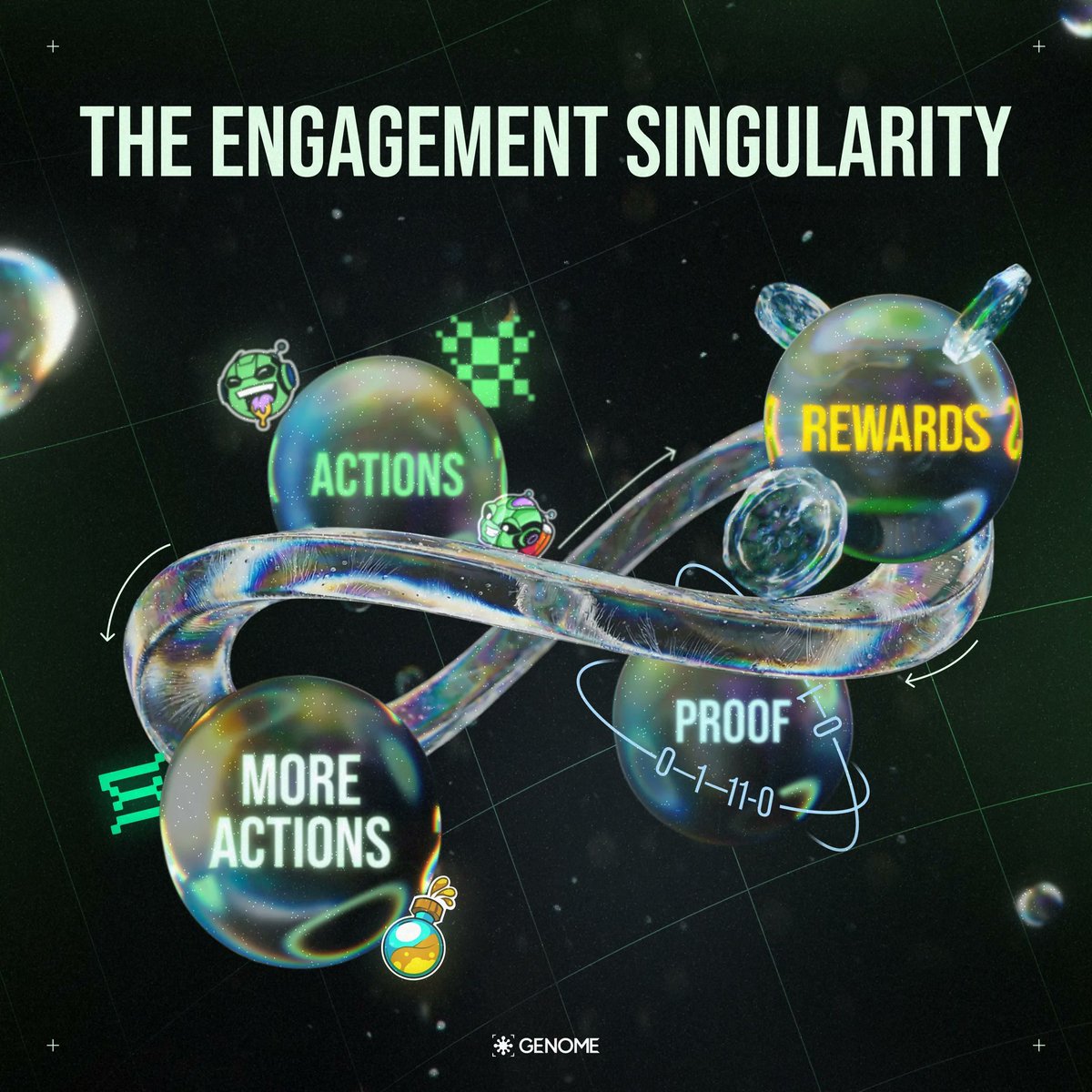
Genome’s Edge and Splice modules together illustrate a highly sophisticated approach to bridging player engagement with measurable economic and behavioral value, positioning Genome as more than just a platform it’s an intelligent gaming infrastructure.
Edge functions as a modular, whitelabel ecosystem that integrates gamified progression, tournaments, predictions, AI agents, badges, and live streaming. Its frictionless onboarding, powered by Privy account abstraction, automatically provisions EVM and SOL wallets for users, effectively removing a critical barrier to blockchain adoption. For players, Edge provides a seamless, rewarding experience where objectives, progress tracking, and earned rewards converge to drive engagement. For developers, the modular design allows rapid integration, offering granular control over user interactions while providing tools to enhance retention and monetization. By combining modularity with whitelabel flexibility, Edge enables games of any scale to cultivate dynamic, evolving communities without requiring bespoke infrastructure development.
Splice, @genome_protocol behavioral intelligence engine, complements Edge by transforming raw player activity into actionable insights. Beyond simple wallet tracking, Splice monitors real-time interactions clicks, completions, returns, and social actions to create a persistent engagement layer. Metrics like the Edge Score allow developers to reward meaningful activity, dynamically evolve campaigns, and personalize user experiences based on actual behavior rather than assumptions. For teams, this translates into smarter decision-making, improved retention, and measurable ROI from engagement strategies.
while Edge and Splice provide a powerful framework, their effectiveness relies on thoughtful implementation. Over-gamification or overly complex scoring systems could overwhelm users, while reliance on behavioral analytics introduces potential privacy considerations that must be addressed transparently. Additionally, as these tools scale across multiple games and chains, ensuring consistent performance, cross-chain interoperability, and fair reward distribution remains a key technical and operational challenge, Edge and Splice together exemplify Genome’s vision for InfoFi: a fully programmable, intelligence-driven infrastructure that turns user attention into persistent, cross-platform value. Their combination empowers both developers and players, creating ecosystems where engagement is measurable, meaningful, and monetizable but success depends on careful design, privacy-aware implementation, and ongoing optimization. #GNOME #wallchain
Kode represents a pivotal advancement in gaming infrastructure, positioning Genome as a bridge between traditional game mechanics and fully programmable, interoperable Web3 ecosystems. At its core, Kode abstracts away the complexity of blockchain integration, allowing developers to focus on engagement and gameplay innovation rather than the technical overhead of tokenomics, cross-chain compatibility, or payout automation. By providing a universal SDK, Genome enables games whether singleplayer, competitive, or score-based to integrate AI-driven, reward-oriented, and decentralized features with minimal friction.
The modularity of Kode is particularly notable. Its Gateway allows developers to assemble competitive environments tailored to their game’s unique dynamics, while also supporting native asset transfers such as tokens and NFTs without requiring additional wrapping or intermediary layers. This approach solves one of the biggest bottlenecks in Web3 gaming: true cross-chain interoperability. Developers no longer face siloed ecosystems, and players gain the freedom to engage with assets and competitions across multiple networks seamlessly.
Kode’s functional modules Tournaments and Predictions further extend its strategic utility. Automated prize pools and tournament orchestration reduce administrative overhead while maintaining fairness and transparency. The Predictions module, by enabling viewers to speculate on live gameplay outcomes, opens new avenues for engagement and monetization, blending traditional esports dynamics with decentralized finance principles.
Kode’s success hinges on adoption and integration fidelity. While the SDK abstracts much of the complexity, developers must still design experiences that meaningfully leverage these features without overwhelming users or compromising gameplay flow. Additionally, as with any cross-chain system, ensuring security and preventing exploits across multiple networks remains a challenge, particularly when real-value assets like NFTs and tokens are involved.
Kode positions @genome_protocol not just as a gaming toolkit, but as an infrastructure layer that redefines how developers can integrate competition, monetization, and cross-chain interoperability. Its combination of simplicity, modularity, and native asset support has the potential to transform traditional gaming paradigms into truly programmable, composable, and financially meaningful ecosystems but its impact will ultimately depend on developer adoption and careful execution. #gnome #wallchain
idOS represents a strategic shift in the approach to decentralized identity moving from aspirational “nice-to-have” solutions to infrastructure that is essential for real-world business and regulatory compliance. While Web3 has long promised user-controlled identity, the reality has consistently fallen short: fragmented solutions, siloed data, and limited adoption left users with nominal control and developers with inconsistent tools. By contrast, idOS tackles the problem with both pragmatism and ambition. The team’s experience since 2017 in compliance, identity, and data storage in Web3 underpins a solution that balances user sovereignty with enterprise-grade usability.
One of idOS’s defining features is its emphasis on availability and reliability. Rather than treating self-custody as an abstract principle, idOS designs the Storage Network to function under real-world conditions where uptime, cross-chain access, and verifiable data sharing are non-negotiable. This approach directly addresses a core limitation of previous decentralized identity solutions: they often faltered in production due to usability issues, network fragmentation, or regulatory ambiguity. By embedding legal and compliance considerations into the engineering process, idOS acknowledges that decentralized identity must coexist with regulatory frameworks, not exist in iso idOS also reframes the philosophical challenge of digital identity. As AI systems proliferate and misinformation spreads, the ability to recognize a human actor online becomes increasingly important. Current Web3 ecosystems provide no meaningful notion of “human presence,” leaving both governance and participation exposed. idOS’s architecture which integrates permissioned biometrics, reusable credentials, and composable modules positions identity not merely as data storage but as a foundation for accountability, governance, and scalable financial onboarding.
the ambition carries inherent challenges. Aligning compliance, user autonomy, and interoperability across multiple ecosystems and stakeholders is a monumental coordination problem. The network’s success depends on consistent adoption by developers, regulators, and financial platforms alike. Furthermore, embedding legal and compliance rules into the technical stack is complex, requiring ongoing adaptation to evolving regulations.
@idOS_network is less about a single technology breakthrough and more about a systems-level approach to decentralized identity. By prioritizing availability, regulatory alignment, and practical usability, it offers a credible path to finally delivering self-sovereign, onchain identity that businesses can adopt and users can trust. The project is an ambitious attempt to convert Web3’s long-standing promises into functional infrastructure capable of supporting the next generation of open, composable financial and digital ecosystems.
#wallchain #idos
idOS positions itself not as a standalone identity product, but as an industry-wide coordination effort. Its open-source, composable, and chain-agnostic design reflects a deliberate rejection of proprietary identity stacks that fragment ecosystems and lock users into siloed data models. By being founded and funded through a consortium of ecosystems and industry players, idOS acknowledges a hard truth about decentralized identity: no single team can solve it alone. Identity only works at scale when multiple stakeholders agree on shared primitives and commit to maintaining them together.
At the infrastructure level, the @idOS_network Storage Network operates as its own chain, optimized specifically for secure data storage and access management. Yet it is not intended to be another isolated blockchain. Support for all leading wallet signatures and seamless connectivity to both EVM and non-EVM ecosystems is central to its thesis. Identity, by nature, must be portable across environments. If it cannot follow users between chains, applications, and financial services, it fails its most basic purpose. idOS treats interoperability as a baseline requirement, not an optional feature.
The consortium model is particularly important when viewed through the lens of financial onboarding. Bringing users and real-world financial applications onchain requires more than wallets and smart contracts; it requires compliant, reusable identity data. Today, that data is trapped in walled gardens, duplicated across providers, and governed by opaque policies. idOS proposes a shared, self-custodial data layer that allows users to reuse verified credentials without surrendering control. Instead of every company building its own closed identity system, consortium partners align around a common, composable stack that reduces redundancy and systemic risk.
this approach shifts identity from a competitive moat to shared infrastructure. That is both idOS’s strength and its main challenge. While coordination reduces fragmentation, it also demands long-term alignment between participants with different incentives, regulatory obligations, and business models. Governance, standards enforcement, and ecosystem incentives will determine whether the consortium remains cohesive or gradually fractures into forks and proprietary extensions.
The fact that idOS is already live, with a working demo showcasing KYC reusability for a stablecoin neobank and a self-custodial card, strengthens its credibility. Too many identity projects remain theoretical or trapped in pilot phases. Demonstrating a real onboarding flow under realistic compliance constraints suggests idOS is designed for production environments, not just idealized Web3 use cases.
idOS frames decentralized identity as an infrastructural problem that requires collective action rather than isolated innovation. By prioritizing self-custody, composability, and industry alignment, it offers a pragmatic path toward reusable identity for the onchain economy. Whether it succeeds will depend less on cryptography and more on sustained cooperation but that, arguably, is the real problem idOS is trying to solve. #idos #wallchain