In-stock gas turbine generator sets up to 100 MW target AI data centers. More here: https://t.co/448gWv42l1
Xinran Group and China Hydrogen Energy Corporation Limited have introduced a range of gas turbine products for international markets, and the companies say they’ve built an “in-stock” supply system aimed at faster delivery into regions including the United States, Canada, Europe, and the Middle East. The pitch is straightforward: shorten lead times for on-site power equipment that can hold up AI data center build schedules.
Long equipment lead times are a real constraint for power-dense builds that can’t wait for traditional made-to-order generator and turbine procurement. Xinran points to typical production cycles for high-end power equipment stretching from months to years, which can delay commissioning for projects that need power infrastructure in place early.
Coherent samples 300mm high thermal conductivity SiC substrates for AI chips. More here: https://t.co/GdfXbES2hy
Coherent has begun customer sampling of 300 mm high thermal conductivity silicon carbide (SiC) substrates to AI semiconductor partners, aiming at thermal management needs in AI and high-performance computing systems. The move takes Coherent’s 300 mm SiC platform from internal development into customer evaluation.
Coherent describes the substrates as engineered for heat-spreading applications such as next-generation heat spreaders and related packaging solutions. The company says the high thermal conductivity substrates can improve heat spreading by up to 25% compared with current solutions while maintaining compatibility with existing semiconductor manufacturing platforms.
Avicena ships 1 Tbps microLED optical interconnect evaluation kits for AI links. More here: https://t.co/UKBW8WLLGc
Avicena has started shipping 1 Tbps LightBundle evaluation kits to customers and partners working on next-generation AI infrastructure, bringing its microLED-based optical interconnect platform into customer labs at terabit-class operation.
The LightBundle eKit uses a 335-channel microLED transmitter array, with each channel operating up to 3 Gbps. The microLED array is coupled through an Avicena multicore fiber bundle to a 335-element integrated photodiode array, for up to 1 Tbps of aggregate raw throughput.
High-security data center drive shredders now supported from Sweden hub. More here: https://t.co/rgEdoQxRXZ
Phiston Technologies has opened a new operational hub near Stockholm, extending its European presence into Sweden to support high-security data destruction equipment and on-site services for data center customers in the region.
The company says the Stockholm-area location is intended to speed delivery and support for European clients, and to reduce shipping delays and import hurdles that previously slowed equipment and service delivery across Sweden, Scandinavia, and the broader EU. Phiston Technologies says it has shredding and disintegrating equipment deployed in more than 52 countries.
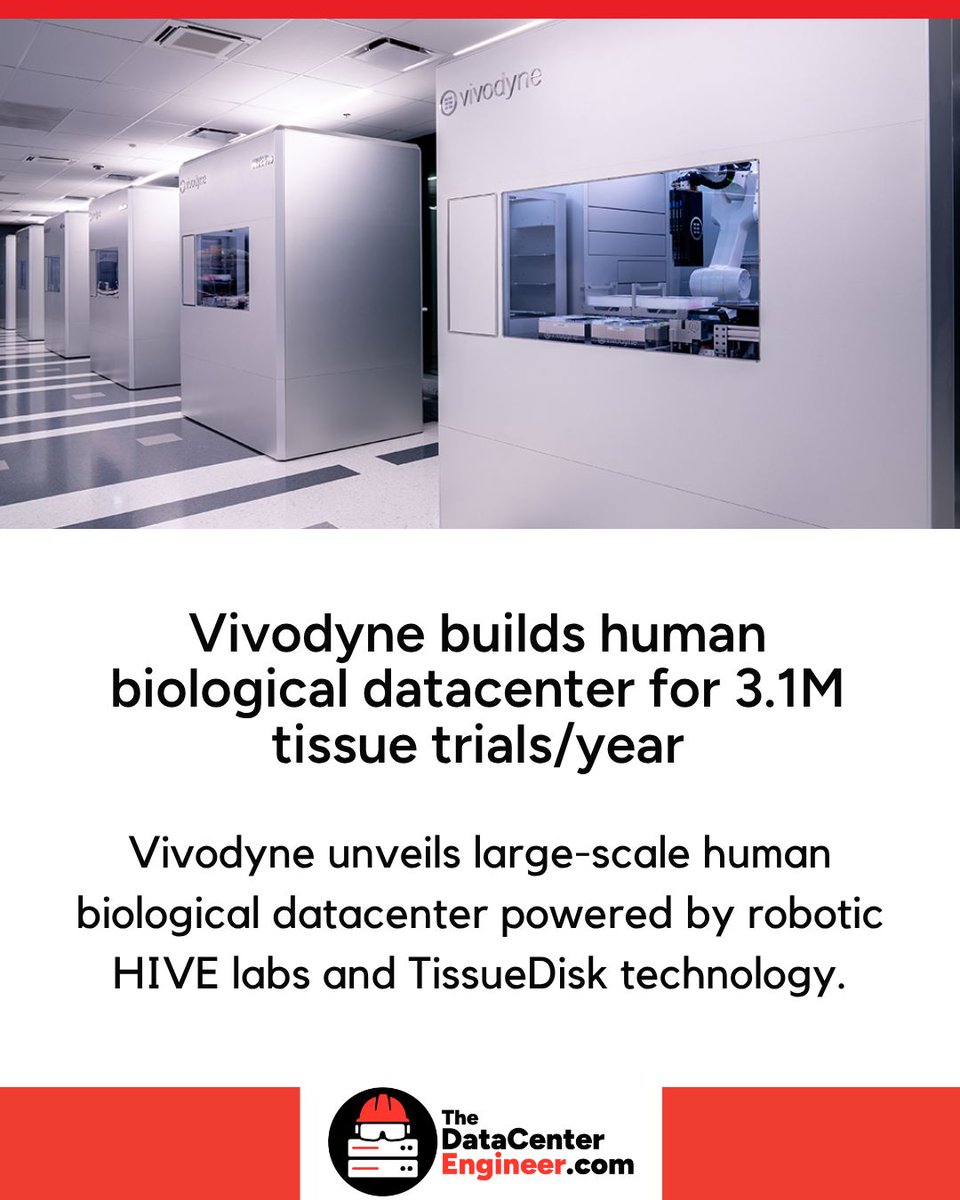
Vivodyne builds human biological datacenter for 3.1M tissue trials/year. More here: https://t.co/nr9udOyd0s
Vivodyne says it has built what it calls the world’s largest “human biological datacenter,” made up of 12 robotic HIVE laboratories with annual capacity for controlled trials on 3.1 million large human tissues. The company also introduced its Series 2 TissueDisk, a wafer-scale biological chip designed to grow hundreds of large, functional, living human tissues at the same time.
Vivodyne says TissueDisks are manufactured end-to-end on its own robotic production line, and that the disks run inside its robotic HIVE laboratories. Each lab is designed to operate automatically for weeks with unattended automation, covering cultivation, experimentation, and longitudinal data collection on tens of thousands of tissues at a time.
Airgain NimbeLink modems designed into AI data center energy monitors and PDUs. More here: https://t.co/Unq6gkQw30
Airgain has secured two data center IoT design wins for its NimbeLink embedded cellular modems, targeting power monitoring and rack-level power distribution systems used in AI and high-performance computing environments. The wins center on keeping electrical infrastructure connected for monitoring, diagnostics, and remote management as facilities push to higher power density and tighter uptime requirements.
One of the design wins, previously disclosed on the company’s Q2 2026 earnings call, is with an “electrical intelligence” provider serving AI-scale infrastructure across major data center environments. That customer selected Airgain’s NimbeLink Cat 1 bis embedded modem for an energy monitoring platform that uses sensing and analytics to improve visibility into power consumption and equipment health. Airgain ties that visibility to practical operational outcomes including improved energy efficiency, support for preventive maintenance, and reduced unplanned downtime.
100 MW Kraaken concept vessel exports 40 MW power and 30M L/day water to shore. More here: https://t.co/O8CJPlJlEG
Optimal Transit, a maritime technology partnership of InMar Technologies and OptiFuel Systems, has unveiled a second configuration of its Kraaken platform: a proposed 100 MW SWATH vessel that would split output among shore power, desalination, and onboard AI compute.
The Blue Economy VITAL 100 MW concept uses the same small-waterplane-area twin-hull architecture, flexible mooring, and patented Digital Ocean Thermal (DOT) engine described in the company’s July announcement. Nothing in the announcement indicates a hull has been built, contracted, or classed. The company says it is still working toward ABS-ready drawings and digital-twin validation of the DOT engine.
Molex backs CAEPlus BoundaryCool active liquid cooling for AI data centers. More here: https://t.co/cZjSLFe3fu
Molex has made a strategic investment in CAEPlus, an early-stage company developing active liquid cooling technology aimed at AI and high-performance computing (HPC) data center heat loads. Molex said the investment is intended to accelerate development of CAEPlus’ BoundaryCool platform, which the company describes as a compact, active cooling architecture targeted at next-generation GPU and ASIC thermal challenges.
Molex characterized the work as part of its data center thermal management efforts, with the goal of advancing BoundaryCool’s active liquid cooling approach for higher heat-removal performance in AI and HPC environments.
MaxLinear launches RackCommander control-plane silicon for AI rack management. More here: https://t.co/FAZo0P9fgT
MaxLinear has introduced RackCommander, a control-plane portfolio aimed at rack-level management for AI, cloud, enterprise, and edge infrastructure. The portfolio groups connectivity, monitoring, control, and power-management building blocks that are typically spread across multiple device families in a rack-management design.
RackCommander builds on MaxLinear’s Coronado (MxL81424) and Laguna (MxL81108) USB-UART devices for control-plane connectivity, and adds other components that target console access, sideband communications, telemetry aggregation, and rack-level power monitoring and protection. MaxLinear ties the portfolio to rack-scale designs such as Universal Baseboards (UBBs), multi-node systems, and rack-scale architectures.
Cummins to supply 5 MWh BESS for large U.S. data center project. More here: https://t.co/L40zHivn72
Cummins Power Generation has been selected to supply battery energy storage systems (BESS) for a large US data center project, targeting utility-defined requirements tied to AI-driven load behavior, including managing load fluctuations, mitigating load oscillations, and improving ride-through performance.
The company didn’t name the data center developer, site, or project size. Cummins described it as its largest BESS deployment to date, and positioned the system as an additional layer in the project’s power architecture to help stabilize the load profile at the utility interconnection point.
MaxLinear samples 50A and 60A intelligent eFuses for AI rack power telemetry. More here: https://t.co/84uPEU042W
MaxLinear has added two 16 V high-current electronic fuses (eFuses) to its AI infrastructure control-plane portfolio, targeting rack-scale power-path protection and telemetry in dense AI systems. The new parts, MxL745950 and MxL745951P, are aimed at protecting and monitoring power paths in AI servers, accelerator trays, data center switches, fan trays, power shelves, plug-in modules, and rack-scale platforms.
The MxL745950 is specified as a 16 V, 50 A eFuse with 1 mΩ on-resistance in a 5 mm × 5 mm LGA-32 package. It integrates current sensing, temperature monitoring, fault indication, programmable soft-start, and parallel-operation capability intended to support higher-current applications.
AI photonic integration platform targets optics-to-packaging bottleneck. More here: https://t.co/xkgVrfNZ0j
Atomica has launched its AI Photonic Integration Platform, a microfabrication platform aimed at one of the harder problems in AI infrastructure hardware: integrating photonics with electronics, memory, thermal structures, and package-level interfaces in a way that’s actually manufacturable at scale.
The AI Photonic Integration Platform is built around a “configurable microfabrication pathway” that spans interposers and vias, bonding, optical alignment, and wafer-level packaging. Atomica describes it as a platform for customers developing photonic and heterogeneous AI hardware where optical functions have to live alongside dense electrical I/O and aggressive thermal constraints in compact packages.
Compal opens Daxi AI server plant, targets 2x output by 2026. More here: https://t.co/EUi4JiFjng
Compal Electronics has opened its Daxi AI Server Manufacturing Center in Taiwan, bringing new manufacturing capacity online for AI server systems and rack-level solutions. The company is tying the site to growing demand for AI, HPC, and large-scale data centers, where build volume, integration capability, and supply chain execution can become limiting factors as quickly as silicon.
Compal previously disclosed a total investment of NT$4.03 billion for the Daxi facility, covering property acquisition, facility upgrades, and deployment of manufacturing equipment. The Daxi site occupies about 7,654 m² of land and has a total floor area of about 21,706 m².
Design instability: when the build takes longer than the spec lasts. More here: https://t.co/Gm3Ba5QsSN
Five years ago Starline was powering data center racks in the 10 kW range. Today it’s speccing racks at 142 to 150 kW, and customers are already asking what 200 kW looks like next year. Over the same stretch the busway itself went from 250 to 400 A as a normal order to 1,000 and 1,200 A as a routine one.
Chris Osian works in product management at Starline, the overhead busway brand at Legrand, where he’s spent about 14 years, a little over a decade of it as an applications engineer sitting with customers and turning their specs into a power chain. His job now is to keep busway ahead of whatever the next generation of racks asks for.
800 VDC power platform targets ERCOT ride-through for AI data centers. More here: https://t.co/5yI98nhHuO
DIMAAG has launched the ZettaWatt Power Platform, a modular grid-to-800 VDC power conversion and stabilization system designed for hyperscale AI data centers. The company is targeting utility interconnection hurdles in Texas’s ERCOT region, where large computational loads are being required to ride through specified grid disturbances rather than disconnect.
DIMAAG says the ZettaWatt platform has been independently validated by Electric Power Engineers (EPE) and meets ERCOT requirements for low-voltage ride-through. The system is also intended to smooth cyclic loads to less than 1% “as seen by the grid,” while avoiding the energy-efficiency penalties associated with double power conversion.
Runware ships 1 MW containerized AI inference pods with closed-loop cooling. More here: https://t.co/T14gGPJY8H
Runware has introduced its Sonic Inference Pod, a containerized, modular AI inference “data center” built to bring GPU capacity online faster than a conventional facility build. The company describes each pod as a self-contained 1 MW deployment packaged in a 20-foot shipping container, aimed at model providers that need inference infrastructure without waiting on multi-year data center timelines.
Runware’s Sonic Inference Pod integrates custom servers, PCBs, and a closed-loop cooling system that the company says is engineered specifically for inference performance. Runware also claims a cost advantage versus traditional, gigawatt-scale builds, citing “facilities costs” up to 100x lower than a conventional data center build and saying it passes those savings through its GPU compute pricing.
PCIe 7.0-ready Summit M616 analyzer targets 128 GT/s validation and debug. More here: https://t.co/sBOfYzkBmF
Teledyne LeCroy Summit M616 is now labeled “PCIe 7.0 ready,” extending the currently shipping PCIe protocol analyzer/exerciser platform with an upgrade path aimed at PCI Express 7.0 validation and debug workflows as the ecosystem moves toward 128 GT/s operation.
Teledyne LeCroy describes the Summit M616 as a modular platform that can be extended via an add-on solution for PCIe 7.0 development. The company says the system maintains the existing Summit workflow used across earlier PCIe generations while adding support for next-generation protocol traffic capture, decode, generation, and analysis.
SiC MOSFETs cut RDS(on) drift to ~8% from -25°C to 125°C. More here: https://t.co/k9sef2lZkc
Para Light has launched its ThermaFlat SiC MOSFET family, introducing two series—ThermaFlat I and ThermaFlat II—aimed at reducing temperature-driven RDS(on) drift in high-power designs. The company is pitching the devices at applications where junction temperature swings can push conduction losses up and force more aggressive thermal design.
The core technical claim is “Ultra-Low RDS(on) Drift Technology,” which Para Light says keeps on-resistance relatively flat across operating temperature. In benchmark testing cited by the company for a 650 V, 21 mΩ TO-247 device, RDS(on) changes by about 8% as junction temperature moves from -25°C to +125°C. Para Light also says its 1200 V ThermaFlat family applies a similar low temperature coefficient for high-power conversion architectures.
Peak+ launches CORE factory-installable adiabatic pre-cooling for chillers. More here: https://t.co/67q8cJk78l
Peak+ has launched the Peak+ CORE adiabatic pre-cooling system, a new form factor designed to integrate directly into air-cooled chillers and other air-cooled equipment and support factory installation. The company is targeting data center campuses where higher power densities are making heat rejection harder and where “failing external CFDs” are becoming more common.
CORE is built for v-coil style air-cooled chillers and dry coolers, with frames positioned directly in front of condenser coils on v-coil air-cooled chillers, as well as other air-cooled condensers and radiators. Peak+ says the approach is aimed at high-temperature environments where suppressing condenser entering air temperature (CEAT) to the chiller system design temperature, or below, helps avoid chiller performance derate.
AI compute storage targets 1B random IOPS; eval units due Q1 2027. More here: https://t.co/KCgbYfYele
Smart IOPS and H3 Platform detailed an AI compute storage design that pairs Smart IOPS’ Unobtanium T50 SSD with a GPU-centric, air-cooled H3 Platform appliance, targeting up to one billion 512-byte random IOPS in a single system. The configuration is intended for NVIDIA’s Storage-Next initiative and the NVIDIA SCADA (Scaled Accelerated Data Access) programming model, which focus on GPU-initiated access to NVMe storage for working sets that don’t fit in local GPU memory.
The Smart IOPS Unobtanium T50 is described as a PCIe Gen6 x4, NVMe 2.0 device in an E3.S 2T form factor. Smart IOPS lists preliminary performance targets of up to 50 million random-read IOPS and up to 10 million random-write IOPS at a 512-byte block size, along with up to 28 GB/s sequential reads and 24 GB/s sequential writes. Capacity options listed are 9 TB, 18 TB, and 36 TB.