if you want to get every last bit of performance out of your local setup, you need to know a bit about inference 🥵
but we've got you covered, shipping conceptual guides 🔥
here's the first one about prefill, decode, KV cache what you should optimize for 🙌🏻
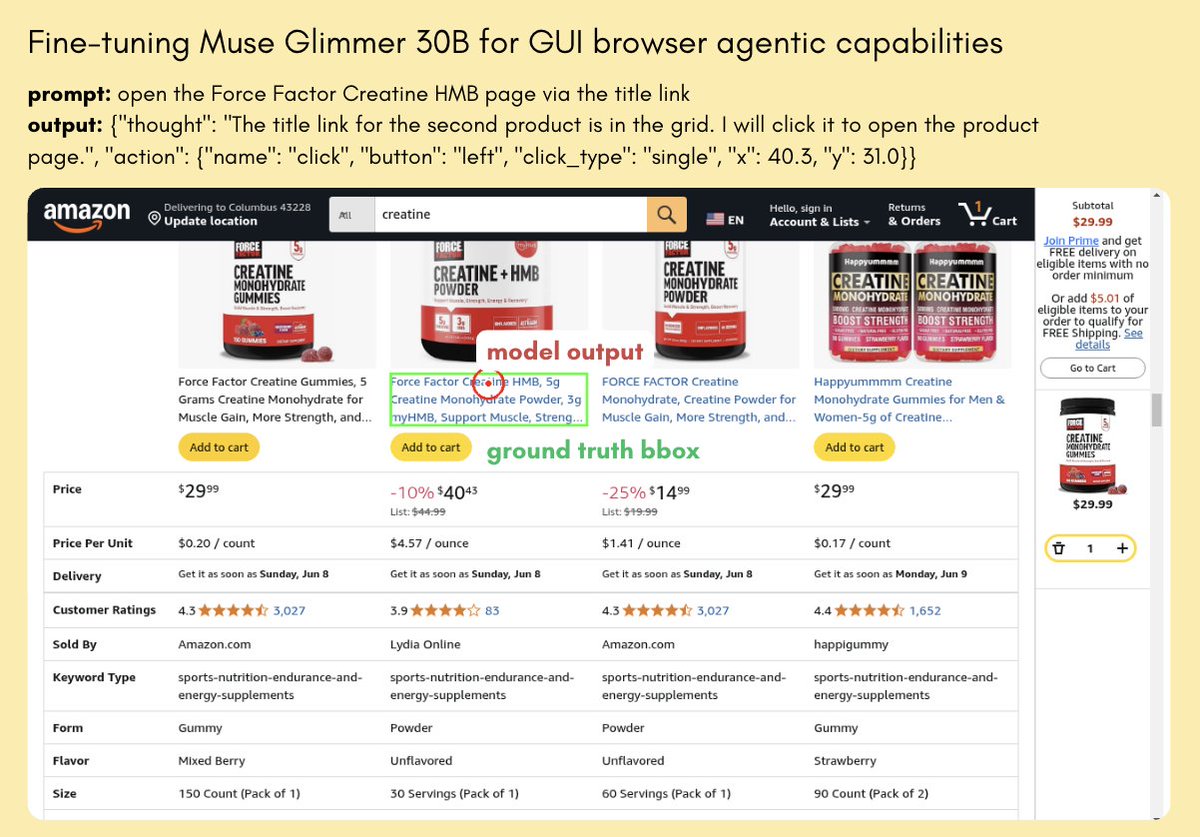
I shipped a fine-tuning tutorial for Muse Glimmer 30B on AI2's MolmoWeb dataset with TRL
https://t.co/VstYoch3le
> but merve, this model is sota on ScreenSpot-Pro?
yes, but it doesn't work well with ambiguous prompts of MolmoWeb that are close to how you interact with computer, e.g. "jump to nutrition facts"
I compared model fine-tuned on MolmoWeb format against base model zero-shot outputs converted to MolmoWeb format (coordinates on 100)
I found that base model has 13% click accuracy + 35.0% within 5% diagonal while fine-tuned model has 41% + 68% within 5% diagonal
The @liquidai cookbook is such an underrated developer resource:
Curious about fine-tuning text, vision, audio, or encoder models?
Curious about fine-tuning with CPT, SFT, DPO, or GRPO?
Curious about fine-tuning LFMs with Unsloth or TRL?
It has it all.
I just did a little cleanup. Enjoy!
https://t.co/y4mJxrQwDC
A super long overdue (3+ years?) post on scaling laws.
Compute is expensive. Scaling laws are a way to help us reason about the optimal compute allocation between data and model size before committing to a large run.
The post covers what scaling laws predict, how compute-optimal allocation works, why Kaplan et al. and Chinchilla disagree, and how data limits + fitting details make extrapolation tricky.
https://t.co/HP26eJvjHB
Introducing LFM2.5-Embedding-350M and LFM2.5-ColBERT-350M: two multilingual retrieval models built for ultra-fast and accurate search across 11 languages.
> End-to-end retrieval latency as low as 1.5ms with our enterprise stack! 🚀
> Consistently best-in-class multilingual and cross-lingual performance across Arabic, German, English, Spanish, French, Italian, Japanese, Korean, Norwegian, Portuguese, and Swedish.
🧵
NVIDIA & Unsloth dropped one of the best practical guides on building RL environments from scratch, filling gaps most tutorials skip.
Covers:
- Why RL environments matter + how to build them
- When RL beats SFT
- GRPO & RL best practices
- How verifiable rewards & RLVR work
Very hyped by the new Cohere Transcribe model 🌍
Works surprisingly well on bad quality audio when the mic doesn't cooperate. 2B params, 14 supported languages and it's Apache 2.0.
try the official Hugging Face demo ⬇️
If you guys aren't following the CEO of Cerebras-you should be. One of the brightest guys in the industry. Great writeup for the technical analysis guys who know nothing about AI. I'm somewhere in the middle and learned a lot here.
@andrewdfeldman would love to hear your thoughts on power density and last inch power delivery. Why did Cerebras decide to use Vicors' vertical power delivery?
$NVDA $VICR $MU $AMD $RMBS $BE $AAOI $SNDK
- 230 training runs
- 1,623 GPU hours (67 B200 days)
- 76 TB of training data
- a 2x faster model
Every paper said it can't be done.
Quantization Aware Distillation made it possible.
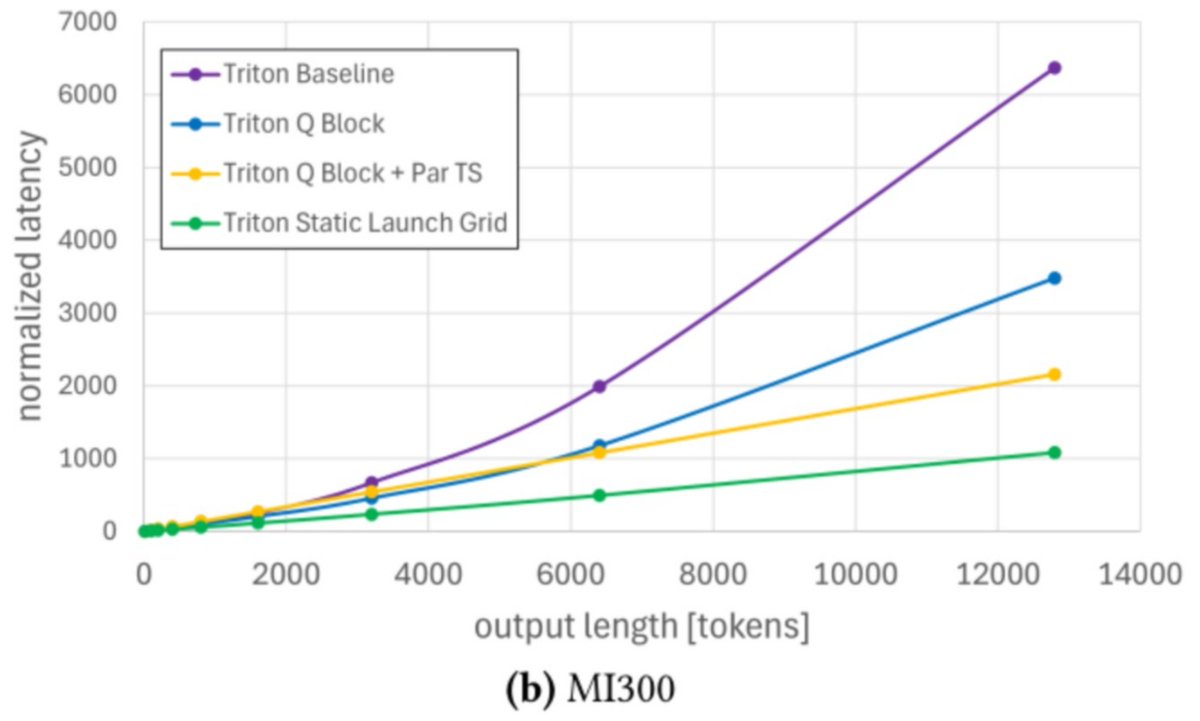
Maintaining separate attention kernels for every GPU platform doesn't scale.
The vLLM Triton attention backend takes a different approach: ~800 lines of Triton, same source code across NVIDIA, AMD, and Intel GPUs. On H100, it matches state-of-the-art attention performance. On MI300, ~5.8x faster than earlier implementations.
The blog covers Q blocks for better dot utilization, parallel tiled softmax for decode, persistent kernels for CUDA graph compatibility, and cross-platform benchmarking.
Now the default attention backend on AMD ROCm, also available on NVIDIA and Intel.
📖 Deep dive: https://t.co/De58RQuvu5
Thanks to @IBMResearch, @RedHat_AI, and @AIatAMD for driving this work!
Wrote an in depth breakdown of Paged Attention and KV cache management in modern inference systems like vLLM.
Starting from first principles:
- LLM training vs inference
- Prefill vs decoding
- Why KV caching exists
- Where memory fragmentation comes from
Then how vLLM style paged KV caching fixes it. Appendix also covers continuous batching, speculative decoding, and quantisation.
Blog: https://t.co/L97njbPDkM
not having a GPU is not an excuse to learn CUDA/triton.
> sign in to platforms like leetgpu/tensara.
> make an account
> solve challenges, look at other solutions , read docs, get better.