Demystifying Data 🌌 | Led by @ghowkay, a Data Engineer, dedicated to democratizing data know-how. Follow for diverse insights in #DataEngineering and Tech
If you’re interested in transitioning or starting a career in devops, go follow thedevopsdude on IG 👉
https://t.co/oCVJJpAWiK
You can also join the cloudpros community for continuous learning and growth: 👉 https://t.co/HdA3rT0JPg
yesterday, @Suhail asked me why I'm a data engineer, and what makes me optimistic about the field.
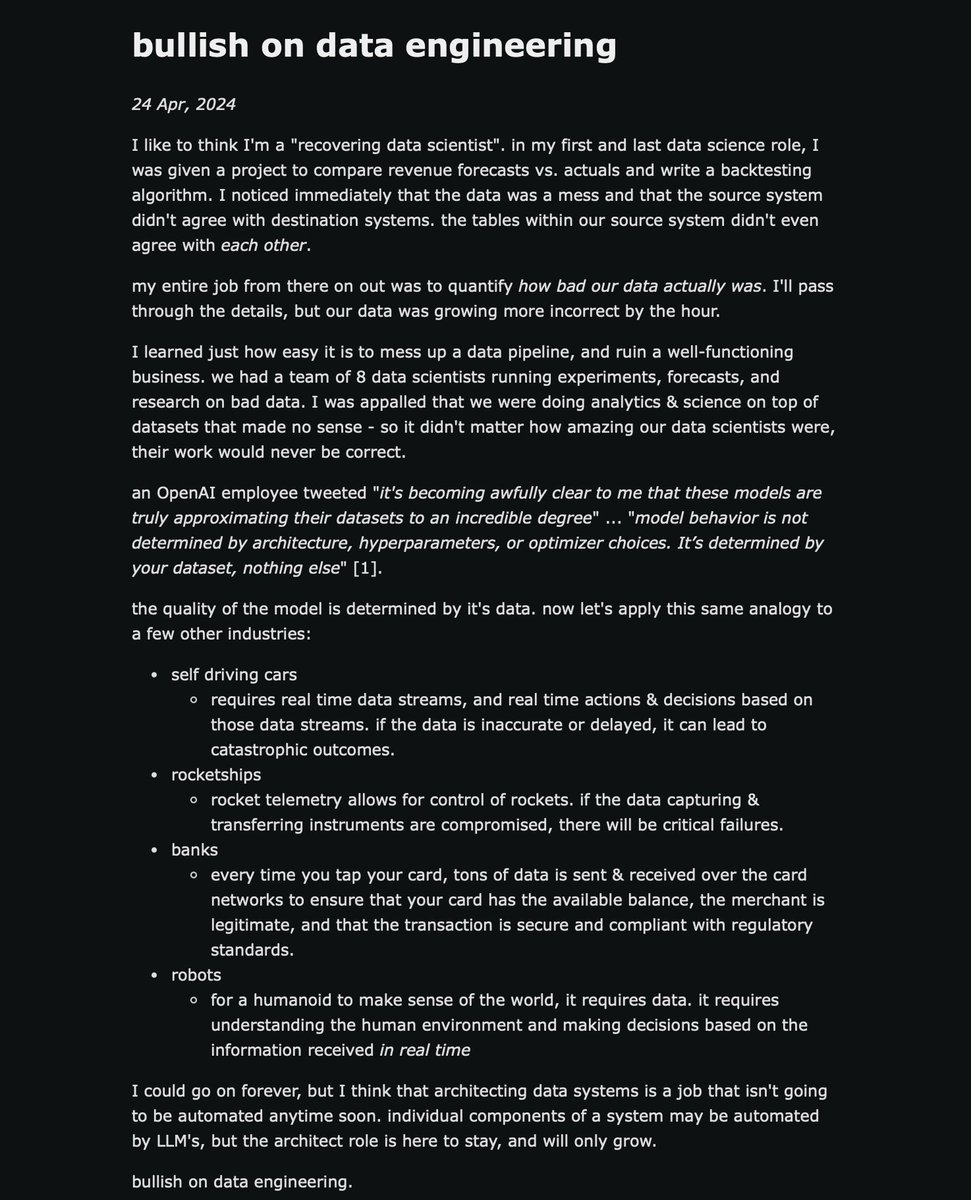
tl;dr to my answer: every company is a data company. whether you're training LLMs, sending rockets to space, making humanoid robots, running a bank, use the blockchain, or write any code at all - you're a data company. your products would never work if the correct data isn't used, or if the data could not be transferred between systems quickly & reliably.
getting to work on data is exciting to me, and I'm bullish on the field.
I'll touch on Best Practices for Data Lake Management and Optimization today.
Efficiently managing your data lake is key to unlocking its full potential. Stay tuned as we explore strategies to organize, secure, and leverage your data lake for maximum insight and value
#dataengineering #datalake #optimization #insights
Stumbled on this fun game. If you love big data , give it a go and let me know what you think of the game 😄
#dataengineering#firebolt
https://t.co/cxgCvhQQfd
Conclusion: Schema evolution is essential in maintaining a functional, future-proof data lake. Embracing change and employing the right strategies ensures your data stays relevant and valuable.
As data structures evolve over time, managing schema changes becomes critical for data integrity and analysis. I’ll provide more details around schema evolution in data lakes in the next post
👌#dataengineering#schemaevolution
Data pipeline quality is critical! Here’s the long process of building a solid gold pipeline:
- build a spec and solicit feedback
This spec should include rough outlines of sources, business impact, business metrics, output data sets, and data quality checks. Get this spec reviewed by both stakeholders and another data architect!
- when spec is approved,
Start building the base pipeline. Preferably using a static type language like Scala or Rust but Python will do in most cases. Backfill one month of data.
- have a data analyst look extremely closely at that one month of data to validate it. A validation report showing the data is high quality is required.
- while the analyst is validating, the engineer should be implementing data quality checks and unit tests.
- when the validation report looks good and all the checks are solid. Have a data architect come back to check out the pipeline code and sign off.
- last piece is integrating the metrics. A high level data scientist should be looking at these to sign off.
And that’s it! That’s how you make a very high quality data pipeline. Remember you can’t check or validate your own work!
Any steps I missed or details you think are worth including?
#dataengineering #datascience
Conclusion: Mastering data types is foundational in data engineering, impacting everything from database design to analytics. It's where efficiency meets accuracy.
5. Significance in Storage: Proper data type selection minimizes storage space and optimizes performance, crucial for large-scale data engineering projects