The 𝗻𝗲𝘄 science of data.
#DataScience research center, joint effort of 4 departments of @UNI_FIRENZE : statistics, maths, information engineering, economics
How much do PhD students earn?
The first comprehensive overview of PhD income shows vast imbalances across much of Europe
Read the full story: https://t.co/AKk2SyX5cT https://t.co/EXVWETGS6W
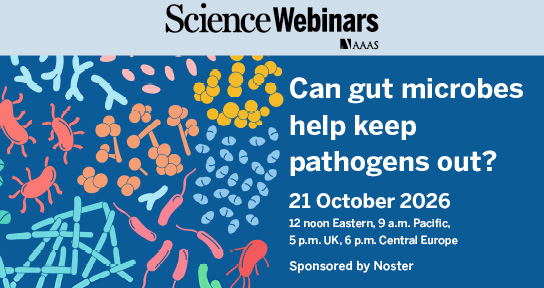
Join #ScienceWebinars for their next #Technology broadcast on Wednesday, 21 October at 12 p.m. ET ➡️ Battle for the gut: From microbial competition to therapeutic communities.
Register now: https://t.co/g9fyfxnYQs
I’m glad to be among the co-authors on Jason Gibbons’s “Reinforcement Learning for Repetitive Transcranial Magnetic Stimulation Protocol Selection in Treatment-Resistant Depression,” which was just accepted by NPJ Digital Medicine. A great example of careful use of AI methods!
Anthropic engineer:
"You're not supposed to prompt Claude. You're supposed to build a system that prompts itself."
In 45 minutes she breaks down how Anthropic builds agents that remember, learn from their mistakes, and get smarter with every run.
Worth more than any paid course you'll find on building agents.
Watch the session, then read the guide on building loops below.
📢We’re excited to share that StaTalk 2026 is coming on 21–22 May 2026 at the University of Turin!
✨For researchers & students
🗓️21–22 May 2026
💻Register & submit abstracts now! https://t.co/nVzdf52VBe
#StaTalk2026#Statistics
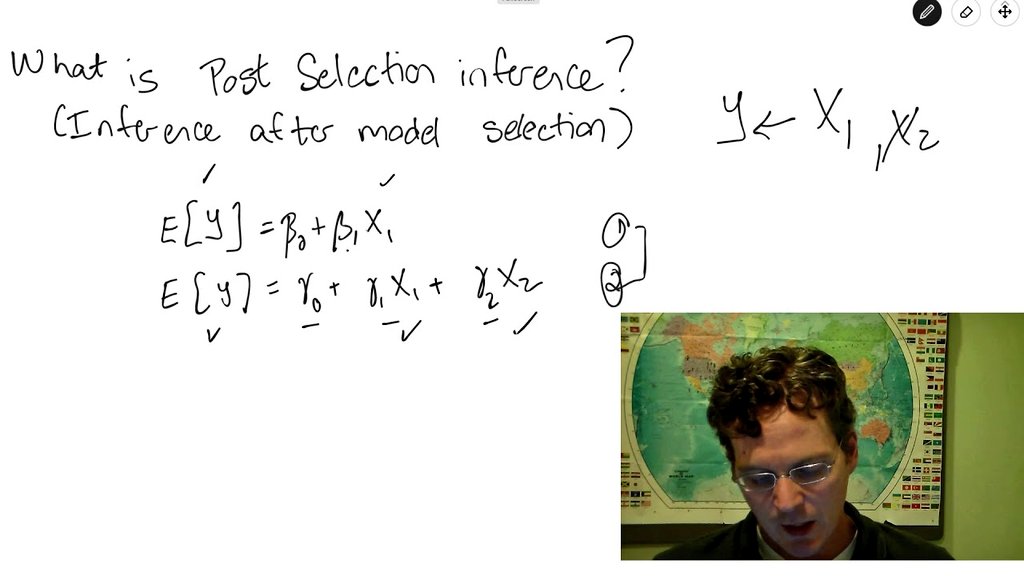
Post-selection inference studies how to perform valid statistical inference after a model, variable set, or hypothesis has been chosen using the same data. Classical theory assumes the model is fixed in advance, but modern workflows first select features, tune hyperparameters, or choose networks, which introduces hidden bias. Post-selection theory corrects for this by conditioning on the selection event and using tools from probability, such as truncated distributions, martingales, and selective likelihoods, to recover valid p-values and confidence intervals. In statistics, it enables honest inference after LASSO, stepwise regression, and data-driven model choice. In machine learning, it is crucial for feature selection, neural architecture search, and adaptive pipelines, where naïve uncertainty estimates are misleading. In deep learning, post-selection ideas support reliable evaluation and interpretability. By accounting for data reuse, post-selection inference restores trust in conclusions drawn from complex, adaptive learning systems.
https://t.co/7dCevCZcBk
📢 FDS–DiSIA Seminar
Peter McCullagh (University of Chicago)
Title: Statistics of speciation and the evolution of reproductive isolation
🗓 Jan 30, 2026 | 11:00📍 DiSIA, Room 205 (Florence)
In person, open to all.
#Statistics#DataScience
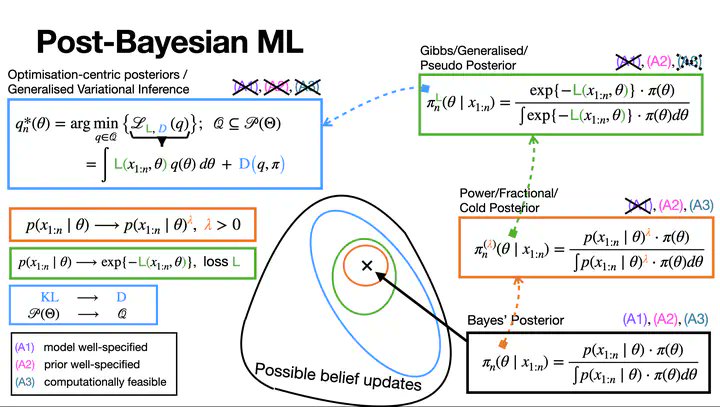
Bayesian machine learning is an approach to modeling and inference that treats unknown parameters and predictions as random variables and updates beliefs using Bayes’ rule as new data arrives. Instead of producing single best guesses, it produces full probability distributions that quantify uncertainty. In probability theory, Bayesian ML builds directly on conditional probability, likelihoods, and prior distributions, providing a coherent framework for learning from data. In machine learning, it powers methods such as Bayesian neural networks, Gaussian processes, and probabilistic graphical models, enabling robust prediction, uncertainty estimation, and principled model comparison. In real life, Bayesian ML is used in medicine, finance, robotics, and recommendation systems, where decisions must be made under uncertainty and models must adapt as evidence accumulates.
Image: https://t.co/BZNSK73Fpc
Nonparametric regression (f̂ = arg min ∥y − f(x)∥² + λ∥f∥²_H) is a flexible approach to modeling the relationship between inputs and outputs without assuming a fixed functional form, allowing the data itself to determine the shape of the curve. In probability theory, it is studied through kernel estimators, splines, and Gaussian processes, which describe how random functions can be estimated and how uncertainty behaves as sample size grows. In machine learning, nonparametric regression powers methods such as k-nearest neighbors, kernel ridge regression, and Gaussian process regression, enabling accurate prediction in complex, high-dimensional settings. In real life, it is used in economics, medicine, climate science, and engineering to uncover trends, forecast outcomes, and make decisions when the true underlying relationship is unknown or too complicated to be captured by simple formulas.
Image: https://t.co/4iS9VEsO5N
Thank you, 2025, for all the models that were perfect on training data and then failed spectacularly. Overfitting keeps us humble. Also, thank you for making “it depends” the correct answer more often than not. In 2026, may we at least know WHAT it depends on. 🥳 #datascience