@BraedendotTECH This is my experience when I'm using it to accomplish something I am OBLIGATED to do.
When I'm using it to do something I WANT to do I'm far more engaged and feel like I'm actually learning.
Use AI to explore something you're passionate about and it won't feel so numb.
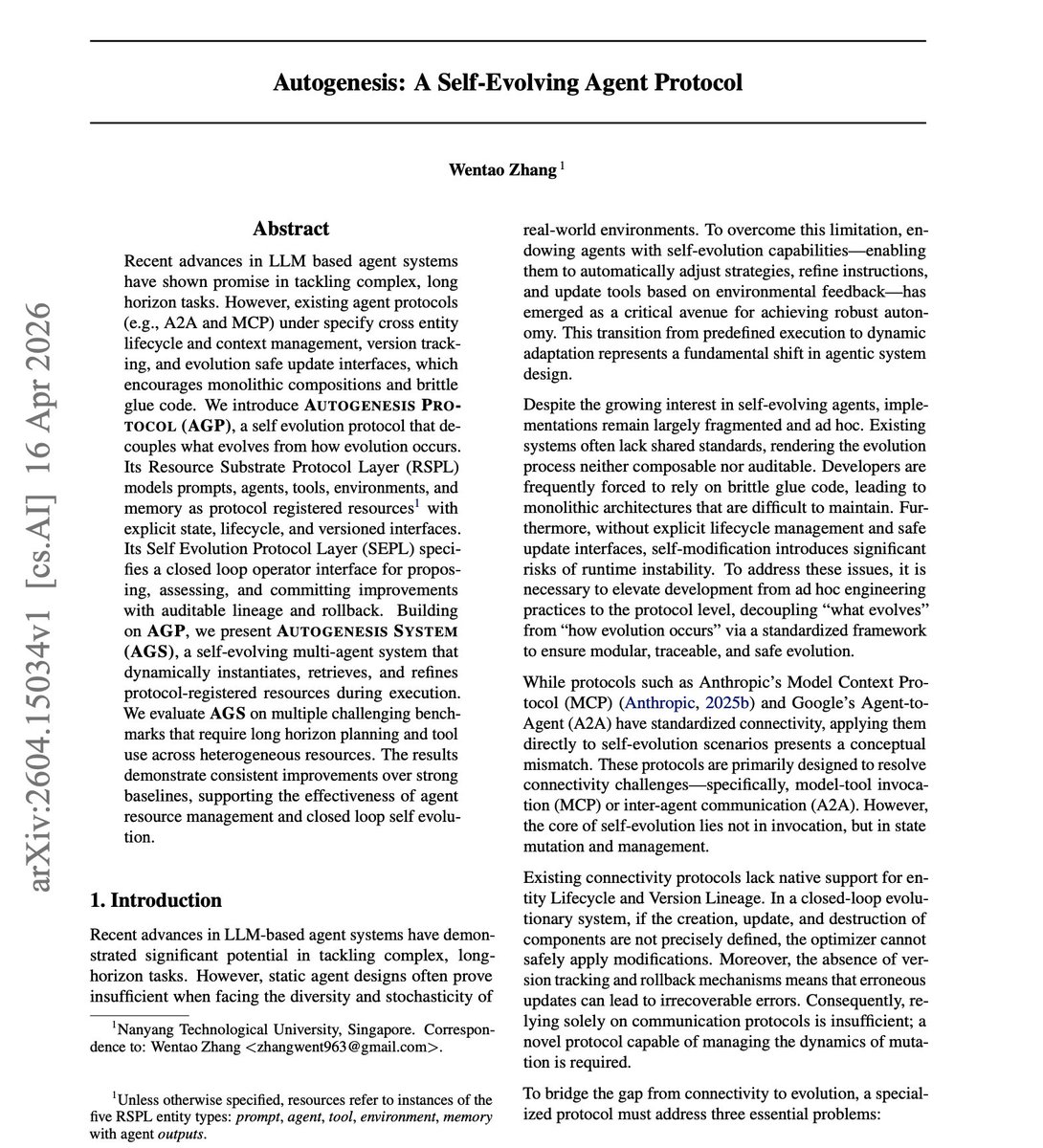
// Self-Evolving Agent Protocol //
One of the more interesting papers I read this week.
(bookmark it if you are an AI dev)
The paper introduces Autogenesis, a self-evolving agent protocol where agents identify their own capability gaps, generate candidate improvements, validate them through testing, and integrate what works back into their own operational framework.
No retraining, no human patching, just an ongoing loop of assessment, proposal, validation, and integration.
Why it's worth reading this paper:
Static agents age quickly.
As deployment environments change and new tools arrive, the agents that survive will be the ones that can safely rewrite themselves. Autogenesis is part of a growing wave of self-improving agent systems, alongside work like Meta-Harness and the Darwin Gödel Machine line, and it's one of the cleaner protocol-level takes on continual self-improvement so far.
Paper: https://t.co/3aj9LLjSbk
Learn to build effective AI agents in our academy: https://t.co/1e8RZKs4uX
I visualized all 1,309 Titanic passengers in 3D, positioned by their actual cabin locations.
Used Three.js to render the ship's structure with passengers as colored dots - green survived, red didn't.
The vertical distribution tells the whole story.
I put "Both of the above" but honestly it's whatever you enjoy working on the most. One thing that would be cool to see is the workflow you do on the backend to create the pieces you share. I know you show your code but I'm talking more about the process you work through to identify what you're going to visualize.