Quickly implement DB branching in any @PostgreSQL database by installing DBLab SE into your AWS, GCP, Digital Ocean, or Hetzner Cloud account in just a few clicks. Includes lots of extensions, monitoring features, and vendor support: https://t.co/JXIT8aX3iM
DBLab Engine v4.2.1 is out: fixes and security hardening, upgrade from v4.2.0 recommended.
- clone state saved atomically (a crash mid-write could destroy all clones)
- clone upgrade fixed for TLS-mounted setups
- safer upgrade image default (breaking)
https://t.co/uTeDplaD6Y
Investigating: Impact: All platform API requests are failing, so the console, CLI and
integrations are unusable. The website and marketing pages are unaffected. https://t.co/pASqukt8OK
DBLab Engine 4.2 is out!
Main thing: you can now pg_upgrade a clone with just one click or in CLI call:
==> dblab clone upgrade my-clone
=> automation stops the clone, "pg_upgrade --link" runs in place, then clone comes back on a new Postgres major version.
As usual, prod and every other clone untouched.
Didn't like the result?
==> dblab clone reset
No more excuses to avoid full-fledged testing before production Postgres gets upgraded.
Also in 4.2:
- paste a source URL, DBLab figures out provider, image, databases, settings
- branches and snapshots expire on policy (off by default)
- secrets from env vars (not plain-text in configs anymore)
- clone creation ~2x faster
traditional reminder that simple ALTER TABLE that felt instant on your laptop can put your production Postgres down
it needs to be cooked properly in production – use lock_timeout and retries https://t.co/QlZcli776t
Working on this is a lot of fun. Here I shared how it all started, what original PgQ already has and what didn't, and what v0.2 brings (RC1 stamped yesterday)
Precise (not sampled) wait even analysis is something I didn't expect to have for Postgres - but here we go
Being able to zoom into concrete millisecond (!) and see the exact chain of wait events opens new possibilities for RCA, benchmarks, and performance studies
links 👇
New episode: "pg_wait_tracer"
Nik and Michael are joined by Dmitry Fomin to discuss his new tool pg_wait_tracer, as well as changes to core that would allow wait event tracing with lower overhead (and on managed services).
🎧 https://t.co/oEgydSWt1X
📺 https://t.co/hN7nd5zIjh
PgQue v0.1.0 is out.
PgQ -- the Postgres queue system built at Skype 20 years ago for 1B-user-scale workloads -- repackaged for the managed-Postgres era. One SQL file. No C extension. No external daemon. pg_cron to tick.
Why bother reviving a 2007 architecture?
Every major Postgres queue in production today uses some flavor of SKIP LOCKED + UPDATE/DELETE. It works under light load. When you have more data and higher load, it degrades predictably. Then you get posts like these:
- Brandur at Heroku, 2015: 60k job backlog in one hour from a single open transaction
- PlanetScale, 2026: death spiral at 800 jobs/sec
- River issue #59, awa issue #169 and so on, Oban's partitioning work, PGMQ's autovacuum tuning guide and duct-taping with pg_partman
The core issue is how Postgres MVCC is implemented and how we deal with it. Dead tuples in the hot path, xmin horizon pinned, vacuum falling behind, query performance quickly degrades. This happens every time you run pg_dump, execute an analytical query, or have a lagging/unused logical replication slot.
PgQ solved this in 2007 with snapshot-based batching and TRUNCATE rotation -- zero dead tuples in the event
path, by design.
But PgQ needed a C extension and an external daemon. Which means it doesn't run on RDS, Aurora, Cloud SQL, AlloyDB, Supabase, or Neon -- i.e., where most
Postgres lives now.
PgQue closes that gap.
💎 Pure SQL + PL/pgSQL (PgQ engine)
👩💻 \i sql/pgque.sql -- you're done
🕑 pg_cron replaces pgqd (optional, recommended)
💻 Python, Go, TypeScript client examples shipped
💙 Apache 2.0
Trade-off: end-to-end event delivery latency is up to a second, it depends on ticking frequency. If you need sub-3ms job dispatch, use River, Oban, or graphile-worker (and avoid anything that blocks xmin horizon). If you need high-throughput event streaming with fan-out inside Postgres -- Kafka-shaped, without Kafka and dealing with transactional outbox implementation -- this is the right shape of tool.
Kudos to Marko Kreen and Skype engineers who implemented this decades ago, for the original PgQ, and to Alexander Kukushkin whose recent "Rediscovering PgQ" talk brought this quiet corner of the Postgres ecosystem back into view.
Stars, issues, PRs, and honest criticism all welcome.
Link 👇
Stop giving your AI agents access to your production database.
Here is the setup that fixes it.
I was using @neondatabase for disposable Postgres environments. Great DX, branching, one-click resets. Then traffic grew, costs followed, and even dev environments got expensive.
Paying for a production-grade managed service just to run experiments started to feel hard to justify.
So I went looking for an open source alternative and found @Database_Lab.
It takes any Postgres database and lets you spin up isolated clones, branches, and snapshots from it. Reset to any point with one click. Rerun migrations. Break things freely. Zero risk to anything real.
The detail that matters most: data flows one direction only. From Postgres into Database Lab, never the other way. Your source database stays completely untouchable.
AI agents are getting broader infrastructure access every week. Giving them a safe, isolated clone instead of production access is basic risk management at this point.
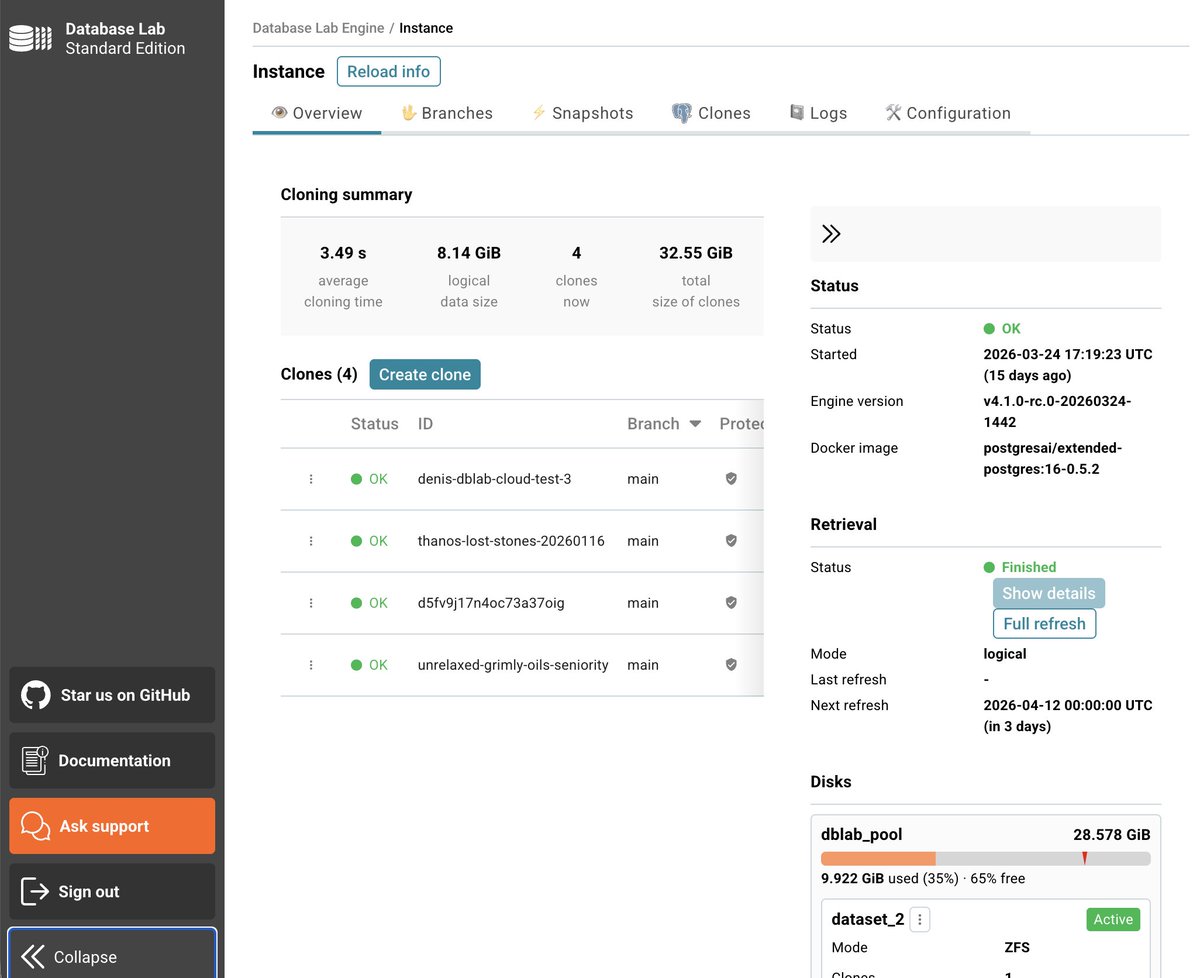
🚀 DBLab Engine 4.1 is out!
- Protection leases: time-limited clone protection
- Improved ARM64/Colima support
- Prometheus exporte
- RDS/Aurora logical refresh (so primary's health is not affected at all)
- Teleport support in SE/EE
and lots of other improvements and fixes