How does misogyny and misandry, get so intense among some singles? And what can be done about it? Check out my latest blog post on @PsychToday
https://t.co/Re6Zzfzb24
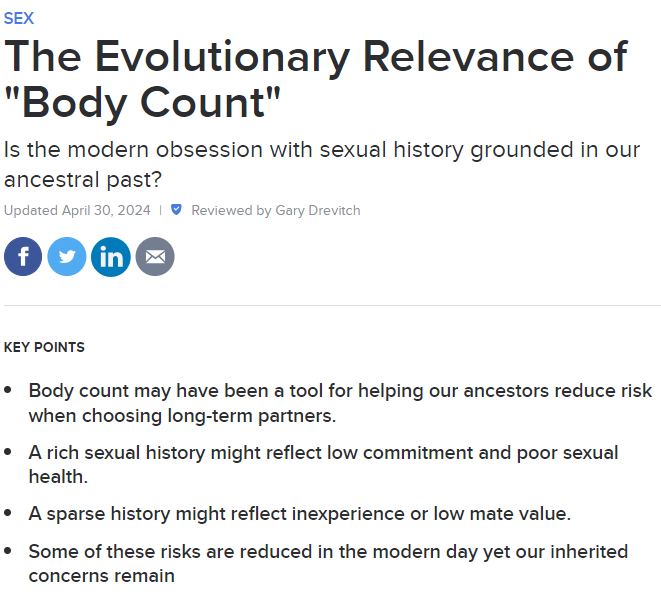
Is the modern obsession with "body count" a shallow cultural artefact that will fizzle out?
Or does it serve some kind of function—a way of helping us reduce risk when making important relationship choices?
An evolutionary perspective on the importance of sexual history in my latest blog post on @PsychToday
https://t.co/kJLUPOkpwc
Important to know right now, since in the UK it looks like we might be thinking of introducing mindfulness in schools - it doesn't help, folks. Let's not fall for the politician's fallacy: "Something must be done; this is something; therefore this must be done."
What we look for in a partner is, to some degree, unique to ourselves. Yet, on the whole, most of us actually seek pretty similar things in an "ideal" mate. Why? It likely comes down to this, writes @DatingDarwin https://t.co/boFCnjc6aK
New blog post just dropped.
Most (99%) of my followers think attachment is more important than pseudoscience like♉Zodiac signs... yet one in five know more about their Zodiac sign than their attachment style! Tragic. Let's change that.
In this new post, I talk about the importance of attachment style in mate choice including why insecure attachment might have evolved.
https://t.co/1CNUXxdrDY
@DatingDarwin@PsychToday
Again, if you had to figure out someone's intelligence in very little time (say seconds), using physical attractiveness would improve your estimate over a random guess.
Thus, filtering hard on physical attractiveness doesn't necessarily mean that the one cares only about physical attractiveness. It's a (more than) two birds with one stone heuristic.
This doesn't mean it the situation doesn't suck for those who possess intellect but little physical attractiveness. But this is more due to the contexts in which modern humans get to know each other rather than people "only caring about one thing"
Grade inflation makes it harder for the best students to distinguish themselves.
And it disincentives deep learning.
So it bums me out that departments that have meaningful grades (say, Econ) lose majors to departments where 70% of students get As (I won't name names), the result being that if we don't want to lose majors, we probably have to give out A's to a much wider range of students, including those who don't quite show mastery of the material.
@kearney_melissa When I taught in a Chinese university, grade inflation was solved by prohibiting professors in any department from giving more than 20% A grades.
Maybe we should do the same.
Let's get back to basics. How consistent are long-term mate preferences? Is it just "different strokes for different folks?" I take a look at the variation in a classic study in my latest Darwin Does Dating blog post. Just in time for 🎄 https://t.co/pgxZyWhbA2
As a professor who favors free speech on campus, I can sympathize with the "nuanced" answers given by U. presidents yesterday, about whether calls to attack or wipe out Israel violate campus speech policies.
What offends me is that since 2015, universities have been so quick to punish "microaggressions," including statements intended to be kind, if even one person from a favored group took offense. The presidents are now saying: "Jews are not a favored group, so offending or threatening Jews is not so bad. For Jews, it all depends on context." We might call this double standard "institutional anti-semitism."
University presidents: If you're not going to punish students for calling for the elimination of Israel and Israelis, it's OK with me, but ONLY if you also immediately dismantle the speech policing apparatus and norms you created in 2015-2016. Please read The Coddling of the American Mind. @glukianoff and I laid out exactly where the oppressor/victim frame came from (ch. 3), how it spread out of a few departments to gain power over administrators and campus culture (chapters 4 and 5), and how it drove the creation of the bureaucratic structures and processes that now have us all teaching and learning on eggshells (ch. 10). In chapter 13 we offer advice to leaders on how to to return universities to their academic mission and regain public trust.
"While it can be tempting to dismiss someone's feelings of loneliness, they should not be taken lightly..."
"Loneliness weaves a complex web that influences physiological processes, epigenetic changes, health-related behaviours, and even genetic factors."
My newest blog post is now up on @PsychToday
https://t.co/SDzzIdy6GX
“16 percent of professors said they have either been disciplined or threatened with discipline for their speech, teaching, or academic research… And a whopping 29 percent said they’ve been pressured by administrators to avoid controversial research. https://t.co/hZSqxnv0wU
"There is a Chinese term that roughly means ‘Revenge bedtime procrastination’ — when 'people who don’t have much control over their daytime life refuse to sleep early in order to regain some sense of freedom during late night hours.'” — @LuHai_Liang
Not everyone is equally desirable as a prospective romantic partner. Luckily, there are ways to maximize one’s attractiveness. Here are some of the most common across different countries, explains @DatingDarwin https://t.co/HSNyXiySC3
This month's blog post just dropped. I discuss the findings from our latest study on self-enhancing behaviours among singles. Remarkable similarities across 14 countries! @mapostolou4 @PsychToday
@SwanseaPsych https://t.co/Qv81wIiX0f
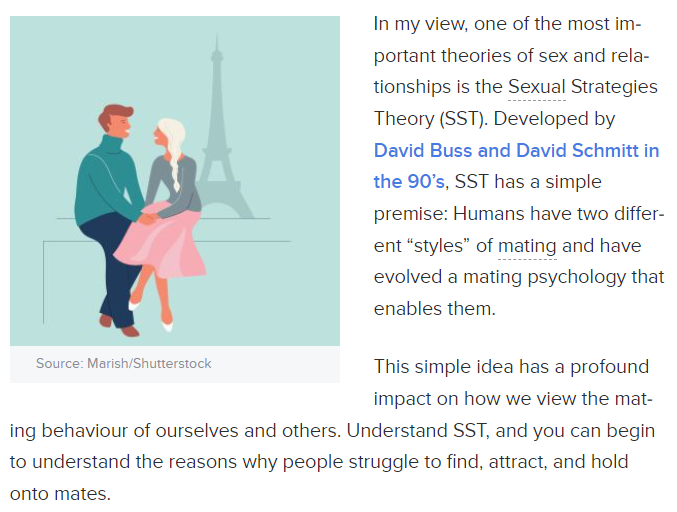
In my view, one of the most important theories of sex and relationships is the Sexual Strategies Theory.
It has a simple premise: Humans have two different “styles” of mating and have evolved a mating psychology that enables them."
https://t.co/tV2t0OPcYU
Bit of a milestone - my Darwin Does Dating blog has over 600,000 reads on @PsychToday!
For those not in the loop: it's my monthly blog about evolutionary perspectives on mating behaviour and sex differences.
Here's 5 recent posts that you should check out!