What i believe that egocentric data solved the volume problem. It didn't solve the post-training problem, and that's actually the harder half.
Ego is basically commoditized now. GEN-1.5 pretrained on 500,000 hours of it. Ego2Robot turned under 2,000 hours into over 18,000 hours of synthetic robot data. That side of the market is getting crowded fast, and raw ego pricing will keep dropping as supply keeps growing.
Post-training is a different problem entirely, and more ego video doesn't fix it, for a specific reason. Post-training exists to fix what a policy actually gets wrong once it's close to working, precise contact, recovering from a bad grasp, adapting as the robot's own motors wear down or its environment shifts. None of that shows up in a human doing a task cleanly on camera. A human doesn't fumble the way a specific robot gripper fumbles. You only see that failure by actually running that robot.
So better post-training data has to come from three places, and each solves a different part of the gap. Teleoperation, since a person driving the actual robot produces real robot dynamics, not an approximation of them. UMI and similar handheld rigs, since they sit closer to the robot's own end effector than a bare hand does, so there's less to retarget and less error to correct for. And purpose built hardware with force and tactile sensing, since plain video can't recover contact force no matter how much of it you collect, you need a sensor actually built to measure it.
One more piece worth building around: post-training isn't a one time dataset, it's a standing need. A robot deployed for six months has drifted from where it started, worn parts, a slightly different environment, new edge cases nobody saw during collection. So the real question isn't "how do we collect a big post-training dataset once," it's "how do we keep collecting the right failure and recovery data as long as the robot stays deployed."
The "same pool of capital" point is the sharpest part of this. It explains something easy to miss. If your whole business is just collecting hours of data and selling it, you have nothing holding your customers in place. When their funding gets tight, you're the easiest thing to cut. No lock in, nothing sticky, nothing they'd miss.
Infrastructure and data intelligence aren't really two different things either. Once you're actually processing the data that flows through you, you're already becoming the intelligence layer too. Just collecting data gets you neither.
This is exactly why we built Actuate at @Datra_ai as infrastructure, not a collection business. We handle the parts most collection companies skip. Simulation to check the physics before anything ships(working on this part). Processing to sync, clean, and label the data properly. Evaluation to score quality and catch mistakes. And a workflow that gives robotics teams a pipeline to plug into, instead of a raw pile of data they have to clean up themselves.
Actuate is ready to launch.
We're now focused on making the retargeting layer more robust across different embodiments. Huge thanks to @boskykode for the GPU grant that helped accelerate development.
Launching soon !
@Datra_ai
The “GPT moment” required massive-scale pretraining data. If robotics follows a similar path, teleop and UMI alone may struggle to generate data at that scale.
Egocentric data can scale massively, but the real bottleneck is the embodiment gap turning human interaction into robot-learnable actions. I think the unlock lies in better dexterous manipulation retargeting, grounded with tactile and multimodal signals.
Solve the embodiment gap, and egocentric data becomes far more useful at scale.
Scaling data collection itself won’t be the hardest problem once we figure out what data actually works. Right now, everyone is still experimenting with the recipe egocentric video, depth, tactile, UMI, teleop, and different combinations of them.
Once that recipe becomes clearer, collection will scale massively.
The harder problem then becomes: can we turn all of this heterogeneous raw data into consistent, training-ready trajectories?
Different modalities, timestamps, coordinate frames, embodiments and action spaces all need to become something a model can actually train on.
I think that processing layer will become as important as collection itself. This is exactly we're building at @Datra_ai . A product Actuate which convert different modalities of raw data into training ready trajectories.
Really good breakdown of data pipeline for world models by the Reka team.
One thing we've been learning while building for VLAs: annotation and action labels are still not the end of the data pipeline.
Raw multimodal demos still need temporal alignment, coordinate/frame normalization, trajectory + state/action construction, feature extraction,Retargeting, QC and finally conversion into the exact schema the training stack consumes.
raw demo → annotated data → model-consumable trajectory
We've been heads down building around this layer for the last couple of weeks.
Shipping something very soon.
Native depth support in LeRobot is really a big step.
The interesting data infra problem now is upstream: taking heterogeneous streams like RGB, depth, IMU, tactile or pose, aligning them temporally, extracting the right representations, and exporting them as model-consumable observations without losing sensor semantics.
Exactly the layer we're working on at @Datra_ai .
On data in robotics, quality is the real moat, not volume.
India is playing an important role in the robotics data economy sheer scale of collection is real and valuable. But raw volume alone doesn't translate to model performance. What actually makes data usable for robotics, especially for VLA (Vision-Language-Action) models, is the pipeline after collection:
1. QA — filtering out corrupted, ambiguous, or physically implausible demonstrations before they ever reach a training run
2. Proper multi-modal sync — millisecond-accurate alignment between vision, proprioception, force/torque, and language instructions, since even small temporal drift breaks the action-conditioning signal
3. Segmentation — breaking long-horizon tasks into meaningful sub-trajectories/skills, so models learn composable behaviors instead of memorizing entire episodes
4. Annotation — grounding objects, affordances, and language instructions precisely enough that the model can generalize across scenes, not just recall training instances
5. Action labelling — precise, densely-sampled action-space labels (joint angles, end-effector poses, gripper states) that are consistent across embodiments and time steps
But for VLA models specifically, the pipeline doesn't end at action labelling that's just the raw substrate. To make it genuinely trainable, you need:
1. Embodiment normalization — remapping actions/observations across different robot morphologies into a shared representation, so data from one arm/gripper transfers to another
2. Failure & recovery curation — deliberately capturing (and labeling) failed attempts and corrections, since VLA models need to learn recovery behavior, not just clean success trajectories
3. Language-action grounding validation — verifying that the paired instruction actually matches the executed action, not just a loosely correlated caption
4. Temporal chunking / action-tokenization — converting continuous control signals into the discrete or chunked action tokens the model architecture expects
5. De-duplication & diversity balancing — ensuring the dataset doesn't over-represent easy, common scenes/tasks at the expense of rare but critical edge cases
6. Simulation-to-real consistency checks — if sim data is blended in, validating that dynamics and visual domain gaps are small enough not to introduce silent training bias
Volume gets you coverage. This pipeline is what gets you a model that actually works in the physical world.
That's why we're building Actuate at @Datra_ai.
A Multimodal data processing pipeline for VLAs and World action models !
Building Actuate — DatraAI's multimodal data pipeline for physical AI.
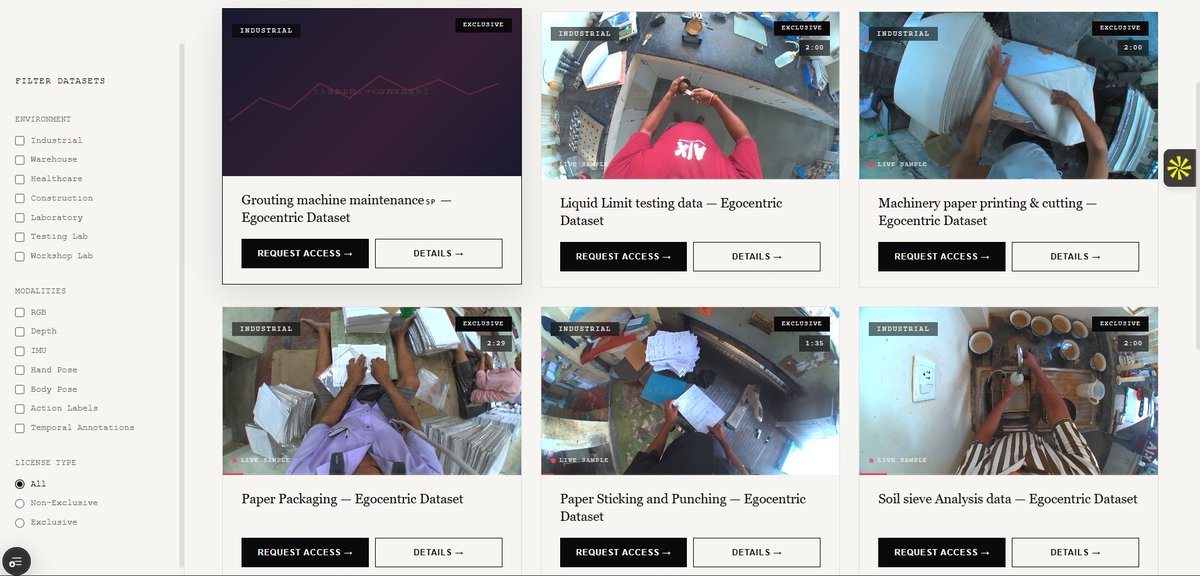
QA, Synced egocentric video + IMU + hand-pose, UMI gripper data from real household and industrial environments, processed into training-ready datasets for VLA and robotics foundation models.
If your team is stuck turning raw multimodal data into training-ready data for VLA, let's talk.
Today we're launching the @Datra_ai Marketplace (https://t.co/qG1afxR01t).
A platform where robotics researchers and Physical AI teams can discover and license real-world multimodal datasets.
Real human demonstrations collected from factories, workshops, warehouses, and labs.
Every dataset will be processed into a structured, training-ready format with rich metadata to plug into robotics training pipelines.
By mid of july, we'll launch our dataset library, processing pipeline, and multimodal sensor stack to make high-quality robotics data more accessible.
If you're building:
Vision-Language-Action Models
World Models
Manipulation Systems
Embodied AI
We'd love your feedback.
🔗 https://t.co/qG1afxR01t
Excited to share that @Datra_ai has been accepted into the NVIDIA Inception Program.
The last month has been heads down.
We've been building our multimodal data infrastructure for Physical AI and working on a processing pipeline that turns raw real-world human demonstrations into training-ready robotics datasets.
The product is launching soon.
This is what egocentric training data looks like at the sensor level.
↳ 1920×1080 @ 30fps, head-mounted
↳ 9-axis IMU at 563Hz, hardware-synced
↳ VTS-aligned timestamps (sub-frame accuracy)
↳ Accel + gyro + mag + temp, every frame
↳ Annotation and action labeling and Depth pipeline about to integrate
If you're training manipulation, tool-use, navigation, or any physical AI model that needs first-person human motion data at scale
We're the supply side infrastructure you don't have to build.
DMs open.
Soon going to launch website as diverse Egocentric data marketplace .
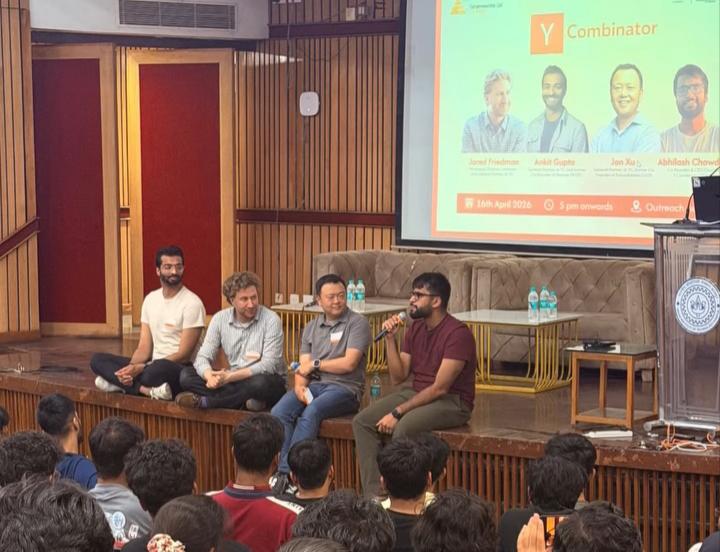
A month ago I was talking to @xuster in IITK and asked him:
"Everyone is collecting robotics data. Who's actually going to win?"
His answer was simple:
Either build the highest quality datasets with the best environments and hardware, or build the most diverse datasets.
And this is why we got bullish on diversity at @Datra_ai
Most people are playing a volume game.
We're betting on diversity.
Over the last few weeks, we've been collecting data across factories, hospitals, workshops, and educational labs. But one thing we're particularly excited about is partnering with Engineering anf ITI colleges.
Why?
Because these students spend years learning practical industrial skills before entering the workforce.
Welding.
Wiring.
Electrical assembly.
Machine operation.
Workshop tasks.
These are exactly the kinds of skills robotics companies ultimately want to automate.
If future industrial robots are going to learn from humans, it makes sense to learn from skilled humans performing real tasks.
We're now collecting data across industrial environments, hospitals, and technical training labs to capture a much broader distribution of real-world human behavior.
Also looking to connect with robotics labs and teams building VLAs, world models, manipulation systems, or industrial automation. I'd love to understand what you're building and what data is actually missing today.
Been quiet for 1 months.
A lot changed.
We finally started deploying our devices across Factories MSMEs in India.
Every day we go factory to factory figuring out:
which environments produce the most valuable real-world robotics data.
So far we're working with:
textile, leather, tanneries, packaging, manufacturing, households, Engineering and Nursing College labs and workshops and hospitals/clinic labs.
The interesting part is not just collecting video.
It’s:
diversity of environments
continuous workflows
exclusivity of datasets(Because we're collecting directly not buying from vendors)
and processing everything end-to-end ourselves instead of outsourcing to vendors.
We’re building a real-world multimodal data layer for physical AI.
Scaling much faster this month with better hardware deployments.
Also looking to partner with hardware + robotics labs working on sensing, wearables, perception, or physical AI infra.