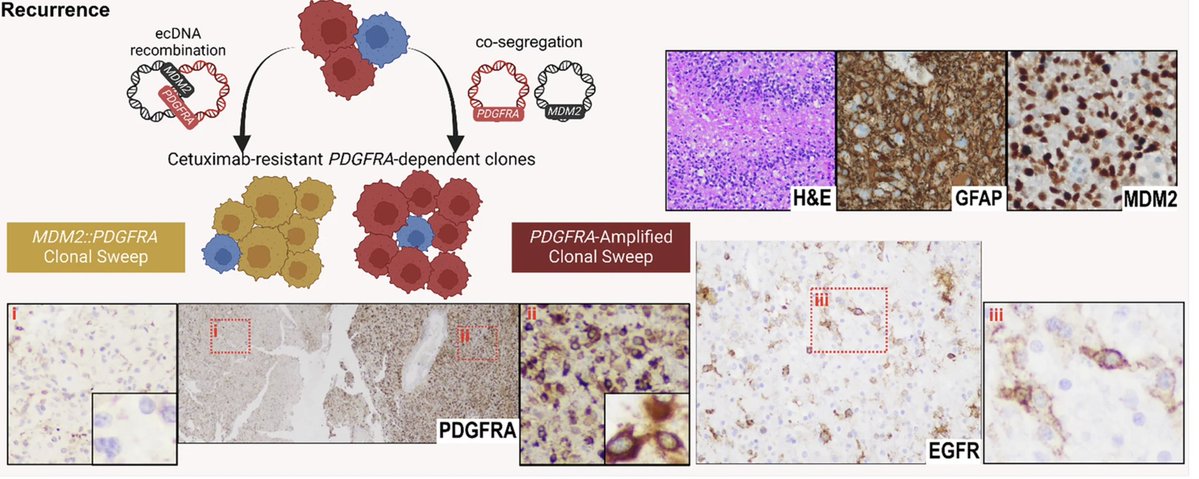
It is with great honor that I share our most recent publication, exploring actionability of acquired #PDGFRA fusions in #GBM. We show evidence of clonal sweep after exposure to an #EGFR monoclonal antibody and successful targeting of the newly acquired MDM2-PDGFRA fusion. This emphasizes the importance of repeat #NGS in patients with recurrent #GBM, evolution of #glioblastoma through several rounds of therapy and proactive monitoring and treatment through its evolution. Thank you to all my collaborators! @DavareLab@ChrisFebres@RandyDAmico_MD@johnboockvar@tamikawong1163 @JLG_Marti @SaeedAsiry@NaturePortfolio@Nature_NPJ@NeuroOnc https://t.co/HfbI70HFOr
Most negative results remain unpublished, creating blind spots in AI training and risking suggestions of already-failed ideas. AI can transform science—but only if it sees the full record of scientific successes and failures. https://t.co/Adop48xuRT
#AI#OpenScience#scicomm
@RobertKennedyJr@RobertKennedyJr Happy to see your support! Hope NIH will continue to support rigorous basic and translational research for rare cancers, including childhood cancers.
@VPrasadMDMPH You make some good points. Reproducibility is a serious issue in our field. So garbage in, garbage out is a liability of this approach. We need to invest more in rigorous basic science research to generate quality datasets for AI training to maximize potential.
“When I met Dr. Cetnar, he had an associate who was doing research with ROS1.
They told me my diagnosis, explained everything about it, and gave me so much relief and hope I said, ‘Can I hug both of you? You both gave me my life back.’"
Clare's story: https://t.co/dIoPu5zy8b
Loss of ROS1's extracellular domain may suffice for catalytic activation. However, the 5' fusion partner's promoter/enhancer will be required to drive its expression in diverse cancer cell lineages, as ROS1 expression is normally highly restricted in most adult human tissues.
ROS1 researchers & enthusiasts! Check our new paper: loss of ROS1's extracellular domain alone drives oncogenic activity, no N-terminal fusion partner needed. Dreaming of future cryo-EM studies... funding willing!
https://t.co/jEzskKlDcq
“This effort fills a critical gap in pediatric oncology and will accelerate effective treatments for youth impacted by these devastating bone cancers.”
- @KuniFoundation president Angela Hult: https://t.co/xP5Gyh6XFq
Read out manuscript "TKI type switching overcomes ROS1 L2086F in ROS1 fusion-positive cancers" in @Nature_NPJ
This collaborative work from @DavareLab@alexdrilon shows data on the use of type II TKIs in ROS1 fusion cancers with L2086F mutation
https://t.co/qNN3OF3awX