A lot of apologists for the press' treatment of Jason Arday are ignorant, wilfully or otherwise, of what campaigners (and the public) actually demand: an independent regulator to investigate complaints of press abuses. Not censorship. Not state interference. Just an independent body to weigh up the facts and be a voice for the victims and the public. What is it about fair and and independent regulation that causes such terror and anxiety at the likes of @thetimes , @spectator and @Telegraph ?
@davidyelland Sorry David, it’s just stupid deadly season in the street of shame, fresh from crucifying Arday, they now want to crucify Harry & Meghan.
Arday blogged all those marathons in real time. I can’t remember the dozens of journalists who told me there’s no evidence he ran them. Are any of you big enough — or good enough journalists — to correct your error?
It is interesting because I keep coming back to the same image: a lynching.
Not because I think somebody at the Guardian ordered a rope from Amazon, or because “lynching” is a cute synonym for criticism, but because the important part is the crowd. The permission. The atmosphere. The sudden transformation of a human being into public property. Jason Arday became something everyone was allowed to inspect, jeer at, prosecute and pronounce upon.
There were 289 articles in 22 days. That is not scrutiny conducted at human scale. That is a town square with floodlights, refreshments and everybody pretending they only came to watch.
And now the man is dead, and you can practically hear chairs scraping backwards. Nobody accepts responsibility, apparently. Nobody even knew anybody else was there. The Times was merely reporting. The Guardian was merely checking. The Spectator was merely commenting. Novara was merely discussing. Private Eye was merely doing Private Eye. The Telegraph was just passing through with a notebook and a disappointed prefect’s face. Everyone brought one fagot to the bonfire and now seems astonished there was a bonfire. This is the miracle of institutional responsibility: fifty people can construct the gallows and every one somehow only handled timber.
That does not mean every allegation was invented, or that journalists were forbidden from investigating him. It means proportionality went feral. Arday was not a minister running a war, a banker detonating the economy or a celebrity accused of assault. He was an education professor whose biography contained claims people decided required excavation. Marathons. Charity work. Visiting appointments. Qualifications. Anecdotes.
Suddenly Britain’s media establishment was behaving like Columbo after three espresso martinis, rifling through cupboards because a Black academic might have embellished something. Then Nathan Cofnas, a self-described race realist, entered the story. Somehow nobody thought the temperature might matter.
This is why “lynching” feels appropriate as metaphor.
Historically, lynching was more than a method of killing. It was theatre: accusation becoming permission, permission becoming congregation, congregation becoming righteousness.
Everybody gets to feel clean because the crowd distributes culpability until each participant possesses a teaspoon.
This version does not require a tree.
It requires notifications, quote-tweets, columns, podcasts, newsletters and the anaesthetic produced when thousands of people decide somebody deserves another kicking. Arday was converted from a person into content. His flaws became episodes. His humiliation became a franchise. Then the franchise acquired the development nobody knew how to monetise.
And this is the bit hanging in the air now.
What do you do when the bloke you spent weeks disassembling dies?
There is no victory lap that does not look obscene. No tasteful retreat erases the archive. No collective statement explains why so many independent actors independently arrived at the same corpse. So everyone becomes interested in nuance, process, unanswered questions and not rushing to judgment. Splendid. That instinct might have been useful while Arday was alive. The crowd has dispersed, the square is being swept, and every participant heads home insisting there was never a lynching. Just journalism.
@afneil Yes freedom of the press, but freedom to hound any vulnerable individual they don’t like to death? IPSO is surely not fit for purpose, what is the point of having an editors code of practice that is supposed to stop harassment when all they see is ad sales & social media clicks?
@horton_official The journalists write their pieces but it is the editors & sub-editors who decide to publish. Wouldn’t it be better for the editor of the Guardian to publicly comment on this?
After the death of Jason Arday, Will Self asks what happens when newspapers, platforms, editors and audiences become components in a machine nobody admits to controlling.
The public interest is not the same thing as the public being interested. https://t.co/FwczdbQWsY
@ozcarptweets@David__Osland To be honest, I had never heard of Charlie Kirk before his passing & I believe a majority of the UK population hadn’t either.
@hackinginquiry If you think that the Telegraph’s 43 articles on Jason Arday was excessive you can write to the papers editor, Chris Evans or alternatively you can write to the chairman of the IPSO editors code of practice committee who is Chris Evans.
@Telegraph If anyone feels that the Telegraph’s hounding of Jason Arday was excessive they can either write to the papers editor, Chris Evans or alternatively write to the chairman of the IPSO’s editors code of practice committee, who is Chris Evans.
Jason Arday was hounded through the national press for weeks. There was nowhere for him to turn.
IPSO has not opened a single standards investigation in over a decade.
Add your name for an inquiry into press culture:
https://t.co/0ds6oRCEEH
I think this has probably shocked me more than anything else.
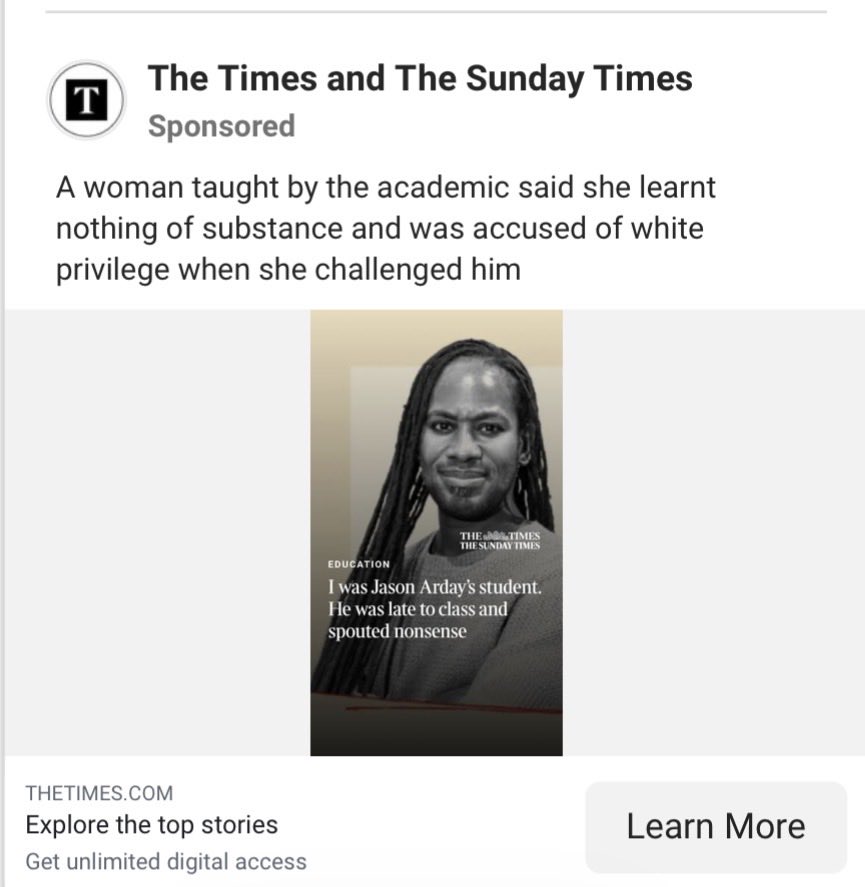
The Times ran multiple ads trashing Jason Arday. This one reached 195,746 people & ran until Aug 16 - today.
There’s a rearguard action to defend journalism. But this isn’t journalism. It’s monetised racebait.
@msjanebond007@carolecadwalla Because the single complainant - from 8 years ago from Arday’s time at Roehampton - chose to be anonymous. Her piece complaining about not getting 75% in her exams, originally posted on Unherd, was then reprinted in toto in the Telegraph and Times. When does that happen?