I’m creating a front-end portal for the public to see how the U.S. stock market is manipulated and operated with precision by leading banks and hedge funds.
I came out as a whistleblower reporting this work to the @SECGov—discovering that the entire public market operates on real time risk-analysis and communication between trading divisions to calculate ‘risk’ and effectively code the same product to engage in system-automated trading and market manipulation.
The U.S. stock market in the most plain technical terms is a product of elite capital investment firms using a combinatorial of the same information to trade, purchase stocks ‘long’, bet on stocks ‘short’, know how much money to ‘risk’, and discreetly use the following information to hide from regulators.
Advanced trading teams use the following information to score, rank, and identify ’relevant’ algorithms using basic technical analysis to set chain reactions for other aggressive hedge funds to exploit.
This system aggregates timeframes, equities, and a term called ‘SMA outfits’ to monitor and control the outcomes of the U.S. stock market. The implications of this are simple. Our administration knows about this, often using the news that may appear as a driving force for the price of stocks to push the market higher or lower. Leading hedge funds will be reaping record profits without any reason to care for looming inflation that will eventually destroy the average American’s pockets.
This is a call for clarity and transparency.
The U.S. stock market operates on [1-59 seconds, 1-59 minutes, 1-23 hour][NYSE NASDAQ CBOE exchange listed equities][1-999 SMA outfits + advanced SMA Outfit ciphers][OHLC contact] in order to seamlessly structure and move markets to reward or degrade money from other market participants.
This is all back-end coded. In order to understand this you need to have the very basics defined. Understanding the stock market through this lens will indefinitely shift your understanding of finance.
Glossary:
“Equity”
— An equity in this context often represents a singular stock, index, exchange traded fund [ETF], or commodity price.
That can mean a popular stock like GameStop, Gold’s XAUUSD, the NASDAQ’s IXIC or QQQ, and proshare multi-leveraged securities like the TQQQ or SPXU.
“Timeframe”
— Timeframe in this context refers directly to candlestick charts that accurately reflect a stock’s historical performance. A timeframe can range from prefixes like 30 seconds to 30 minutes. Timeframes are part of the encryption process used for SMA outfit detection.
“SMA outfit”
— Simple Moving Average outfit is a technical term for a structure of an equity’s price.
This structure is relevant to specific relationships between recorded Open/High/Low/Close [OHLC] values on an individual equity, outfit, and timeframe.
“SMA Outfit detection”
— Each thread is the product of a tabulation of records that asses each NYSE/NASDAQ/CBOE listed stock, and relationship detection between OHLC values on a singular outfit and singular timeframe to produce a signal.
— SMA Outfit detection is best represented as ranking precise timeframe-candle data to a ‘SMA Outfit’ and structuring ‘risk’ for banks and leading trading divisions to identify ‘risk’ and opportunity’ with historic use.
Something fundamental to consider here is just how little these massive financial institutions are risking when placing these trades. These threads operate with extreme to-the-penny precision to prove a point about how well organized U.S. stocks move to reward aggressive financial divisions.
Each thread is shared with near-second precision using an automated system documenting snapshots of a specific equity, outfit, timeframe and the specific protocol. All threads are posted and never destroyed. Threads terminate on a complete profit-taking or the strike of a negative parameter.
The Ugly Teenage Phase of Profitable Growth
This is a phase that companies that were once high-growth, high-burn companies (that are typically transactional) go through as they try to get profitable.
Phase 1: You start with high revenue growth, high burn rate. Then you realize due to market conditions that you need to get profitable.
Phase 2: You drive for operating leverage:
- You cut operating expenses - inefficient marketing spend, headcount, etc.
-All out focus on enhancing gross margins - pricing, COGs, shipping, etc.
Phase 3: You focus on improving working capital dynamics.
-renegotiate with vendors, suppliers, manufacturers, etc. to enhance payment terms to improve cash.
Phase 4: You clean up the balance sheet
- Optimize inventory, renegotiate/refinance debt, try and solidify cash, etc.
During these four phases, revenue is declining YoY (sometimes materially) because you're comping against prior quarters with heavy marketing spend. This is why this is the "ugly teenage phase" - it looks ugly if all you're looking at is the top-line. But, there are usually good signs:
-marketing and sales efficiency is improving
-all opex lines are decreasing as a % of revenue
-EBITDA and/or OCF is growing
Phase 5: Revenue is declining YoY, but you have achieved profitability (EBITDA and/or FCF).
At this phase, you are still ugly to the world because revenue is declining, but the end of the teenage years is on the horizon.
Phase 6: Maintaining profitability and returning to YoY revenue growth by investing some of your own cash flow back into growth.
This happens typically in 4 steps:
-step 1: sequential Q/Q gross margin growth
-step 2: sequential Q/Q revenue growth
-step 3: YoY gross margin growth
-step 4: YoY revenue growth
The revenue growth comes from first from delivering real customer value and then:
-efficient marketing spend
-introducing new products
-expanding new channels
-reactivating churned customers
-pricing
-defending the base of loyal customers
The challenging part of this journey is the ugly period can last a long time. From Phase 1-5, you don't get much of any credit. It's not until you hit Phase 6 that outsiders will believe in the company again. But, those close to the company can watch as each phase is cleared and know that the company is going in the right direction. However, to be fair, until you get to Phase 6, you haven't reached the ultimate end goal.
**For the sake of clarity, this is a general observation across several different companies in different contexts many of which I'm not involved with. This is not an observation or prediction related to any specific company.
Last week @jalilwahdat shipped a fix to one of the most famous, storied, and misunderstood bugs in web3/eth/nft history - the ability to safely trade unwrapped @v1punks. For 9 years this has not been possible, and now it is. It's a remarkable achievement.
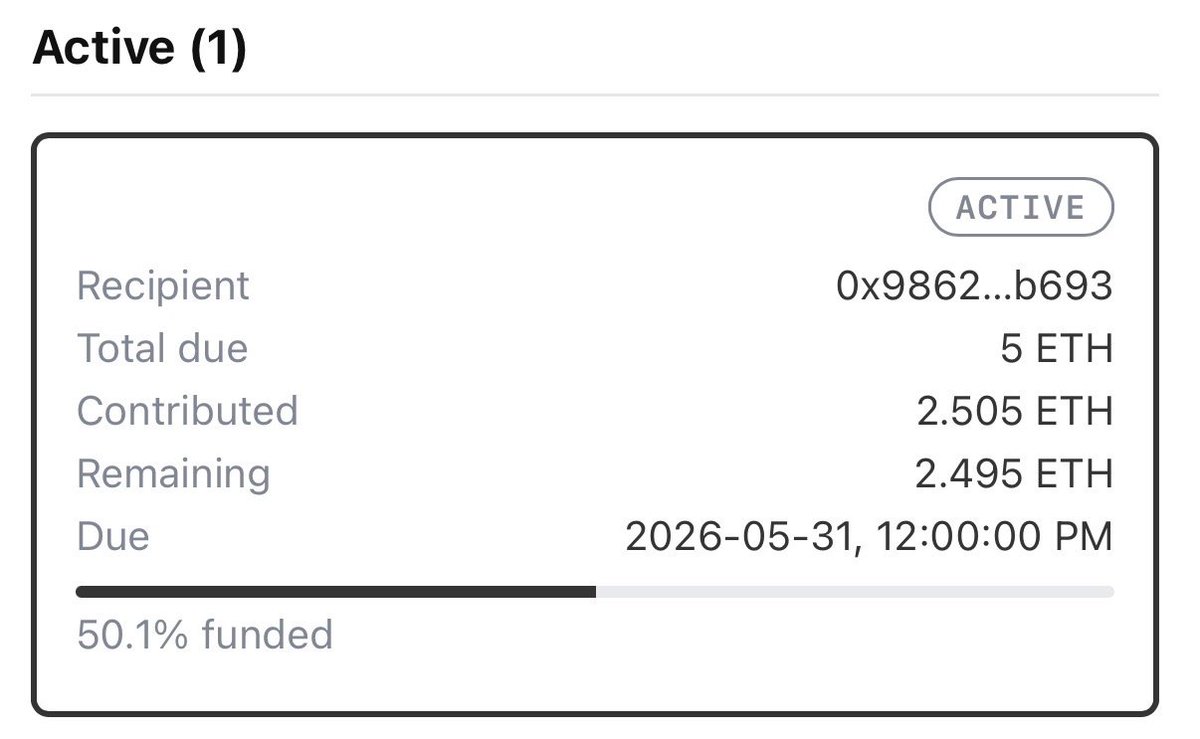
As a sign of gratitude a number of people are pooling eth to purchase the V1 token for Jalil's Cryptopunk from the original claimer to gift to him and reunite the V1🤝V2 pair. Seemed like that would be a nice gesture.
To facilitate this a I whipped up a little contract that accepts eth (in this case to 0xD7C988727bc47fDCC550F15062286B124f37033D ) up until the goal it met, and refunds anything above that. If the goal isn't met by a set deadline (in this case, end of the month) everyone gets their eth back. Launched this yesterday and it just passed 50% funded.
We could have just had everyone send eth to someone, but thought a trustless contract solution would be more in the spirit of the event, and also now this is available for anyone to use for anything else, with no fees.
If you like to throw in something send eth from a wallet you control (not an exchage) to the address above. To see progress or make your own pool, check out https://t.co/5RSZhjiS44 or if you want to fork it and do it differently, code is open https://t.co/OBF0NZKTyW
I just unwrapped one of my CryptoPunks today. Sent her home to the original 2017 contract. I'm not selling her, but for the first time in this Punk’s life she can be traded native, unwrapped, no receipt standing in for the real thing.
Stupid this has to be said, it shouldn't matter if they own 0 or 100. The bug in the original CryptoPunks contract is one of the most storied complications in NFT history, and that 9 years later it was solved through pure technical curiosity is legendary.
A major competitive advantage for those with this DNA:
"Thiel said the number one predictor of which of his students went on to build something important was not intelligence. It was tolerance for being publicly wrong-sounding for years before being right."
Power to the players just met power to the sellers & it looks to be the beginning of a beautiful friendship.🤝
GameStop CEO @ryancohen takes eBay pitch direct to sellers sharing vision for the platform with Flipwise co-founder Justin Glow.
$EBAY $GME
https://t.co/eRXskCang6