Two questions you can ask yourself at the end of a week:
"Am I doing the most?"
"Am I learning?"
Only one of them has a finish line that stays put. 🧭
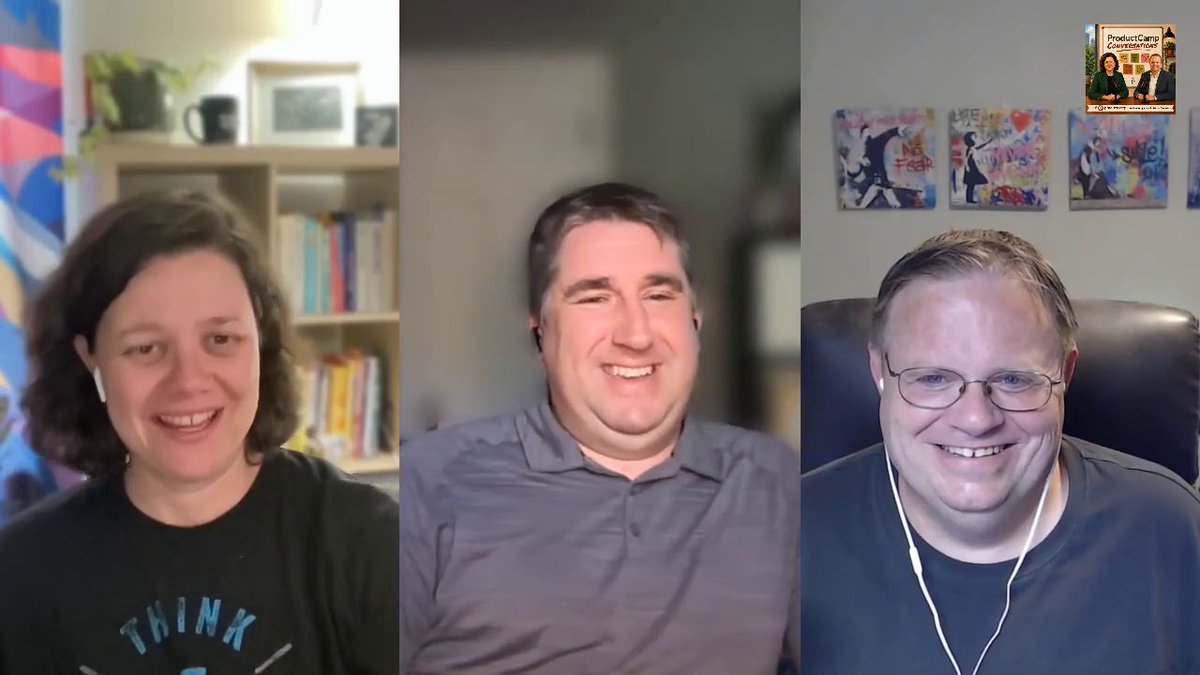
Allison Herbert and I sat down with Jackie Flake, an Atlanta product consultant, coach, and recruiter who says she learned product the hard way. Her first ProductCamp Atlanta talk was about five mistakes to avoid in your product career, and she's been showing up as a whole person ever since.
We got into a lot:
🎤 Pitching with a story instead of a bio, and why it changed how her sessions land
🌱 Her talk on faith and layoffs, and why your identity doesn't have to be wrapped up in your career
🤖 Swapping the first question for the second when AI FOMO keeps moving the goalposts
💼 Going fractional, where sales is the hard part and you have to add value from day one
My favorite practical idea: post for the next person who hires you, not for the algorithm. And try a 60 to 90 second voice memo as a modern cover letter.
The full conversation is on Apple, Spotify, and YouTube:
🎧 Apple: https://t.co/EeYE4xXGTD
🎵 Spotify: https://t.co/Xcu13oOxVF
▶️ YouTube: https://t.co/UhvTeXViqx
Which question have you been asking yourself lately?
A good decision can still lose. A bad decision can still win. 🎲
At ProductCamp Austin's PCA35, I talked about "You Were Wrong. Now What?" Every product talk says it's okay to fail. I wanted to talk about what you do the morning after a bad call.
A few ideas from the session:
🧾 Write a "decision receipt." For any big bet, capture what you decided, the context, your assumptions, the evidence, the alternatives you passed on, the outcome you expect, what would change your mind, and a date to revisit it. Six months later, even the same team remembers the decision differently.
🔲 Separate the decision from the outcome. Good decision, bad outcome happens when the world changes. Bad decision, good outcome is just luck. Know which one you're looking at before you judge it.
🥤 Recovery is a skill. New Coke was backed by roughly 200,000 taste tests and still flopped, but Coca-Cola owned it and reversed course in 79 days. Google Glass had a clear exit plan: it shipped as a beta to developers, so Google could pull it from consumers without burning the people who bought it.
🛠️ Build systems instead of grading people. The goal isn't "Bob makes good calls and Joe doesn't." Start with your own team, not the whole company.
A huge thank you to everyone who made PCA35 happen: Arturo Piña 🍍and the ProductCamp Austin board and organizers, the sponsors (including Texas McCombs MSTC, the McCombs School of Business, the Brumley Institute for Graduate Entrepreneurship, Pragmatic Institute, Civic, Productside, Alchemer, and Coffee Enlightenment), the other presenters, the volunteers, and every attendee who gave up a Saturday to learn together. Having helped organize ProductCamp Twin Cities, I know how much work goes into a day like that. 🙏
🎥 Watch the full session: https://t.co/Y9JlK5KEgP
What's one decision your team made that you wish you'd written a receipt for?
Last month at ProductCamp Austin, the idea that resonated most from my talk was the simplest one: write a receipt for your big decisions.
So that's where my new newsletter, Good Option, starts. Every other Tuesday I'll share a few ideas on product, decisions, and AI, plus one thing you can use the same week.
Edition 1: eight lines to write before you commit, and a template you can copy today.
What's one decision you wish you'd written down at the time?
https://t.co/DtJaVL6F8O
We’re hiring 2027 Summer Analysts at @greatnorthvc! Looking for AI-first, curious, & driven talent.
Apply by Nov. 20: https://t.co/hkfeAz8Vfa
Please Reply & RT for visibility! 🙏
@sjohnson717 has trained an estimated 40,000 product people. His take on AI fits in five words: "yes, and," not "instead of." 🎙️
On the new ProductCamp Conversations, Allison Herbert and I talked with Steve about why training alone doesn't change a product team, why judgment and firsthand customer experience are what keep PMs employed, and how product work drifted from solving problems to writing feature specs.
His best advice came from a sales mentor: nothing important happens in the office. For PMs he tweaks it to "little is learned in your office." 👀
🎧 Apple: https://t.co/XiwcYg9Q5j
🎵 Spotify: https://t.co/yD6B3pdbwV
▶️ YouTube: https://t.co/PZLJtyMtHG
What's one thing your team could learn this month by getting out of the building?
The lawyers who gained the most from AI retained the least.
That's the finding from a new randomized trial of 133 patent lawyers, and it caught my attention because I started my legal career drafting patents.
For three months, some lawyers got a custom AI drafting assistant and others didn't. Blinded expert attorneys scored the work.
With AI, drafting quality improved, and junior lawyers saw the biggest gains.
Then everyone completed a judgment task without AI: marking up an existing patent application.
Senior lawyers who'd used AI outperformed seniors who hadn't. Junior lawyers showed no average gain. Their scores spread out instead: fewer in the middle, and more at both the high and low ends.
The senior lawyers didn't just hold on to their skills while using AI. They came out of it sharper than similar seniors who never used it. The authors suggest that existing expertise may be what lets people learn from AI instead of leaning on it.
You don't need to work in patent law for this to matter. Here's what I'd take into any team adopting AI. These are my takeaways, not the study's conclusions:
1. Measure capability, not just output. Dashboards will show better, faster work. They won't show whether people can still do the work when the tool isn't there. Build in some unaided moments: a live review, a whiteboard session, a client conversation.
2. Look past the average. "No average gain" hid juniors moving in opposite directions. Ask people individually how they're using the tool.
3. Don't confuse speed with seniority. With AI, juniors drafted as fast as seniors, at similar quality. Without it, they didn't show the gain seniors did.
4. Keep experienced people in the loop. Seniors seemed to get lasting value because they could judge what the AI produced. Pair juniors with someone who can explain why a draft works, not just whether it's done.
5. Have people think before they prompt. Outline first, then compare with the AI's version. Critiquing AI output may build more judgment than accepting it.
Caveats: it's a working paper, not yet peer reviewed, in one specialized field, and Google funded it. It doesn't show AI erodes skill on average, and I don't read it as a case for keeping AI from junior professionals.
It does make the case for asking two separate questions:
1. Did the tool improve today's output?
2. Did using it improve tomorrow's capability?
Those can move together. They can also split.
Study link https://t.co/eyCK2wQIWf
While every other ProductCamp room was talking AI, Kevin Palmstein stood up and gave the intentionally non-AI talk.
Customer interviews. Regularly. Effectively.
Allison Herbert and I sat down with him on ProductCamp Conversations. Interviews get bumped for time, fear, and gatekeeping. They should be a visible product output, not a nice-to-have.
One-on-one. Shut up and listen. No demos mid-interview. The relationship doesn’t end when you hang up.
Apple, Spotify, and YouTube links are in the reply.
Cam Gross started Applied AI’s AI in Product Meetup out of pure fear of being left on the sidelines.😨
🎙️ Allison Herbert and I sat down with him on ProductCamp Conversations and traced the arc: a decade-plus in sales and account management that turned into a “10-year bootcamp” of asking better questions… then ChatGPT hit, and Cam helped build the room he wished he already had.
We got into career transitions at ProductCamp Twin Cities with Beth-Alison Berggren and John DeBauche, why networking beats a blind LinkedIn apply when AI floods hiring, and a hiring frame that sticks — hungry, humble, smart. Plus the line that became the episode title: the only reason a career ends in product is deciding not to participate.
If you’ve been hovering on the edge of AI practice, job search, or community — this one’s a nudge off the sidelines. 👉
Links in the first comment. 🔗
What’s one thing you’ve built with your hands lately that you’d actually tell the story of in an interview — not just the prompts you ran? 🛠️
#ProductManagement #ProductCamp #CareerTransitions #AI
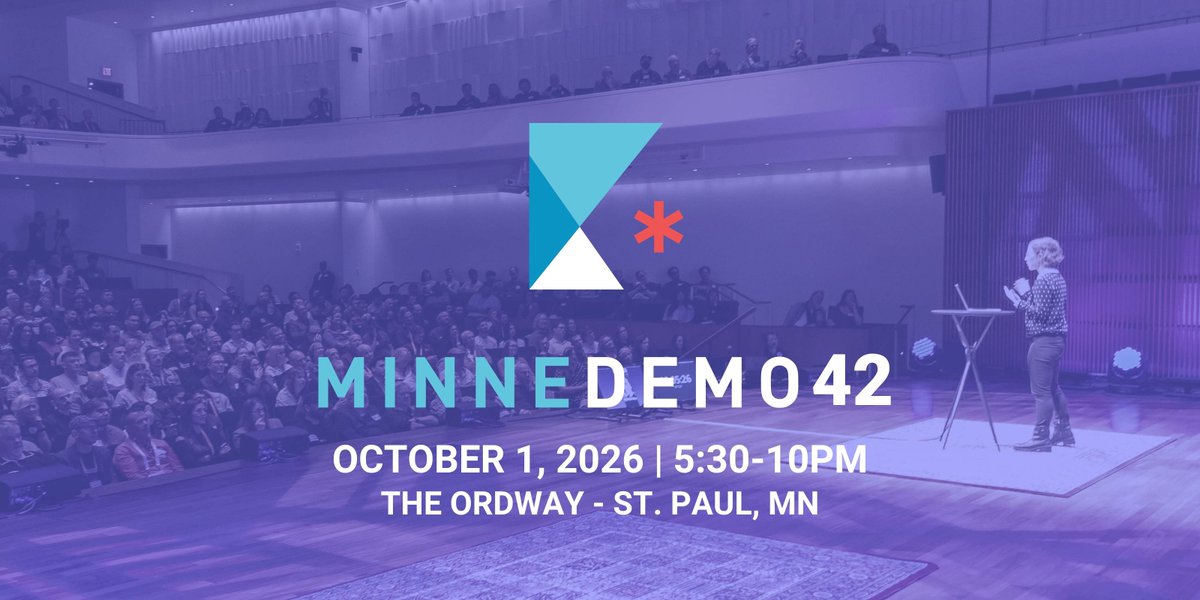
📢 Minnedemo is back Oct 1 in St. Paul!
Building cool tech?
🛠️ Apply by Aug 23 to show it off
Want a seat for the show?
🎟️ Snag tickets Aug 25
It’s geek show-and-tell: 7 demos. 7 minutes each. No slides. Just real, MN-made tech.
👉 https://t.co/FeQX0ElJH5
What does product management become when AI can actually do the work?
That's how we open ProductCamp Amsterdam 2026, with @carlvellotti of The Full Stack PM on his keynote "Agentic Product Management."
Sat Aug 29. You pitch the sessions, you vote the agenda. Limited seats.
It's Minnebar day. 20 years of the MN tech community showing up, sharing, and building something bigger than any one of us. Stoked to be back at Best Buy HQ for the biggest Minnebar yet! 👀 #Minnebar#MNtech
We are building Grokipedia @xAI.
Will be a massive improvement over Wikipedia.
Frankly, it is a necessary step towards the xAI goal of understanding the Universe.