Your agent can now grow new abilities, just by asking.
Reef now supports personalized harness evolution with /reefine: describe what you want your agent to do. Reef builds the change, checks it, and ships a new version.
Examples:
💬 "> /reefine add a /chat mode for faster responses"
🔊 "> /reefine tell me out loud when you're done"
⚡ "> /reefine add jev as a tool": 120 papers screened in 9 s
Works with any agent harness through a Reef adapter: Codex, Hermes, OpenCode, Pi and Terminus 2 today.
Try it here: https://t.co/yUfl1eoj6F
#agent #harness #rsi #llm
🔥 Jev is on fire!
😎 So we ask Reef: /reefine add jev as a tool
Reef then evolves the agent, and adds Jev into its harness.
We use this evolved agent to hunt for papers related to "Self-evolving Agents" published in 2026 on arXiv. The agent found and screened 120 papers in 9 seconds!
Come and use Reef to evolve your agent: https://t.co/IsAcJZFNQq
SKF is accepted for @NeurIPSConf as spotlight!
Wow, I didn't expect it. Kudos to AC and reviewers for valuing basic research. We feel extra rewarded and motivated!
Flash-KMeans has been accepted to NeurIPS 2026 as a poster! 🎉
Really happy to see the work getting interest from the community. Nice collaboration with @Andy_ShuoYang !
PEEK has been accepted to NeurIPS 2026! 🎉
One thing I learned from this project: even with ever-larger context windows, language models and coding agents can still get lost in large files and repos. That’s why I love the idea of a “Context Map as an Orientation Cache” --- more context alone doesn’t mean better navigation!
Huge credit to @astrogu_ and the mentors!
Reef's new /reefine command helps you equip your harness with new capabilities, not just micro-optimizations that gets you higher on benchmarks.
Checkout the demo video for the example cases!
Code is open-sourced at https://t.co/84OF3sXMxu
I love Open Source. Its the future. Reef gives developers two ways to build agents that learn from their work: update the model's weights, or improve the prompts, rules and skills around it.
The harness route can use a model API, *without local training GPUs*.
One documented example starts with a coding agent missing a test case. Feedback triggers a proposed skill update, which is tested against the current version before publication.
That's a useful foundation for experimenting with agents that stop repeating the same mistakes. You can define what counts as an improvement and track the versions you actually deploy.
Open source under Apache 2.0. Thats the way to go.
Continuous self-improvement needs an ever-expanding supply of training environments (goals).
SPADE: one model self-plays the Environment Designer and the Reasoning Agent, writing executable, agentic environments that get harder as it improves. Environment scaling on its own. ♠️
We pretrained a 2.3B MoE (360M active) Hybrid Mamba-2 that lands within a few points of Llama-3.2-3B using <1% of its pretraining FLOPs.
No dedicated cluster. The run hopped between H100s, A100s, V100s (yes, V100s) and TPU v5p/v6e on a single codebase.
Meet Rigel 🧵
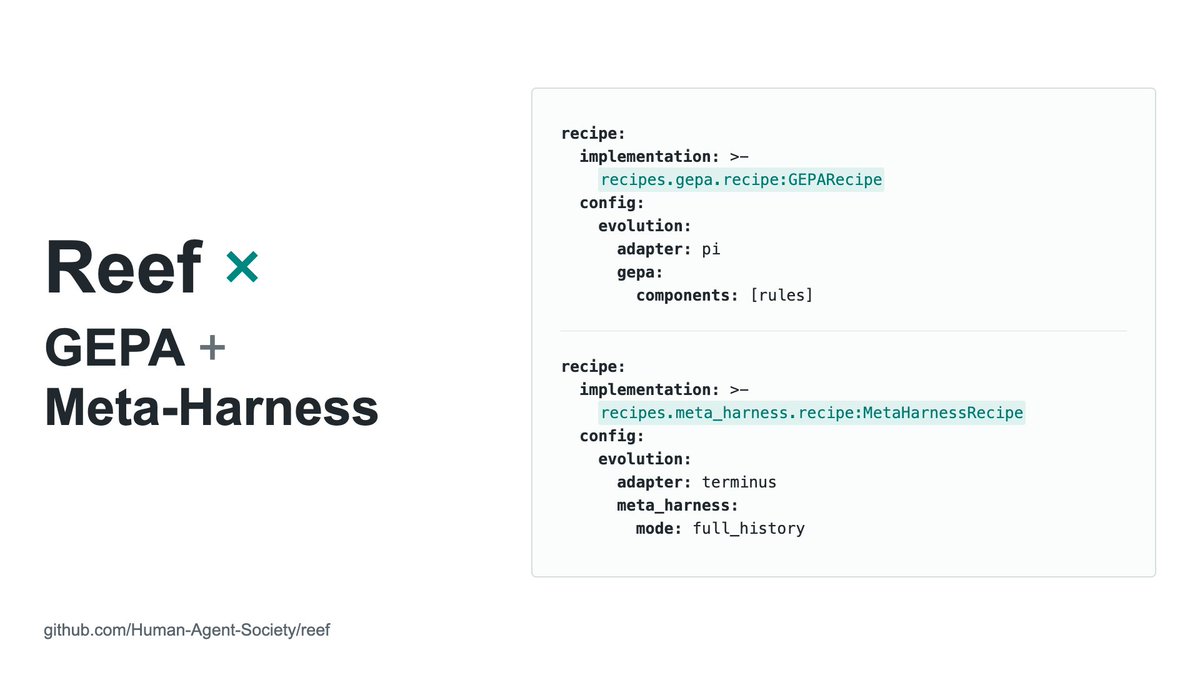
🚀 Reef now supports GEPA for prompt optimization and Meta-Harness for harness optimization!
Both run on Reef’s own harness evolution backend and work across a variety of harnesses (you can integrate your own by adding an adapter). The backend maintains an algorithm state that tracks past attempts, their relationships, and their performance.
Bring your tasks and an evaluator. Let Reef evolve your prompts or your entire harness!
Check it out here: https://t.co/IOhoLExXmI
Thanks @simon_ycl for implementing and maintaining this feature!
Computer use has been one of Muse Spark’s core agentic capabilities since MS 1.1. The model is trained end-to-end to automatically decide when to use scripts or when to use clicks to reduce latency
Kudos to our amazing CUA team @shuyanzh36@yashvarpatel@ZiYiDou@TianbaoX @.tongy @.tudorpt @.williamwong @.yipan @.czxttkl @.ericgan @.fanyix @.jerryzwu @frederick0329@hongjin_su@JunliWang2021
And a special shoutout to our incredible CUA lead @taoyds for leading the charge!!
Don’t have GPUs? No problem.
Reef can now train through the Tinker API. Just change one line in your config and turn production feedback into continuously improving models.
🚀 Reef now supports training with the Tinker API!
Unlock continual learning with LoRA training by changing just one line in your config. Collect feedback, train, and publish versioned updates. No local GPU required.
Thanks to @Jayzou3773 for implementing this feature! 🙌
Check out our repo and contributions are always welcome! 👇
https://t.co/IOhoLExXmI
Introducing PC-ALM, a local-learning alternative to backpropagation.
Our method trains 1000-layer neural nets using only local dynamics, and without backprop.
Blog: https://t.co/bBGCgalqKW
Standard deep learning relies on backpropagation. The brain, however, cannot implement backpropagation, at least not exactly. How can a physical system, such as the brain, solve multilayer credit assignment without explicit use of backprop?
We look for inspiration in two related fields: distributed optimization and NeuroAI.
In NeuroAI, predictive coding asks each neuron activation to solve an energy-based inference problem instead of using a standard forward pass. That inference step can be implemented as energy-minimization dynamics on local prediction errors.
This perspective -- each layer as a dynamical system -- has proven promising, but performance of predictive coding hasn't scaled well with depth. Credit signals at far ends of the network struggle to diffuse into internal layers.
We turn to distributed optimization, generalizing predictive coding to use an augmented Lagrangian instead of energy. This motivation stems back to a classic 1988 paper by LeCun, showing that the Lagrange multipliers of a deep network can be identified with gradients of a supervised loss. The augmented Lagrangian then bridges LeCun's perspective to the standard predictive coding that is used in NeuroAI.
We find that this new perspective yields a natural PC-like alternative to backpropagation, resulting in a method we call PC-ALM. PC-ALM differs from PC in that it introduces dual neurons (Lagrange multipliers) as part of the layer-local dynamics, resulting in each layer acting as a PI feedback control system to minimize local prediction errors.
We find that PC-ALM is capable of propagating signals to seemingly arbitrary depth, especially in deep narrow networks where standard PC struggles to learn.
Ultimately, our motivation here is to understand how distributed physical systems, such as the brain, can compute credit signals using only local coupling and local dynamics.
PC-ALM may also inform deep learning in neuromorphic hardware, where dynamics are cheaper than on GPUs.
Paper: https://t.co/doSZ8mzoyK
Code: https://t.co/rxEDIszVKD
If an agent truly understands a video, can it reconstruct it?
Introducing BVB: benchmarking agentic video understanding via programmatic reconstruction in Blender.
288 real videos. 51 agent configurations.
Paper, demos & leaderboard: https://t.co/YE5bL3SSzG
Code: https://t.co/2WFOsflJgZ
Paper: https://t.co/YHk4avmynX
Reef just hit 1k GitHub stars ⭐️ in 10 days since we open-sourced it!
Huge thanks to everyone building with and supporting Reef. Let’s goooo Reef!!!🔥
Github: https://t.co/khqHcnbypi
I will defend my PhD thesis, “Physics-Constrained Generative Models for Computational Design,” on Tuesday, September 8, 2026, at PM ET.
Location: MIT @MIT_CSAIL 32-G449
Zoom: https://t.co/wzQZElMjqK
Committee: Kaiming He, Bill Freeman, Wojciech Matusik
Generative models can now propose candidate designs at high throughput, yet the physical world remains the ultimate judge: a candidate becomes a solution only if it can be realized in the real world and satisfies the functional requirements of the design problem. (1/7)