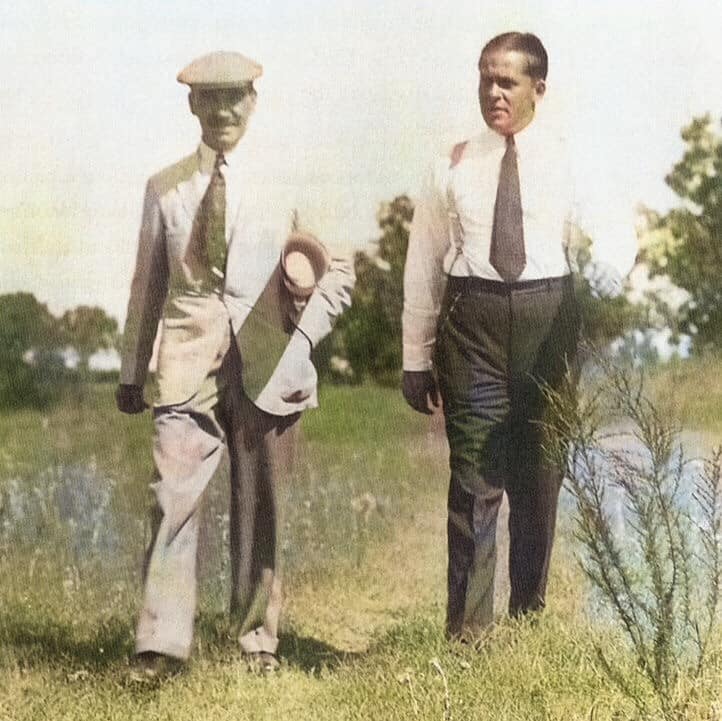
I shot 62 — 10 under par — playing a modified scramble called a FIGJAM.
The rules are simple: if you like your first shot, play it. If it’s so-so, hit another. You can hit up to 3 shots total, but once you choose to move on, that’s your ball.
Padraig Harrington has said he’d play this format as often as he could, and Luke Donald used it on his way to becoming #1 in the world.
What surprised me wasn’t the 62. It was what the format did to my confidence.
I was playing a new course but instead of getting defensive after a mediocre shot, I had the freedom to try again. Pretty soon I was seeing shots more clearly, committing to them and expecting good results.
And here’s the interesting part: a lot of my first shots were perfectly good. Sometimes you need to experience what great golf feels like before you can learn to expect it.
My next free compression webinar is Wednesday, August 26th at 7pm CT. If you’re ready learn how to smash a golf ball every time, the link is in the next post!
What's the difference between red and yellow penalty areas? Not much!
Red stakes allow lateral relief where you may drop within two club lengths of where the ball last crossed the edge of the penalty area, no closer to the hole.
I ran a poll asking what the most important factor in a junior golfer’s development is.
I was shocked that everybody didn’t pick Parenting.
Because after 25 years in competitive golf, having 3 kids of my own play D1 golf, coaching at Duke and Ohio State, and working with hundreds of junior golf families, here’s what I’ve observed, researched and learned:
How you parent is the single biggest factor in your child’s junior golf success.
Almost nobody shows parents how to do this well. I’m on a mission to change that.
So, here are the 10 most important factors in elite golf parenting. From my chapter on Parenting in Becoming Elite:
1.Create a Safe Environment. Your home must be a safe harbor, not a pressure cooker. Your love is unconditional and separate from their golf score. Same affection after an 85 as after a 65. If your mood changes with their scorecard, you are creating a toxic environment that destroys their love for the game. And eventually your relationship.
2.The Car Ride Home. This is where most parents blow it. The car ride home is a sanctuary. A no golf talk zone. Enforce the 48 Hour Rule. Let them decompress, listen to music, stare out the window. The post round autopsy is one of the most damaging things a parent can do.
3.Body Language. Your kids are reading you on every single shot. Every. Single. Shot. A fist pump after a birdie tells them birdies are what matter. Slumped shoulders after a bogey tells them you’re disappointed. Your expression must be the same after a birdie as after a double bogey. Calm, positive, steady. You are the emotional thermostat.
4.Communication. The most important words when they come off the 18th green: I love to watch you play. Not “what did you shoot.” Not “what happened on 12.” After 48 hours, ask open ended questions. How do you feel about your round? What were you most proud of? What do you want to work on? You are a facilitator, not a judge.
5.Creating Ownership. A player led journey is sustainable. A parent led journey leads to burnout. If you are more invested than they are, that is a red flag. Motivation must come from within. Great parents ask questions instead of giving answers. The player who owns their development keeps improving long after the lessons end.
6. Giving them Freedom. Be a lighthouse, not a tugboat. At tournaments, stay at least 50 yards away. Do not walk the fairway with them or stand behind every green. Give them space to breathe and compete. Do not talk to them during the round unless they initiate. They are in their performance bubble. Do not burst it.
7.Allowing Them to Fail. Failure is not the enemy. It is a prerequisite to growth. Your child is more resilient than you think. They can handle failure and disappointment. They need you to believe in them and let them learn, not protect them from every setback. Removing the opportunity to fail is the real enemy.
8.Staying in Your Lane. You are the parent. Not the coach. Not the caddy. Not the swing analyst. These roles do not mix. Constantly offering swing advice creates a toxic triangle of confusion. Hire a professional. Trust them. Stay out of the way. Your job is love and support. Period.
9.Building an Identity Beyond Golf. If your child’s entire sense of self worth is tied to their golf score, you are setting them up for misery. They are a person who plays golf, not the other way around. Encourage other interests. Protect their social life. Let them go to school dances. Family vacations and time with siblings are sacred. A one dimensional identity is one of the three ingredients that causes burnout.
10.Playing the Long Game. This is a 10 year journey, not a 10 tournament sprint. You are not in a race to be the best 12 year old golfer. You are on a patient journey to see how good they can be at 18, at 22, and beyond. Slow down. The car rides, the early morning tee times, the post round ice cream. These are the moments you will remember. Savor them.
I once asked a former pro “how do I hit my driver as straight as you?”
He said bluntly, “Hit a million more golf shots.”
A not-so-gentle reminder that there is no tip, YT vid, or new driver that shortcuts reps. 😄
1M = 274 shots/day for 10 yrs.
The am/pro gap is in the dirt.
Observing a golfer swing on a near-frictionless surface like ice reveals a movement pattern we normally can’t see without force plates.
As they initiate the downswing, the lead foot moves toward the target line while the trail foot moves away, highlighting how golfers apply anterior–posterior force through each leg to rotate the pelvis.
This is a key kinetic variable which not only helps generate rotational velocity, but maintain dynamic posture.
🎥 from our Power Level 3 seminar (ccoopergolfpt, IG)
Tiger Woods giving a 3 minute lesson on hitting 50 yard pitches. With Fred Couples.
“Close the face when I hit a fade”
“Open the face when I hit a draw”
He then demonstrates 5 different ball flights for the pitch.
I’ve watched it 3 times. It probably won’t help me, but man what a genius with the golf ball. Some of the best hands to play the game. (Crazy to think he battled the chipping yips.)
I asked my producers not to make any clips from the dad grief portion but enough people reached out about this part I changed my mind.
Jim Nantz on what Arnold Palmer told him about his dad is one of the most impactful things I’ve ever heard. A lot of people need to hear this.
Even before he was World No. 1 and a four-time major champion, Scottie Scheffler's putting process was still giving every putt he had a chance to drop.
From the archive: Scottie Scheffler walks us through his green-reading process for longer putts. 👇