Pleased to announce that I will be joining @RominaBoccia's budget team at @CatoInstitute later this week!
I'm glad to be joining an outstanding organization that fights for American founding ideals such as limited government and free markets.
On the Anthropic donations to the transit tax measures:
This is what a lot of us were afraid of and now it is coming true. The Anthropic and OpenAI IPO's are going to bring a windfall to money to people who like sales taxes and property taxes. They can now flood the zone with campaign cash and drive the rest of us out of the Bay Area with the resulting insane tax levels.
What @johnmoz said here applies to a staggering amount of government spending. So many programs and policies don’t even pass the Econ 101 test, let alone more rigorous analysis.
"(Corporate welfare programs) are more correctly assessed using the tools of political science than of economics. When you do that, they all start making sense. They make no economic sense because they're not economic tools, they're political tools."
- @johnmoz
This is possible. So @Brendan_Duke is correct there. But is this what we want to do?
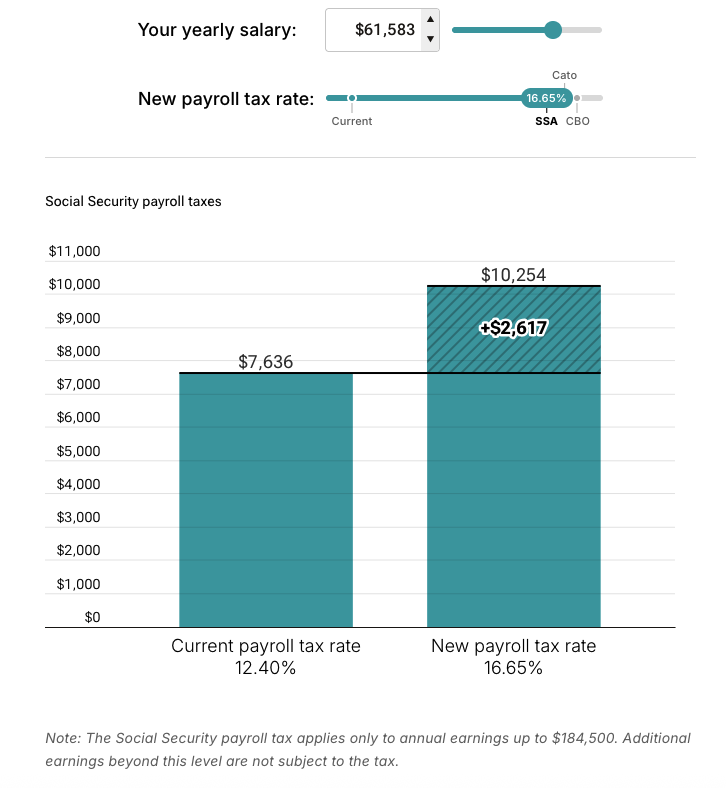
Raising the Social Security payroll tax ceiling and rate as Brendan describes would increase the marginal tax rate on a person earning $200k by 14 percentage points. All so we can pay even higher Social Security benefits to seniors who already are among the richest in the world.
And before we've fixed Medicare's even larger funding gap.
Congress fixates on Social Security *solvency* and, sure, Social Security needs to be made solvent.
But they also need to think about Social Security policy: why do have the program, what do we want it to do, and what are the trade-offs of doing those things?
It was disastrous for Washington to base fiscal policy on an assumption that borrowing costs would stay low, especially in the context of massive Social Security and Medicare funding gaps in the not-too-distant future.
Furman/Summers 2020: "markets expect they will remain low for at least another decade"
Auerbach/Gale 2021: "Most projections expect interest rates to remain lower in the future than they were in the 1980s and 1990s"
Blanchard 2021: "likely to remain low for a long time"
Games in NFL HISTORY with the following:
3 Pass TD | 2 Rush TD | 0 Int | 60+ Rush Yards
Josh Allen: 2️⃣ (tonight & 12/8/2024)
Rest of NFL: 1️⃣ (Mike Vick - 11/15/10)
Two things worth highlighting:
-They estimate that the Social Security deficit exceeds 2% of GDP within 50 years. Just one program!
-This is based on demographic assumptions of birthrates flattening rather than declining further - so the number will likely be even worse.
In CBO's projections, the gap between Social Security's outlays and revenues generally widens over the next 75 years, and the balance of the Old-Age and Survivors Insurance Trust Fund is exhausted in fiscal year 2032. https://t.co/1BPI5Ezw5p
.@GOP has resisted broad tax increases for decades. Social Security’s approaching insolvency may be testing that commitment.
Before lawmakers put such an increase on the table, workers deserve to know what it would cost them���
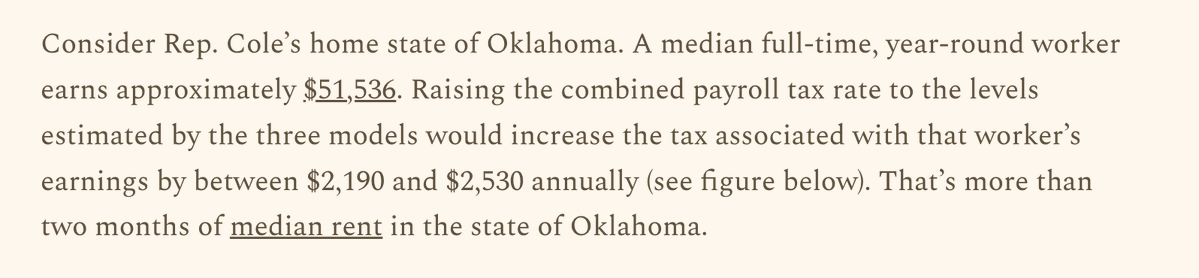
Rep. Tom Cole (R) is "willing" to hike payroll taxes in order to protect Social Security benefits for the idle rich.
Raising payroll taxes to a level necessary to perpetuate SS would cost the median Oklahoman worker over $2,000 a year. More than two month's rent.
Your new, pro-worker Republican party, ladies and gentlemen.
via @RominaBoccia
Huge factor for inflation in the healthcare sector (people are less price sensitive, increasing demand) and the economy as a whole (financed with deficits that pushes interest rates and inflation upward).
In total federal spending and tax breaks for health care account for nearly half of all healthcare spending in the US. Who's to blame for healthcare disfunction? I would argue the feds.
Federal debt is rising fast, bond markets are reacting, and Congress has just six weeks of session left in 2026. Cato's @DavidADitch argues Reconciliation 3.0 is the 119th Congress's last real shot at fiscal reform.
https://t.co/pt0vzezIUB
Of course the Federal Reserve had to raise rates.
Inflation is still too high, and the Fed has to trade off higher interest rates or higher inflation.
The way out: cut red tape and cut wasteful spending.
1/ Medicaid work requirements take effect January 1, 2027 across the country. My new post identifies a loophole:
In most states, $580 of gross gambling winnings once every six months could satisfy the work requirement.
https://t.co/xF6OvJh4k3
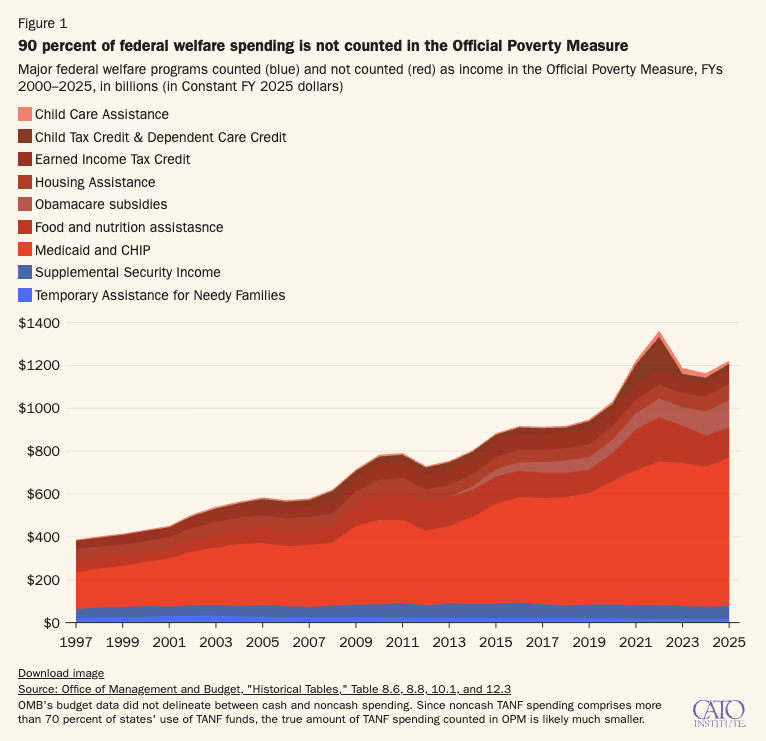
Something to always remember when looking at the official poverty rate (10.2% in 2025) is that it doesn't count 90 percent of welfare spending as income.
Irresponsible deficit spending --> heavy federal borrowing --> debt markets demand higher rates across the board. Washington needs to get serious about the budget.
Mortgage rates this past February were at 5.98%: https://t.co/LwH6OP7dTU
That was the first time they had dropped below 6% since 2022.
Compared to today’s 7.22% rate, the monthly payment on a $500,000 mortgage has gone from about $3,000 to $3,400 in less than 7 months.
Given that farmers are on average older and wealthier, the farm subsidy system is an aspect of Total Boomer Luxury Communism. It's not the biggest part of the federal budget, but it's one of the most wasteful.
Senate Ag Republicans plan to go it alone on a partisan farm bill later today. Weird that a "conservative" bill is so far from the reforms conservatives have long fought for. https://t.co/H2Qt4WiK8v
Reminder that CA is counting on more federal handouts to complete the project. Imperative that they don't get another penny from out of state to support such disastrously bad governance and judgment.
NEW: Premium airfare without documentation, luxury rideshares to a gym, tiki bar, cigar bar in D.C. and nightclubs.
CA's High-Speed Rail Authority allowed consultants to waste more than half a million dollars on questionable spending, project's OIG says
https://t.co/mssyCOnMK3