@Edel_PLopez If you are confident in the judgement of fabrication, you should write to the authors' review board, chairman, or dean. They will then review the accusation and hopefully take appropriate action.
We have put a significant part of our course "Happiness: a Neuroscience and Psychology Perspective" online at https://t.co/fngIJske43. We have 515 eager university students this fall and the course has a 95-100% approval rating. Want use our materials for your course? Contact us
Two papers from my postdoc are out this week. Together, they advance the use of ethological visual tasks and techniques for studying visual coding in freely moving mice. I am looking for folks to join me on this exciting journey forward in my new lab at Rutgers! 1/4
Imaging cholinergic and noradrenergic axons across the cortex in awake mice reveals a broad state-dependent signal as well as heterogeneity. Congrats Lindsay Collins! @DrAxonHunter @IONatUO https://t.co/8bgSabb2Jl
@realAlexHuk@jcbyts Great paper and effort. My main concern is whether or not the non-running period is equivalent between the mice and marmosets. I can well imagine the marmosets were still highly engaged with the visual stimuli while non-running, while the mice may be very dis-engaged.
Looking for postdoctoral fellows to join the McCormick lab, University of Oregon. Working in systems neuroscience on cortical/thalamic activity, attention, performance and state using the latest in optical/ electrical techniques. Please retweet!
https://t.co/xAZakaammU
My postdoc, Dennis Nestvogel (@Neural_Nestbird), just published a very nice paper in Neuron today - showing that visual cortical arousal state changes are driven by activity in the thalamus and that the alpha rhythm is a thalamocortical oscillation. https://t.co/Jb5q2sBX3L
Thriving in a dynamic world requires flexibility. A team of researchers in UO’s Institute of Neuroscience that includes @DavidAMcCormick & @cris_niell is seeking to better understand the neural mechanisms behind such shifts in attention and behavior. https://t.co/okUYUSJvxa
The future of US science is in the hands of current leaders- university presidents, provosts, deans and chairs, who are confronting huge budget deficits. I hope they will be wise, take the long view and strive to support the scientific enterprise, which is needed more than ever.
@CheloniaGirl I use mentimeter and Zoom breakouts and smaller discussion sections and one on one Skype or zoom. I have 86 students and so far it has been a lot of fun. It would be nice to be in person I agree. But they need us now.
Just published a review with Biyu Jade He @BiyuHe and Dennis Nestvogel @Neural_Nestbird in Annual Review of Neuroscience on State Dependent Activity and Performance in Mouse and Human. Have a look if you are bored and stuck at home. https://t.co/ORzlwjZ9QU
@rburdine1 I used to live as faculty in residence with 400 students and had every meal with them. I miss their smiling happy faces and great conversations. Zoom is helping to keep that going although many students are stressed. I enjoy helping them feel a bit more cared for and connected.
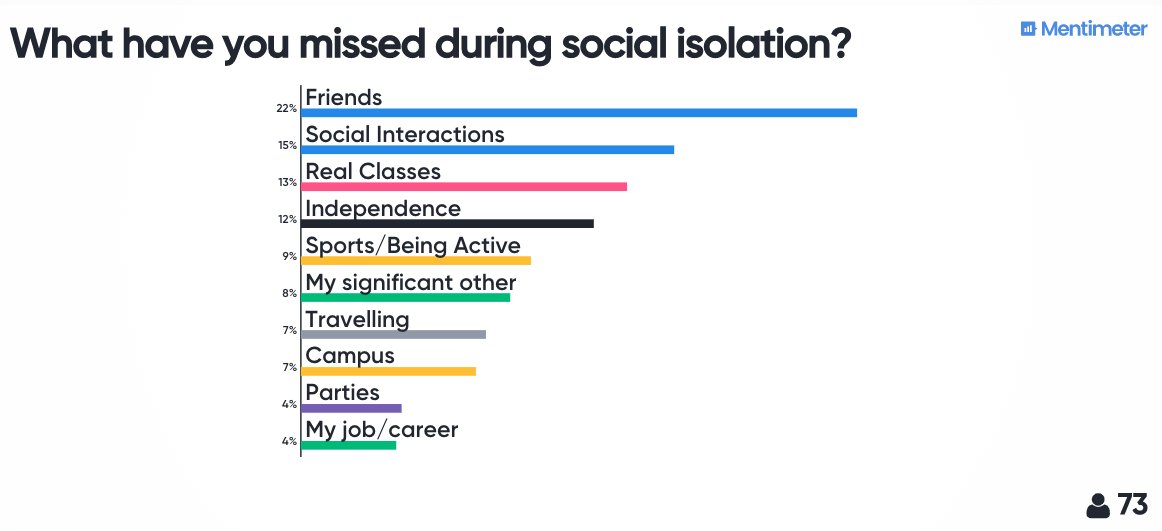
Despite what people think about the younger generation, what they miss most during this time is their friends, social interactions, and real classes. Not partying or traveling. Survey in my class on happiness using mentimeter.
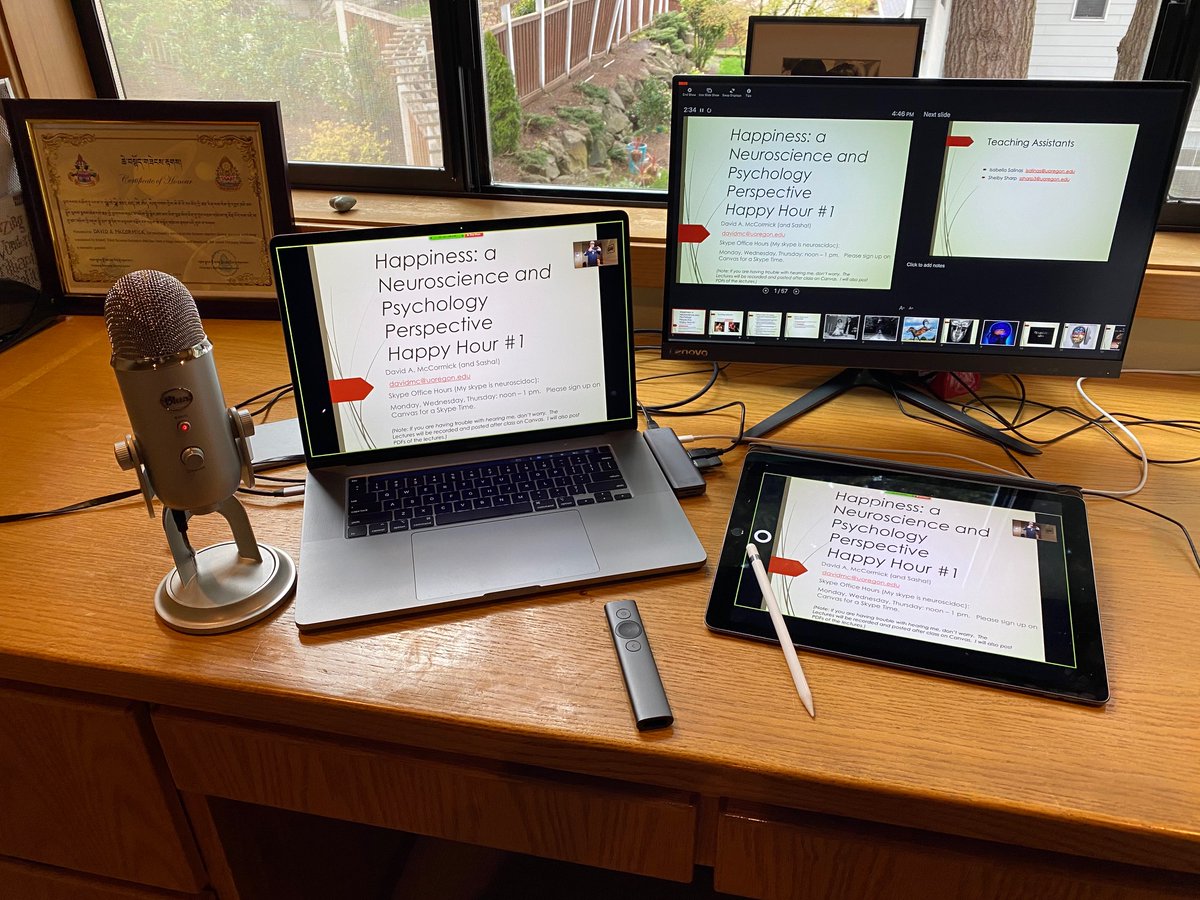
My online teaching setup. Zoom on a Macbook pro, connected to an extra monitor. Yeti Blue microphone for better sound quality, ipad running Astropad, so that I can draw on the slides or whiteboard with an apple pen. Logitech Spotlight allows for laser pointing or highlighting.