Honest Cover Letter:
I’m interested in this job because it’s available. I feel I’m a match because I, too, am available.
You also list a “competitive salary,” which aligns with my passion for food and shelter.
I look forward to discussing this further with your AI screener.
George Carlin in 2005:
"They don't want people smart enough to sit around the kitchen table and figure out how badly they're getting fucked by a system that threw them overboard 30 fucking years ago."
He died in 2008. Nothing changed.
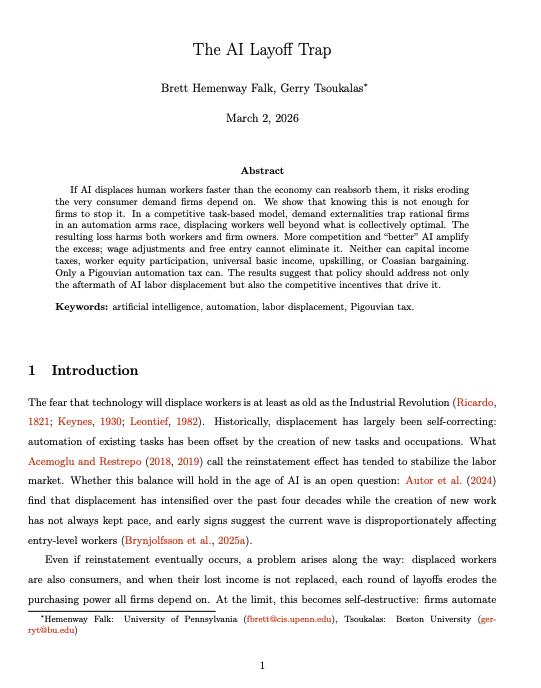
Most interesting part of the article is the explanation of 'why' CEOs would cut so many jobs, knowing AI layoffs are destroying the very customer spending they need to survive.
But here’s the trap: each company pockets 100% of the cost savings by displacing humans with AI, while only feeling 1/N of the demand collapse it causes when millions lose their job.
So every CEO automates anyway. It isn't stupidity. It’s an arms race that nobody can quit despite the long term implications to the culture and economy.
🤯BREAKING: Researchers just mathematically proved that AI layoffs will collapse the economy: and every CEO already knows it.
The AI Layoff Trap. A game theory paper from UPenn + Boston University is glaringly important!
100K+ tech layoffs in 2025. 80% of US workers exposed. And no market force can stop it.
→ Every company fires workers to cut costs
→ Every fired worker stops buying products
→ Revenue collapses across every sector
→ The companies that fired everyone go bankrupt
It's a Prisoner's Dilemma with math behind it. Automate and you survive short-term. Don't automate and your competitor kills you. But everyone automating destroys the demand that makes all companies viable.
UBI (universal basic income) won't fix it.
Profit taxes won't fix it.
The researchers found only one solution: a Pigouvian automation tax "robot tax"
The AI trap on the economy is here!
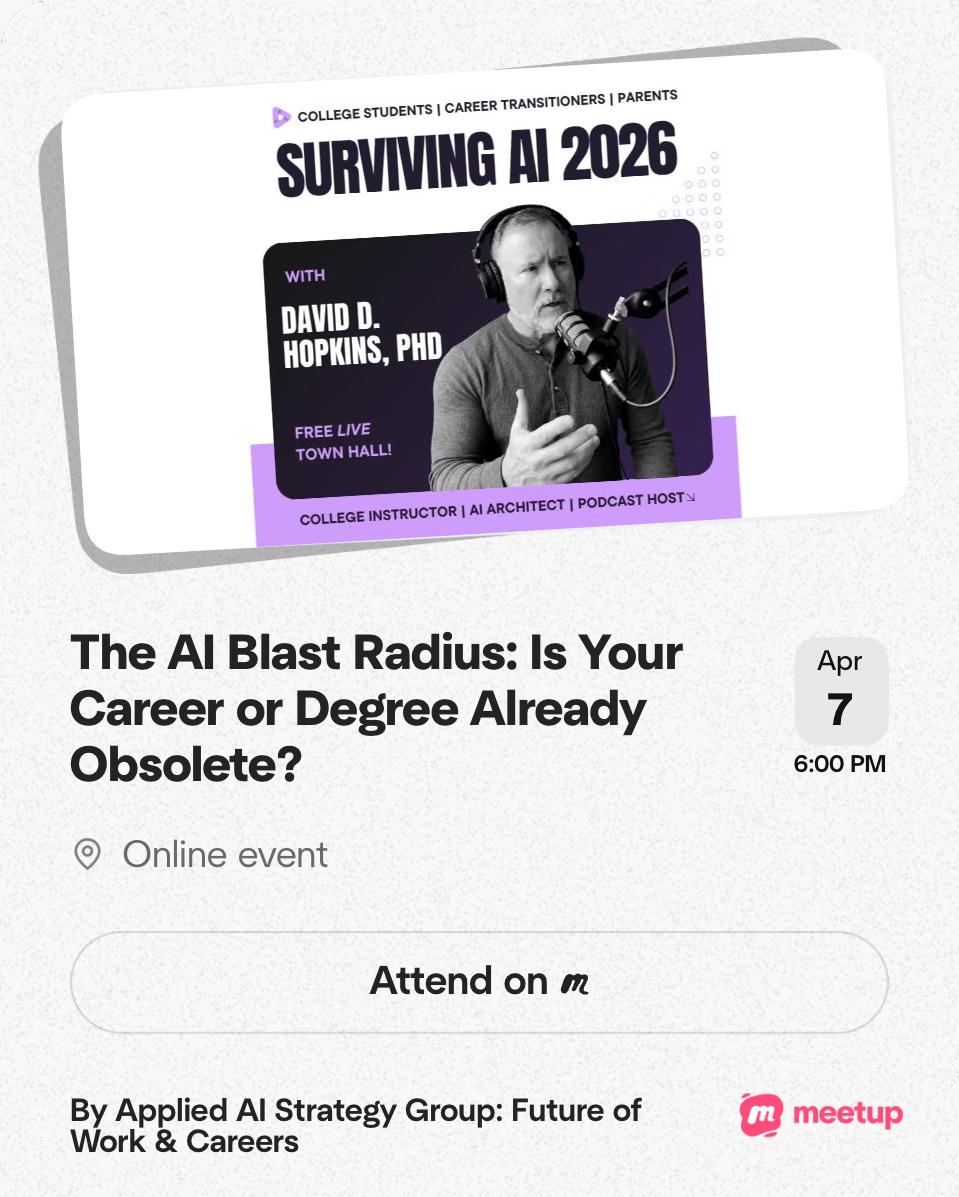
I am excited to announce an upcoming public talk focused on the intersection of higher education, career viability, and the new AI economy. I am very much looking forward to delivering this presentation and opening the floor to public Q&A.
We are currently observing the most profound structural shift to the workforce in modern history. The traditional blueprint—secure a degree, find a safe desk job, and climb the ladder—is mathematically decoupling from current market realities.
In this session, we will step away from the hype and examine the raw macroeconomic data.
We will look at plunging placement rates in certain fields, the specific degrees facing automation, and the necessary architectural pivot required for both students and professionals to remain viable in the coming decade.
Whether you are a parent, a student, or a mid-career professional, I invite you to join the conversation.
Seating is limited for this free, virtual event. Registration is required. You can reserve your seat below 👇
https://t.co/lFFXL0wqjC
#events #artificialintelligence #ai #careers #aiandjobs #aiandcollege
As a PhD who has spent 20 years in the classroom, this is painful to read—but entirely predictable.
89% to 19% placement in under three years.
This is what it looks like when a legacy workforce faces a structural collapse. These students were trained to be "Human Nodes" in a system that no longer needs them.
The university is selling a 2019 map for a 2026 terrain.
If your career relies on "following the formula," you are no longer an asset. You are overhead.
A CS professor at a mid-tier state university just sent me their internal placement data
Fall 2023: 89% of their graduates had offers by graduation. Average starting salary $94k
Spring 2024: 71% placement rate. Average dropped to $78k
Fall 2024: 43% placement rate. Those who got offers averaged $61k
Spring 2025: 31% of graduates employed in software roles six months out
This semester? 19% placement rate and falling
Faculty meeting last Tuesday got heated when the department chair suggested "pivoting curriculum toward AI collaboration skills"
One professor stood up and said "we're teaching students to build the systems that eliminate their own jobs"
The career fair last month had 12 companies show up. Half were MLMs and insurance sales
Students keep asking why they're learning data structures when the job postings all say "3+ years experience with LLM integration"
Professor told me the hardest part is the parent meetings
"My daughter took out $140k in loans for this degree and she's working at Starbucks"
Meanwhile the university is still running ads promising "94% job placement rates in high-growth tech careers"
The disconnect is crushing everyone involved
Faculty knows the industry has fundamentally shifted but the marketing department is still selling the 2019 dream
These kids mortgaged their futures for careers that evaporated while they were in class
My thesis has evolved regarding AI over the past couple of years, from being just a cool "tech trend" to a structural breakdown of the legacy economy.
For twenty years, I’ve taught the timeline of human civilization. I’ve taught how things like the steam engine and the printing press didn't just "change" the world—they permanently phased out the people who refused to adapt to the new architecture.
Some generations never have to face a structural shift in society. We, for good or bad, are living through one of these structural shifts. We are in the early hours of that shift right now.
It seems that, still, too many in education and the professional world are treating the proliferation of AI like a cyclical process. They think that if they just "optimize" their resumes and wait, the market will eventually return to normal.
It won’t. This isn't a temporary dip; it's the beginning of a permanent structural decoupling.
The math is already leaking out. In 2023, AI layoffs were a 1% footnote. In February 2026, they hit 10%. We aren't at the end; we are at the start of an exponential curve.
If you are a "Human Middleman"—someone paid to move information from Point A to Point B using a predictable set of rules—you are currently being calculated as overhead. I’ve spent the last few months moving from Researcher to Architect. I stopped just studying the timeline and started building the escape route while the doors were still open.
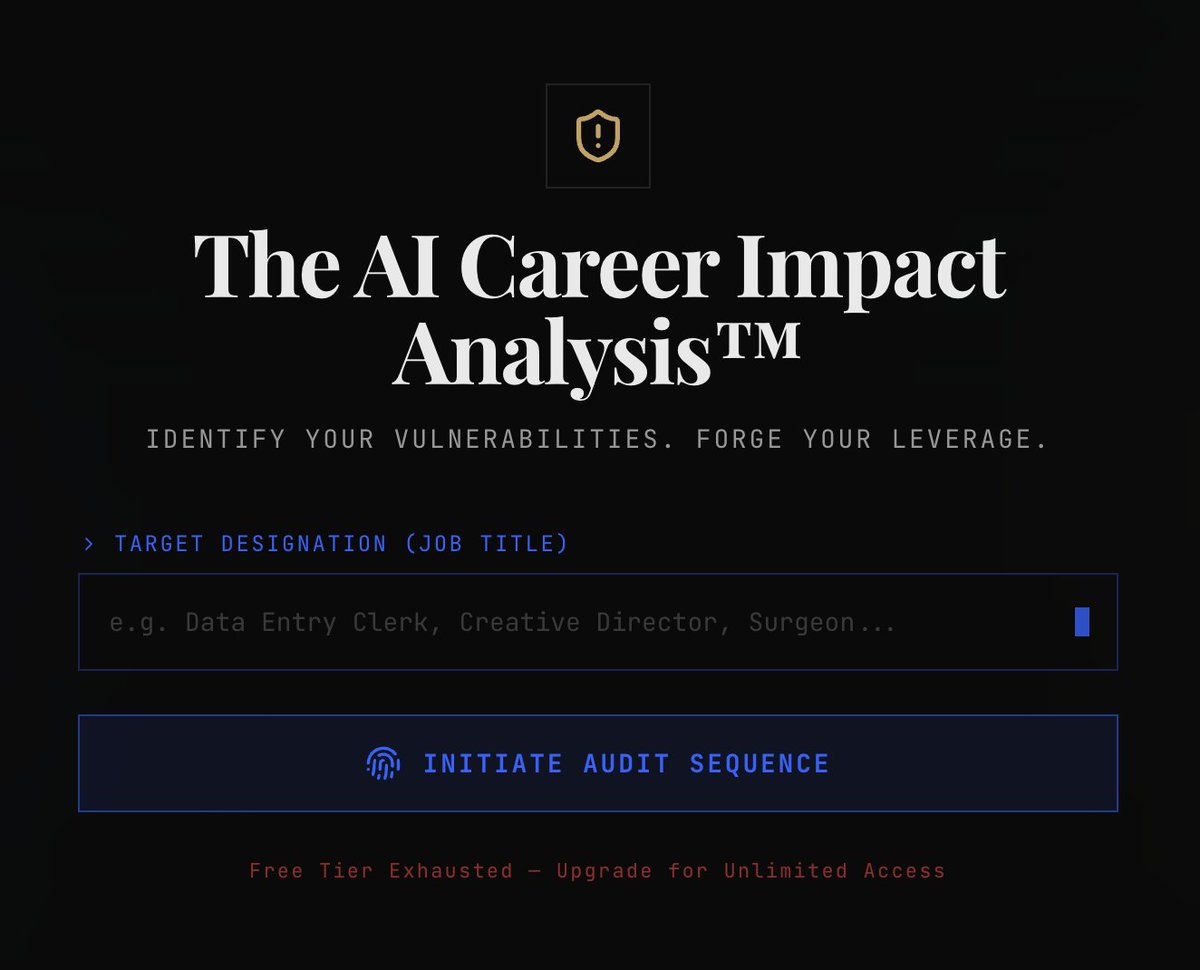
I’ve deployed the AI Career Impact Analysis as a career advising project. It’s a mathematical audit that cross-references your career coordinates against UPenn’s ground-breaking research on AI occupational exposure and live BLS data.
My full briefing and the free diagnostic link are below. Test your career against some of the best data in the public sphere right now: 🔗
#aiandjobs #ArtificialInteligence #careers #futureofjobs
https://t.co/UKji5deAFM
Stop Writing Code. Start Commanding It.
I tell my students, "Don't just read Plato. Argue with him."
But until now, that was a metaphor. Today, it is software that a Humanities Professor can control.
I have launched Plato's Republic, powered by a Next.js application that fundamentally changes how we interact with classical texts. Here is the architecture behind the experience:
*** The Interface (Next.js + Tailwind): A "Glassmorphism" UI that removes all friction. No nav bars, no ads. Just the text and the arena.
*** The Brain (Gemini 1.5 Pro): I utilized the massive context window to ingest the entirety of The Republic + multiple foundational commentaries. The AI doesn't hallucinate quotes; it cites them.
*** The Spine (Python FastAPI): Real-time, low-latency conversation state management. The Socratic method dies if there is lag. We killed the lag.
***. The Guide (DavOS Persona): A custom system prompt that rejects "generic answers." DavOS forces the user to define their terms before proceeding.
The video/podcast provides the context.
The App provides the arena.
The AI provides the resistance.
This is the convergence of Podcasting (Personal Narrative) and Generative AI (Personalized Rigor). It allows me to be globally at once, not just as a voice on a screen, but as an active participant in your logic.
This is the end of "One-Size-Fits-All" education.
See the future of AI Enhanced Active Media in the Humanities: https://t.co/xlZvIamu8F
#AIArchitect #EducationReform #Philosophy #TechTrends #intellectualfreedom #edtech #artificialintelligence
This narrative is fighting a ghost. This isn't a 'Scientific Breakthrough.' No one who actually invests a basic amount of time to understand what an LLM does believes these models are 'Thinking.' They are Autoregressive Transformers. They are math. They are statistical engines that predict the next token based on a probability distribution, not conscious entities with 'Goals' or 'Understanding' (at least so far).
They do some amazing, peculiar things, with incredible potential (even the potential to harm), but they aren't thinking as humans do. Don't anthropomorphize the machine.
AI isn't a magic wand that absolves users of competence. It's a power tool that demands it. If this guy was blindly trusting a probability engine to handle his analytics without auditing the output, he isn't an analyst—he is a passenger.
The machine brings speed and scale, but we must bring judgment. I don't feel sorry for this guy. He took his hands off the wheel, and the car crashed. Then tried to blame the engine. Blame the driver who fell asleep.
I am a Humanities Professor. I am not a Full-Stack Developer.
My knowledge of Python is basic. My SQL skills are functional at best.
I do not have a Computer Science degree.
And yet, in the last 30 days, I have architected and deployed two enterprise-grade AI systems.
How?
The era of Syntax is ending. The era of Orchestration has begun.
Previously, if you couldn't write the code, you couldn't build the tool. But today, the barrier between Human Concept and Digital Execution has collapsed.
I used a self-taught methodology called Agentic Orchestration. Instead of writing every line of code by hand, I curated the strategic intent (the "Vibe") and coordinated a swarm of autonomous AI agents to handle the implementation, debugging, and deployment.
I moved from "Coder" to "Director of Intelligence."
The Result: Two Living Architectures
🏛️ Project 1: The Republic (EdTech)
I didn't just record a lecture from my "Intellectual Freedom Podcast; I engineered a "Synthetic Reasoning Engine."Using a recursive AI architecture, I built my Digital Twin that debates listeners using Socratic logic—transforming static video podcasts into an active, high-fidelity mentorship that scales infinitely.
📊 Project 2: CNHC Data Analytics Dashboard
(Business Intelligence) I didn't just make a spreadsheet; I architected an "Executive Command Console." I built a role-based BI system that filters raw Google Analytics data through a strategic lens, turning noise into a strategic dashboard for executive decision-making.
The Lesson: To survive the AI shift, you don't need to be a master of syntax. You need to be an architect of Living Systems.
See the full architectural breakdown of how I did it: https://t.co/LrDyQxA4KH
#ArtificialIntelligence #edtech #futureofwork #vibecoding #Coding #podcasts
Elon Musk just identified which jobs go first, and it destroys every assumption about who’s safe.
Musk: “AI is going to take over those jobs like lightning. Anything that is digital, which is like just someone at a computer doing something.”
Not factory workers. Office workers. The people who spent decades assuming education and desk jobs meant security are actually first.
Musk: “Anything that’s physically moving atoms… those jobs will exist for a much longer time.”
Output is a file? Vulnerable. Output is physical? Protected. That’s the entire framework.
Musk: “AI is really still digital.”
AI doesn’t need a body. Doesn’t need an office. Just needs access to the same software you use. Executes faster. Never tires. Costs nothing to scale.
But it can’t weld. Can’t wire a building. Can’t fix pipes or work soil.
Musk: “Literally welding, electrical work, plumbing. Those jobs will exist for a much longer time.”
Trades aren’t the vulnerable jobs. They’re the durable ones. Physical presence, real-world adaptation, manual dexterity provide protection no digital credential offers.
Analyst, accountant, paralegal, programmer, anyone producing files and documents, automates first because digital work is exactly what AI does natively.
Person moving atoms has natural defense. Physics, unpredictable environments, material resistance create friction AI can’t scale past.
Person moving bits has nothing. No friction. No physical barrier. Just software AI already operates better than most humans.
The assumption that desk work and degrees represent safety just inverted completely. College graduate producing documents faces faster displacement than the electrician producing installations.
Society spent generations telling people trades were beneath them. Pushed everyone toward offices and screens. Turns out the people who didn’t listen built the most automation-resistant careers.
Most ironic outcome of the AI revolution. The work society treated as inferior turned out to be the work society couldn’t replace. And the work society valued most turned out to be the easiest to eliminate.
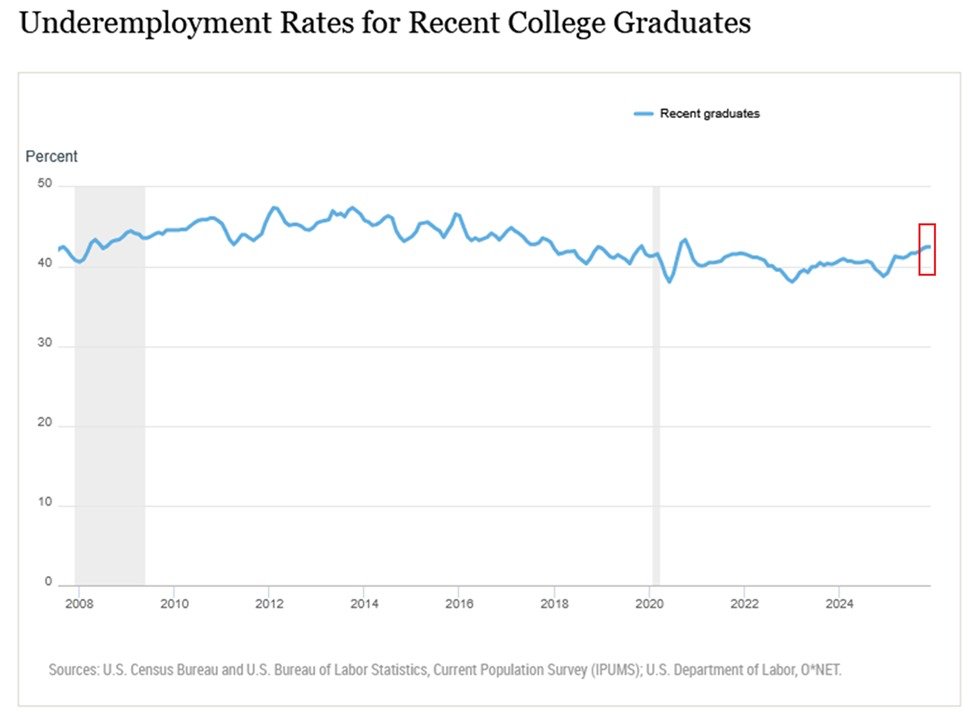
US college underemployment hits 42.5% for recent grads—highest since pandemic peak. The traditional degree = middle class job dream is fading fast for too many. Structural shift underway.
#highereducation#collegecost#ArtificialIntelligence
The US college underemployment rate is at crisis levels:
The underemployment rate for recent college graduates is up to 42.5%, the highest since the 2020 pandemic peak.
This means nearly half of all recent graduates are working jobs that do not require a college degree.
The rate also matches the levels seen during the 2008 Financial Crisis.
Furthermore, 52.0% of all college graduates are underemployed upon initial entry into the labor market.
Even 10 years after graduation, 45.0% of college graduates remain underemployed.
Criminal justice majors have the highest underemployment rate at 67.2%, followed by performing arts at 62.3%, medical technicians at 57.9%, liberal arts at 56.5%, and anthropology at 55.9%.
Americans are paying more than ever for a degree that no longer guarantees the career it promises.