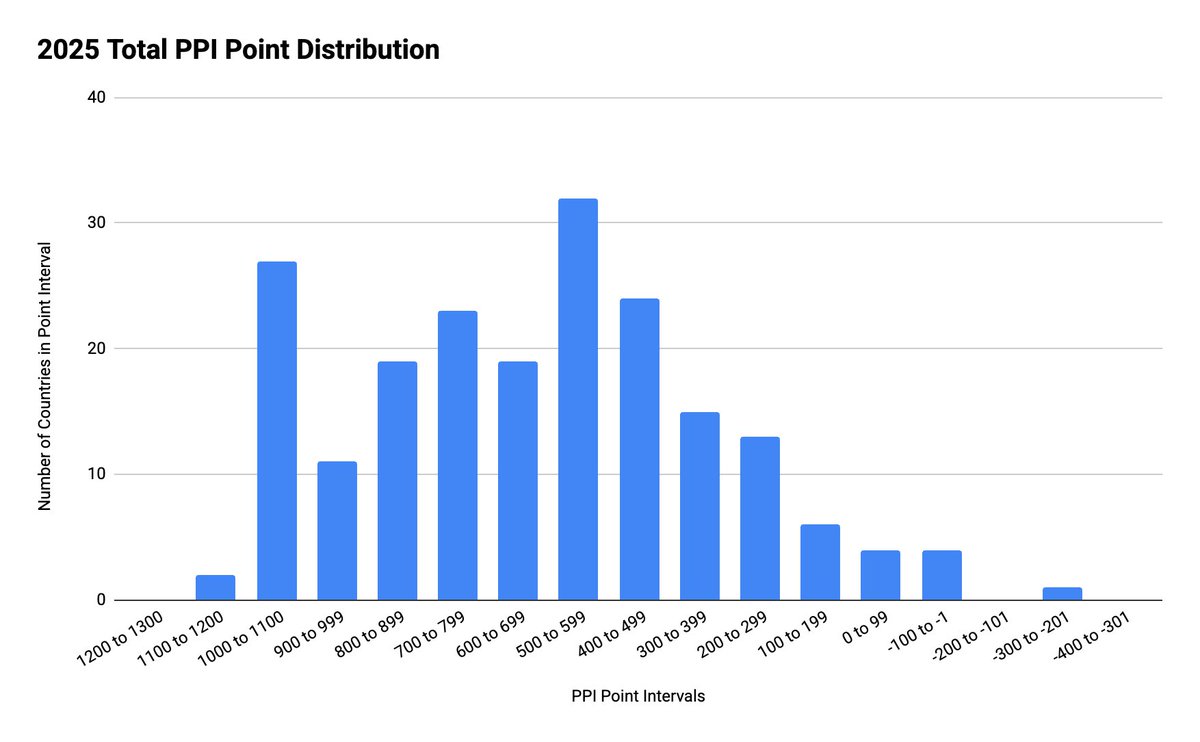
So excited that the fifth edition of the Peddling Peril Index is out and available for free on our website. The Index started in 2016 in a workshop we pulled together of export control, sanctions, and enforcement experts and practitioners. It was unanimously agreed that it was no longer acceptable that there was no evaluation of the effectiveness of all countries’ national strategic trade controls. The Peddling Peril Index remains the only source of such an evaluation. I encourage you to have a look at it. A visualization tool is also available on our website https://t.co/Yf0bsnpTLu
Available Now: The Peddling Peril Index for 2025/2026 - the fifth edition of our in-house ranking of strategic trade control systems - is out! Get your paperback on Amazon here: https://t.co/QVKgc2pjaE Explore the interactive PPI map and get your free PDF here: https://t.co/rYNDfrThrm
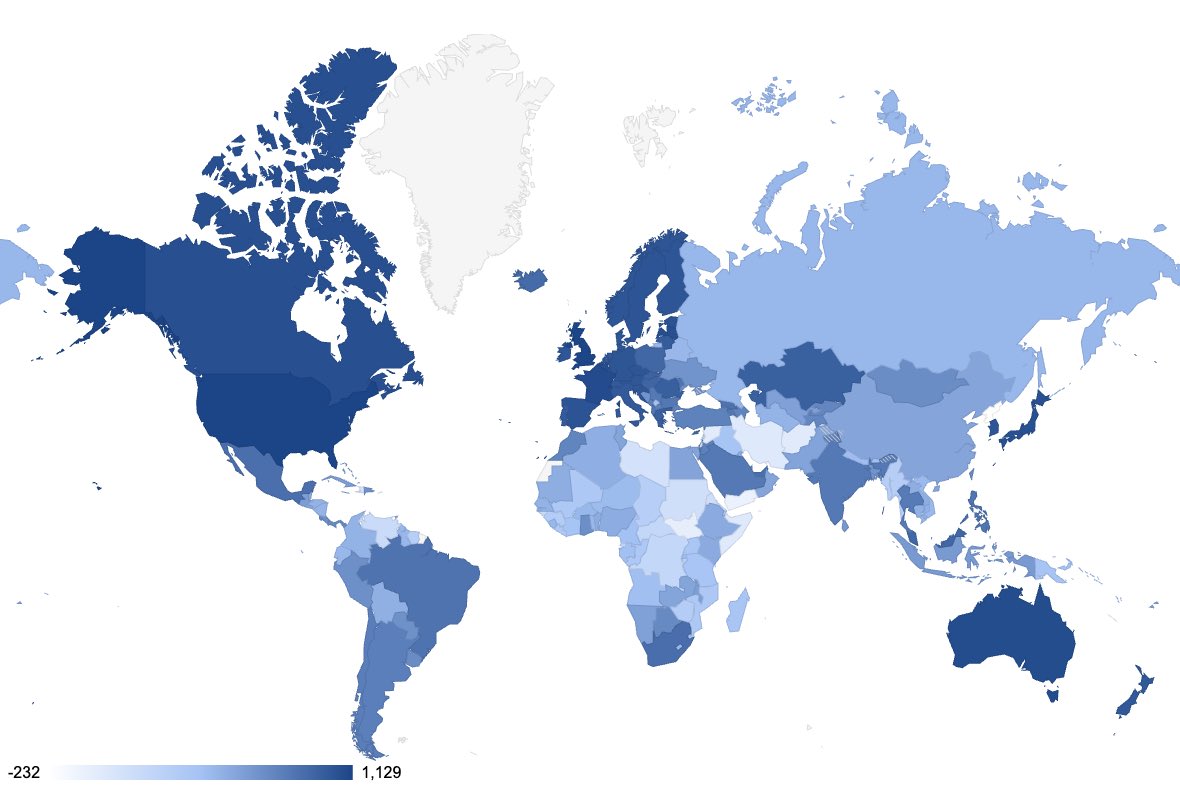
The PPI is a biennial project, using over 100 indicators across five super criteria areas to evaluate national strategic trade controls in 200 countries & entities. The PPI is the product of thousands of hours of work that draws from a collective decades of in-house expertise and an intensive effort to collect, compile, and review information from numerous sources. It remains the only public, comprehensive evaluation of the state of global implementation of export controls and it continues to paint a dire picture. As in the previous PPI editions, countries could receive a total of 1300 points. Scores ranged from -232 to 1,129, meaning that no country received more than 87 percent of the possible points, and a few countries had very low scores. Around 50 percent of countries evaluated scored below half of the maximum points in the PPI, with the areas of enforcement and proliferation financing most in need of global improvements. Additionally, over half of all countries lack relevant, comprehensive export control legislation.
The PPI book contains over 300 pages of in-depth methodology, analysis, recommendations, and applications chapters in addition to the full rankings. By identifying countries that are both leading and lagging behind in controls, the PPI aims to provide a key starting point for discussions in government, industry, academia, and the NGO community to improve the global implementation of strategic trade controls.
Curious how your country performed? View its 2025/2026 rank, tier of supply potential, performance cluster, overall score, and subscores, here: https://t.co/rYNDfrThrm
@catoletters I do not know what the CIA knew before operation Merlin, but by that time Iran had started a crash nuclear weapons program, codenamed Amad. See https://t.co/K8UuTlICv7
The U.S. State Department’s Rewards for Justice program is offering up to $20 million and possible relocation for information about Iran’s nuclear program. If you have firsthand knowledge of undeclared nuclear facilities, hidden nuclear material, or work related to developing a nuclear weapon, consider coming forward if you can do so safely. Your information could help uncover covert activities and prevent the regime from building nuclear weapons.
Coming forward takes courage. Helping protect Iran and its people from the dangers of the regime’s nuclear weapons efforts is an act of patriotism.
The U.S. government remains committed to countering any attempt by Iran to develop a nuclear weapons program.
If you have information on Iran’s nuclear personnel or technologies, send us a tip.
Pickaxe Mountain Elevation Profile: Where are the tunnel site’s key features?
We used Google Earth terrain data to derive the elevation profile of the mountain, showing the elevation levels of four key points: the eastern and western primary tunnel entrances, the probable ventilation port/shaft north of the ridge, and the possible ventilation shaft south of the ridge. We previously reported on the elevation difference between the two pairs of tunnel entrances, which could mean that there are two separate tunnels; the facility has multiple levels; or the western tunnel progresses downwards to meet the other tunnel under the ridge. In our early 2022 reporting, we considered various options which remain plausible. We newly discuss the elevation of the probable ventilation port/shaft, first identified by the Institute in 2024, and situated north of the mountain ridge, closer to the Eastern tunnel entrances. Interestingly, it sits at the same elevation as the Western entrances, indicating it is able to service either tunnel, both tunnels, or a combined tunnel. It might also provide an opening for a horizontal tunnel into the western tunnel accessible operations area, i.e., an additional point for ingress and egress, such as for personnel. It should be noted that it is serviced by electricity, in addition to the primary eastern and the primary western tunnel portals. The attached ground photo from 2005 shows its future location on the north side of the mountain. Note: We confirmed the relative accuracy of the Google Earth elevation profile with high resolution elevation data.
Read the full report here:
https://t.co/kPIU2vQJty
IAEA DG Grossi’s summary on the status of Iran’s *declared* nuclear program is largely aligned with our observations in satellite imagery; post June 2025 there have been some repairs at the Natanz PFEP and the above ground Esfahan facility but we also assessed them to be unlikely for actual reconstruction and more likely for shielding from overhead observation. The key declared sites where enriched uranium storage and/or enrichment took place at Fordow, Natanz, and Esfahan remain non-operational. We do have concerns about sites associated with Iran’s UNDECLARED program however, past and present. DG Grossi does not explain which sites the IAEA is monitoring when referring to "locations associated with [Iran's] past undeclared nuclear programme." But it should include Taleghan 2, which is actively undergoing reconstruction, and Minzadayi, which sees high levels of activity around the site. The former was part of Iran’s crash nuclear weapons program codenamed Amad and investigated but never visited by the IAEA. The IAEA did find uranium particles at the building next door (Taleghan 1), despite intensive sanitization efforts, that were never adequately explained. Taleghan 2 was linked to nuclear weapons relevant work as recently as 2024. Minzadayi was targeted by the IDF in March 2026 for its role in Iran’s most recent nuclear weapons capabilities and was linked in public reporting to metallurgy and to the Turquz Abad site, which is part of an ongoing IAEA investigation. Also not mentioned explicitly by DG Grossi is the status of surviving centrifuges and Pickaxe Mountain, where centrifuges and components were moved according to @WSJ reporting on Israeli intelligence. Together with the enriched uranium, these are critical elements of Iran's nuclear program that could provide Iran a path to reconstitute its capabilities outside of declared facilities.
Quote from DG Grossi today: "As stated in my reports to the Board of Governors, the IAEA continues to monitor activities at Iran’s declared nuclear facilities and locations associated with its past undeclared nuclear programme. Also, and since June 2025, we have not identified any activity to repair or reconstruct any of the facilities damaged in the military attacks of 2025 and 2026."
Tricky to collapse tunnel entrances like the ones at Pickaxe. Tomahawks could be used but it would require a lot of them. There are other possibilities as well. But MOABs, if they can be delivered, would more clearly destroy entrances, send large shock waves down the tunnels, and destroy supporting infrastructure and utilities on the surface.
According to @CNN, Trump is considering using MOABs against Pickaxe nuclear site. I would not be dismissive of the idea as CSIS expert was on Thursday’s Erin Burnett. The rationale of using a MOAB is that the blast is so violent that it can overcome typical blast traps of tunnel entrances. It is like a small nuke; it is difficult to engineer entrances to withstand that level of a blast.
The goal may be the confirmed closure of known access routes at Pickaxe, creating a monitored condition. Reopening is an observable change requiring action. That can be valuable even when the condition of the underground chambers would remain unknown. Moreover, MOABs would destroy surface support structures and utilities.
Monitored closure, with lack of information about activities inside, has been the situation for months at Esfahan Mtn complex and the underground Natanz enrichment plant. So MOABs could put Pickaxe in the same condition as the other two nuclear sites.
Note: Fordow was destroyed by earth penetrators, GBU-57s, reaching the underground halls via crashing through ventilation systems. While we have discovered probable ventilation shafts at Pickaxe, it is uncertain how they reach the main underground halls. But a MOAB on a ventilation shaft may be worth trying, if there is one to spare.
The huge blast would be on the surface. Pickaxe is an isolated site, so neighboring communities would be unlikely to be affected by the blast.
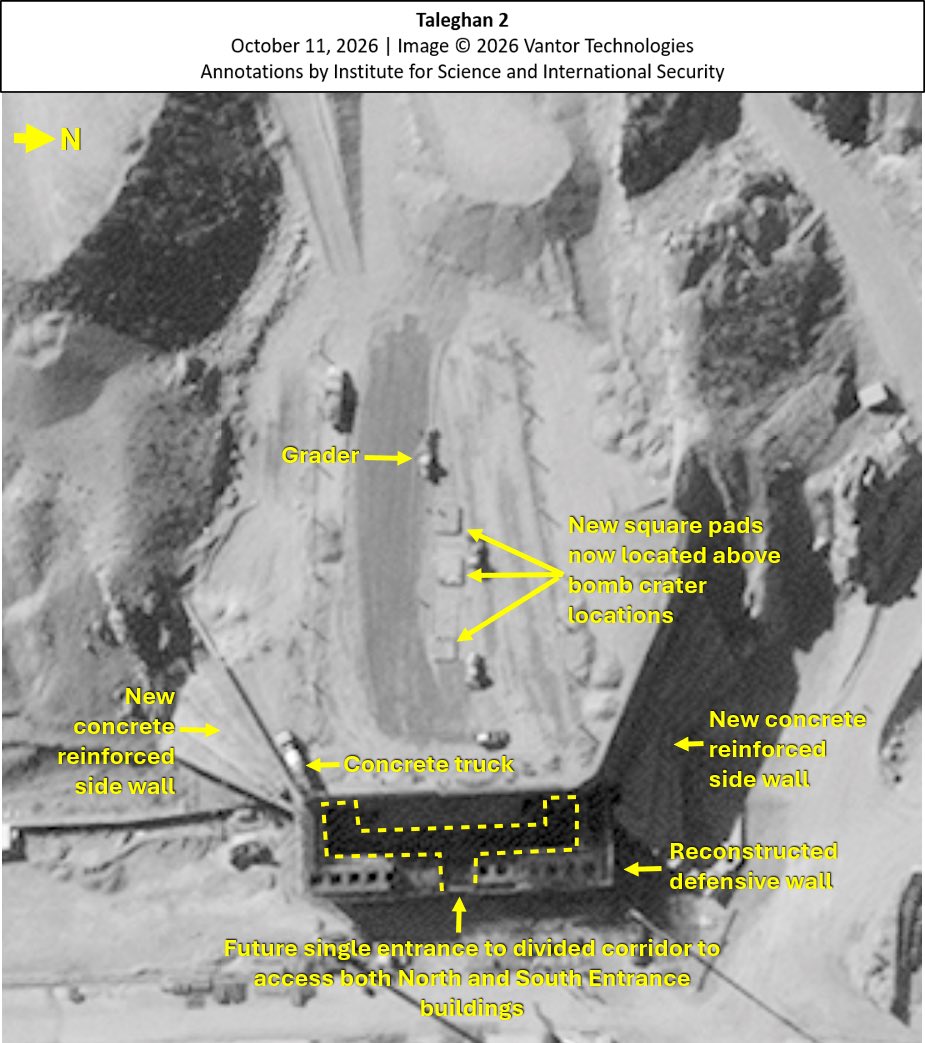
Recent @vantortech satellite imagery from October 2026 of the second reconstruction effort at the Taleghan 2 nuclear weapons related R&D facility shows that this effort is progressing rapidly. The facility was first bombed by Israel in October 2024. Despite Iran having expanded and hardened the facility after the first bombing (REF 1), Israel used bunker buster bombs to again attack the facility as well as destroy additional structures around the site (REF 2). Since March 2026, Iran has repaired the roof covering, most recently adding three concrete pads directly over the penetration holes, possibly to serve as hatchways or vents. Whatever their function, associated construction activity was concealed by temporary tarp coverings in September (REF 3). Other work included reinforcing the structure with two stepped concrete side walls, and completing a new hardened entrance way that was damaged in the last bombing. This effort has been an intensive undertaking by Iran to reconstruct the facility, but when it could become operational is unclear. The reasoning why Iran is reconstructing a well known and well characterized facility is perplexing, but, at a minimum, it shows that Iran wants to reestablish its lost capabilities there. Below are several images showing the current state of construction since the facility was destroyed by an airstrike in March 2026.
REF 1: https://t.co/I6TMkFnvvK
REF 2: https://t.co/jLeqHsFHRf
REF 3: https://t.co/0j4sJwBMlB
Over the last few months, we have seen high levels of activity at certain nuclear weaponization sites pointing to reconstruction efforts specifically at Taleghan 2 (starting in June 2026), notable vehicle activity at Minzadayi (September/October 2026) and significant cleanup including the removal of containers at Mojdeh / Malek Ashtar University (August/September 2026). Hardly any activity has been observed at known sites tied to uranium enrichment where the main entrances remain destroyed / blocked by earthen materials and on which the media and public at large tend to focus: Pickaxe Mountain (as of October 7), the Natanz Nuclear Complex (as of October 7), Fordow (as of October 11), and Esfahan (October 12).
Additional @TheGoodISIS Reporting on Activity Identified at Minzadayi
In addition to the earlier @TheGoodISIS reporting of high levels of vehicle activity, we noticed the repair of a probable water tank and the addition of a new, small building nearby in the northern part of the Minzadayi site. This again points to Iran's efforts to not just clean up the site, which was attacked by Israel in March 2026 for its nuclear weapons connection, but to resume regular activities. See our earlier report here: https://t.co/40LbRFHycg
NEW Report: Significant Activity Identified at Minzadayi, an Iranian Nuclear Weapons Development Site
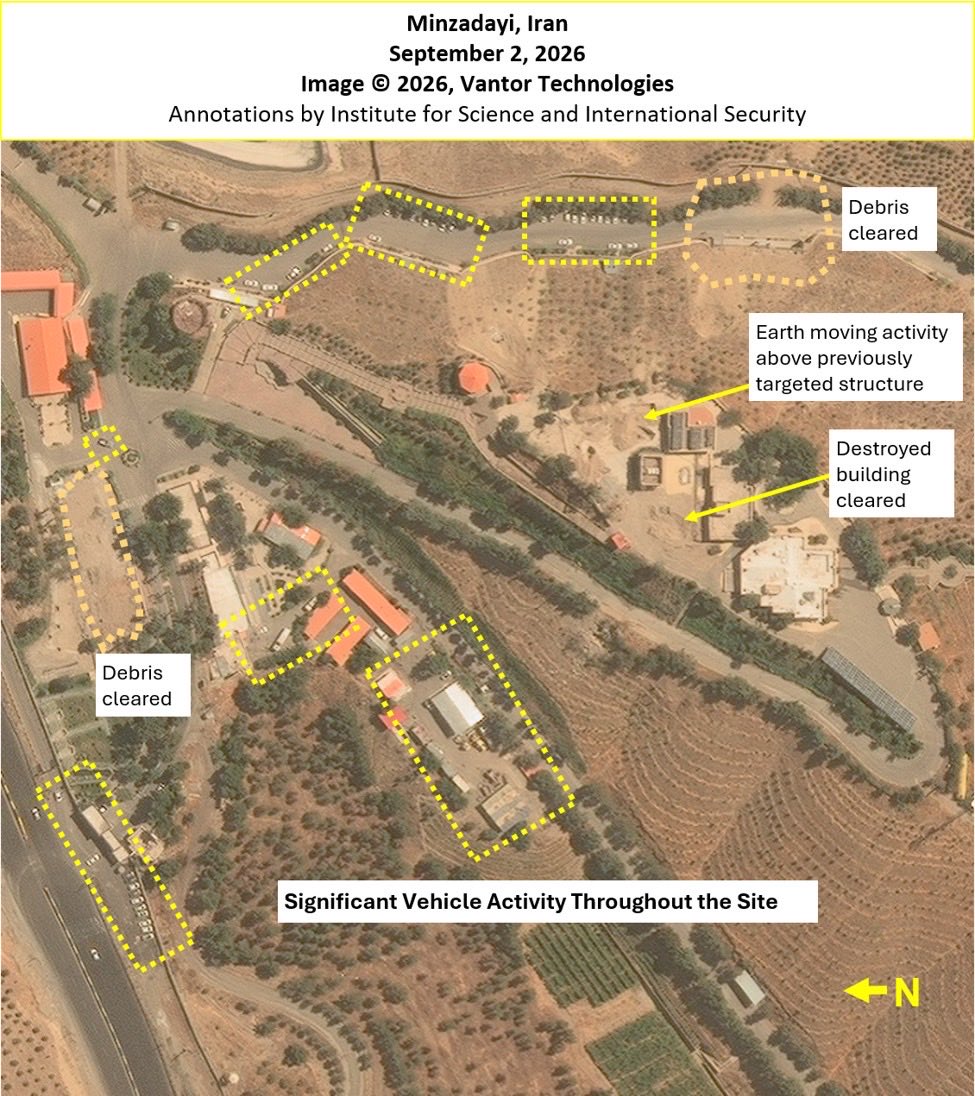
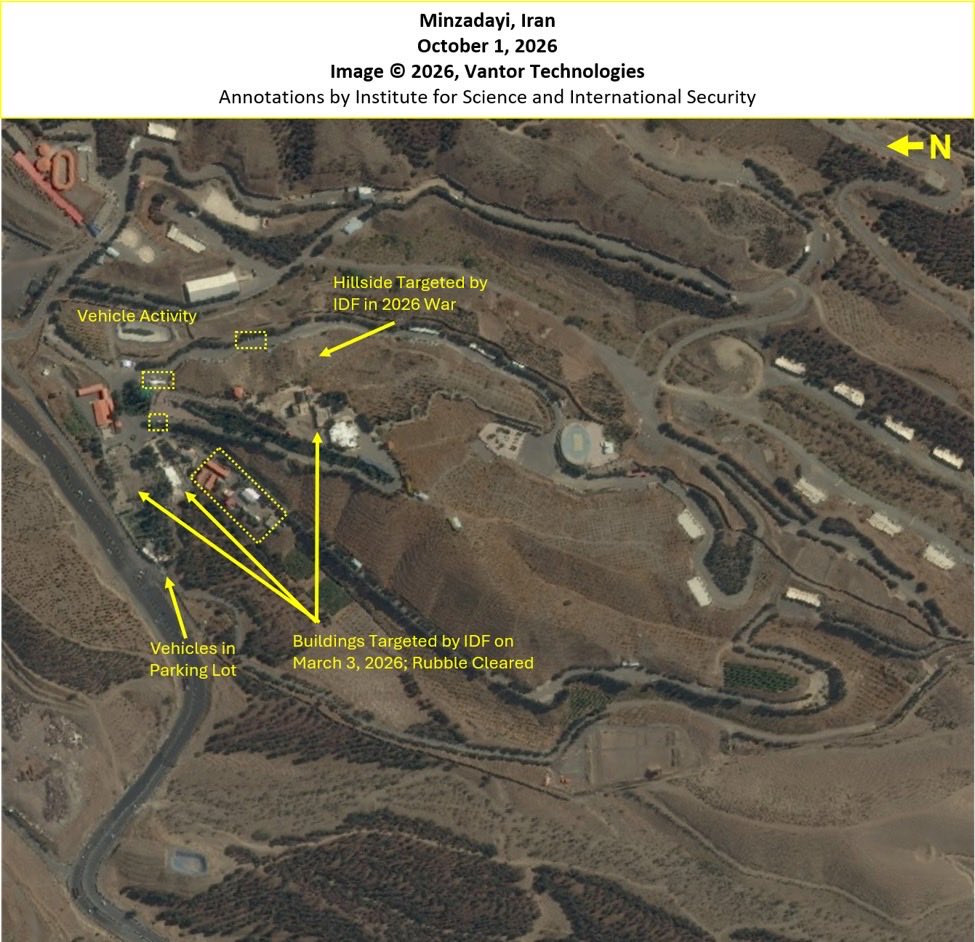
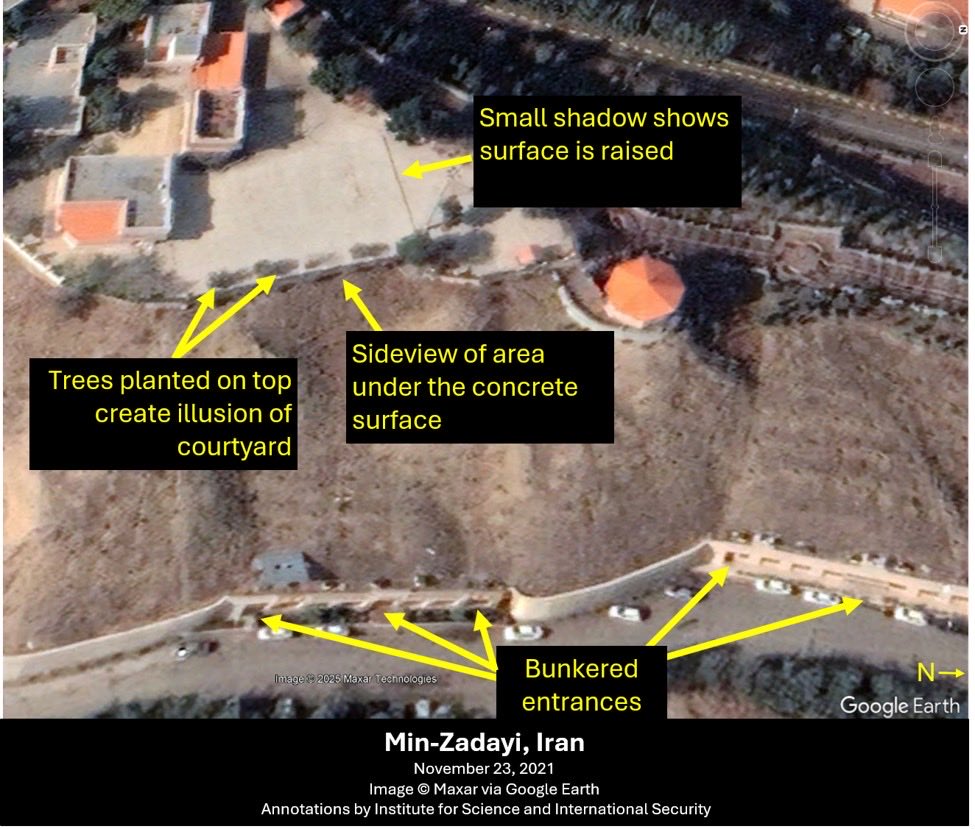
High resolution @vantortech satellite imagery from September and October 2026 shows significant renewed activity at Minzadayi, a nuclear weapons development compound northeast of Tehran revealed by Israel during the 2026 war. The compound was attacked by Israel on March 3rd, 2026, destroying several buildings and likely underground structures. The recent satellite imagery indicates a return to regular vehicle activity around the site post extensive cleanup operation that included the clearing of rubble and debris and repair of damage on the hillside. One area attacked in March 2026 shows ongoing earth moving activity. The earth moving activity is occurring at a surface made to look like a courtyard where multiple craters could be seen following the attacks on the site in March 2026. Significant vehicle presence can be seen throughout the site between early September and early October 2026. Cars are parked outside the security perimeter in the parking lot, and many passenger vehicles and trucks can be seen inside the perimeter. Given what is known about this compound, this activity may be indicative of an effort by Iran to reestablish a nuclear weapons development capability and to reconstitute what was lost in the attack on the compound.
Based on public reporting and statements released by the IDF, the nuclear weapons work carried out here likely involved research and development on nuclear warheads. The IDF originally stated, that a “group of nuclear scientists operated covertly to develop a key component in the nuclear weapons system,” adding that “the complex is designed to enable the restoration of the required technology and the advancement of capabilities for the development of nuclear weapons.”
@IntelliTimes, released additional information on the compound. In a post from September 24, 2026, it states that the nuclear weapons related infrastructure was established in 2022 and “absorbed part of the means from the nuclear warehouse,” a common reference to the Turquz Abad site revealed by Israeli Prime Minister Benjamin Netanyahu in September 2018. Netanyahu revealed the site following Iran’s removal of more than a dozen shipping containers from the site that were assessed to hold nuclear material and equipment relevant to Iran’s nuclear weapons capabilities.[4] When the IAEA visited Turquz Abad in March 2019, it found evidence that nuclear material or contaminated equipment had been present at the site and the IAEA Board has since been pressing Iran to answer the IAEA’s questions about the current whereabouts of said material and/or equipment. @IntelliTimes indicates Iran did not simply move the material and/or equipment to a new long term storage site but used the new site in northeast Tehran, aka Minzadayi, to establish an” industrial nuclear headquarters for the reconstruction of research, development, and adaptation infrastructure for nuclear warheads,” including the means to “produce cores of enriched uranium and the explosive material required to cast into them the detonation chain.”[5] The current renewed effort underway at this highly secure compound suggests that the work being conducted here is of top priority.
Read the report here: https://t.co/SXt9waDSER
True on knowledge, but it is the expertise that counts and that can be killed. Would you ask someone who read only a book on bridges to build one? Or maybe operate on you after reading a medical text book
On bomb acquisition, Iran does not have nuclear weapons today because of international and national efforts to prevent Iran from succeeding. It is a lesson that pressure and persistence can prevent proliferation. We will see what happens; it is by no means over.
Trump's statement on not seeing a lot of activity at Pickaxe mountain is fully in line with our satellite imagery observations. Access to all four tunnel entrances has been severely restricted since the beginning of August. Iran apparently figured better to block the entrances voluntarily than have them blocked by force. The last several weeks show virtually no movement of equipment and little vehicle movement. Pickaxe Mtn effectively joined the list of nuclear related sites that are not currently operational, not easily accessible, and where resumption of activity would be easily detected. Media outlets and other reporting that recently highlighted high activity at Pickaxe Mountain should also take note of this significant slowdown.